
Which Type of Exercise Bike Is Right for You? A Decision Framework for Home Buyers
Most buyers jump to model recommendations without first choosing the right bike category. This guide compares the five types of exercise bikes — indoor cycling, recumbent, upright, air, and folding — across fitness goals, space, budget, and total cost of ownership, so you can pick the right category before comparing specific models.
The Five Types of Exercise Bikes at a Glance
Most buyers start by searching for the "best exercise bike" and land on a list of model recommendations. That approach skips a critical step: choosing the right category of bike first. The five types — indoor cycling (spin), recumbent, upright, air, and folding — differ so fundamentally in riding position, intensity ceiling, joint impact, footprint, and cost structure that picking the wrong category is the most expensive mistake you can make. A $2,000 bike you barely use because it doesn't match your goals or space is far costlier than a $500 bike that fits your actual needs.
The table below maps each type across the dimensions that matter most for a home purchase decision. Use it to narrow your options before you start comparing specific models.
| Bike Type | Riding Position | Intensity Ceiling | Joint Impact | Typical Footprint | Subscription Required | Price Range |
|---|---|---|---|---|---|---|
| Indoor Cycling / Spin | Forward-leaning, aggressive | Very high (HIIT, sprints, climbs) | Low (magnetic resistance, smooth flywheel) | ~7 sq ft (e.g., Schwinn IC4: 48.7" x 21.2") | Often (Peloton $50/mo, iFIT $39/mo) | $800 – $2,500+ |
| Recumbent | Reclined, legs-forward, back supported | Low to moderate | Lowest (seated, back-supported) | ~11 sq ft (e.g., Horizon 5.0R: 66" x 25.2") | Optional (JRNY $12/mo) | $300 – $2,000 |
| Upright | Upright, similar to outdoor bike | Moderate to high | Low to moderate | ~6 sq ft | Optional | $200 – $2,800 |
| Air / Fan | Upright with moving handles | Extreme (unlimited resistance) | Moderate (full-body, high impact on joints) | ~8 sq ft | No | $400 – $1,000 |
| Folding | Upright, compact | Low (typically 8 resistance levels) | Low | ~4 sq ft unfolded, ~1.2 sq ft folded | No | $150 – $400 |
If you are still deciding between an exercise bike and a smart trainer, read our comparison of exercise bikes vs. smart trainers vs. spin bikes before diving into bike types.
Detailed Breakdown of Each Bike Type
Indoor Cycling / Spin Bikes
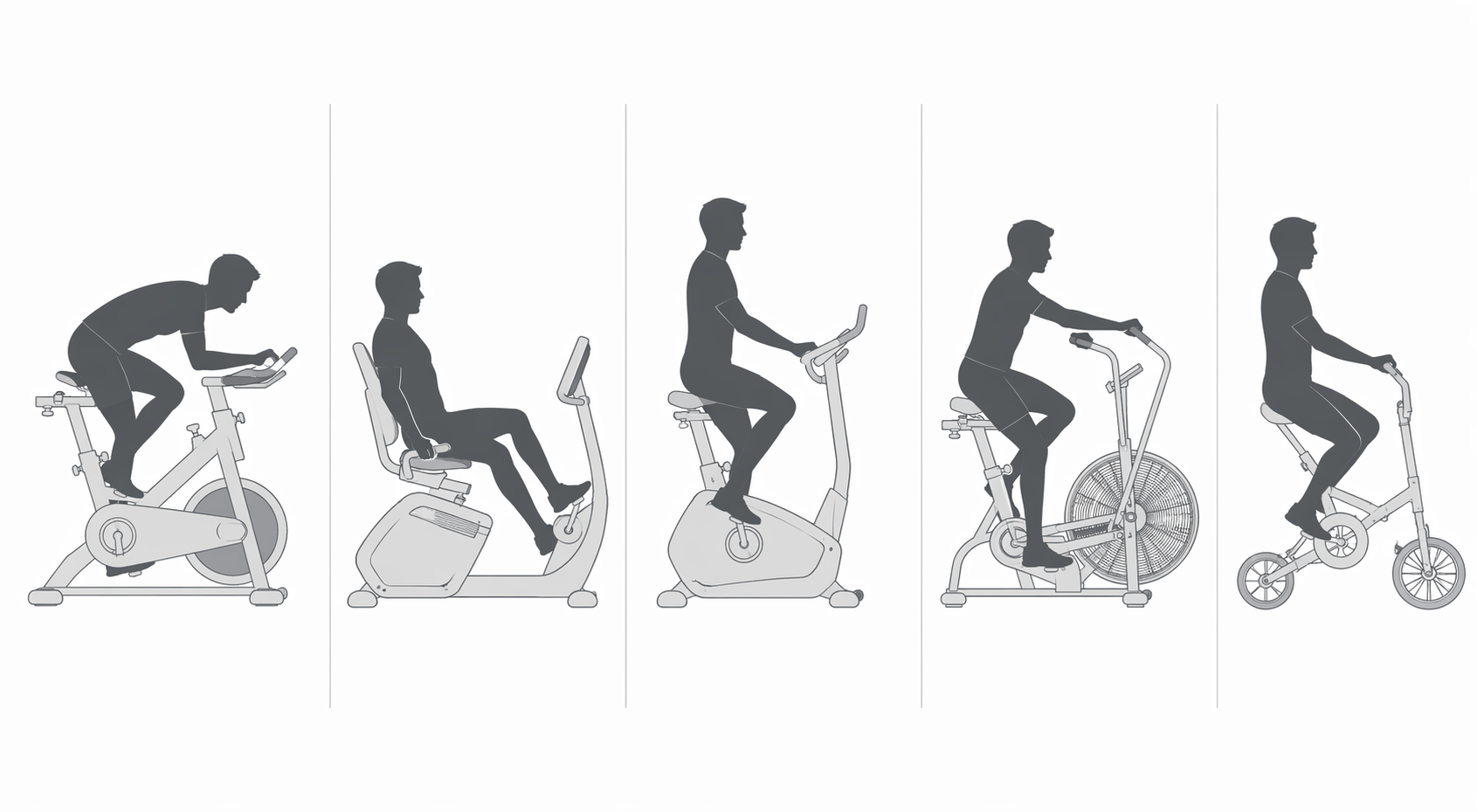
Indoor cycling bikes — often called spin bikes — place the rider in a forward-leaning, aggressive posture similar to a road cyclist. They are built for high-intensity interval training (HIIT), simulated climbs, and class-based workouts. The average cost of a worthwhile indoor cycling bike, based on testing of 25+ bike profiles by Garage Gym Reviews, is approximately $1,400. These bikes typically feature a heavy flywheel (30+ lbs is the industry standard for stability), magnetic or felt resistance, and compatibility with app-based training platforms.
The Schwinn IC4, which measures 48.7" x 21.2" (under 7 square feet), is a strong example of the category. It offers 100 levels of magnetic resistance, a 330 lb max rider weight, a 10-year frame warranty, and Bluetooth connectivity to eight cycling apps — all at a $999 price point. Wirecutter selected it as their top pick after testing 25 bikes with 25 volunteer testers over five years.
- Best for: HIIT, structured class workouts, serious cyclists, riders who want app-based training
- Pros: Highest intensity ceiling, smooth magnetic resistance, compact footprint for the capability, large ecosystem of apps and classes
- Cons: Aggressive riding position may be uncomfortable for long sessions, often requires a subscription for full app functionality, can be noisy with felt resistance pads
Recumbent Bikes
Recumbent bikes feature a reclined seat with back support and pedals positioned out in front of the rider. This design distributes weight across the back and glutes rather than the hands and wrists, making them the only bike type with genuine back support. They have the lowest intensity ceiling of any category — you cannot stand on the pedals or generate the same power output as a spin bike — but that is a feature, not a bug, for their target audience.
Wirecutter's recumbent pick, the Horizon Fitness 5.0R, measures 66" x 25.2" (roughly 11 square feet), offers 100 resistance levels, magnetic resistance, a built-in fan, a lifetime frame warranty, and a 300 lb weight limit. At the budget end, the YOSUDA Recumbent Bike (under $300) offers 16 resistance levels and a 350 lb capacity, while the Sunny Health & Fitness Essential Recumbent Bike (under $300) provides 8 resistance levels and a 300 lb capacity.
- Best for: Seniors, rehabilitation patients, anyone with chronic back pain, low-impact cardio seekers, riders who want to watch TV or read while cycling
- Pros: Excellent back support, lowest joint impact, comfortable for long sessions, easy to mount and dismount
- Cons: Largest footprint of any bike type, lowest intensity ceiling, no standing climbs, fewer app-connected models
For a broader comparison of low-impact options, see our guide to low-impact exercise equipment, which compares joint load, calorie burn, and footprint across multiple machine types.
Upright Bikes
Upright bikes position the rider in a straight-backed posture similar to a traditional outdoor bicycle. They require core engagement to maintain stability and allow standing climbs, which increases intensity. Upright bikes offer the most compact footprint of the non-folding categories — typically around 6 square feet — and deliver the best value in the $300 to $800 range, according to Garage Gym Reviews.
Despite their versatility, upright bikes are somewhat underserved in the market. Fewer models exist compared to spin or recumbent categories. At the premium end, the NordicTrack X24 upright bike ($2,799) features a 24-inch HD touchscreen, iFIT compatibility, and a -10% to 20% incline range, effectively blurring the line between upright and smart trainer.
- Best for: Riders who want a traditional cycling feel, budget-conscious buyers ($300–$800 sweet spot), small-space dwellers who don't need folding, intermediate fitness levels
- Pros: Compact footprint, allows standing climbs, more comfortable seat than spin bikes, good value at mid-range prices
- Cons: Fewer models available, less intense than spin bikes for HIIT, no back support, fewer app-connected options at lower price points
Air / Fan Bikes
Air bikes use a large fan blade for resistance — the harder you pedal, the more air resistance you generate, creating an unlimited intensity ceiling. They include moving handles that engage the upper body, making them the only bike type that delivers true full-body conditioning. The Rogue Echo Bike is a well-known example in this category, noted by Garage Gym Reviews for its ability to produce a full-body workout in short duration.
Air bikes typically range from $400 to $1,000. They require no subscription and no electricity — resistance is purely mechanical. However, they are the loudest option by a significant margin. The fan noise at high intensity can reach levels that make apartment use impractical, and the moving handles create a wider footprint than stationary-handle bikes.
- Best for: CrossFit athletes, HIIT enthusiasts, riders who want full-body conditioning in under 10 minutes, garage gym owners
- Pros: Unlimited resistance, full-body workout, no subscription, no electricity needed, extremely durable
- Cons: Loudest bike type (unsuitable for apartments), no app connectivity, no structured classes, uncomfortable for sessions over 20 minutes
Folding Bikes
Folding bikes prioritize space savings above all else. They trade durability, resistance range, and overall build quality for the ability to collapse into a compact form. Most folding bikes offer only 8 resistance levels — a fraction of the 100 levels available on mid-range spin and recumbent bikes. They are best suited for light daily movement, not serious training.
BarBend tested 30+ exercise bikes and found that the Marcy Foldable Upright Exercise Bike ($189.99) unfolds to just 4 square feet (32" L x 18" W) and folds to a 14-inch length. It has 8 levels of magnetic resistance, a 250 lb capacity, and weighs only 37 lbs. The Sharper Image Space Saving Bike ($349) folds to a 1.24 square foot cube (23" x 25.5" x 7" folded) with 8 resistance levels and a 300 lb capacity.
- Best for: Apartment dwellers with extreme space constraints, light daily movement, riders who need to store the bike in a closet, budget buyers under $400
- Pros: Smallest footprint when folded, lowest price point, lightweight and portable, no subscription required
- Cons: Limited resistance range (typically 8 levels), lower weight capacity, less durable construction, not suitable for high-intensity training
If space is your primary constraint, our dedicated guide to best exercise bikes for small spaces and apartments covers folding, compact, and under-desk options in greater depth.
Decision Matrix: Match Your Constraints to the Right Bike Type
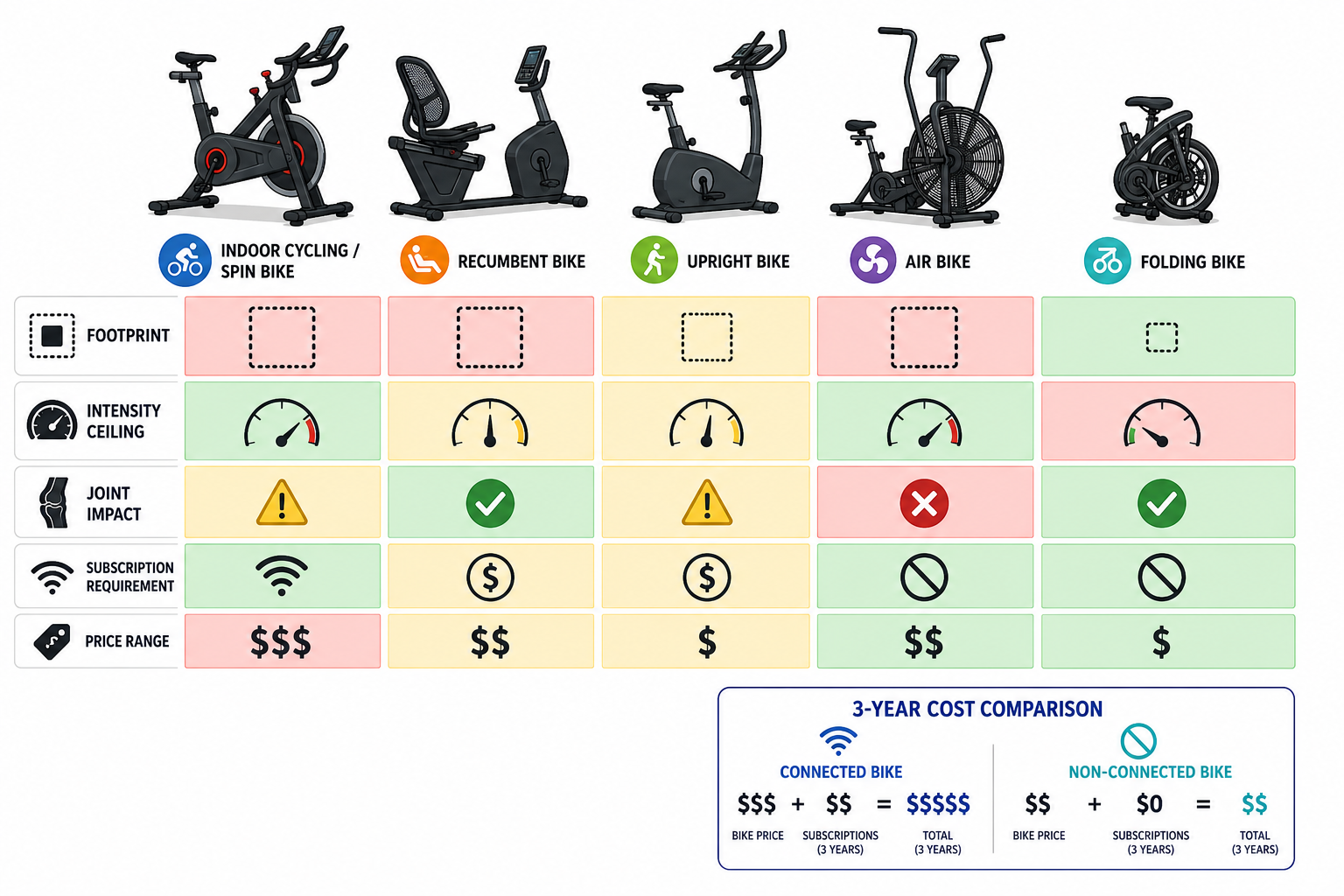
The following matrix maps common buyer constraints — primary fitness goal, available space, budget, joint concerns, and tolerance for subscription costs — to the recommended bike type. Use it as your primary decision tool before comparing specific models.
| Your Primary Constraint | Indoor Cycling / Spin | Recumbent | Upright | Air / Fan | Folding |
|---|---|---|---|---|---|
| HIIT / high-intensity training | Best choice | Not suitable | Good | Best choice | Not suitable |
| Low-impact / rehab / back pain | Not suitable | Best choice | Moderate | Not suitable | Moderate |
| Casual cardio / general fitness | Good | Good | Best choice | Moderate | Good |
| Full-body conditioning | Not suitable | Not suitable | Not suitable | Best choice | Not suitable |
| Space under 6 sq ft | Good (compact models) | Not suitable | Good | Not suitable | Best choice |
| Budget under $500 | Not suitable | Good (budget models) | Good | Moderate | Best choice |
| No subscription tolerance | Moderate (app-free models exist) | Good | Best choice | Best choice | Best choice |
| Apartment / noise-sensitive | Moderate (magnetic is quiet) | Good | Good | Not suitable | Good |
Key Spec Thresholds by Price Tier
Once you have identified your bike type, the next step is understanding what specifications you should expect at different price points. These thresholds help you evaluate whether a specific model delivers fair value for its price — without getting lost in marketing claims.
| Price Tier | Flywheel Weight | Resistance Levels | Frame Warranty | What You Get | What You Give Up |
|---|---|---|---|---|---|
| Under $300 | Under 20 lbs | 8 or fewer | 1–2 years | Basic magnetic or felt resistance, compact design, entry-level build | Durability, smooth resistance, high weight capacity, app connectivity |
| $300 – $800 | 20–30 lbs | 8–16 | 2–5 years | Solid build, magnetic resistance, basic app connectivity, decent weight capacity (300 lbs) | Premium flywheel feel, advanced app features, long warranty |
| $800 – $1,500 | 30–40 lbs | 16–100 | 5–10 years | Smooth magnetic resistance, Bluetooth/app connectivity, high weight capacity (330+ lbs), 10-year frame warranty | Large touchscreen, auto-resistance, premium subscription content |
| $2,500+ | 40+ lbs | 100+ | Lifetime frame | Large HD touchscreen, auto-resistance, premium subscription content, commercial-grade build | Price — you are paying for the connected experience and brand |
Garage Gym Reviews recommends at least 12 resistance levels for workout variability and a flywheel weight of at least 30 lbs for stability. A 10-year frame warranty is the industry standard for quality bikes. If a bike in the $800–$1,500 range lacks these three features, it is overpriced.
For a broader perspective on what each budget tier buys across all home gym equipment, see our best home exercise equipment for every budget guide.
The Subscription Cost Trap: What You Actually Pay Over 3 Years
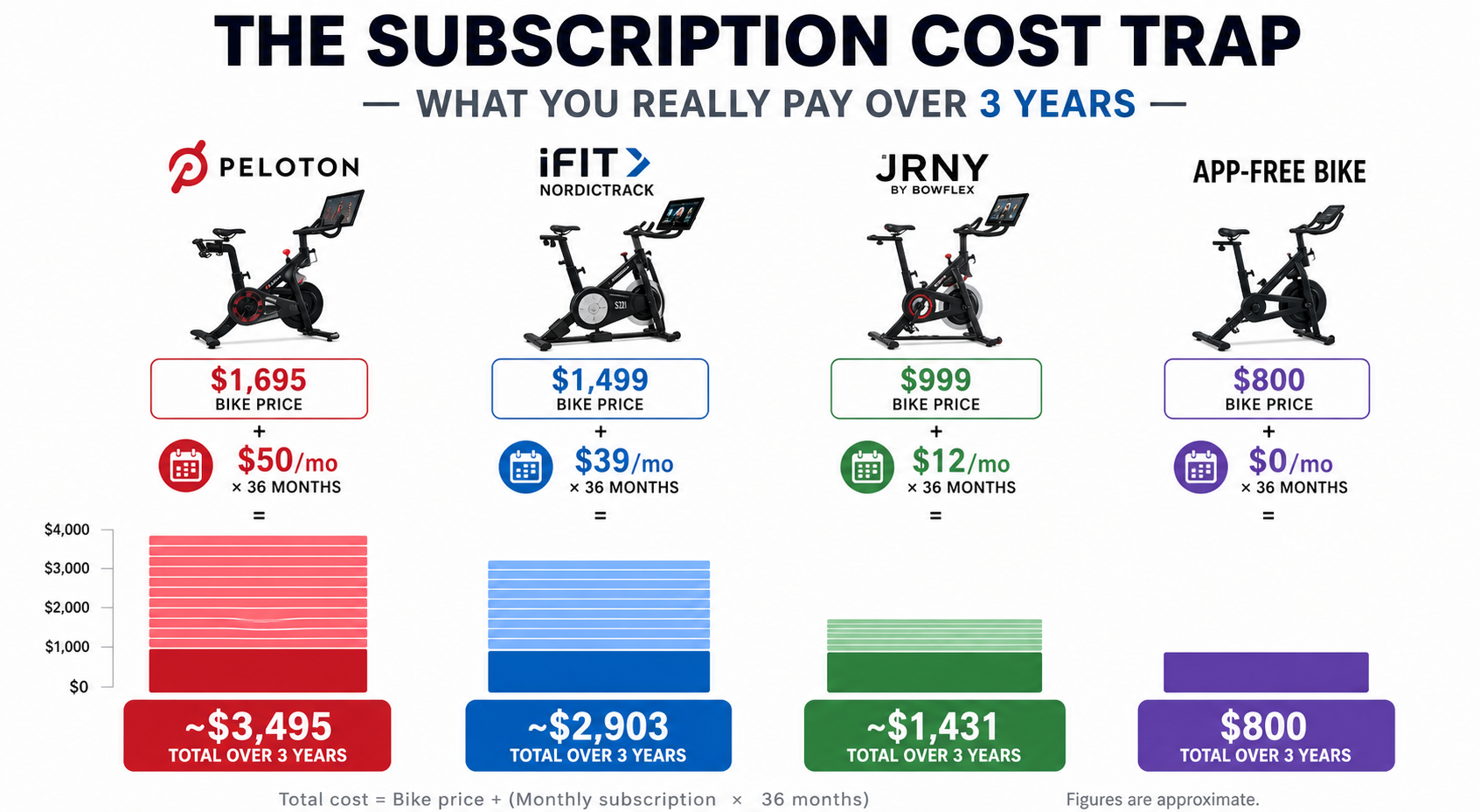
Subscription costs are the most overlooked factor in exercise bike purchasing. A connected bike's monthly fee can exceed the bike's purchase price within two to three years, yet many buyers focus only on the upfront cost. The table below shows the true three-year cost of popular subscription models versus an app-free bike.
| Bike / Subscription | Upfront Cost | Monthly Fee | 3-Year Total | Cost Breakdown |
|---|---|---|---|---|
| Peloton Bike + All-Access | $1,695 | $49.99/mo | ~$3,495 | Bike + 36 months of membership |
| iFIT-enabled bike + iFIT Family | $1,500 (est.) | $39/mo | ~$2,904 | Bike + 36 months of membership |
| JRNY-enabled bike + JRNY | $800 (est.) | $11.99/mo | ~$1,232 | Bike + 36 months of membership |
| App-free bike (e.g., Schwinn IC4) | $999 | $0 | $999 | No subscription required |
The math is stark: a Peloton Bike's three-year total of approximately $3,495 is more than triple the upfront cost of the bike itself. Even the more affordable JRNY subscription ($11.99/month) adds $432 over three years to the bike's purchase price. An app-free bike like the Schwinn IC4, which supports Bluetooth connectivity to eight cycling apps without a mandatory subscription, costs $999 total — no recurring fees.
For a deeper dive into the math, including specific model breakdowns and 5-year projections, read our dedicated article on the true 5-year cost of an exercise bike. For a general home gym TCO perspective, see our hidden costs of home gym equipment guide.
Final Decision Flowchart: Your Next Step
Use the flowchart below to route yourself to the right next step based on your primary constraint. This is not a replacement for the decision matrix above — it is a navigation tool to help you find the most relevant content on this site for your specific situation.
- If your primary constraint is space (under 6 sq ft, apartment living, storage in a closet): Read our guide to best exercise bikes for small spaces and apartments for detailed folding and compact options.
- If your primary constraint is subscription cost sensitivity (you want to avoid monthly fees): Read our true 5-year cost of an exercise bike article, then focus on app-free models like the Schwinn IC4.
- If your primary constraint is fitness goal (HIIT, rehab, casual cardio, full-body): Use the decision matrix above to identify your bike type, then browse our equipment comparisons for model-specific reviews within that category.
- If your primary constraint is budget (under $500, $500–$1,500, $2,500+): Use the price tier thresholds table above to set your expectations, then read our best home exercise equipment for every budget guide for a broader perspective.
- If you are still unsure which machine type is right for you (bike vs. treadmill vs. elliptical): Read our constraint-based guide to finding the right home exercise machine.
This result comes from one real apartment under the stated conditions — it is a strong signal, not a guarantee your space will measure identically.
Builds this evidence supports
Cable Machine Alternatives That Save Space and Money
Compare the best cable machine alternatives for home gyms – from resistance bands and pulley systems to suspension trainers and compact digital units – and find the right option for your space and budget.
How to Choose a Compact Home Gym That Works for Your Space, Budget, and Noise Tolerance
This article provides a structured decision framework for apartment dwellers and small-space residents to match their specific floor footprint, noise sensitivity, and budget to the most suitable compact home gym strategy — whether that's an all-in-one machine, modular build, smart digital system, or band/bodyweight setup.
The Garage Gym Reality Check: What Equipment Actually Fits in a Single-Car Garage
Most garage gym guides assume a two-car space. This article uses real dimensions, real equipment footprints, and three layout templates to show what fits—and what doesn't—in a single-car garage (10x20 to 12x20 ft).
Spot something off?
If this result didn't match your own space, let us know — floor-damage and noise claims carry real deposit-risk consequences if we get them wrong.