
Best Home Exercise Machine: A Constraint-Based Guide to Finding the Right Fit
There is no single best home exercise machine — the right choice depends on your fitness goal, available floor space, and budget. This guide maps those three decision axes to specific machine types, compares real footprint and subscription data in a side-by-side table, and delivers tiered picks with total cost of ownership transparency so you can make a confident, well-informed purchase.
Why Generic 'Best Machine' Lists Fail Home Buyers
Most "best home exercise machine" roundups share the same structural flaw: they rank machines against each other without accounting for the three variables that actually determine whether a machine works for you — your fitness goal, your available floor space, and your budget. A treadmill ranked "best overall" is useless if your apartment has 120 square feet of living space. A smart gym ranked "best for strength" is a poor fit if you discover the $44/month subscription doubles your effective cost.
The second problem is subscription opacity. Many high-profile machines — Tonal 2, Speediance Gym Monster — require ongoing subscriptions for core functionality. Roundups typically mention this in a footnote, if at all. When you calculate 3-year total cost of ownership, a "$3,000 machine" can become a $4,500–$5,600 commitment. That changes the comparison entirely.
This guide takes a different approach. Instead of a ranked list, it gives you a constraint-mapping framework — goal, space, budget — and maps each machine type to the intersection that fits your situation. The comparison table includes stored footprint, subscription flags, and 3-year cost estimates. The tiered picks are tied to specific constraint profiles, not generic audience labels.
How to Use This Guide: Three Decision Axes
Before scanning any product list, answer these three questions. Your answers will narrow the relevant sections of this guide and eliminate machine categories that don't fit your situation.
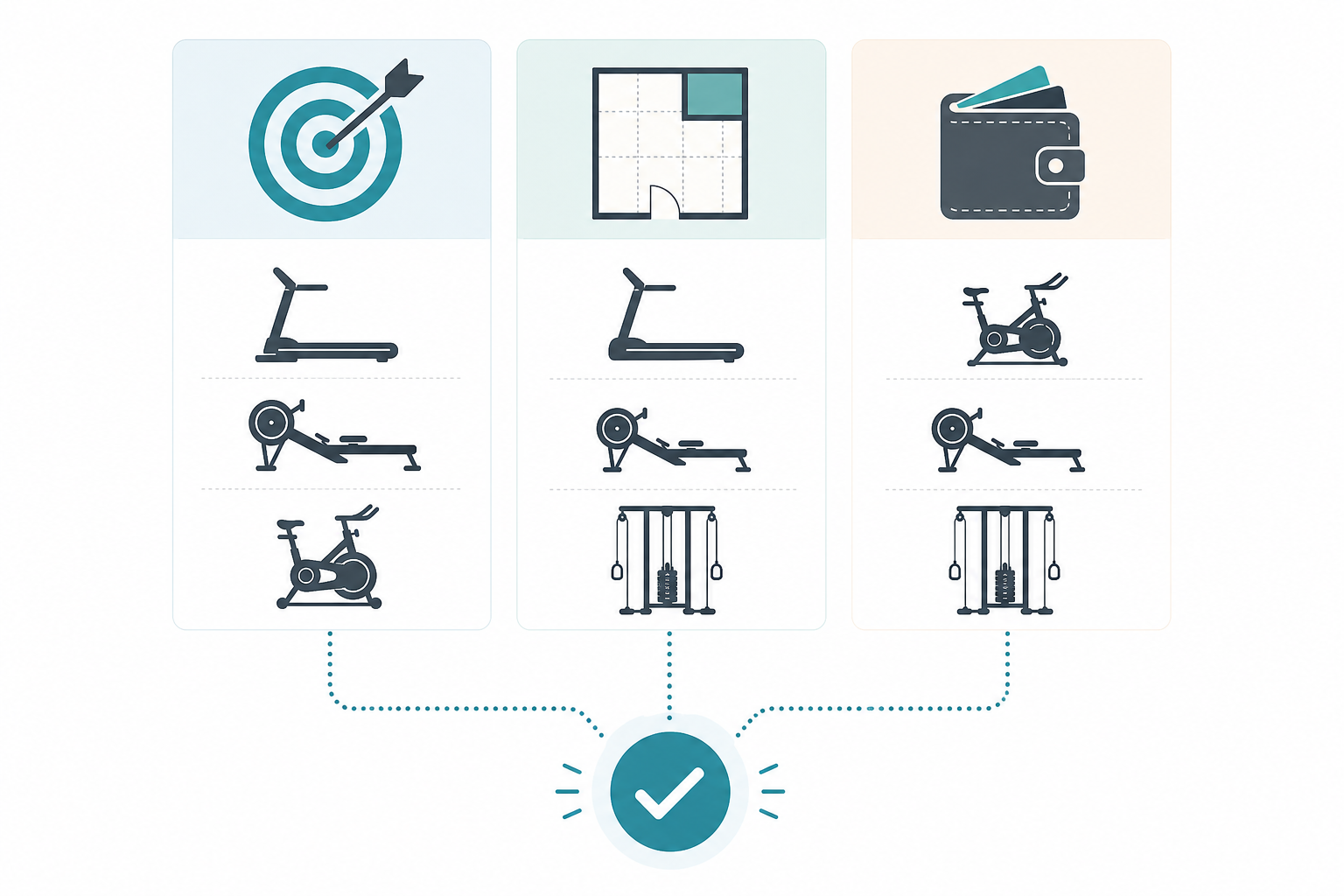
- Primary fitness goal: Cardio and endurance (treadmill, rowing machine, exercise bike, elliptical) vs. strength and muscle building (cable tower, functional trainer, all-in-one rack) vs. full-body conditioning with guided programming (smart gym systems). If you want both cardio and strength from one machine, you're in the hybrid/smart category — with the subscription costs that come with it.
- Available floor footprint: Under 20 sq ft (compact apartment, shared space, small spare room), 20–40 sq ft (dedicated corner or medium spare room), or 40+ sq ft (garage, large basement, dedicated gym room). Note that in-use footprint and stored footprint are different numbers — a rowing machine may use 14 sq ft in use but fold to under 6 sq ft stored. This guide tracks both.
- Budget tier: $200–$500 (entry-level cardio or basic strength), $500–$1,500 (mid-range cardio or solid strength setup), or $1,500+ (premium smart gym, functional trainer, or high-end treadmill). For subscription-dependent machines, budget means the hardware cost plus ongoing monthly fees — calculate at least 3 years.
Once you know your answers, you can skip directly to the relevant tiered picks or the small-space section. You don't need to read everything.
Machine Types at a Glance: What Each One Actually Does
Home exercise machines fall into three functional categories. Comparing machines across categories — asking whether a treadmill is better than a cable tower — is the wrong question. They serve different goals.
- Cardio-only machines: Treadmill (walking and running, high calorie burn, high impact), exercise bike (cycling, low impact, good for knees), rowing machine (full-body cardio, low impact, foldable), elliptical (low-impact full-body cardio, larger footprint). Best for: cardiovascular fitness, endurance, calorie burn, and weight management goals.
- Strength and resistance machines: Cable tower (single or dual-stack, pulley-based, wide exercise variety), functional trainer (dual adjustable pulleys, the most versatile strength machine for home use), all-in-one power rack (barbell-based, requires more space and weight plates). Best for: muscle building, strength development, and progressive overload training.
- Hybrid and smart gym systems: Tonal 2 (wall-mounted electromagnetic resistance, guided programming, subscription-dependent), Speediance Gym Monster / Gym Monster 2 (freestanding cable-based smart gym, guided programming, subscription-dependent). Best for: users who want both strength and cardio variety with structured coaching and are willing to pay ongoing subscription costs.
One clarification before the comparison table: "all-in-one" is used loosely in the market. Cheap all-in-one machines ($150–$300) typically offer limited resistance and poor durability. The all-in-one category worth considering at the premium tier is the functional trainer or smart gym — not the budget multi-station units.
Side-by-Side Comparison: Footprint, Muscles, Cost, and Subscription
The table below covers the major machine types with the data points that matter most for a home purchase decision. Footprint figures are approximate and vary by specific model. Calorie burn estimates are ranges for a 155 lb adult at moderate intensity over 30 minutes — individual results vary significantly based on body weight, fitness level, and workout intensity.
| Machine Type | In-Use Footprint | Stored Footprint | Primary Muscles | Cal Burn (30 min, moderate) | Price Range | Subscription Required | 3-Year TCO Estimate |
|---|---|---|---|---|---|---|---|
| Treadmill | 17–22 sq ft | 17–22 sq ft (non-folding) / 10–12 sq ft (folding) | Legs, glutes, core | 240–400 kcal | $400–$2,500+ | No (most models) | $400–$2,500 |
| Exercise Bike (upright) | 5–8 sq ft | 5–8 sq ft | Legs, glutes, core | 200–320 kcal | $200–$1,800 | No (most models) | $200–$1,800 |
| Rowing Machine | 14–18 sq ft | 3–6 sq ft (folded vertical) | Back, legs, arms, core (~86% of muscles) | 220–360 kcal | $300–$1,500 | No (most models) | $300–$1,500 |
| Elliptical | 20–30 sq ft | 20–30 sq ft (non-folding) | Legs, glutes, arms, core | 180–300 kcal | $400–$2,000 | No (most models) | $400–$2,000 |
| Cable Tower (single stack) | 10–15 sq ft | 10–15 sq ft | Full body, strength-focused | 150–220 kcal | $435–$1,200 | No | $435–$1,200 |
| Functional Trainer (dual cable) | 15–25 sq ft | 15–25 sq ft | Full body, strength-focused | 150–220 kcal | $1,200–$2,500 | No | $1,200–$2,500 |
| Tonal 2 (wall-mounted smart gym) | ~7 sq ft (arms folded) | ~7 sq ft | Full body, guided strength | 200–350 kcal | $2,995 hardware | Yes (~$44/mo) | $4,580–$4,990 (3 yr) |
| Speediance Gym Monster / Monster 2 | ~20 sq ft | ~20 sq ft | Full body, guided strength + cardio | 200–350 kcal | $1,999–$2,599 hardware | Yes (subscription tier) | $3,500–$4,100 (3 yr, est.) |
Tiered Picks by Budget
The picks below are organized by budget tier with a cardio pick and a strength pick at each level. Each recommendation includes a constraint profile — the specific goal, space, and budget combination it fits best. These are not universal top picks; they are the best fit for the described constraint profile.
Budget Tier: $200–$500
- Best cardio pick — Foldable rowing machine (e.g., Sunny Health & Fitness SF-RW5515 or equivalent): Fits this tier at $250–$400. Folds vertically to under 6 sq ft stored. Engages the full body with low joint impact. No subscription. Best for: apartment dwellers, beginners, anyone prioritizing low-impact cardio with space efficiency. Avoid: if you have knee or hip mobility limitations that make the rowing position uncomfortable — an upright bike is the better alternative.
- Best strength pick — Single-stack cable tower (entry-level, e.g., Body-Solid or Marcy equivalent): Available in the $435–$600 range at the low end of this tier. Provides pulley-based resistance for 30+ exercises. Footprint is 10–15 sq ft. No subscription. Best for: users who want strength training variety without barbell equipment. Limitation: weight stack on budget models tops out at 150–160 lbs, which limits progression for stronger users.
Mid Tier: $500–$1,500
- Best cardio pick — Quality upright or recumbent exercise bike: At $600–$1,200, mid-tier exercise bikes offer magnetic resistance, solid build quality, and a compact 5–8 sq ft footprint. No subscription required on most models (avoid bikes that bundle mandatory content subscriptions). Best for: users with knee or joint concerns, anyone who prefers seated low-impact cardio, and buyers who want a quiet machine for apartment use.
- Best strength pick — Mid-range functional trainer or dual-cable machine: At $1,200–$1,500, you enter the range of quality dual-cable functional trainers. These offer the widest exercise variety of any home strength machine — cable flyes, rows, presses, lat pulldowns, curls, and more — with no subscription and a 15–25 sq ft footprint. Best for: intermediate users who want to build a complete strength program at home without a barbell setup.
Premium Tier: $1,500+
- Best smart gym pick — Tonal 2: Wall-mounted, ~7 sq ft footprint with arms folded, electromagnetic resistance up to 200 lbs, guided programming. Hardware: ~$2,995. Subscription: ~$44/month. 3-year TCO: approximately $4,580–$4,990. Best for: users who genuinely want guided programming and coaching and will use the platform consistently enough to justify the ongoing cost. Not recommended for users who are still establishing a consistent training habit — the subscription cost accrues whether or not you use it.
- Best all-in-one pick — Speediance Gym Monster or Gym Monster 2: Freestanding cable-based smart gym with guided programming. Hardware: $1,999–$2,599 depending on model. Subscription required for full programming access. 3-year TCO: approximately $3,500–$4,100 estimated. Best for: users who want a freestanding (not wall-mounted) smart gym with cable-based strength training. Footprint is larger than Tonal (~20 sq ft), but it doesn't require wall installation. Verify current subscription pricing directly with Speediance before purchasing — tiers change.
Best Picks for Small Spaces and Apartments
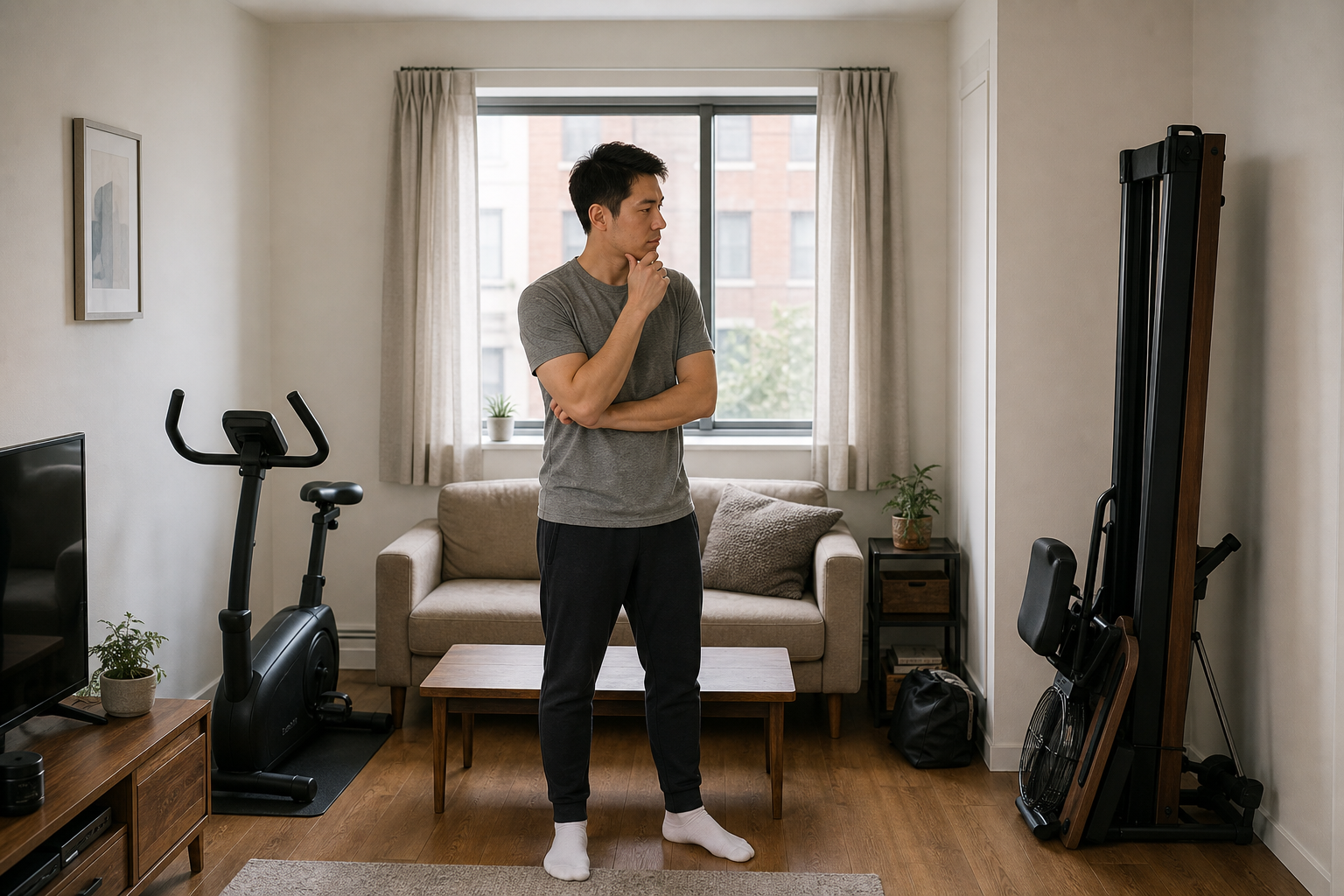
If your usable floor space is under 150 square feet, or if you need to store equipment between sessions, the stored footprint is the primary constraint — not the price or feature set. The machines below are the top choices when stored footprint is the deciding factor.
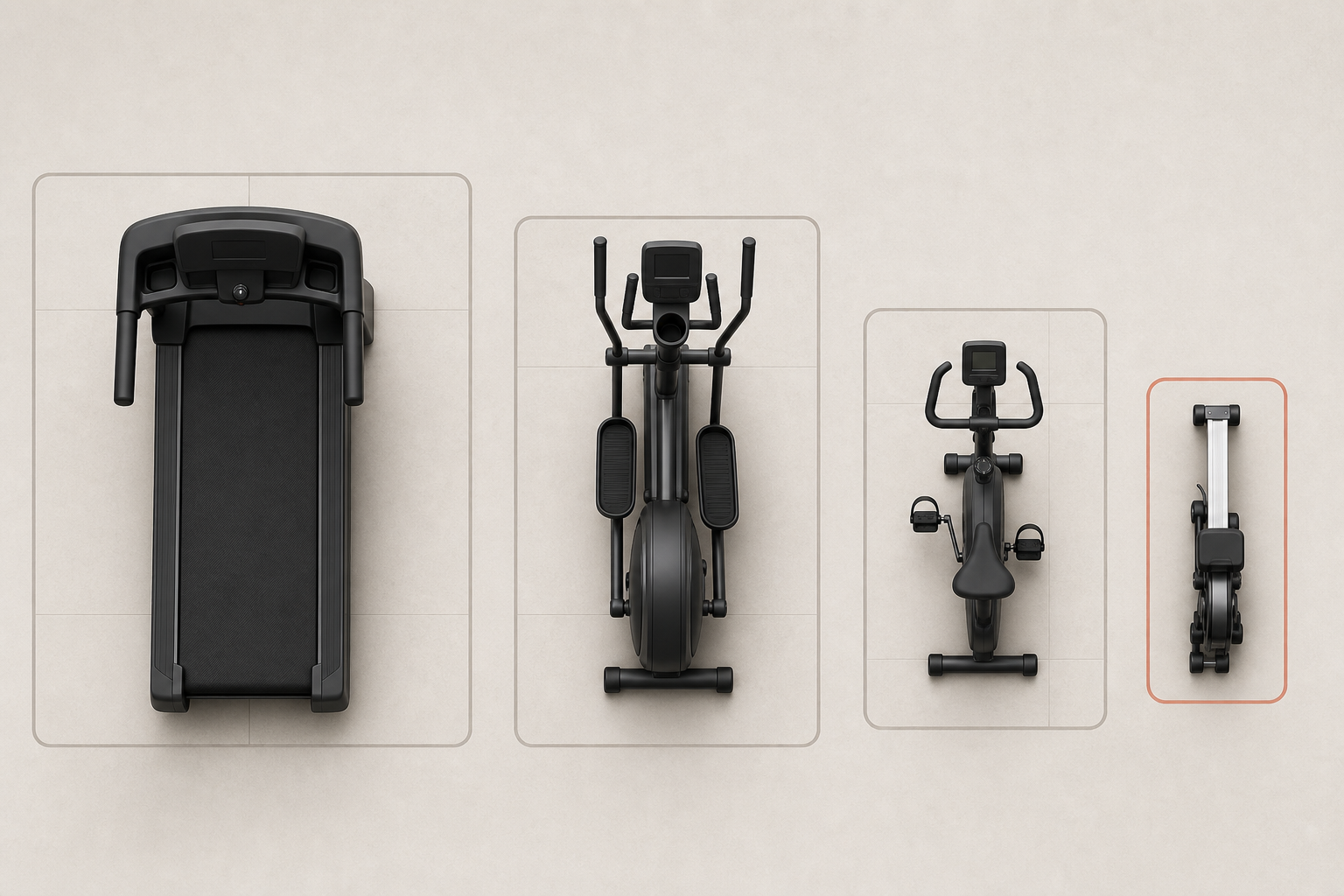
| Machine | In-Use Footprint | Stored Footprint | Price Range | Subscription |
|---|---|---|---|---|
| Foldable rowing machine (vertical fold) | 14–18 sq ft | 2–6 sq ft | $300–$900 | No |
| Compact upright exercise bike | 5–8 sq ft | 5–8 sq ft (doesn't fold) | $250–$900 | No (most) |
| Folding treadmill | 10–14 sq ft | 8–12 sq ft (folded deck) | $500–$1,500 | No (most) |
| Tonal 2 (wall-mounted) | ~7 sq ft (arms folded) | ~7 sq ft | $2,995 hardware | Yes (~$44/mo) |
| Compact folding elliptical | ~12 sq ft | ~8 sq ft (folded) | $400–$900 | No |
The foldable rowing machine is the standout choice for apartments. Most models fold vertically — the seat slides up and the rail pivots to stand nearly upright — reducing the floor footprint to roughly the size of a dining chair. This is a genuine storage solution, not a marketing claim.
The exercise bike's advantage is that it doesn't need to fold: its compact 5–8 sq ft footprint is already small enough for most apartment corners. It's also quieter than a treadmill, which matters in multi-unit buildings.
Subscription Costs and Total Cost of Ownership
Subscription-dependent machines look more affordable at the hardware price point than they are over time. The tables below show 1-year, 3-year, and 5-year total cost of ownership for the two primary subscription-dependent machines and comparable non-subscription alternatives.
| Machine | Hardware Cost | Subscription (Annual) | 1-Year TCO | 3-Year TCO | 5-Year TCO |
|---|---|---|---|---|---|
| Tonal 2 | $2,995 | ~$528 (~$44/mo) | ~$3,523 | ~$4,579 | ~$5,635 |
| Quality functional trainer (no subscription) | $1,500 | $0 | $1,500 | $1,500 | $1,500 |
| Speediance Gym Monster | $1,999–$2,599 | Varies by tier (verify current) | ~$2,500–$3,200 est. | ~$3,500–$4,800 est. | ~$4,500–$6,400 est. |
| Mid-range cable tower + accessories (no subscription) | $600–$900 | $0 | $600–$900 | $600–$900 | $600–$900 |
At the 3-year mark, a Tonal 2 subscription adds roughly $1,584 in cumulative subscription fees to the hardware cost. A quality functional trainer purchased for $1,500 reaches the same 3-year point at $1,500 — with no ongoing obligation. The non-subscription setup costs $3,079 less over three years.
This doesn't mean smart gyms are a bad purchase. If you use the guided programming consistently and it drives adherence you wouldn't otherwise have, the value case is real. But the comparison must be made with accurate numbers — not just the hardware sticker price.
What Beginners Should Avoid and Why
If you're new to home fitness and making your first significant equipment purchase, three common mistakes are worth flagging explicitly.
- Buying a cheap all-in-one machine ($150–$300): Budget multi-station machines with a weight stack, lat pulldown, and leg extension combined typically use low-quality cables, pulleys, and weight stacks that fail under regular use. The exercise variety sounds appealing but the durability doesn't hold. At this price tier, a single-purpose machine (rowing machine or exercise bike) is more durable and more useful.
- Buying a treadmill before building baseline fitness: Treadmills are effective tools, but running is a high-impact activity with real injury risk for deconditioned beginners. Walking on a treadmill is lower-risk, but a rowing machine or exercise bike provides equivalent cardiovascular benefit with significantly less joint stress. For most beginners, starting with a low-impact machine and progressing to a treadmill later is the safer and more sustainable path.
- Committing to a subscription-heavy smart gym before establishing a consistent routine: Smart gyms are optimized for users who already have a training habit and want to upgrade it. If you're still in the habit-formation stage — working out 1–2 times per week inconsistently — a $44/month subscription accrues regardless. Establish a consistent routine with a lower-cost machine first, then upgrade when you know the habit is durable.
Frequently Asked Questions
What machine burns the most calories?
Calorie burn depends more on workout intensity and your body weight than on machine type. That said, treadmills and rowing machines tend to produce higher calorie burn at equivalent effort levels because they engage more muscle mass and/or involve weight-bearing movement. At moderate intensity for 30 minutes, a 155 lb adult might burn 240–400 kcal on a treadmill and 220–360 kcal on a rowing machine. These are estimates — actual burn varies significantly. Calorie figures from machine displays and fitness trackers are notoriously imprecise and should be treated as rough guides, not precise measurements.
What is the best machine for weight loss?
No single machine produces weight loss — calorie deficit over time does. Any machine you use consistently is the best machine for weight loss. In practice, the machine most likely to be used consistently is the one that fits your space, doesn't require a subscription you'll resent, and matches a workout style you don't dread. For most home users, that's a rowing machine or exercise bike, not a treadmill or smart gym. If you have specific health conditions or weight loss goals, consult a healthcare provider before starting a new exercise program.
Is a rowing machine good for beginners?
Yes, with one caveat: rowing requires learning a specific stroke sequence (legs, body, arms on the pull; arms, body, legs on the return) that takes a few sessions to internalize. Once the form is established, rowing is one of the most beginner-friendly cardio machines available — it's low-impact, full-body, and scalable from very low resistance to high intensity. Most manufacturers provide setup videos. If you have lower back issues, consult a healthcare provider before using a rowing machine, as poor form can place stress on the lumbar spine.
Do I need a subscription for a home gym machine?
No. The majority of home exercise machines — treadmills, rowing machines, exercise bikes, ellipticals, cable towers, and functional trainers — operate fully without any subscription. Subscriptions are primarily associated with smart gym platforms (Tonal, Speediance, Peloton, iFIT-enabled treadmills) that gate guided programming and sometimes core resistance control behind a monthly fee. If you want to avoid subscription dependency entirely, any machine in the cardio-only or strength/resistance categories will work without one. If you're considering a smart gym, calculate the 3-year and 5-year total cost of ownership before committing.
This result comes from one real apartment under the stated conditions — it is a strong signal, not a guarantee your space will measure identically.
Builds this evidence supports
Cable Machine Alternatives That Save Space and Money
Compare the best cable machine alternatives for home gyms – from resistance bands and pulley systems to suspension trainers and compact digital units – and find the right option for your space and budget.
How to Choose a Compact Home Gym That Works for Your Space, Budget, and Noise Tolerance
This article provides a structured decision framework for apartment dwellers and small-space residents to match their specific floor footprint, noise sensitivity, and budget to the most suitable compact home gym strategy — whether that's an all-in-one machine, modular build, smart digital system, or band/bodyweight setup.
The Garage Gym Reality Check: What Equipment Actually Fits in a Single-Car Garage
Most garage gym guides assume a two-car space. This article uses real dimensions, real equipment footprints, and three layout templates to show what fits—and what doesn't—in a single-car garage (10x20 to 12x20 ft).
Spot something off?
If this result didn't match your own space, let us know — floor-damage and noise claims carry real deposit-risk consequences if we get them wrong.