
The True 5-Year Cost of an Exercise Bike: Why That $2,695 Peloton Actually Costs Over $5,000
Most exercise bike reviews hide the real cost. This guide breaks down the 5-year total cost of ownership for Peloton, NordicTrack, Echelon, and subscription-free alternatives so you can see exactly what you'll pay before you buy.
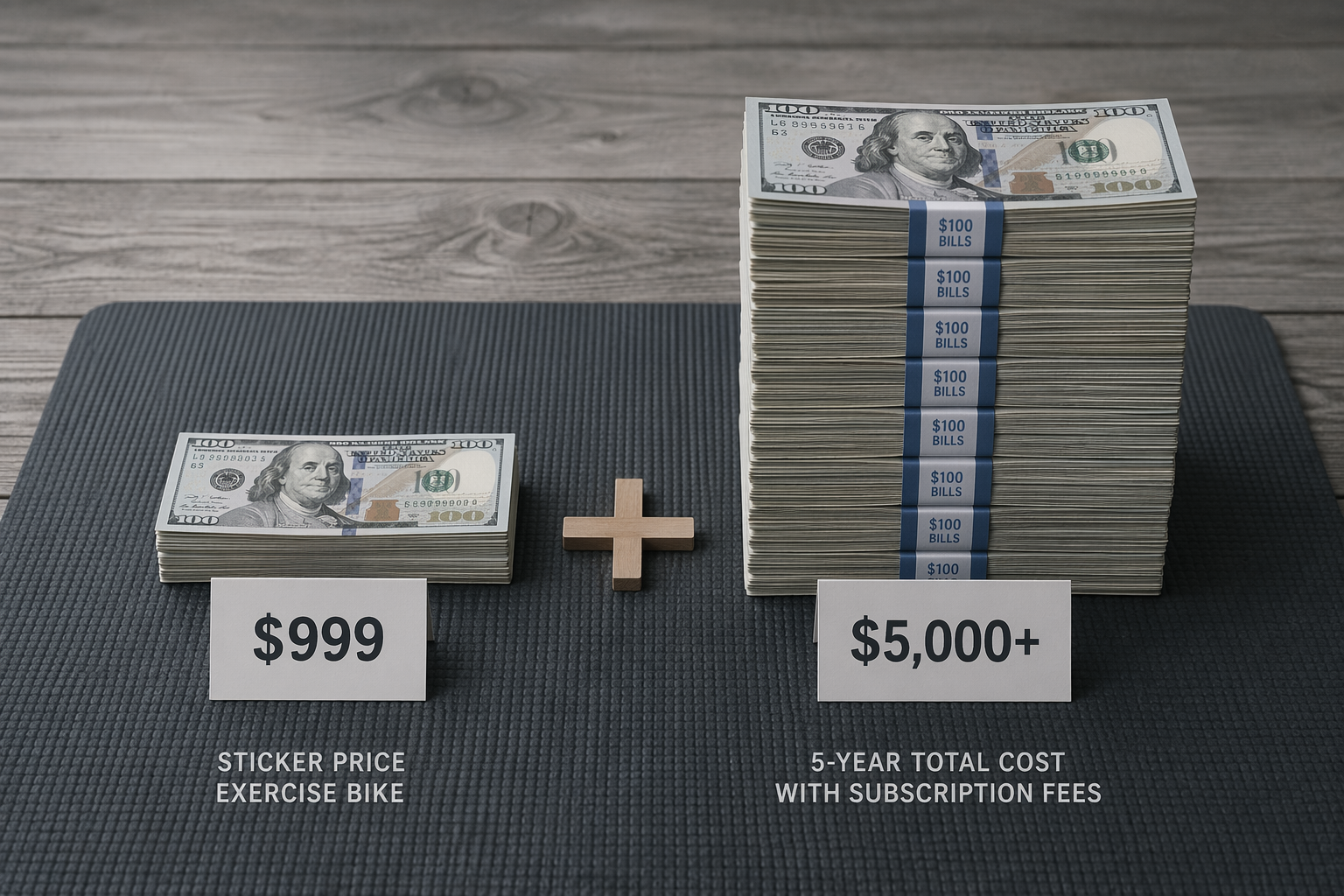
The Subscription Trap: Why Sticker Price Is Only Half the Story
When you see a Peloton Bike+ listed at $2,695, it is easy to think that is the price of entry. It is not. That number represents roughly half of what you will actually spend over the first five years of ownership. The other half — and in some cases more — comes from the monthly subscription fee that most marketing materials bury in the fine print.
Consider the math: a Peloton Bike+ at $2,695 plus $44 per month for the All-Access membership adds up to roughly $5,335 over five years. The Schwinn IC4, a bike that costs $999 and requires no subscription at all, totals exactly $999 over the same period. That is a difference of more than $4,300 — enough to buy a second bike, a year of personal training, or a very nice vacation.
The core problem is structural: most exercise bike reviews compare models by upfront price, resistance type, and screen size, but treat the subscription as an afterthought. A $2,299 NordicTrack X24 looks like a better deal than a $2,695 Peloton Bike+ until you add the $39 per month iFIT membership for five years, which brings the total to $4,639. That is still cheaper than the Peloton, but it is more than double the upfront price. The same pattern repeats across nearly every connected bike on the market.
This article exists to expose that math. Every section that follows is built around a single question: what will this bike actually cost you over five years, including every subscription, accessory, and hidden fee?
The Subscription Landscape: What Each Platform Costs Per Month
Before comparing total costs, it helps to understand what each subscription actually costs and whether it is required or optional. The table below lists the major platforms tied to exercise bikes sold in the U.S. as of mid-2026.
| Platform | Monthly Cost | Required or Optional | Typical Bike Brands |
|---|---|---|---|
| Peloton All-Access | $44 | Required for full functionality | Peloton Bike, Bike+ |
| NordicTrack iFIT | $39 | Required for screen-based content | NordicTrack, ProForm |
| Echelon Fit | $40 | Required for live/on-demand classes | Echelon EX series |
| SoulCycle Equinox+ | $40 | Required for SoulCycle classes | SoulCycle At-Home Bike |
| JRNY | $12 | Optional | Schwinn IC4, BowFlex C6, BowFlex IC Bike SE |
| Zwift | $15 | Optional | Any Bluetooth-compatible bike |
A few important distinctions: Peloton's $44 per month All-Access membership is required to access the bike's full class library and metrics. Without it, the screen shows only a limited free tier with basic ride data. NordicTrack's iFIT at $39 per month works the same way — the bike's touchscreen is essentially a paperweight without an active subscription. Echelon's $40 per month Fit plan unlocks live and on-demand classes, though the bike can still be used manually without it.
On the optional side, JRNY costs $12 per month (or $100 per year) and works with the Schwinn IC4, BowFlex C6, and BowFlex IC Bike SE. It offers adaptive coaching and scenic rides but is not required to use the bike. Zwift at $15 per month is a third-party platform that works with any Bluetooth-compatible bike, including subscription-free models like the Schwinn IC4 and Concept2 BikeErg.
5-Year Total Cost of Ownership: Side-by-Side Comparison
The table below calculates the five-year total cost for 12 popular exercise bike models. The formula is simple: upfront bike price plus (monthly subscription cost × 60 months). For bikes with optional subscriptions, the table shows the cost with and without the subscription so you can see the range.
| Model | Upfront Price | Required Subscription | Monthly Cost | 5-Year Total |
|---|---|---|---|---|
| Peloton Bike+ | $2,695 | Peloton All-Access | $44 | $5,335 |
| NordicTrack X24 | $2,299 | iFIT | $39 | $4,639 |
| Echelon EX-5S | $1,600 | Echelon Fit | $40 | $4,000 |
| SoulCycle At-Home Bike | $2,500 | Equinox+ | $40 | $4,900 |
| ProForm Studio Bike Pro | $1,404 | iFIT | $39 | $3,744 |
| BowFlex IC Bike SE | $999 | None (JRNY optional at $12/mo) | $0 / $12 | $999 / $1,719 |
| Schwinn IC4 | $999 | None (JRNY optional at $12/mo) | $0 / $12 | $999 / $1,719 |
| Schwinn Airdyne AD6 | $899 | None | $0 | $899 |
| Concept2 BikeErg | $1,200 | None | $0 | $1,200 |
| Yosuda Indoor Cycling Bike | $340 | None | $0 | $340 |
| Assault AirBike Classic | $699 | None | $0 | $699 |
| Sunny Health & Fitness SF-B1002 | $399 | None | $0 | $399 |
The takeaway is stark: a bike that costs $340 upfront (Yosuda) can be cheaper over five years than a bike that costs $999 upfront (Schwinn IC4) if you never pay for a subscription. But the Schwinn IC4 offers magnetic resistance, Bluetooth connectivity, and compatibility with Zwift and Peloton Digital — features the Yosuda lacks. The trade-off is between cost and capability, and the table makes that trade-off visible.
Outdoor Gear Lab's analysis confirms that the BowFlex IC Bike SE (identical to the Schwinn IC4) has the lowest five-year cost among connected bikes at $38 per month when including the optional JRNY subscription. That is less than half the monthly cost of a Peloton Bike+ ($86 per month over five years) or a NordicTrack X24 ($67 per month).
The 'Free Ride' Option: Subscription-Free Bikes That Still Deliver
If the subscription math above makes you wince, you are not alone. A growing number of buyers are choosing bikes that require no monthly fee at all. These bikes do not have built-in touchscreens or branded class libraries, but they work with a wide range of third-party apps — including Zwift, Peloton Digital, and Apple Fitness+ — giving you flexibility without lock-in.
- Schwinn IC4 / BowFlex C6 ($999): 100 levels of magnetic resistance, Bluetooth connectivity, and compatibility with Peloton, JRNY, and Zwift. No subscription required. The optional JRNY app costs $12 per month but is not needed to use the bike.
- Schwinn Airdyne AD6 ($899): Air resistance fan bike with no electronics, no screen, and no subscription. Extremely durable. Popular for HIIT training.
- Concept2 BikeErg ($1,200+): Air resistance bike built to commercial gym standards. Connects to Zwift, ErgData, and other apps. Zero ongoing costs. Used by CrossFit boxes and serious cyclists.
- Yosuda Indoor Cycling Bike ($340–$440): Belt-driven magnetic resistance bike with a basic LCD console. No Bluetooth, no apps, no subscription. The lowest-cost option that still delivers a solid ride.
- Assault AirBike Classic ($699): Fan-based air resistance bike with a simple performance monitor. No subscription. Extremely durable for high-intensity training.
The trade-off is real: you lose the guided programming, leaderboard, and curated playlists that make subscription bikes engaging. But you gain the freedom to use any app you want — or none at all. Many riders find that a $10 per month Spotify subscription and a $15 per month Zwift membership still cost less than a single $44 Peloton membership, and they are not locked into one ecosystem.
For readers who also need a compact footprint, the Schwinn IC4 is a strong candidate. If space is also a concern, see our guide to the best exercise bikes for small spaces for a detailed comparison of footprint, noise levels, and folding designs.
When a Subscription Makes Sense — and When It's Wasted Money
Subscriptions are not inherently bad. For the right user, a $44 per month Peloton membership delivers real value: thousands of classes, live instruction, performance tracking, and community accountability. The question is whether you are that user.
A subscription makes sense if:
- You ride 5–7 days per week and rely on class scheduling for consistency.
- You use the bike's native classes exclusively and do not plan to use third-party apps.
- You value the leaderboard, social features, and performance tracking that come with the platform.
- You have the budget and do not mind the ongoing cost.
A subscription is wasted money if:
- You ride 2–3 times per week and prefer your own music, podcasts, or TV shows.
- You plan to use Zwift, Peloton Digital, or Apple Fitness+ instead of the bike's native app.
- You are unsure about your long-term commitment and do not want to be locked into a monthly payment.
- You are buying the bike primarily for structured training (power zones, intervals) rather than entertainment.
A simple decision framework: if you would pay $44 per month for a gym membership and actually use it, a subscription bike may be a good fit. If you would rather pay $10 per month for a streaming service and ride on your own terms, a subscription-free bike with a tablet mount is the smarter choice.
Used and Refurbished Strategies: How to Cut Costs Without Getting Burned
Buying a used exercise bike can slash the upfront cost, but the subscription math changes when you enter the secondhand market. Peloton, in particular, has specific policies that affect the total cost of a used purchase.
- Peloton charges a $95 used equipment activation fee to transfer the bike to a new owner and enable the full subscription. This fee applies to both the original Bike and the Bike+.
- Peloton offers refurbished bikes directly at up to 60% off the retail price. These come with a warranty and do not require the activation fee.
- Peloton also offers a rental option for the original Bike+ at $125 per month, which includes the subscription fee. This is a viable option for short-term commitments but is expensive over five years ($7,500 total).
- Peloton's recall history adds risk to used purchases. In May 2023, Peloton recalled the original Bike (model PL-01) due to seat post issues. In November 2025, Peloton recalled the Bike+ (model PL-02) for the same reason. If you buy a used bike, verify that the seat post has been repaired or replaced under the recall program.
For subscription-free bikes like the Schwinn IC4, Yosuda, or Concept2 BikeErg, the used market is simpler. There is no activation fee, no recall risk, and no ongoing cost to transfer ownership. Prices are typically 30–50% below retail, and the total cost of ownership remains low regardless of how many times the bike changes hands.
Hidden Costs That Add Up: Shoes, Mats, Delivery, and More
Even after you account for the bike and subscription, there are additional expenses that many first-time buyers overlook. These costs apply to every bike — subscription or not — and can add $300 to $900 or more to the first year of ownership.
| Item | Typical Cost Range | Notes |
|---|---|---|
| Cycling shoes with cleats | $100 – $300 | Required for clip-in pedals on most indoor bikes. Look for SPD-compatible shoes. |
| Heart rate monitor | $50 – $100 | Chest strap models are more accurate than optical wrist sensors. Many bikes display HR data. |
| Exercise mat | $20 – $50 | Protects floors and reduces noise. Essential for apartment dwellers. |
| Dumbbells / weights for floor workouts | $50 – $200 | Many bike classes include off-bike strength segments. A basic set of dumbbells adds versatility. |
| Delivery and assembly fees | $100 – $250 | Peloton charges $250 for delivery and setup. Some retailers offer free shipping but charge for assembly. |
| Extended warranty | $50 – $150 | Typically covers electronics and moving parts beyond the standard 1–2 year warranty. |
The image below shows a typical set of accessories you will need to budget for.
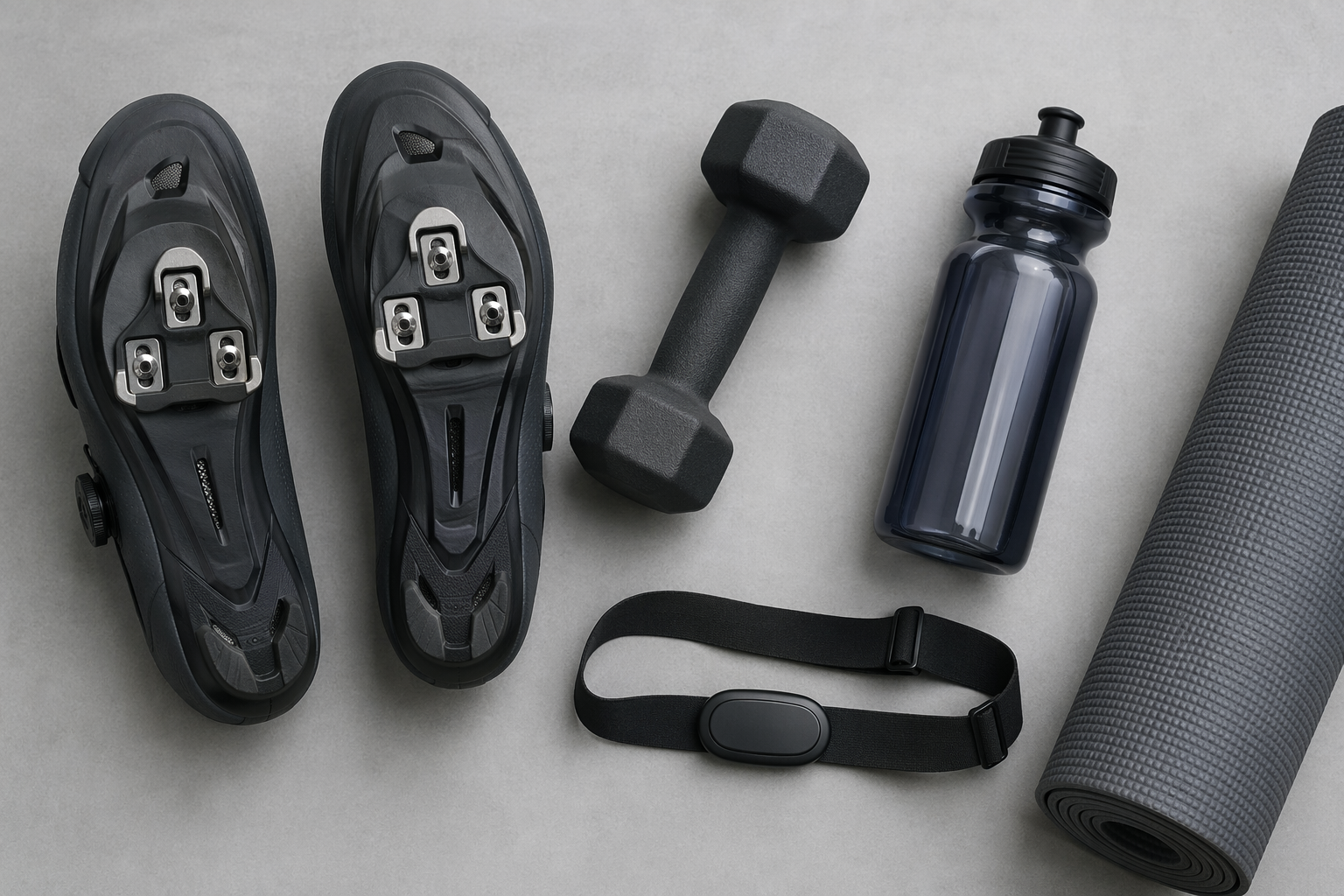
These costs are not optional for most riders. Clip-in pedals require compatible shoes. A mat protects your floor from sweat and vibration. A heart rate monitor gives you meaningful data during workouts. If you are on a tight budget, factor these into your total before deciding which bike to buy.
The Resale Value Equation: Which Bikes Hold Their Worth
Resale value is the final piece of the total cost of ownership puzzle. A bike that retains 50% of its value after three years effectively costs half as much to own as a bike that retains 20%. The difference can be hundreds of dollars.
- Peloton: Peloton bikes hold resale value better than most competitors due to brand recognition and a large secondhand market. However, the $95 activation fee and recall history can deter some buyers. A used Peloton Bike in good condition typically sells for 40–60% of its original price.
- Keiser M3i: Keiser bikes are built to commercial standards and hold value extremely well. A used M3i often sells for 60–70% of its original price after several years. No subscription required.
- Schwinn IC4 / BowFlex C6: These bikes hold moderate resale value, typically 50–60% of retail. The lack of a subscription requirement makes them attractive to secondhand buyers who want a connected bike without ongoing costs.
- Budget bikes (Yosuda, Sunny Health, Marcy): Low-cost bikes have low resale value, typically 30–40% of retail. The secondhand market is smaller, and buyers are often looking for a bargain rather than a specific model.
- Subscription-locked bikes (NordicTrack, Echelon): These bikes lose value faster than subscription-free models because the buyer inherits the subscription requirement. If the subscription model changes or the company struggles, resale value can drop sharply.
The resale value equation ties directly back to the TCO argument. A Peloton Bike+ that costs $5,335 over five years but sells for $800 used has an effective five-year cost of $4,535. A Schwinn IC4 that costs $999 and sells for $500 used has an effective cost of $499. The gap narrows slightly, but the subscription-free bike still costs roughly one-tenth as much to own.
This result comes from one real apartment under the stated conditions — it is a strong signal, not a guarantee your space will measure identically.
Builds this evidence supports
Small Treadmill Buying Guide: 7 Critical Specs to Check Before You Buy
A cross-category spec primer for apartment and small-space dwellers comparing walking pads, ultra-compact folding treadmills, and full-size folding treadmills. Learn the concrete thresholds for motor HP, deck length, noise, warranty, and subscription lock-in so you can compare apples to apples.
Where to Spend vs. Save on Affordable Home Gym Equipment: A Quality Tradeoff Guide
A practical guide for budget-conscious buyers (under $1,000) that reveals which equipment categories demand a higher investment for safety and durability, and where cutting costs is a smart move.
Spot something off?
If this result didn't match your own space, let us know — floor-damage and noise claims carry real deposit-risk consequences if we get them wrong.