
Low Impact Exercise Equipment: A Head-to-Head Comparison by Joint Load, Calorie Burn, and Footprint
Not all low-impact machines are equal. This guide compares recumbent bikes, ellipticals, rowing machines, walking pads, and under-desk pedallers across joint stress, calorie burn, muscle engagement, footprint, and price — so you can choose the right equipment for your goals, space, and budget.
- Duration
- 30 min
What Does “Low Impact” Actually Mean?
In the fitness industry, “low impact” has a specific technical meaning that many product descriptions blur. A movement qualifies as low impact when at least one foot remains in contact with the ground or the equipment at all times. This eliminates the landing forces that occur during running, jumping, or plyometric movements — forces that can reach two to three times your body weight through the knees and hips.
Low impact does not mean low intensity. A rowing machine at full effort can push your heart rate into the same zone as a sprint, but the absence of a flight phase means the joints never absorb a landing shock. This distinction matters for home fitness buyers because the wrong machine choice — even within the low-impact category — can still aggravate existing joint issues or fail to deliver the workout intensity you expect.
To make the trade-offs visible, the comparison below uses a joint-load score on a 1-to-5 scale, where 1 represents the lowest possible joint stress and 5 represents the highest. These scores are derived from ordinal rankings in published comparison tables and qualitative rankings from equipment manufacturers — they are not lab-measured absolute values, but they provide a useful relative benchmark.
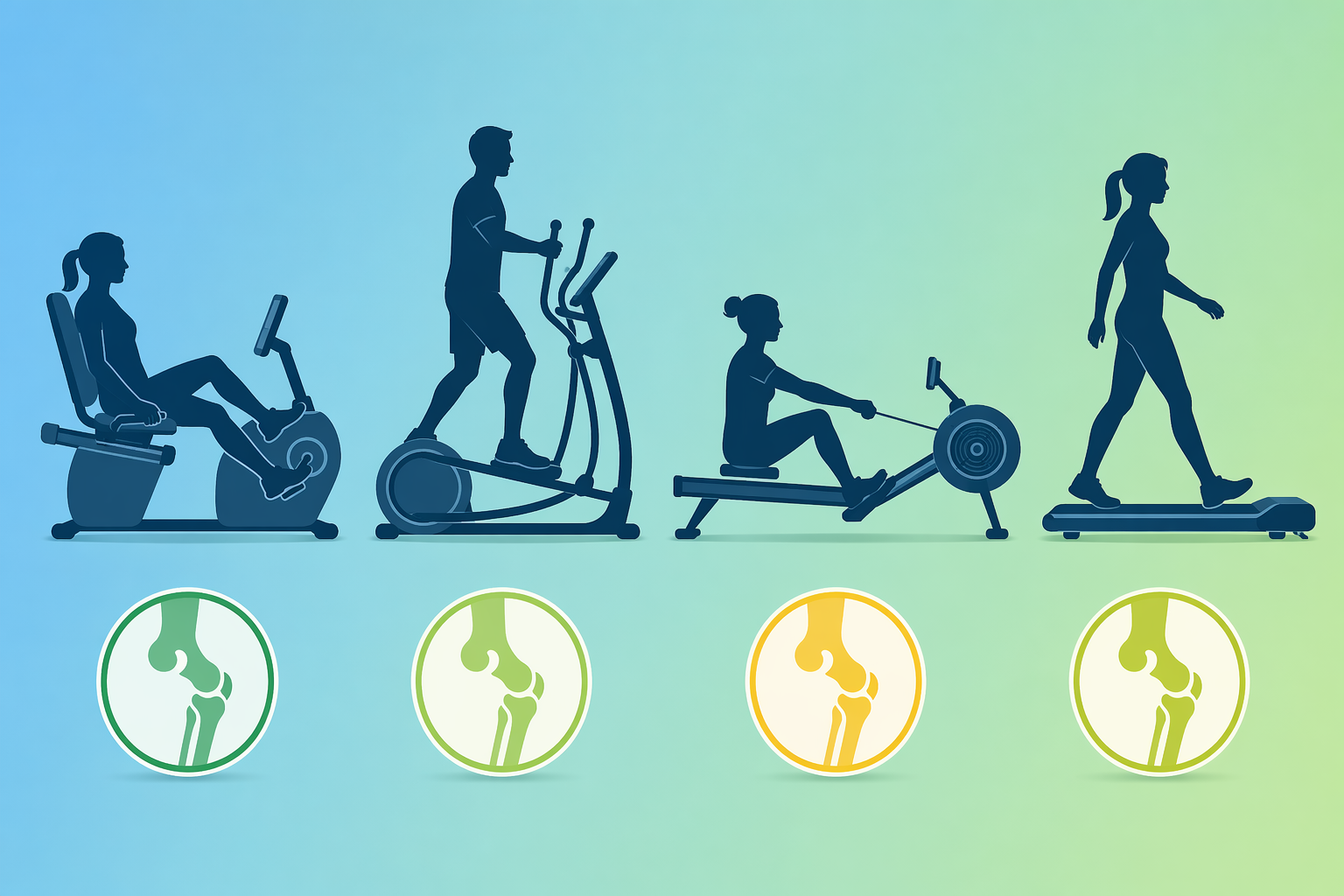
Low-Impact Equipment Comparison Table
The table below stacks six machine types side by side across the dimensions that matter most for a home purchase decision: joint load, calorie burn, muscle engagement, floor space, price, and the scenario each machine handles best. Calorie estimates assume a 70 kg (154 lb) user working at a moderate-to-vigorous effort.
| Machine Type | Joint-Load Score (1–5) | Calories / Hour (70 kg) | Primary Muscles | Footprint | Price Range | Best-Fit Scenario |
|---|---|---|---|---|---|---|
| Recumbent Bike | ~1/5 | 300–500 | Quads, hamstrings, glutes (minimal core) | Medium: 4–5 ft long | $1,700–$11,000+ | Knee rehab, arthritis, lower-back sensitivity |
| Upright Bike | ~2/5 | 400–600 | Quads, hamstrings, glutes, some core | Medium: 3–4 ft long | $500–$2,500 | General cardio, higher intensity without high joint load |
| Elliptical | ~2/5 | 400–600 | Glutes, quads, hamstrings, upper body (with handles) | Medium: 6–7 ft long | $1,000–$8,000+ | Full-body low-impact cardio at moderate pace |
| Rowing Machine | ~1/5 | 400–700 | ~85% of muscles (legs, back, arms, core) | Long: 7–8 ft | $990–$1,200+ | Highest calorie burn, full-body conditioning |
| Walking Pad / Treadmill | ~3/5 | 300–500 | Quads, hamstrings, glutes, calves | Medium: 5–6 ft long | $500–$2,300 | Walking-based cardio, NEAT accumulation |
| Under-Desk Pedaller | ~0/5 | 100–250 | Quads, hamstrings (minimal) | Very small: 1.5–2 ft | $150–$1,100 | Mobility-limited users, seated NEAT, circulation |
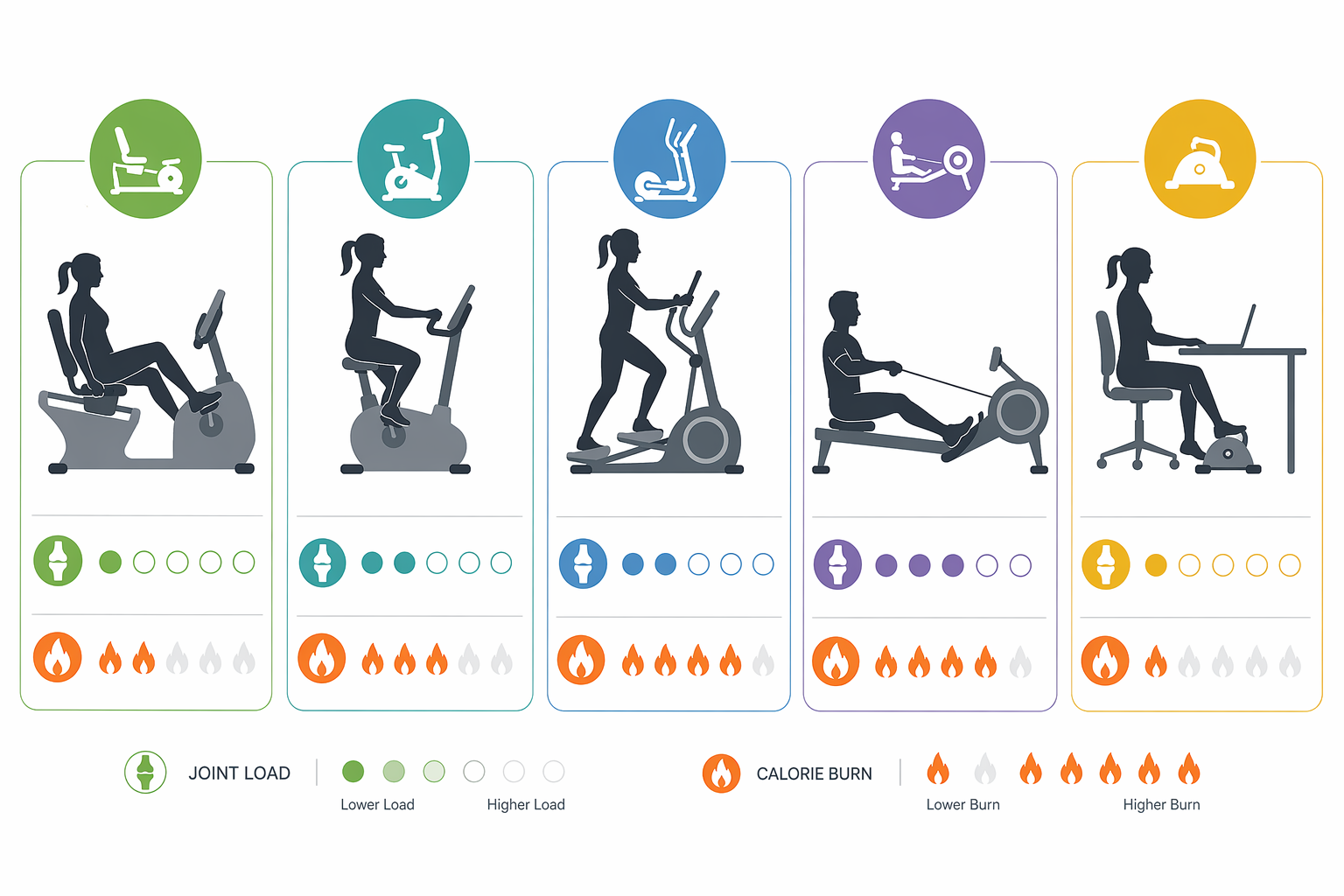
Deep Dive: Each Machine Type
Recumbent Bike
The recumbent bike places the user in a reclined, chair-like position with the pedals positioned forward rather than below. This geometry produces the lowest joint stress of any cardio machine — rated approximately 1 out of 5 on the joint-load scale. The reclined posture reduces pressure on the spine and hip joints, which is why the Arthritis Foundation specifically recommends recumbent bikes for people with arthritis. NordicTrack's biomechanical analysis confirms that the recumbent bike produces the lowest knee stress among common cardio machines, with reduced activation of the tibialis anterior and lateral gastrocnemius compared to upright cycling or treadmill walking.
The trade-off is lower muscle engagement and a smaller calorie ceiling (300–500 kcal/hr at moderate effort). The reclined position also limits core activation, so this machine is best treated as a pure cardio and joint-recovery tool rather than a strength or conditioning device.
Upright Bike
The upright bike positions the pedals directly below the hips, similar to a road bicycle. It carries a joint-load score of approximately 2 out of 5 — slightly higher than a recumbent but still well within the low-impact range. Population-level data supports this: research cited by NordicTrack shows that bicycling across more life stages is linked to a lower prevalence of frequent knee pain and symptomatic radiographic osteoarthritis.
Upright bikes typically produce a higher calorie burn than recumbents (400–600 kcal/hr) because the more vertical posture allows for greater hip and knee extension, engaging the glutes more effectively. They also take up less floor space (roughly 3–4 feet long) and generally cost less than recumbents, making them a strong middle-ground option for general home cardio.
Elliptical
Ellipticals are the most popular low-impact machine in home gyms, but their joint-load profile is more nuanced than marketing suggests. The joint-load score sits at approximately 2 out of 5, but biomechanical analysis from NordicTrack indicates that ellipticals can induce higher knee joint torques than stationary bikes, with torque peaks occurring later in the pedal cycle. High cadence further increases vertical loads through the knee.
This does not mean ellipticals are unsafe — it means they are best used at moderate paces rather than high-speed striding, especially for users with existing knee concerns. At a controlled pace, they deliver 400–600 kcal/hr with upper-body engagement through the moving handles, making them one of the better options for full-body low-impact cardio.
Rowing Machine
Rowing machines occupy a unique position in the low-impact category: they carry a joint-load score of approximately 1 out of 5 while delivering the highest calorie burn of any machine in this comparison (400–700 kcal/hr). The seated, sliding motion eliminates landing forces, and the sequential leg-drive-to-arm-pull sequence activates an estimated 85% of muscles, according to data cited by Hypervibe from Men's Health.
The main limitation is the higher flexion demand on the knees and hips during the catch position (when the seat slides forward and the shins go vertical). NordicTrack's ranking places rowing in a "higher flexion demand" category, which means users with limited knee or hip range of motion may need to shorten the stroke or choose a different machine. The Arthritis Foundation recommends using a bar attachment (easier to grip than a handle) and choosing air or fluid-filled resistance, which is smoother than magnetic or hydraulic systems.
Walking Pad / Treadmill
Walking pads and treadmills occupy the higher end of the low-impact spectrum with a joint-load score of approximately 3 out of 5. Walking itself is low impact because one foot is always on the belt, but the repetitive heel strike still transmits force through the knees and hips — less than running, but more than cycling or rowing. NordicTrack's research on lower-body positive pressure (LBPP) treadmills showed that reduced-weight-bearing walking produced greater gains in walking speed, stride length, and knee range of motion compared to over-ground walking in knee osteoarthritis patients, suggesting that standard treadmills still impose meaningful joint load.
The calorie range (300–500 kcal/hr at walking pace) is comparable to a recumbent bike, but the machine footprint (5–6 feet long) and the ability to incline-walk make it a versatile option for users who want to accumulate non-exercise activity thermogenesis (NEAT) throughout the day.
Under-Desk Pedal Exerciser
Under-desk pedal exercisers are the lowest-impact option available, scoring approximately 0 out of 5 on the joint-load scale. They involve no weight-bearing and no impact whatsoever. However, they are also the lowest-calorie option by a wide margin — 100 to 250 kcal/hr at best. The BST Lagree analysis classifies them primarily as mobility and circulation tools rather than primary strength or cardio builders.
Their niche is real: for users with severe mobility limitations, post-surgical restrictions, or jobs that require prolonged sitting, an under-desk pedaller provides a way to accumulate movement without leaving a chair. They are also the most space-efficient option at 1.5–2 feet and the most affordable, with quality units starting around $150.
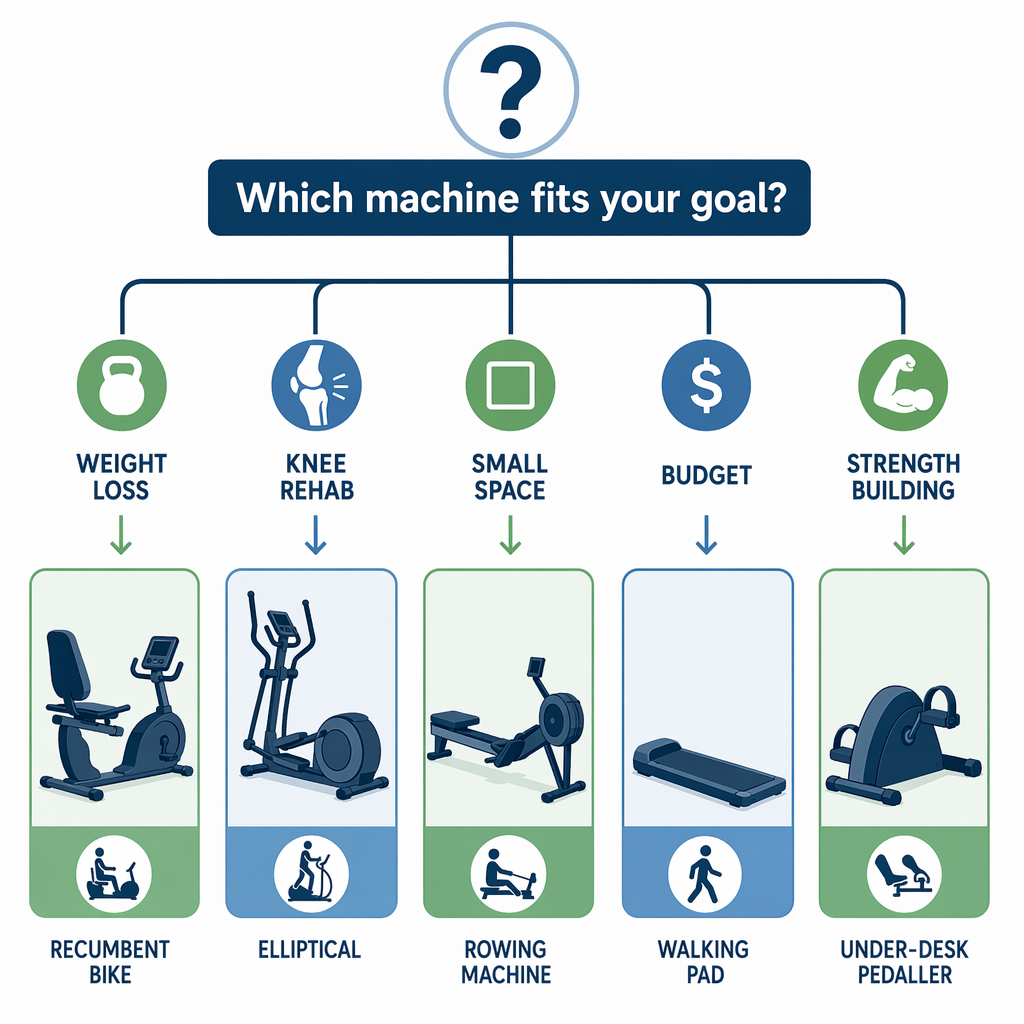
Which Machine Should You Choose? A Decision Framework by Goal
The table above shows the raw specs, but your personal constraint axis — weight loss, joint rehab, space, budget, or strength — should drive the final decision. Use the framework below to narrow your options.
| Your Primary Goal | Best Machine Choice | Why | Runner-Up |
|---|---|---|---|
| Weight loss (highest calorie burn) | Rowing Machine | 400–700 kcal/hr with ~85% muscle activation; highest ceiling in the low-impact category | Elliptical (400–600 kcal/hr with upper-body engagement) |
| Knee rehab or arthritis | Recumbent Bike | Lowest joint stress (~1/5); recommended by Arthritis Foundation; reduced knee torque vs. elliptical | Upright Bike (slightly higher joint load but still low-impact and linked to lower knee pain prevalence) |
| Small space / apartment | Under-Desk Pedaller or Upright Bike | Pedaller fits 1.5–2 ft; upright bike fits 3–4 ft. Both store easily | Walking Pad (5–6 ft, but can slide under furniture) |
| Budget under $500 | Under-Desk Pedaller or Basic Upright Bike | Pedallers start at ~$150; basic upright bikes available under $500 | Used rowing machine (Concept2 RowErg is $990 new, but used units often appear under $500) |
| Full-body strength + cardio | Rowing Machine | Engages legs, back, arms, and core in one movement; 85% muscle activation | Elliptical with moving handles (upper-body engagement, but less total muscle mass) |
Programming Quick-Start for Each Machine
Once you have chosen a machine, the next question is how to use it safely and effectively. The protocols below follow the progression rule recommended by NordicTrack: increase session duration by no more than 5 minutes per week, and only when joint pain stays at 2 or below on a 10-point scale.
- Recumbent Bike: Start with 10–15 minutes at low resistance (level 2–3 on most machines). Maintain a cadence of 60–70 RPM. Increase by 5 minutes per week. Progress resistance only after you can complete 20 minutes without knee discomfort.
- Upright Bike: Start with 15 minutes at moderate resistance (level 4–5), cadence 70–80 RPM. Add 5 minutes per week. Once you reach 25 minutes, begin adding 1–2 resistance levels per week while keeping cadence steady.
- Elliptical: Start with 12–15 minutes at a moderate stride rate (120–130 strides per minute) with low-to-no incline. Increase by 5 minutes per week. Keep the pace moderate — high cadence increases vertical knee loads according to biomechanical analysis.
- Rowing Machine: Start with 10 minutes of steady-state rowing at 20–22 strokes per minute, low drag factor (3–4 on most machines). Focus on the sequence: legs drive first, then hips swing, then arms pull. Increase by 3–5 minutes per week. Log your split time per 500 meters as an objective intensity measure.
- Walking Pad / Treadmill: Start with 15–20 minutes at a comfortable walking pace (2.5–3.5 mph) with zero incline. Add 5 minutes per week. Once you reach 30 minutes, add 1% incline per week rather than increasing speed, which keeps joint load lower.
- Under-Desk Pedaller: Use for 10–20 minutes per hour of seated work at low-to-moderate resistance. There is no formal progression — the goal is accumulated movement, not progressive overload. Stop if you feel knee strain from the repetitive flexion.
The Bottom Line
No single low-impact machine is best for every goal. The recumbent bike is the safest starting point for joint-sensitive users, the rowing machine delivers the highest calorie burn and full-body engagement, the elliptical offers a middle path with upper-body involvement, and the under-desk pedaller fills a real niche for mobility-limited or highly sedentary users. The walking pad and upright bike sit between these poles, each with a specific trade-off in joint load, space, and intensity ceiling.
The trend data supports the growing relevance of this category: according to Les Mills trend reports cited by BST Lagree, 30% of gym-goers now prioritize low-impact workouts, and 20% of fitness enthusiasts report joint issues as a key factor in their training choices. Low-impact class participation has risen approximately 30% year over year. The equipment market is responding, but the buyer's job is to match the machine to the specific constraint — joint concern, space, budget, or goal — rather than assuming any low-impact label is sufficient.
If you are still deciding, start with your primary constraint from the decision framework above. If space is the tightest constraint, look at our small-space setup guides for footprint-specific recommendations. If you are a beginner building your first routine, the beginner's hub has decision pathways that start from your goal and available equipment rather than from a product category.
What a small equipment investment adds
We don't have a build tagged to this exact tier yet. Browse all builds.
How often should you repeat this?
See our recovery and rest reference for citation-anchored rest-interval guidance.
Spot something off?
Tell us if a movement, tier assumption, or duration didn't match your experience.