
7-Minute Workout Myths vs. Facts: What the Research Actually Says
The 7-minute workout is surrounded by overstated claims. This article separates myth from fact using peer-reviewed research, explaining what the workout actually delivers, who it's for, and how to set realistic expectations.
- Duration
- 21 min
Introduction: The Viral Halo vs. The Evidence
Few fitness protocols have achieved the cultural saturation of the "7-minute workout." Since the New York Times introduced it to the public in 2013, it has been cited as a science-backed shortcut to fitness, a calorie-torching miracle, and a universal solution for time-pressed exercisers. The reality is more nuanced — and more interesting.
This article systematically examines the five most persistent misconceptions surrounding the protocol. Each claim is tested against the available peer-reviewed research, the original authors' stated intentions, and the practical constraints of human physiology. The goal is not to dismiss the workout — it has genuine utility — but to replace hype with calibrated expectations so you can decide whether it belongs in your routine and, if so, how to use it correctly.
Myth #1: It's a 7-Minute Workout
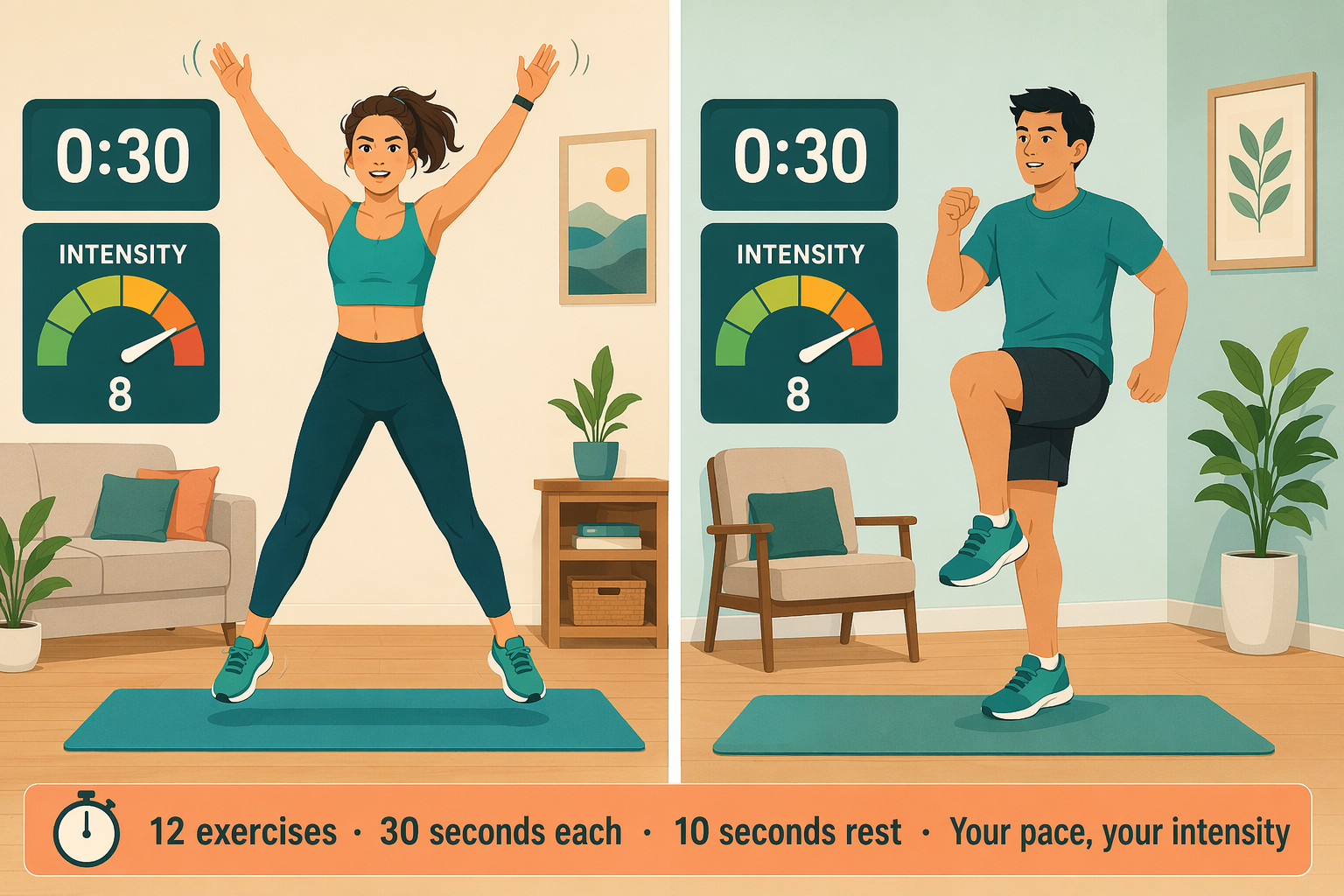
The name is the most successful marketing accident in fitness. The circuit itself — 12 exercises performed for 30 seconds each with 10 seconds of rest between them — does take approximately seven minutes to complete. But the workout, as designed by its creators Brett Klika and Chris Jordan in their 2013 article for ACSM's Health & Fitness Journal, was never intended to be a single seven-minute round.
The original article explicitly states that the high-intensity circuit training (HICT) protocol should be repeated two to three times, resulting in a total workout duration of 14 to 21 minutes. The rationale is straightforward: the American College of Sports Medicine (ACSM) guidelines for high-intensity exercise recommend a minimum of 20 minutes per session. A single seven-minute circuit falls well short of that threshold.
This misconception has practical consequences. Someone who stops after one circuit and believes they have completed a full workout is getting roughly half the stimulus the protocol was designed to deliver. If you are currently doing a single round and wondering why results are slow, the most likely explanation is that you are doing half the prescribed volume.
Myth #2: It's Science-Backed for All Fitness Goals
The phrase "science-backed" is used loosely in fitness media, and the 7-minute workout is a textbook case. The 2013 article by Klika and Jordan was not a study of the protocol itself. It was a proposal — a design framework that synthesized principles from existing high-intensity interval training (HIIT) research and applied them to a bodyweight circuit format. The authors drew on established HIIT science to justify the structure (30-second work bouts, 10-second rest intervals, alternating upper- and lower-body movements), but they did not run a controlled trial of the specific 12-exercise sequence.
Direct experimental evidence for the protocol arrived later, and it paints a more targeted picture of what the workout can and cannot do.
| Study | Year | Participants | Duration | Key Findings |
|---|---|---|---|---|
| Schmidt et al. | 2016 | 96 adults | 8 weeks | Significant improvements in push-up endurance in both 7-min and 14-min circuit groups; men also increased muscle strength. |
| Mattar et al. | 2017 | 29 adults (ages 18–30) | 6 weeks (daily) | ~4 cm reduction in waist circumference; decreased fat mass; no dietary changes were prescribed. |
| Riegler et al. | 2017 | 14 healthy active adults | Single session | Lower peak VO₂max and heart rate compared to cycling intervals; authors still recommended the protocol for its convenience. |
The evidence supports the workout for specific outcomes — muscular endurance and modest body composition changes — but not for maximal cardiovascular improvements or significant strength gains. If your primary goal is building maximal aerobic capacity or increasing one-rep max strength, this protocol is unlikely to be sufficient on its own.
Myth #3: It Burns Hundreds of Calories
Calorie-burn claims for the 7-minute workout range from modest to wildly inflated. The available data, while limited, provides a realistic baseline.
Research from the University of Wisconsin La Crosse recorded approximately 15 calories per minute during a 20-minute bodyweight circuit using a 20-seconds-on, 10-seconds-off Tabata-style protocol. Extrapolating that to a 7-minute round yields roughly 105 calories at maximal effort. However, this figure comes from a different work-to-rest ratio than the 7-minute workout's 30/10 protocol, and the researchers noted that 15 cal/min is "well above what most people hit on a typical day."
For a single round of the standard 30/10 protocol, a more representative range is 25 to 70 calories at moderate-to-hard effort, depending on body weight and exercise selection. The table below provides estimates by body weight.
| Body Weight | Moderate Effort (cal/round) | Higher Effort (cal/round) |
|---|---|---|
| 125 lb (57 kg) | 28–40 | 40–55 |
| 155 lb (70 kg) | 35–49 | 49–63 |
| 185 lb (84 kg) | 42–56 | 56–70 |
Even at maximal effort, a single round of the 7-minute workout burns roughly the same number of calories as a 15-minute brisk walk. It is not a high-volume calorie burner. If weight loss through caloric expenditure is your primary goal, longer-duration moderate-intensity exercise or a full HIIT session will produce a larger total burn.
Myth #4: Anyone Can Do It
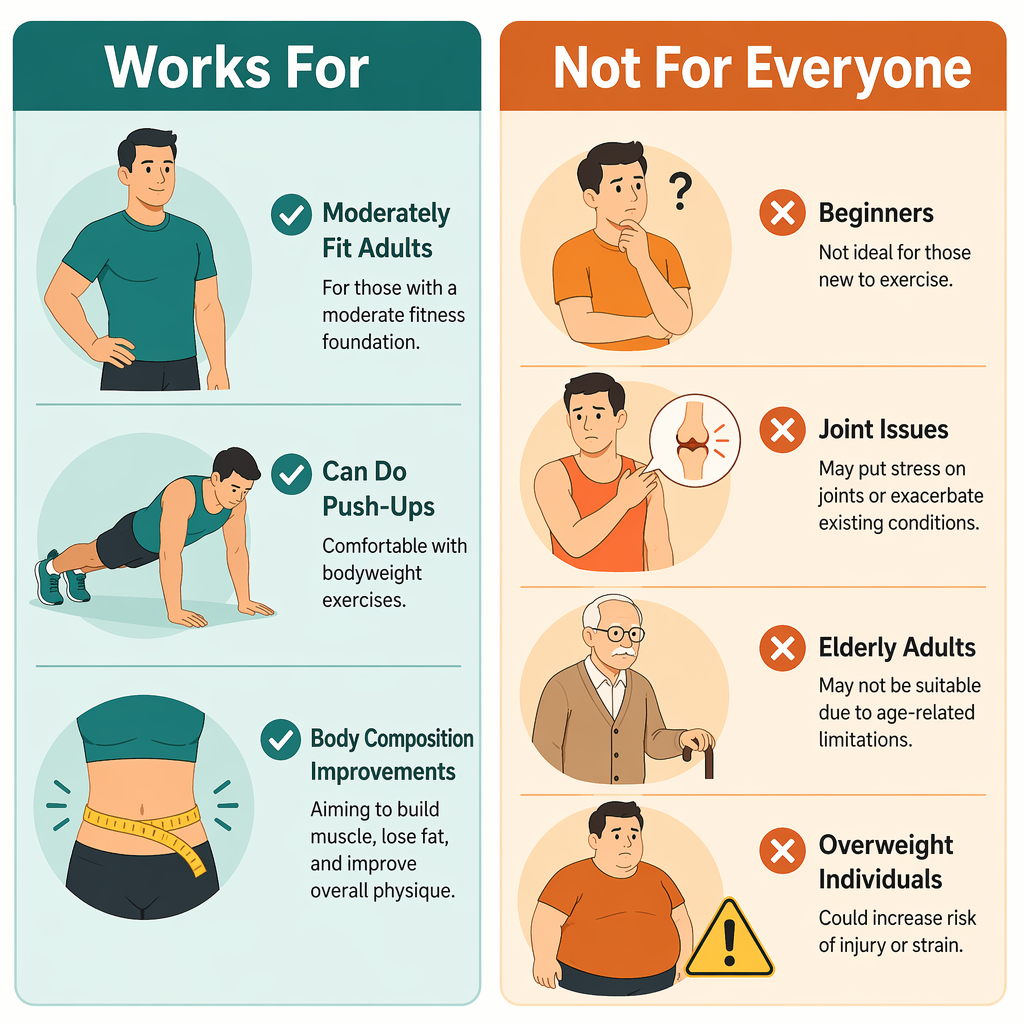
The 7-minute workout is often presented as universally accessible — no equipment, minimal space, short time commitment. But the original authors were explicit about its limitations. In their 2013 article, Klika and Jordan listed specific contraindications: "Because of the elevated demand for exercise intensity in HICT protocols, caution should be taken when prescribing this protocol to individuals who are overweight/obese, detrained, previously injured, or elderly or for individuals with comorbidities."
WebMD's medical review echoes this caution, rating the workout "not for beginners" and warning that jumping jacks, squats, and lunges can stress the knees; push-ups can strain the wrists and shoulders; and planks can be difficult for individuals with weak back muscles. For someone who is not currently active or who has joint concerns, jumping directly into this protocol carries a real risk of injury.
This does not mean the protocol is inherently dangerous. It means the intensity demands are real, and the on-ramp matters. If you are new to exercise or returning after a long break, a gentler starting point is more appropriate. The Home Fitness Decision Guide provides a structured pathway for building foundational fitness before attempting high-intensity circuits. Similarly, workout apps designed for total beginners offer guided, lower-intensity sessions that build capacity safely.
What the Evidence Actually Supports: Muscular Endurance and Body Composition
Once the myths are cleared away, a useful core of evidence remains. The 7-minute workout is not a panacea, but it is a legitimate tool for specific outcomes when used as intended.
Muscular endurance. The 2016 Schmidt study of 96 adults found that both the 7-minute and 14-minute circuit groups showed significant improvements in push-up endurance after eight weeks. Men in the study also increased muscle strength. This makes sense physiologically: the 30-second work intervals at high intensity target Type I and Type IIa muscle fibers, which are responsible for sustained effort and moderate-power output.
Body composition. The 2017 Mattar study of 29 adults aged 18–30 who performed the protocol daily for six weeks reported an average waist circumference reduction of approximately 4 cm and decreased fat mass, all without any prescribed dietary changes. These results are notable for a protocol that requires no equipment and less than 25 minutes per day, but they should be interpreted with the caveat that the sample was small and the participants were young and healthy.
Cardiovascular fitness. This is where the evidence is weakest. The 2017 Riegler study found that the 7-minute workout produced lower peak VO₂max and heart rate compared to cycling intervals. The authors still recommended the protocol for its convenience and accessibility, but if maximal cardiovascular improvement is your goal, traditional HIIT or steady-state cardio is more effective.
| Outcome | Supported by Evidence? | Strength of Evidence |
|---|---|---|
| Muscular endurance (push-ups, core) | Yes | Moderate — one controlled trial (n=96) |
| Body composition (waist reduction, fat loss) | Yes | Moderate — one controlled trial (n=29), no dietary control |
| Cardiovascular fitness (VO₂max) | Limited | Weak — one study showed lower response vs. cycling |
| Muscle strength (maximal) | Partial | Weak — men improved in one study; women did not |
| Weight loss (significant caloric deficit) | No | Not supported by available data |
Who It Works For, Who It Doesn't
The most honest answer to "Is the 7-minute workout for me?" depends on your current fitness level, your goals, and your health status. The table below provides a practical decision framework.
| Profile | Suitable? | Why / Why Not |
|---|---|---|
| Moderately fit adult, general fitness maintenance | Yes | Effective for muscular endurance and as a time-efficient filler workout. Perform 2–3 circuits. |
| Beginner, no recent exercise history | No (not yet) | Intensity too high; risk of joint strain. Start with a beginner program and build foundational strength. |
| Overweight or obese | No (per original authors) | Joint stress from jumping and weight-bearing exercises. Lower-impact alternatives recommended. |
| Elderly or deconditioned | No (per original authors) | Cardiovascular and musculoskeletal demands exceed safe thresholds for this population. |
| Advanced athlete, strength or endurance goals | Limited | Insufficient stimulus for maximal strength or VO₂max gains. Useful as a finisher or active recovery. |
| Person with joint issues (knees, wrists, shoulders) | No (without modification) | Jumping jacks, push-ups, and planks can aggravate existing conditions. Modified versions may be possible. |
| Person with cardiovascular disease | No (without medical clearance) | Cleveland Clinic advises stress testing before high-intensity exercise. |
Practical Takeaways: Setting Realistic Expectations
The 7-minute workout is a legitimate, evidence-grounded training tool — but only when its capabilities and limitations are understood. Here is what the research actually supports:
- Perform 2–3 circuits, not one. The protocol was designed to be repeated. A single circuit is a warm-up, not a workout.
- Expect modest calorie burn. A single round burns roughly 25–70 calories at moderate effort. It is not a high-volume calorie burner.
- Use it for muscular endurance and body composition. The best evidence supports improvements in push-up endurance and modest reductions in waist circumference and fat mass.
- Do not rely on it for maximal cardiovascular fitness. Studies show lower VO₂max response compared to cycling intervals. Supplement with longer cardio sessions if heart health is your primary goal.
- Honor the contraindications. If you are overweight, detrained, injured, elderly, or have comorbidities, this is not your starting point. Build a foundation first.
- Integrate it into a broader routine. The 7-minute workout is a tool, not a complete training program. Combine it with moderate cardio, strength work, and flexibility training for balanced fitness.
The 7-minute workout earned its popularity for a reason: it is time-efficient, requires no equipment, and delivers measurable results for specific outcomes. But the hype has outstripped the evidence. By separating myth from fact, you can use this protocol for what it actually does well — and avoid the disappointment of expecting what it cannot deliver.
What a small equipment investment adds
We don't have a build tagged to this exact tier yet. Browse all builds.
How often should you repeat this?
See our recovery and rest reference for citation-anchored rest-interval guidance.
Spot something off?
Tell us if a movement, tier assumption, or duration didn't match your experience.