
Exercise Bike Subscription Costs Decoded: What You Actually Pay Over 1, 3, and 5 Years
A deep-dive total cost of ownership analysis for budget-conscious home fitness buyers. We break down monthly fees from Peloton, iFIT, JRNY, and Echelon, compare 1-, 3-, and 5-year costs for connected vs. non-connected bikes, and reveal workarounds that can save you thousands.
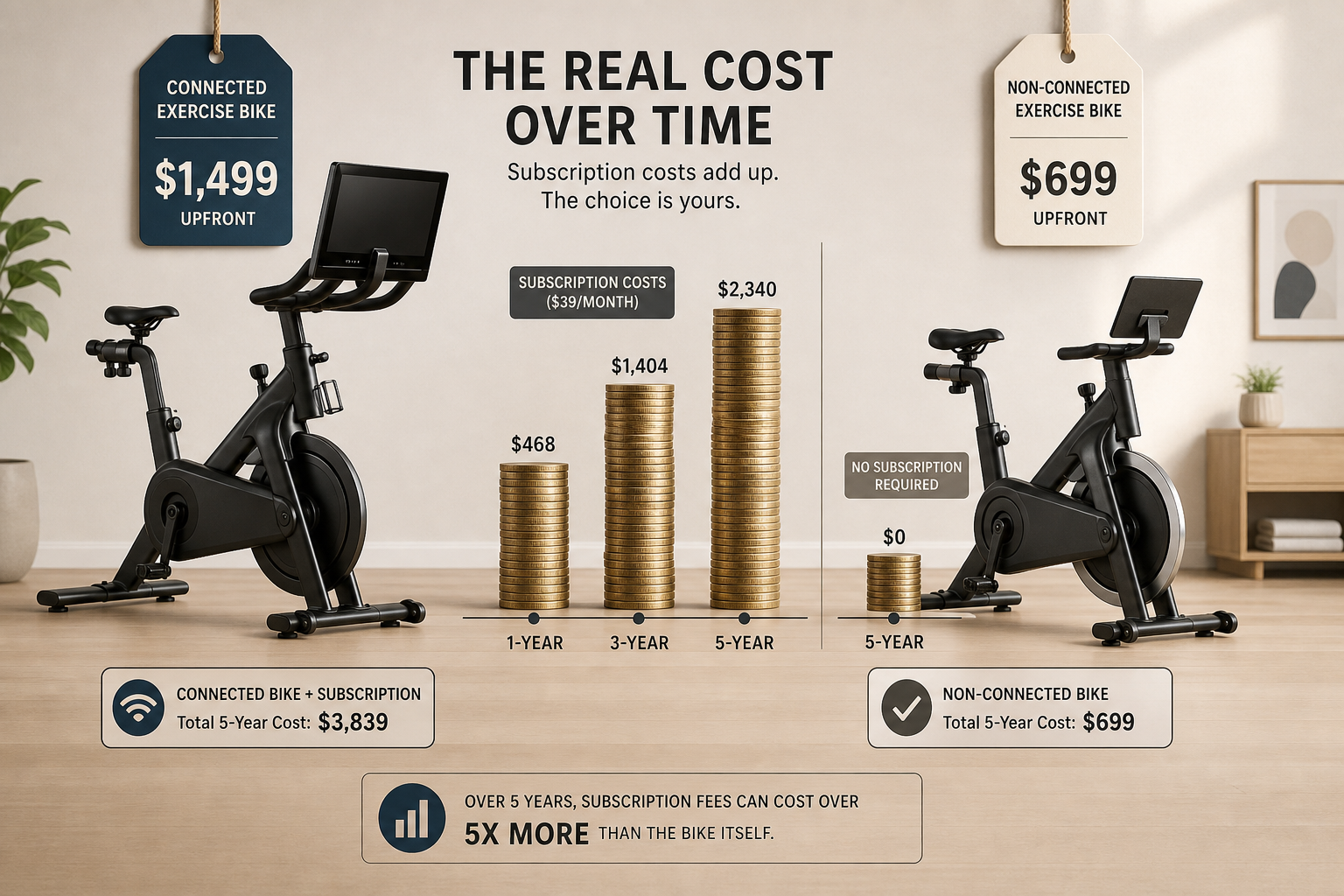
Why the Upfront Price Is Only Half the Story
When you shop for an exercise bike, the price tag on the product page gets all the attention. A $1,445 Peloton Bike looks expensive. A $999 Schwinn IC4 looks reasonable. A $340 Yosuda looks like a steal. But none of those numbers tell you what you will actually spend over the life of the bike.
The missing piece is the monthly subscription. Connected bikes from Peloton, NordicTrack, Echelon, and Bowflex require a paid membership to unlock their full feature sets — live classes, on-demand libraries, scenic rides, and performance tracking. Those fees range from $12 to $50 per month, and they never stop. A $50 monthly fee adds $600 in the first year alone. Over three years, that is $1,800 — more than the cost of many bikes. Over five years, the subscription can double or triple your total outlay.
This article is a pure subscription total-cost-of-ownership (TCO) deep dive. We will walk through every major platform's pricing, calculate what you actually pay over 1, 3, and 5 years for popular bike-and-subscription combinations, expose the hidden fees that catch most buyers off guard, and lay out concrete workarounds that can save you thousands. If you are comparing connected vs. non-connected bikes and want to know where your money really goes, this is the math you need before you buy.
The Subscription Landscape: What Each Platform Actually Costs
Before we run the year-by-year numbers, it helps to see the full menu of subscription tiers side by side. Pricing varies significantly by platform, and some platforms offer multiple tiers depending on whether you want individual or family access.
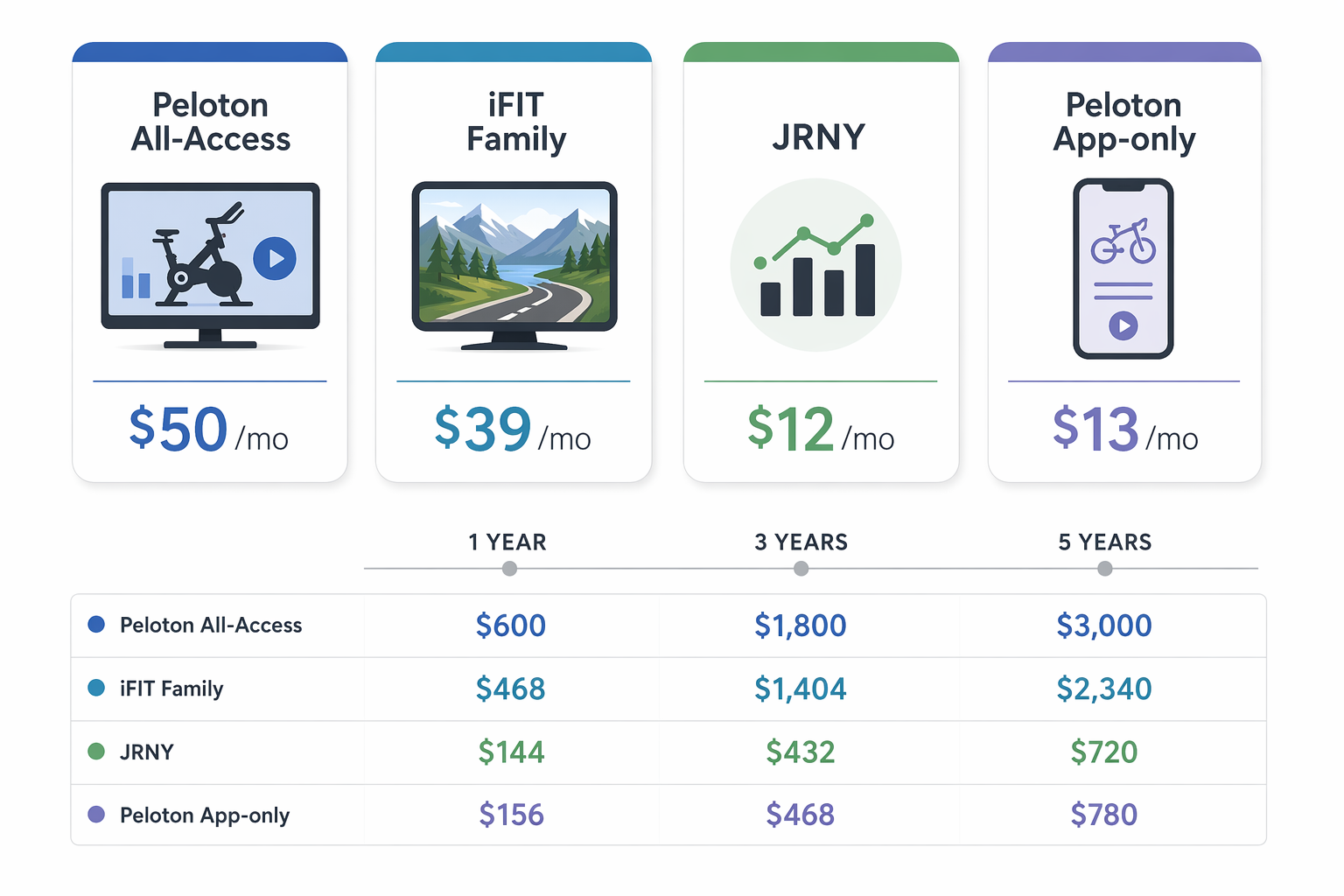
| Platform | Monthly Cost | Annual Cost | Key Details |
|---|---|---|---|
| Peloton All-Access | $44–$50 | $528–$600 | Required for full functionality on Peloton Bike/Bike+; includes live and on-demand classes, multiple user profiles |
| Peloton App-Only | $13 | $156 | Access to Peloton classes on a phone/tablet; does not require a Peloton bike; limited metric tracking on third-party bikes |
| iFIT Family | $39 | $468 | Full family access for NordicTrack and ProForm bikes; includes scenic rides, trainer-led programs, auto-resistance |
| iFIT Individual | $15 | $180 | Single-user iFIT membership; same content library as family tier |
| JRNY | $12 | $100–$144 | Official app for Schwinn IC4 and Bowflex C6; adaptive workouts, scenic routes; $100/year prepaid option available |
| Echelon Fit | $12–$40 | $144–$480 | Multiple tiers: FitPass ($12/mo) for on-demand, Premier ($40/mo) for live classes and family access |
| Spinning | $13 | $156 | On-demand and live classes from the original Spinning brand; no bike lock-in |
| Zwift | $15 | $180 | Gaming-style virtual cycling platform; works with most smart bikes via Bluetooth/ANT+; popular with serious cyclists |
The range is wide. JRNY at $12 per month costs one-quarter of Peloton All-Access at $50 per month. Over a few years, that difference adds up to real money — which is exactly what the next section quantifies.
5-Year Total Cost of Ownership: Connected vs. Non-Connected Bikes
The table below shows the real cost of four common buying scenarios over 1, 3, and 5 years. The bike price is the MSRP or typical street price. The subscription cost is calculated at the platform's standard monthly rate. No promotional trials or discounts are included — these are the steady-state numbers you will pay after any free trial expires.
| Scenario | Bike Price | Subscription | Year 1 Total | Year 3 Total | Year 5 Total |
|---|---|---|---|---|---|
| Peloton Bike+ with All-Access | $2,495 | $50/mo | $3,095 | $4,295 | $5,495 |
| Peloton Bike (refurbished) with All-Access + $95 activation fee | $1,145 | $50/mo | $1,840 | $3,040 | $4,240 |
| Schwinn IC4 with Peloton App-Only ($13/mo) | $999 | $13/mo | $1,155 | $1,467 | $1,779 |
| Schwinn IC4 with JRNY ($12/mo) | $999 | $12/mo | $1,143 | $1,431 | $1,719 |
| Non-connected bike (e.g., Yosuda $340) with tablet holder — $0 subscription | $340 | $0 | $340 | $340 | $340 |
The divergence is stark. A refurbished Peloton Bike with All-Access costs $4,240 over five years — more than four times the upfront price of the bike. The same Schwinn IC4 paired with the Peloton app-only at $13 per month costs $1,779 over five years, saving $2,461 compared to the refurbished Peloton route. And a non-connected bike with no subscription at all costs exactly its purchase price, year after year.
If you are leaning toward a connected bike, the Schwinn IC4 (or its identical twin, the Bowflex C6) deserves a close look. As BarBend notes, the IC4 works with Peloton, iFIT, and Zwift via a tablet, giving you the freedom to choose the cheapest subscription that meets your needs. That flexibility is the single biggest lever for reducing long-term cost.
The Hidden Costs Nobody Talks About
The bike price and the monthly subscription are the two big numbers, but they are not the only numbers. Several additional expenses routinely catch first-time buyers off guard. Here is what to budget for beyond the bike and the membership.
- Peloton used equipment activation fee ($95): If you buy a used Peloton bike from a previous owner, Peloton charges a $95 activation fee to transfer the membership and unlock the screen. This fee is confirmed by both Outdoor Gear Lab and BarBend. It applies to all secondhand Peloton purchases and is non-negotiable.
- Cycling shoes ($100–$200): Most spin-style bikes use Look Delta or SPD cleat systems. The pedals that ship with the bike are usually clipless, meaning you cannot ride effectively in regular sneakers. A decent pair of cycling shoes with cleats runs $100 to $200. Peloton's own shoes are $125.
- Exercise mat ($30–$60): A mat protects your floor from sweat drips and dampens vibration, especially important in apartments or rooms above ground level. Peloton's official mat is $60; third-party options start around $30.
- Tablet or phone mount ($15–$40): If you buy a non-connected bike and plan to use a tablet for streaming classes, you will need a sturdy mount that attaches to the handlebars. Most non-connected bikes do not include one.
- Maintenance and replacement parts ($50–$150/year): Belt-driven bikes require little maintenance, but chain-driven models need periodic lubrication. Brake pads on friction-resistance bikes wear out and cost $15–$30 to replace. Pedals, seat posts, and handlebars may loosen over time and require basic tools to tighten.
These costs apply to both connected and non-connected bikes, but they hit harder on a connected bike because the upfront and recurring costs are already higher. A $95 activation fee on a $1,145 refurbished Peloton is an 8% surcharge. On a $340 non-connected bike, it would be 28% — but you never pay it in the first place.
For a broader look at how exercise bike costs compare to other home gym equipment, see our Home Gym System Cost Breakdown, which breaks down what you actually get at every price tier from $300 to $6,000+.
When a Subscription Actually Makes Sense
The numbers above make a strong case for skipping the subscription entirely. But cost is not the only factor. For many riders, a paid membership delivers real value that a tablet holder and a YouTube playlist cannot replicate. Here is when paying for a subscription is a reasonable choice.
- You need external motivation to ride consistently. Live classes with leaderboards, instructor shout-outs, and community challenges create accountability. If you have bought equipment before and watched it gather dust, the social pressure of a live class may be worth $50 per month.
- You value structured training programs. Platforms like iFIT and Peloton offer progressive training programs — power zone training, climb series, interval programs — that are designed by professional coaches. Building your own structured program from free content requires knowledge and discipline that many riders do not have.
- Multiple household members will use the bike. Peloton All-Access supports unlimited user profiles under one membership. If two or three people in your home ride regularly, the per-person cost drops significantly. iFIT's family tier ($39/mo) serves the same purpose.
- You want immersive scenic rides with auto-resistance. iFIT's auto-resistance feature adjusts the bike's magnetic resistance in real time to match the terrain of a scenic ride. This is a genuinely different experience from manually turning a knob, and it requires both a compatible bike and an active iFIT subscription.
If any of these scenarios describe you, a subscription is not a waste of money — it is a tool that helps you get value from the bike. The key is to choose the right subscription tier for your actual usage, not the most expensive one.
For a deeper look at what connected fitness features actually deliver — including AI coaching, digital resistance, and app ecosystems — read our buyer's guide to smart home gyms in 2026.
When to Skip the Subscription (and What to Do Instead)
If you are self-motivated, comfortable designing your own workouts, or simply unwilling to add another recurring charge to your monthly budget, there are several proven workarounds that let you ride a quality bike without paying a cent in subscription fees.
- Use the Peloton app-only ($13/mo) with a non-Peloton bike. This is the most popular workaround for a reason. You pay $13 per month instead of $50, and you get access to the same library of on-demand classes. The catch: on the Schwinn IC4 and Bowflex C6, the Peloton app on iOS tracks RPM but not speed, power, or distance, as BarBend's compatibility testing confirms. If you care about power zone training or precise distance tracking, this limitation matters.
- Ride in manual mode. Every connected bike — Peloton, NordicTrack, Echelon, Bowflex — has a manual mode that requires no subscription. You can pedal, adjust resistance manually, and view basic metrics (time, distance, calories) on the screen. You lose the class library, but you keep the bike fully functional.
- Stream your own content via a tablet holder. A $20 tablet mount turns any non-connected bike into a content platform. Stream Netflix, YouTube cycling videos, or free workout apps like Apple Fitness+ (which costs $10/mo but includes yoga, strength, and treadmill content in the same subscription). You control the content and the cost.
- Buy refurbished or used equipment. Peloton sells refurbished Bikes directly for $1,145, which is $300 off the new price. But remember the $95 activation fee if buying used from a third party. Non-connected bikes like the Yosuda or Marcy folding bike have no activation fee, no subscription requirement, and can often be found used for under $200.
- Use JRNY at $12/mo instead of Peloton All-Access. If you buy a Schwinn IC4 or Bowflex C6, the official JRNY app costs $12 per month (or $100 per year). That is one-quarter the cost of Peloton All-Access, and it includes adaptive workouts that adjust to your fitness level over time. Wirecutter confirms the $12/mo or $100/year pricing.
Decision Framework: Matching Your Monthly Budget to the Right Tier
The right choice depends on two variables: how much you are willing to spend per month on a subscription, and how often you plan to ride. The table below maps common rider profiles to the most cost-effective bike-and-subscription combination.
| Rider Profile | Monthly Budget | Riding Frequency | Recommended Setup | 5-Year TCO |
|---|---|---|---|---|
| Cost-conscious beginner | $0 | 2–3x/week | Non-connected bike ($340) + tablet holder + free YouTube rides | $340 |
| Casual rider who wants classes | $10–$15 | 3–4x/week | Schwinn IC4 ($999) + Peloton app-only ($13/mo) or JRNY ($12/mo) | $1,719–$1,779 |
| Regular rider, single user | $15–$20 | 4–5x/week | Schwinn IC4 ($999) + Zwift ($15/mo) or iFIT individual ($15/mo) | $1,899 |
| Multi-rider household | $40–$50 | Daily (2+ users) | Peloton Bike ($1,445) + All-Access ($50/mo) or NordicTrack X24 ($1,999) + iFIT family ($39/mo) | $4,445–$4,339 |
| Serious cyclist / data-driven | $15–$20 | 5–6x/week | Wahoo KICKR Bike ($3,500) + Zwift ($15/mo) — or Bowflex VeloCore ($2,199) + JRNY ($12/mo) | $4,400–$2,919 |
The pattern is clear: the more you ride, the more value you get from a subscription. But even daily riders can keep their 5-year TCO under $2,000 by choosing a compatible bike and a low-cost app instead of a premium all-in-one system.
The Bottom Line: What Should You Buy?
For most budget-conscious buyers, the smartest financial move is a non-connected bike with a tablet holder and a low-cost or free app. A Schwinn IC4 paired with the Peloton app-only at $13 per month costs $1,779 over five years. That is $2,366 less than a refurbished Peloton Bike with All-Access, and $4,156 less than a new Peloton Bike+ with All-Access. The bike itself is excellent — magnetic resistance, dual pedals with SPD and toe cages, a clear display — and you are not locked into any single platform.
If you are the type of rider who needs the motivation of live classes and community features to stay consistent, a connected bike with a full subscription may still be worth the premium. Just go in with your eyes open: you are paying $2,000–$4,000 more over five years for that motivation. If it keeps you riding, it is money well spent. If it does not, it is an expensive mistake.
For readers who want to compare subscription costs across multiple equipment types — treadmills, rowers, smart gyms — our Smart Home Gym Total Cost of Ownership: 5-Year Breakdown applies the same year-by-year methodology to the full connected fitness landscape.
This result comes from one real apartment under the stated conditions — it is a strong signal, not a guarantee your space will measure identically.
Builds this evidence supports
Small Treadmill Buying Guide: 7 Critical Specs to Check Before You Buy
A cross-category spec primer for apartment and small-space dwellers comparing walking pads, ultra-compact folding treadmills, and full-size folding treadmills. Learn the concrete thresholds for motor HP, deck length, noise, warranty, and subscription lock-in so you can compare apples to apples.
Where to Spend vs. Save on Affordable Home Gym Equipment: A Quality Tradeoff Guide
A practical guide for budget-conscious buyers (under $1,000) that reveals which equipment categories demand a higher investment for safety and durability, and where cutting costs is a smart move.
Spot something off?
If this result didn't match your own space, let us know — floor-damage and noise claims carry real deposit-risk consequences if we get them wrong.