
Cable Machine vs. Free Weights: What Science Says About Muscle Growth, Safety, and When to Choose Each
A science-backed comparison of cable machines and free weights for intermediate home gym enthusiasts and beginners. This article explains the distinct training benefits of each modality, reviews the latest research on hypertrophy equivalency, and provides a practical framework for combining both in a home gym.
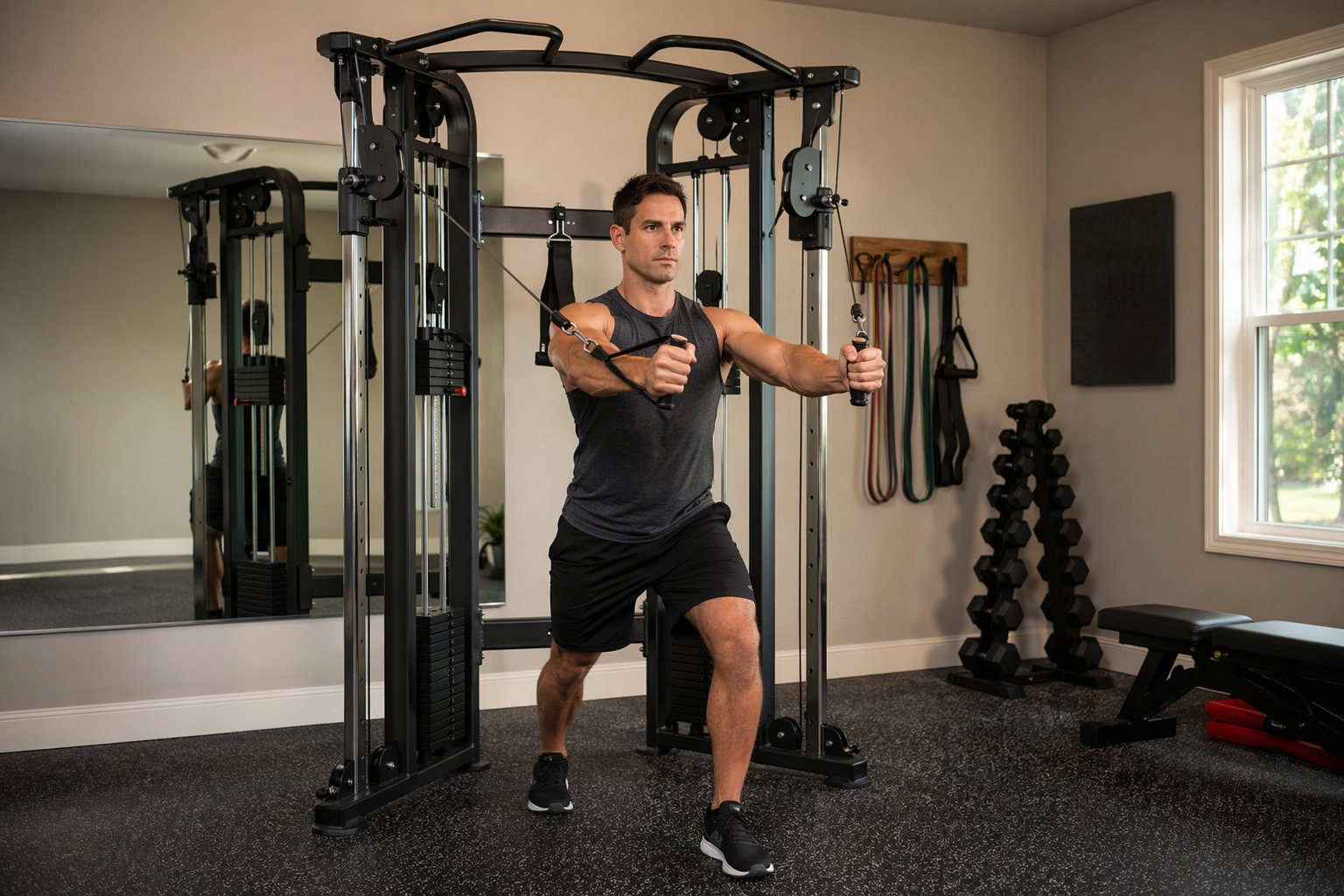
The Free-Weight Advantage: Compound Strength, Stabilizers, and Functional Carryover
Free weights — barbells, dumbbells, and kettlebells — have been the backbone of strength training for good reason. When you load a barbell across your back for a squat or press a dumbbell overhead, your body must coordinate multiple muscle groups simultaneously while stabilizing the load through space. This demand for whole-body coordination and balance is something cable machines cannot fully replicate.
The primary advantage of free weights lies in their ability to develop overall strength and power. Because the resistance is unconstrained — the bar or dumbbell can move in any direction — your muscles, joints, and nervous system must work harder to control the path of the weight. As noted by Bells of Steel, free weights require greater muscle, joint, and nervous system activation and recruitment compared to machines. This translates directly to better gains in maximal strength and explosive power.
Compound Lifts and Stabilizer Recruitment
Exercises like the barbell back squat, deadlift, and bench press are the gold standard for building a strength foundation. These compound movements engage multiple joints and muscle groups in a single, coordinated pattern. The stabilizer muscles — the small, deep muscles that control joint position — are forced to fire continuously to keep the bar path straight and the body balanced. Over time, this builds a level of neuromuscular coordination that carries over to nearly every other physical activity.
- Barbell back squat: Engages quads, hamstrings, glutes, core, and spinal erectors as stabilizers.
- Deadlift: Recruits the entire posterior chain — hamstrings, glutes, back, and grip — plus core stability under heavy load.
- Overhead press: Requires shoulder, triceps, and core activation while stabilizing the bar overhead.
- Barbell row: Targets the back and biceps while the core and lower back work to maintain a stable torso position.
This stabilizer recruitment is a key differentiator. Cable machines guide the weight along a fixed path determined by the pulley system, which reduces the demand on stabilizer muscles. For a lifter whose primary goal is maximal strength or power output, free weights are the more effective tool.
Functional Carryover to Sports and Daily Life
The unconstrained nature of free weights also provides better transfer to real-world movements. Lifting a heavy box off the floor, carrying groceries, or playing a sport that involves pushing, pulling, and rotating all require your body to manage forces that are not perfectly aligned with a pulley path. Free weights train your body to handle these unpredictable, dynamic loads in a way that cable machines, with their fixed planes of motion, cannot match.
The Cable Advantage: Constant Tension, Isolation, and Safety
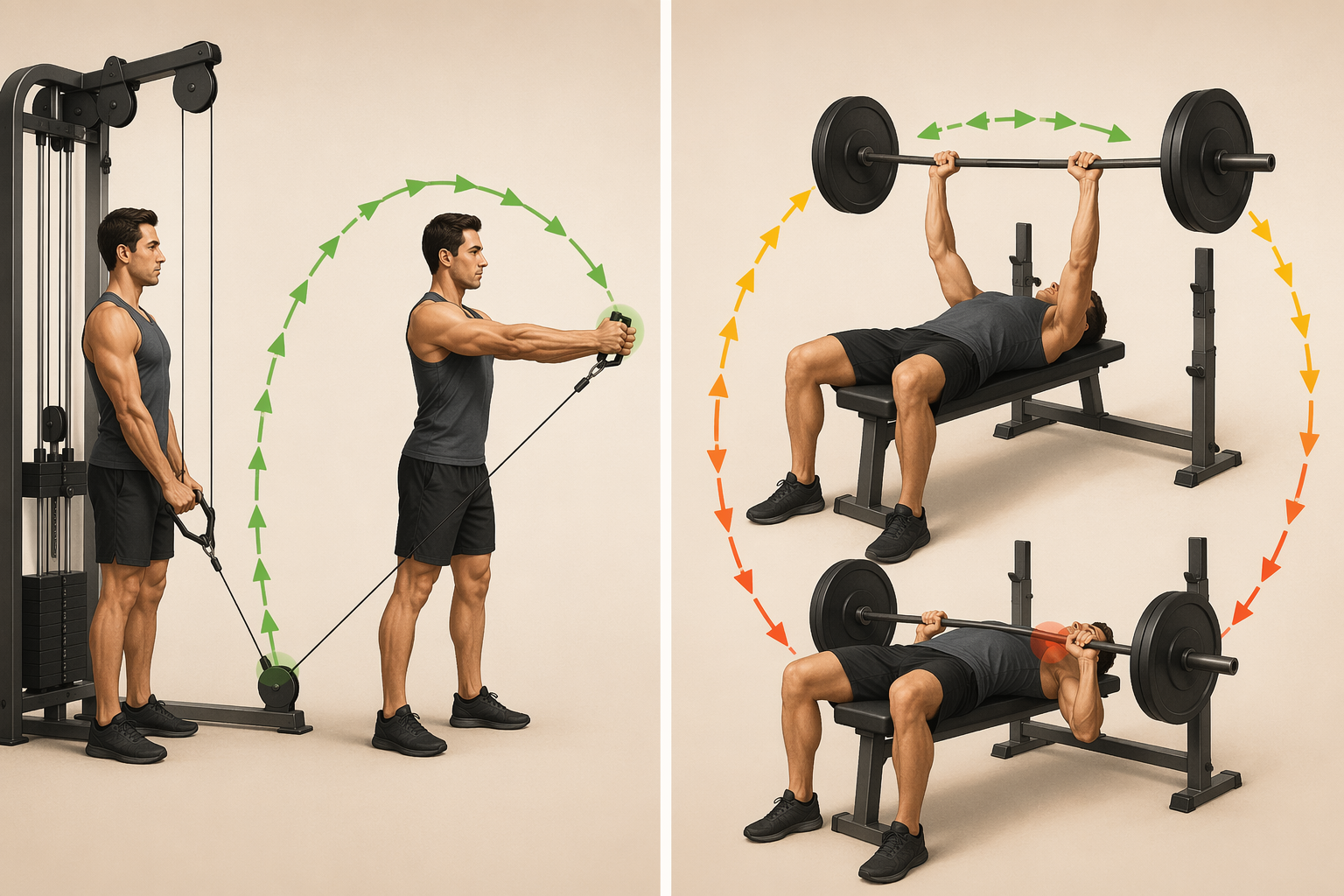
Cable machines offer a fundamentally different type of resistance that addresses several limitations of free weights. The most significant difference is constant tension. When you perform a bicep curl with a dumbbell, the resistance is greatest at the midpoint of the movement (when the forearm is parallel to the ground) and nearly zero at the top and bottom due to gravity. With a cable, the pulley redirects the force so that the muscle is under tension throughout the entire range of motion — from full extension to full contraction.
This constant tension has real physiological effects. A 2012 study by Burd et al. published in The Journal of Physiology found that slow eccentric contractions performed under constant tension — the kind of loading cable machines naturally produce — increased muscle protein synthesis for up to 24 hours post-workout. This suggests that cables may be particularly effective for hypertrophy when time under tension is deliberately emphasized.
Angle Versatility and Muscle Isolation
Another unique advantage of cables is the ability to change the angle of resistance instantly. Dr. Mike Masi, DPT, explains this clearly: "Free weight resistance provides a force vector straight down toward the ground. If you want a different angle to hit a different body part, you'll have to manipulate your body around that force vector. But with a cable machine you can just slide the handle higher or lower to get the desired effect."
This adjustability makes cables exceptional for isolation work. Exercises like cable lateral raises, cable flyes, tricep pushdowns, and face pulls allow you to target specific muscle heads that are difficult to isolate with free weights. A 2016 study by Rendos et al. in the Journal of Strength and Conditioning Research found that different handles and grips on cable attachments can activate different forearm muscles, giving lifters precise control over which muscles are emphasized.
Safety for Solo Training
For home gym users who train alone — which is most of them — safety is a major consideration. A 2010 study by Kerr et al. in The American Journal of Sports Medicine found that the majority of weight-training-related emergency room visits involved free weights dropping on the user. Cable machines eliminate this risk entirely. The weight stack is guided by the pulley system, and if you fail on a rep, the stack simply returns to its resting position. There is no need for a spotter, no risk of being pinned under a barbell, and no chance of dropping a dumbbell on your foot.
What the Science Says: The 2023 Meta-Analysis on Hypertrophy
The most important scientific finding for anyone comparing cable machines and free weights comes from a 2023 systematic review and meta-analysis by Haugen et al., published in BMC Sports Science, Medicine and Rehabilitation. The analysis examined multiple studies comparing free-weight and machine-based resistance training and found no significant difference in muscle growth or hypertrophy between the two modalities.
This finding directly challenges the long-held belief that free weights are inherently superior for building muscle. The meta-analysis suggests that, as long as the training variables — volume, intensity, frequency, and proximity to failure — are matched, the tool you use matters far less than how you use it. A cable chest press performed with sufficient load and volume can stimulate muscle growth just as effectively as a barbell bench press.
What this means for the average lifter is straightforward: do not avoid cable machines because you believe they are inferior for muscle building. The evidence does not support that view. The choice between cables and free weights should be based on your specific training goals, safety needs, and the constraints of your home gym — not on outdated dogma about machine training being second-rate.
When Cables Win: Rehab, Isolation, Time Under Tension, and Small Spaces
While free weights excel for compound strength, there are several scenarios where cable machines are clearly the better choice. Understanding these situations helps you make an informed equipment decision rather than defaulting to one modality.
| Scenario | Why Cables Win | Example Exercise |
|---|---|---|
| Rehabilitation and injury prevention | Controlled, adjustable resistance path reduces stress on injured or recovering joints | Cable face pull for shoulder rehab |
| Targeted muscle isolation | Constant tension and angle adjustability allow precise targeting of specific muscle heads | Cable lateral raise for medial deltoid |
| Maximizing time under tension | Smooth, even resistance throughout the full range of motion prolongs muscle tension | Slow eccentric cable curl |
| Small home gym spaces | Functional trainers combine multiple exercises in a compact footprint (often under 20 sq ft) | Single cable station for rows, presses, and pulls |
| Solo training without a spotter | Weight stack is self-spotting — no risk of being pinned under a failed rep | Cable bench press or squat (with low pulley) |
For home gym users with limited square footage, the space efficiency of a cable machine is a major selling point. A functional trainer with dual weight stacks can replace an entire wall of dumbbells and provide dozens of exercise variations in a footprint of roughly 4 by 4 feet. This makes cable machines particularly attractive for apartment dwellers or anyone setting up a gym in a spare bedroom.
When Free Weights Win: Max Strength, Power, and Cost Efficiency
Despite the hypertrophy equivalency finding, free weights retain clear advantages in several critical areas. The most important is maximal strength and power development. The unconstrained nature of free weights forces your nervous system to coordinate muscle activation at a level that cable machines cannot replicate. This is why competitive powerlifters and Olympic weightlifters train almost exclusively with barbells.
| Training Goal | Best Tool | Why |
|---|---|---|
| Maximal strength (1RM) | Barbell / free weights | Requires full-body stabilization and neural drive that cables cannot match |
| Explosive power | Barbell / dumbbell | Ballistic movements (cleans, snatches, jumps) require free-moving resistance |
| Compound movement proficiency | Barbell / dumbbell | Learning to control a free weight builds coordination and body awareness |
| Budget-constrained setup | Barbell and plates | A quality barbell and weight set costs significantly less than a cable machine |
| Small space, minimal budget | Adjustable dumbbells | Takes up less than 2 sq ft and costs under $500 for a full range of weights |
Cost is another major factor. The average cable machine costs around $2,265 according to Garage Gym Reviews' 2026 data. A complete barbell and plate set can be had for under $500, and a power rack adds another $300–$600. For a beginner building their first home gym on a tight budget, free weights offer far more training value per dollar.
A Practical Hybrid Approach for Home Gyms
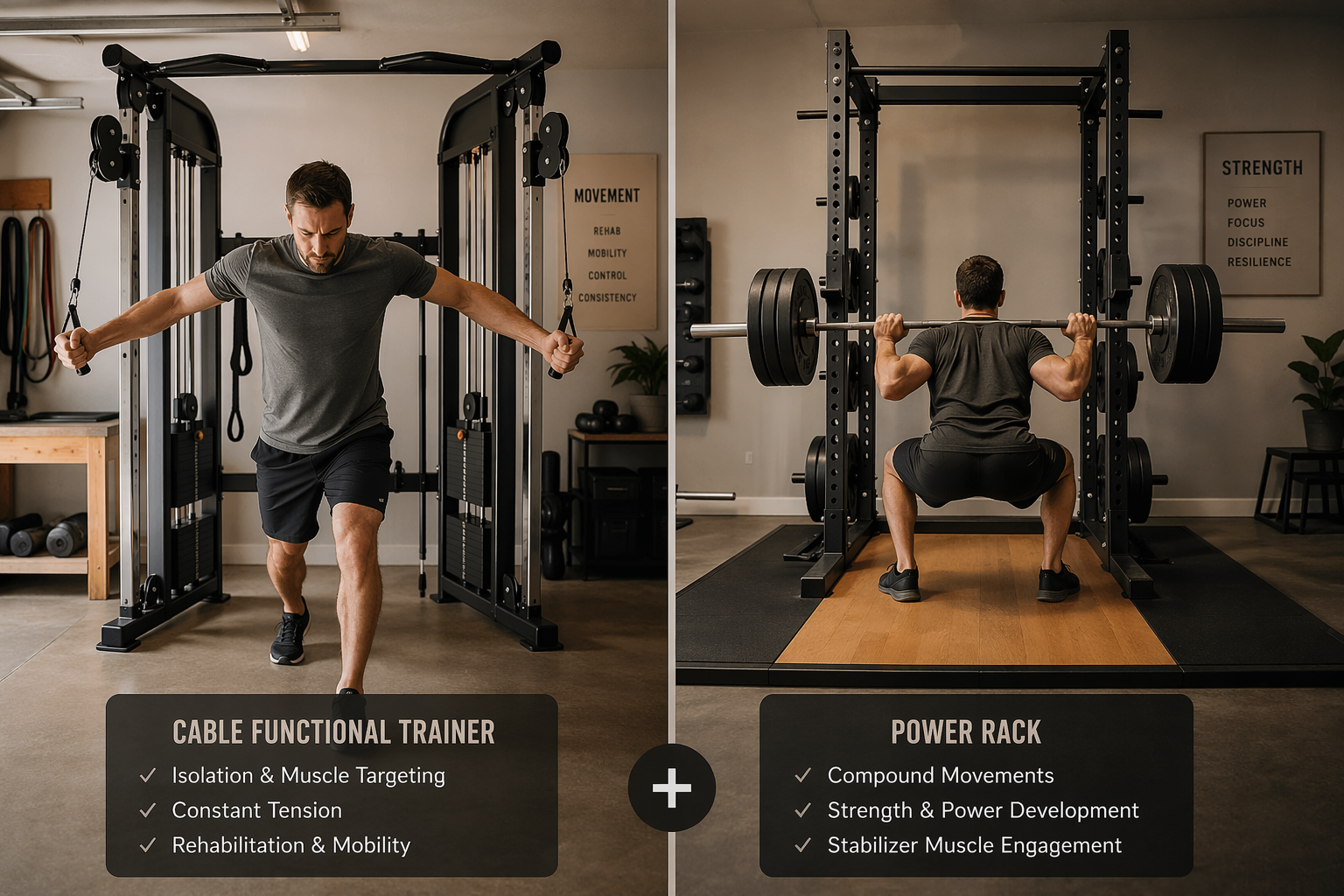
The most effective home gym setup for most lifters is not an either-or choice — it is a hybrid that combines both modalities. A well-designed hybrid approach lets you use free weights for compound strength work and cables for isolation, accessory, and safety-focused training. The key is to prioritize your purchase order based on your primary training goals and budget.
Budget Allocation Strategies
If you are building a home gym from scratch, here is a practical purchase order based on your primary goal:
- Strength-first lifter: Power rack → Barbell and plates → Adjustable bench → Cable attachment (lat pulldown/low row) → Full functional trainer (when budget allows)
- Hypertrophy-first lifter: Adjustable dumbbells → Adjustable bench → Cable machine or functional trainer → Barbell and plates (for compound work)
- Small-space / apartment lifter: Cable machine or functional trainer → Adjustable dumbbells → Folding bench → Resistance bands (for additional variety)
- Budget-constrained beginner: Barbell and plates → Power rack (or squat stands) → Adjustable bench → Add cable attachment later
For readers deciding between an all-in-one machine and separate equipment pieces, our All-in-One Home Gym vs. Separate Equipment comparison provides a detailed cost and space analysis to help you decide.
Sample Weekly Hybrid Split
| Day | Focus | Free-Weight Work | Cable Work |
|---|---|---|---|
| Monday | Strength (push) | Barbell bench press, overhead press | Cable flyes, tricep pushdowns |
| Tuesday | Strength (pull) | Barbell rows, deadlifts | Lat pulldowns, face pulls |
| Wednesday | Rest or active recovery | — | — |
| Thursday | Hypertrophy (push) | Dumbbell incline press, lateral raises | Cable chest press, cable lateral raise |
| Friday | Hypertrophy (pull) | Dumbbell rows, pull-ups | Cable rows, bicep curls |
| Saturday | Legs and accessories | Barbell squats, Romanian deadlifts | Cable hamstring curls, cable hip adductions |
| Sunday | Rest | — | — |
This split uses free weights for the primary compound movements where they excel, and cables for the isolation and accessory work where constant tension and safety are most valuable. The result is a comprehensive program that maximizes the strengths of both modalities.
The Verdict: Which One Should You Buy First?
The research is clear: cable machines and free weights are not competing tools. They are complementary tools that serve different training needs. The 2023 Haugen meta-analysis confirms that both can produce equivalent muscle growth when training variables are matched. The choice between them comes down to your specific goals, constraints, and priorities.
For a broader framework that covers all home gym equipment decisions — including budget tiers, space constraints, and training goals — see our Home Gym Equipment Decision Framework. And if you are specifically comparing different types of full-body workout machines, our Full Body Workout Machine Types Compared guide breaks down the differences between functional trainers, all-in-one machines, and smart gyms.
Ultimately, the best equipment is the equipment you will use consistently. Whether you start with a barbell and a rack or a cable machine and adjustable dumbbells, the most important variable is showing up and training with progressive overload. The tool is secondary to the work.
This result comes from one real apartment under the stated conditions — it is a strong signal, not a guarantee your space will measure identically.
Builds this evidence supports
Cable Machine Alternatives That Save Space and Money
Compare the best cable machine alternatives for home gyms – from resistance bands and pulley systems to suspension trainers and compact digital units – and find the right option for your space and budget.
How to Choose a Compact Home Gym That Works for Your Space, Budget, and Noise Tolerance
This article provides a structured decision framework for apartment dwellers and small-space residents to match their specific floor footprint, noise sensitivity, and budget to the most suitable compact home gym strategy — whether that's an all-in-one machine, modular build, smart digital system, or band/bodyweight setup.
The Garage Gym Reality Check: What Equipment Actually Fits in a Single-Car Garage
Most garage gym guides assume a two-car space. This article uses real dimensions, real equipment footprints, and three layout templates to show what fits—and what doesn't—in a single-car garage (10x20 to 12x20 ft).
Spot something off?
If this result didn't match your own space, let us know — floor-damage and noise claims carry real deposit-risk consequences if we get them wrong.