
The Home Gym Equipment Decision Framework: What to Buy Based on Your Budget, Space, and Training Goals
Overwhelmed by equipment choices? This guide helps you build a home gym that actually fits your life. Instead of a generic 'best of' list, use our constraint-based decision matrix to match equipment to your budget band, available space, and primary training goal — then follow the phased buying plan to avoid costly mistakes.
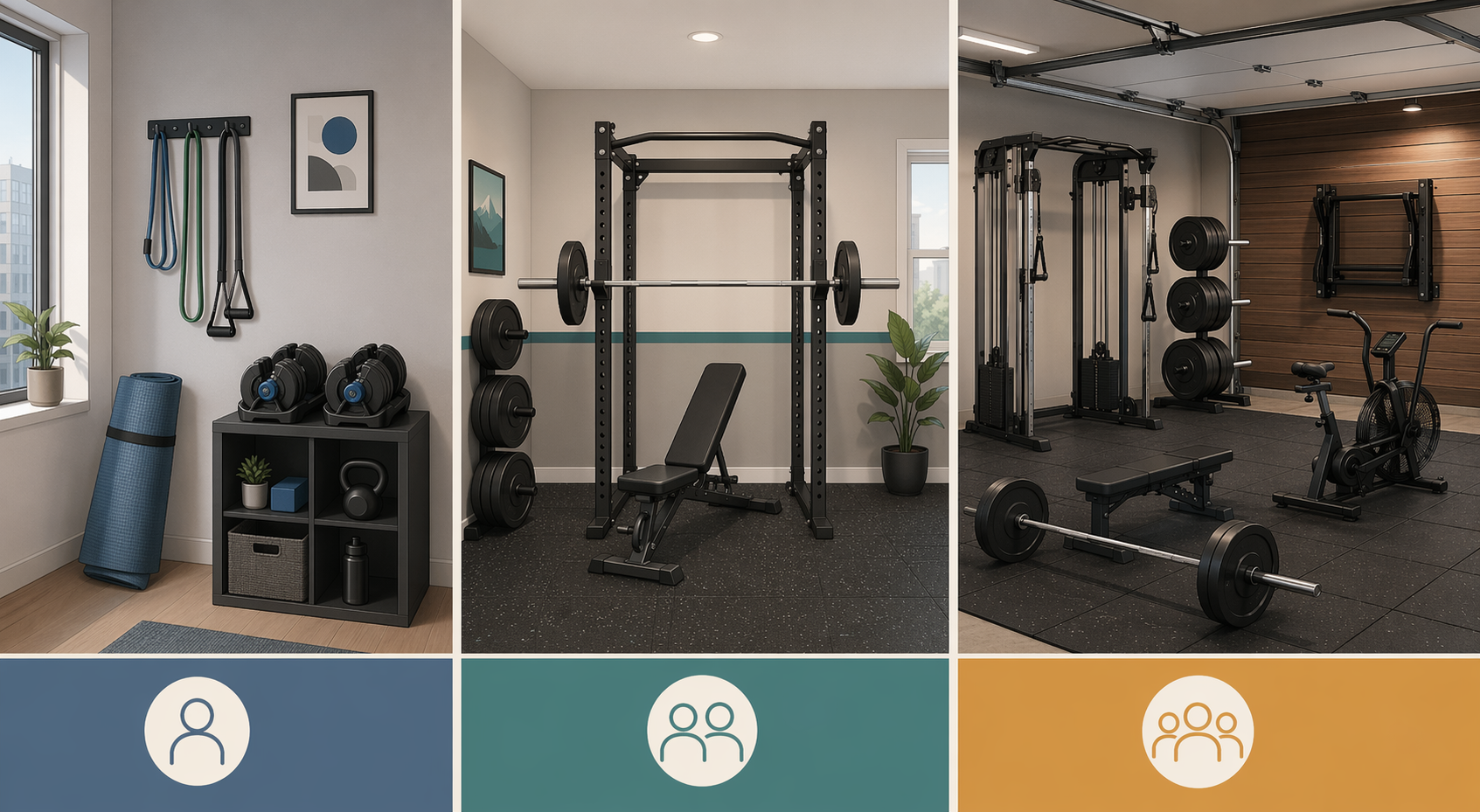
Why the 'Best' Home Gym Equipment Depends Entirely on Your Constraints
The home fitness content landscape is flooded with lists of 'best' equipment, but those lists share a fundamental flaw: they assume a universal user. A power rack is the best choice for a strength-focused lifter with a garage, but it is a terrible choice for someone renting a studio apartment who wants to improve general fitness. The most expensive mistake beginners make is buying equipment that looks impressive in a review but does not match their actual training style, available space, or budget tier.
This guide takes a different approach. Instead of ranking products, it provides a structured decision framework based on three constraint axes: budget, space, and training goal. By identifying your position on each axis, you can filter out irrelevant equipment categories before you ever look at a price tag. The goal is not to find the single 'best' piece of equipment, but to build a home gym that actually fits your life and supports your long-term training consistency.
The Three Constraint Axes: Budget, Space, and Training Goal
Before you open a single product page, you need to answer three questions. Each answer places you in a specific band, and the combination of all three bands determines which equipment categories are worth your attention.
Budget Band
Your total budget for the initial purchase determines the range of equipment categories you can realistically consider. Based on current market data, we use four bands:
| Budget Band | Typical Equipment Scope | Example Total Investment |
|---|---|---|
| $0 – $500 | Resistance bands, yoga mat, one pair of adjustable dumbbells, possibly a jump rope | $50–$500 |
| $500 – $1,500 | Adjustable dumbbells, flat or adjustable bench, barbell, weight plates, basic rack or squat stand | $500–$1,500 |
| $1,500 – $3,000 | Power rack, Olympic barbell, bumper plates, adjustable bench, plate tree, basic cardio machine | $1,500–$3,000 |
| $3,000+ | Full-size power rack with attachments, functional trainer, premium cardio, specialty bars, flooring | $3,000–$5,000+ |
Available Space
Space is the constraint most often underestimated. A power rack with a footprint of 4x6 feet may seem manageable until you realize you need additional clearance for loading plates, performing lunges, and moving around the rack safely. We categorize space into four common scenarios:
- Apartment corner: Roughly 4x6 feet or less. You share walls with neighbors. Noise and vibration are real concerns. Ceiling height may be standard (8 feet).
- Spare room or home office: Roughly 8x10 feet or more. You have a dedicated space but limited square footage. Ceiling height is usually standard.
- Garage half: Roughly 10x12 feet or more. You have room for a rack, bench, and some cardio equipment. Ceiling height may be higher. Concrete floor requires protective matting.
- Full garage or basement: Roughly 12x20 feet or more. You can accommodate a full power rack, multiple bars, plate storage, a functional trainer, and multiple cardio machines. Space is rarely the limiting factor.
Primary Training Goal
Your training goal determines which resistance profile and equipment type will serve you best. We use four broad categories:
- Strength: You want to get stronger on the main compound lifts (squat, bench press, deadlift, overhead press). This requires a barbell, weight plates, and a rack or squat stand.
- Hypertrophy: You want to build muscle size and definition. This requires access to a range of dumbbells, cables, or machines that allow isolation work and variable rep ranges.
- General fitness: You want to improve overall health, body composition, and movement quality. This benefits from a mix of resistance training and cardio, with an emphasis on versatility and ease of use.
- Cardio and endurance: Your primary focus is cardiovascular fitness. This points toward a rower, exercise bike, treadmill, or jump rope, with resistance training as a secondary priority.
The Decision Matrix: Matching Equipment Categories to Your Constraint Profile
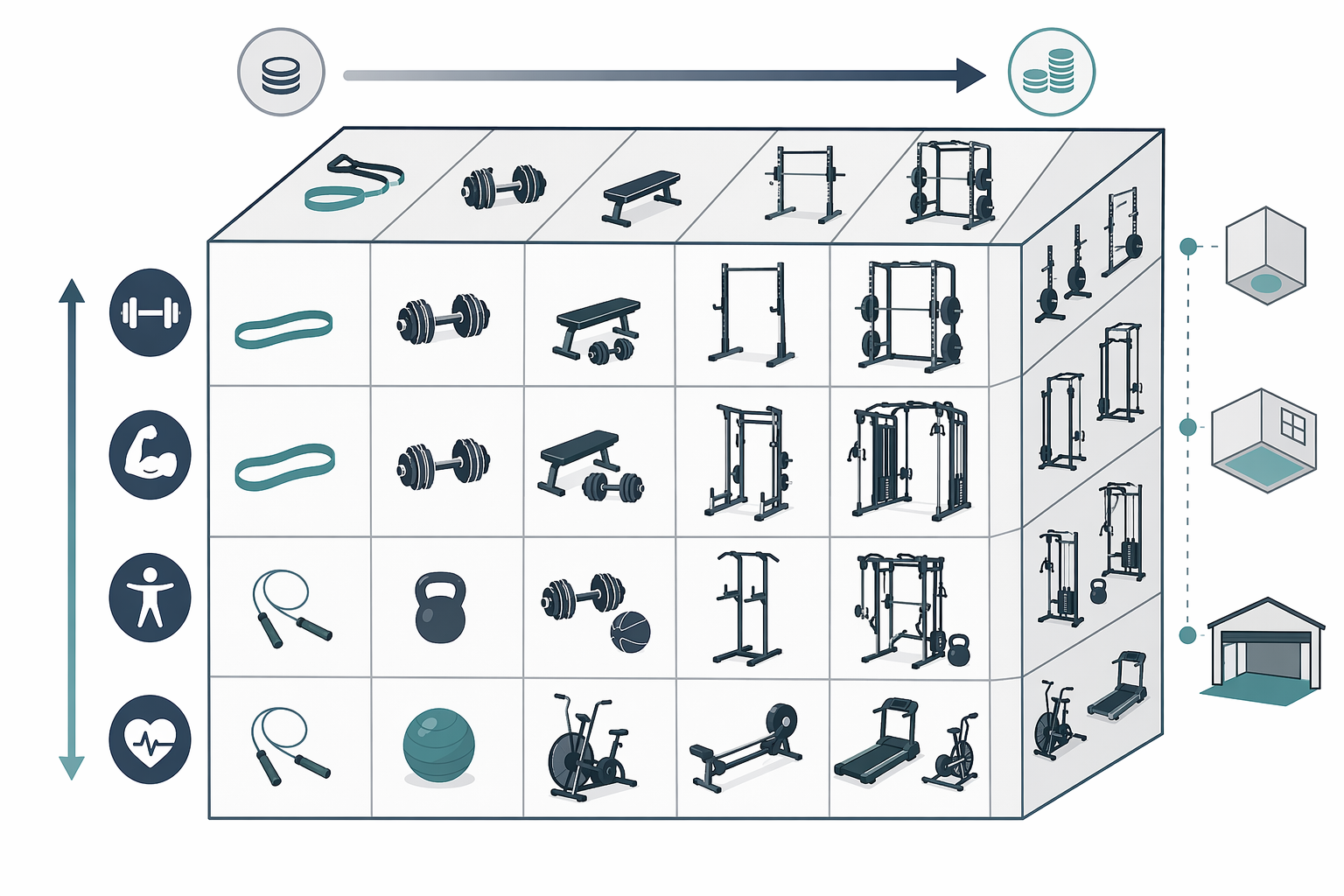
The following matrix shows the recommended equipment categories for each combination of budget band and training goal, assuming a spare room or larger space. For apartment-corner scenarios, see the small-space section below.
| Budget Band | Strength | Hypertrophy | General Fitness | Cardio & Endurance |
|---|---|---|---|---|
| $0 – $500 | Resistance bands, adjustable dumbbells (e.g., REP QuickDraw 40-lb at $336) | Resistance bands, adjustable dumbbells, pull-up bar | Resistance bands, yoga mat, jump rope, adjustable dumbbells | Jump rope, resistance bands for light resistance, yoga mat |
| $500 – $1,500 | Barbell (e.g., Synergee Games at $180), squat stand, weight plates, flat bench | Adjustable dumbbells (e.g., REP QuickDraw 60-lb at $576), adjustable bench (e.g., Major Fitness at $220), cable tower (e.g., Bells of Steel at $435) | Adjustable dumbbells, adjustable bench, barbell, weight plates, rower (e.g., Concept2 at ~$1,000) | Concept2 RowErg (~$1,000), exercise bike, adjustable dumbbells for cross-training |
| $1,500 – $3,000 | Power rack (e.g., REP PR-1100 at $380), barbell, bumper plates, adjustable bench, plate tree | Power rack with cable attachment, adjustable dumbbells, adjustable bench, plate tree, lat pulldown attachment | Power rack, barbell, bumper plates, adjustable bench, rower or bike, plate tree | Premium cardio machine (e.g., NordicTrack S22i at $1,999), adjustable dumbbells, bench |
| $3,000+ | Full power rack with attachments, specialty bars, premium barbell, competition plates, monolifts | Functional trainer (e.g., REP FT-5000 at $2,500), cable tower, full dumbbell set, adjustable bench, lat pulldown | Functional trainer, power rack, barbell, bumper plates, rower, bike, adjustable bench | Treadmill, rower, bike, adjustable dumbbells, functional trainer for cross-training |
For a deeper explanation of each equipment category and how it maps to different training styles, see our Home Gym Equipment Types Explained guide.
Phase 1 Essentials: What to Buy First at Every Budget Tier
Once you have identified your constraint profile, the next step is to build a starter kit. These are not complete gyms — they are the minimum viable setup that allows you to start training immediately while leaving room to expand. The phased approach is more cost-effective than buying a single all-in-one machine, which averages $1,855 across tested models according to Garage Gym Reviews.
| Budget Tier | Phase 1 Starter Kit | Estimated Cost | Key Products (Examples) |
|---|---|---|---|
| $0 – $500 | Resistance bands, yoga mat, one pair of adjustable dumbbells | $50 – $400 | REP QuickDraw 40-lb ($336), basic resistance band set ($30–$60), yoga mat ($20) |
| $500 – $1,500 | Adjustable dumbbells, adjustable bench, barbell, weight plates, squat stand or rack | $600 – $1,400 | REP QuickDraw 60-lb ($576), Major Fitness bench ($220), Synergee Games barbell ($180), Fringe Sport bumper plates (~$2.20/lb), REP PR-1100 rack ($380) |
| $1,500 – $3,000 | Power rack, barbell, bumper plates, adjustable bench, plate tree, basic cardio machine | $1,500 – $2,800 | REP PR-1100 rack ($380), Synergee Games barbell ($180), bumper plates, REP FB-5000 bench ($245), Concept2 RowErg (~$1,000) |
| $3,000+ | Full power rack with attachments, premium barbell, competition plates, adjustable bench, functional trainer or premium cardio | $3,000 – $5,000+ | Rogue R-3 rack ($645+), Rogue Ohio Bar ($295+), Rogue HG 2.0 bumpers, REP FT-5000 functional trainer ($2,500) |
For a more comprehensive list of product options at each tier, see our Best Home Exercise Equipment for Every Budget guide.
Phase 2 Additions: How to Upgrade Your Gym Over Time
After you have been training consistently for three to six months, you will have a clearer sense of which exercises you enjoy, which movements feel limited by your current equipment, and where your training is progressing. That is the right time to add Phase 2 items. The upgrade path depends on your training goal:
- Strength path: Add a second barbell (e.g., a deadlift bar), more weight plates, a deadlift jack, and a plate tree. Consider upgrading to a power rack with spotter arms if you started with a squat stand.
- Hypertrophy path: Add a cable tower or functional trainer for isolation work, a second set of adjustable dumbbells (heavier pair), and a lat pulldown or row attachment for your rack.
- General fitness path: Add a cardio machine (rower or exercise bike), a set of kettlebells, and a plyo box. These expand your workout variety without requiring a major space reconfiguration.
- Cardio path: Add a second cardio modality (e.g., a treadmill if you started with a rower), adjustable dumbbells for resistance cross-training, and a heart rate monitor for tracking intensity.
For a detailed breakdown of what to buy at each stage of your home gym build, see our Garage Gym Equipment Tier System guide.
Small-Space Solutions: Folding Racks, Wall-Mounted Gyms, and Portable Trainers
If you are in the apartment-corner or spare-room space category, you do not need to compromise on training quality. The 2026 market offers several viable options that pack down or fold away when not in use:
- Folding power racks: These mount to a wall and fold flat against it when not in use. They provide a full power rack experience with spotter arms and pull-up bars, but take up only a few inches of floor space when stored. The Bells of Steel Hydra racks, starting at $375, are a 2026 option with 3x3 11-gauge steel construction.
- Wall-mounted smart gyms: Systems like Tonal and Vitruvian mount to a wall or sit against it and use digital resistance. They are compact, quiet, and require no plate storage. The trade-off is a subscription requirement and a higher upfront cost.
- Portable cable trainers: The Beyond Power Voltra I, at $2,199, provides up to 200 lbs of digital resistance in a portable form factor. It can be used with a door anchor or wall mount and stores in a small bag.
- Band-based systems: The X3 Bar system, at $549, uses heavy resistance bands to generate up to 300 lbs of force (600 lbs with the elite band). It is compact, quiet, and requires no weight plates.
For a detailed comparison of these four compact gym strategies, see our Four Strategies for a Compact Home Gym guide. For a step-by-step planning resource, see our Compact Home Gym Buyer's Guide.
Total Cost of Ownership: When Does a Home Gym Pay for Itself?
A home gym is an investment, but the breakeven point against a commercial gym membership is shorter than many people assume. According to the 2024 U.S. Health & Fitness Consumer Report, the average gym membership costs about $65 per month. A mid-range home gym setup in the $1,000–$3,000 range breaks even against that monthly cost in approximately two years.
The calculation becomes even more favorable when you factor in the time and travel costs associated with a commercial gym. A 10-minute drive each way, three days per week, adds roughly 67.5 hours of wasted time per year. At a minimum wage valuation, that time plus mileage costs (6 miles round trip at $0.655 per mile) adds over $1,000 per year in hidden costs, according to an analysis by Gray Matter Lifting.
Additionally, equipment from brands like Rogue retains 80–90% of its resale value, meaning your investment is partially recoverable if you ever decide to sell. For a full 5-year total cost of ownership analysis, see our Hidden Costs of Home Gym Equipment guide.
Common Pitfalls and How the Decision Matrix Helps You Avoid Them
The decision matrix is designed to prevent the most frequent mistakes beginners make when building a home gym. Here are the four most common pitfalls and how the constraint-based approach addresses each one:
- Buying an all-in-one machine when modular equipment would serve better: All-in-one machines average $1,855 and often compromise on every function. The decision matrix forces you to identify your primary training goal first. If your goal is strength, a power rack and barbell will serve you far better than a multi-gym with a limited weight stack.
- Ignoring space constraints: A full-size power rack with a 4x6 footprint may fit in your spare room, but you also need clearance for loading plates, performing lunges, and moving around the rack. The space axis in the matrix forces you to measure your actual available area before you buy.
- Over-spending on the first purchase: The phased approach (Phase 1 essentials, then Phase 2 additions) prevents you from spending your entire budget on equipment you may not need. Start with 3–4 essential items and expand based on your training progress.
- Buying equipment that does not match your training style: A cardio-focused athlete who buys a power rack will rarely use it. A strength-focused lifter who buys a treadmill will neglect their primary goal. The training goal axis ensures your equipment matches your actual training priorities.
For a deeper dive into the most common buying mistakes and how to avoid them, see our 7 Costly Mistakes When Buying Affordable Home Gym Equipment guide.
Your Next Step: A Simple Decision Flowchart
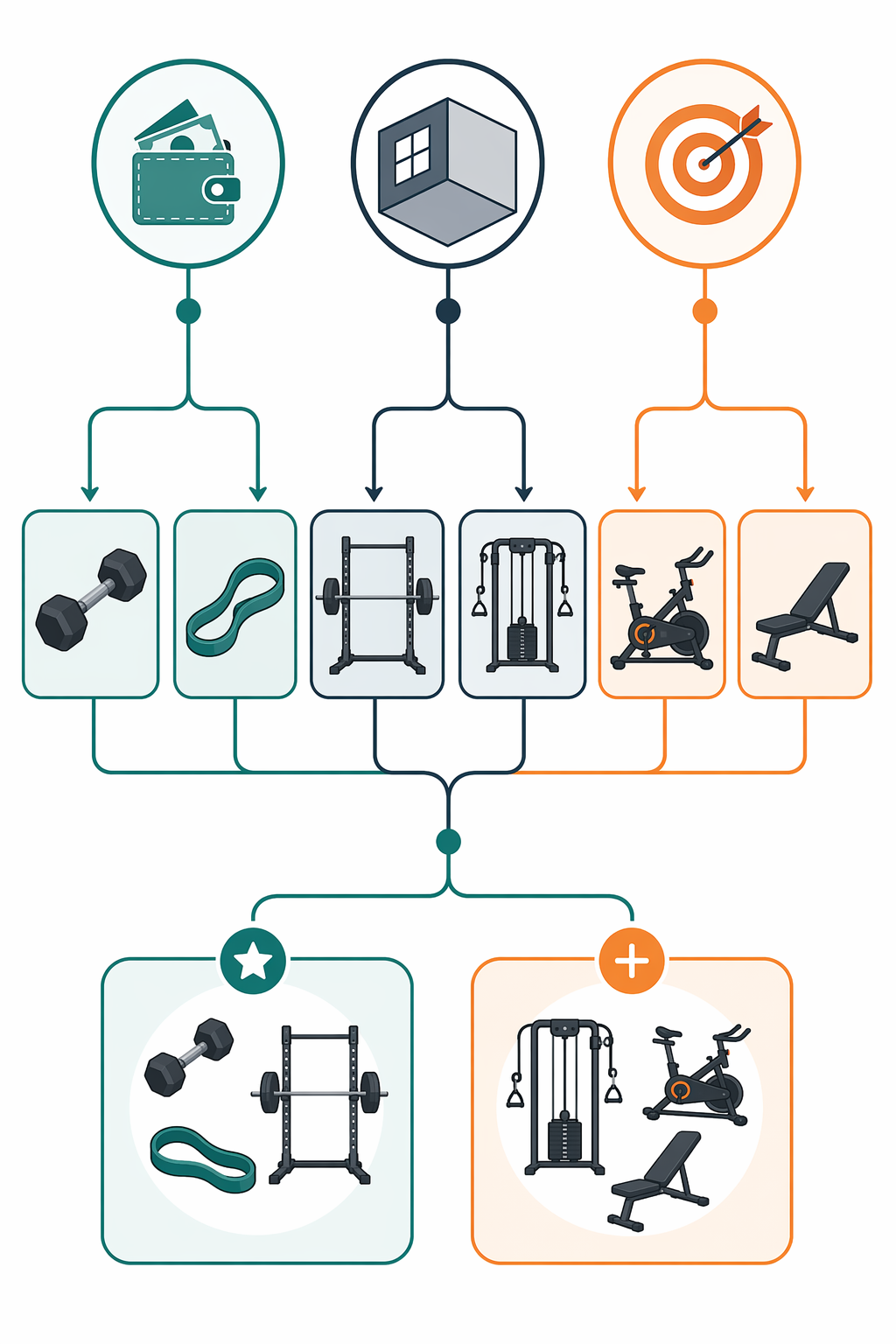
Use the flowchart above to trace your path from your three constraint inputs to a specific equipment category and a Phase 1 shopping list. Here is how to apply it:
- Identify your budget band: $0–$500, $500–$1,500, $1,500–$3,000, or $3,000+.
- Identify your space category: Apartment corner, spare room, garage half, or full garage.
- Identify your primary training goal: Strength, hypertrophy, general fitness, or cardio.
- Find your intersection in the decision matrix above and note the recommended equipment categories.
- Build your Phase 1 starter kit from the table in the Phase 1 Essentials section.
- Plan your Phase 2 additions based on your training goal and budget.
Once you have your equipment category identified, browse our Equipment Comparisons for detailed product comparisons within that category, or visit our Small-Space & Home Gym Setup guides for space-specific planning resources.
This is general fitness education, not medical advice. For diagnosis or treatment of pain or injury, consult a qualified clinician.
Pick your next session
Browse all routines to find an appropriately-spaced next session.
Spot something off?
This content sits adjacent to health guidance — tell us if a citation or figure needs a correction.