
What Makes a Home Gym 'Smart' in 2026? A Buyer's Guide to AI Coaching, Digital Resistance, and Connected Fitness
This guide explains the three tiers of smart features—screen-only, data-tracking, and full AI coaching—and covers digital resistance, connected ecosystems, and subscription models so you can choose a system that truly coaches you, not just one with a touchscreen.
Why 'Smart' Has Become a Marketing Buzzword
Walk into any electronics retailer or scroll through a fitness equipment feed in 2026, and you will see the word 'smart' attached to nearly every machine with a screen. A stationary bike with a tablet holder is called smart. A cable machine with a pre-loaded video library is called smart. A rower that syncs to your phone is called smart. The term has been stretched so thin that it has lost almost all practical meaning for someone trying to make a real purchase decision.
The problem is not that these machines lack utility. The problem is that the label 'smart' collapses wildly different capabilities into a single category. A system that plays a workout video and logs your heart rate is not the same as a system that uses 13 sensors to track your joint angles, analyzes your movement speed rep by rep, and automatically adjusts your resistance for the next set. Both are marketed as smart, but only one actually coaches you.
This guide exists to cut through that noise. If you are new to the category and trying to understand what separates a genuinely intelligent training system from a machine with a touchscreen, you need a framework that maps to real capabilities, not marketing copy. The sections that follow define the three distinct tiers of smart features, explain the underlying technology — digital resistance, AI coaching, connected ecosystems — and give you the vocabulary to evaluate any system you encounter.
The Three Tiers of Smart Features: Screen-Only, Data-Tracking, and Full AI Coaching
The most useful way to evaluate a smart home gym is to place it into one of three capability tiers. This framework, articulated clearly by AEKE in their 2026 buying guide, separates systems by what they actually do with your data, not by screen size or brand name.
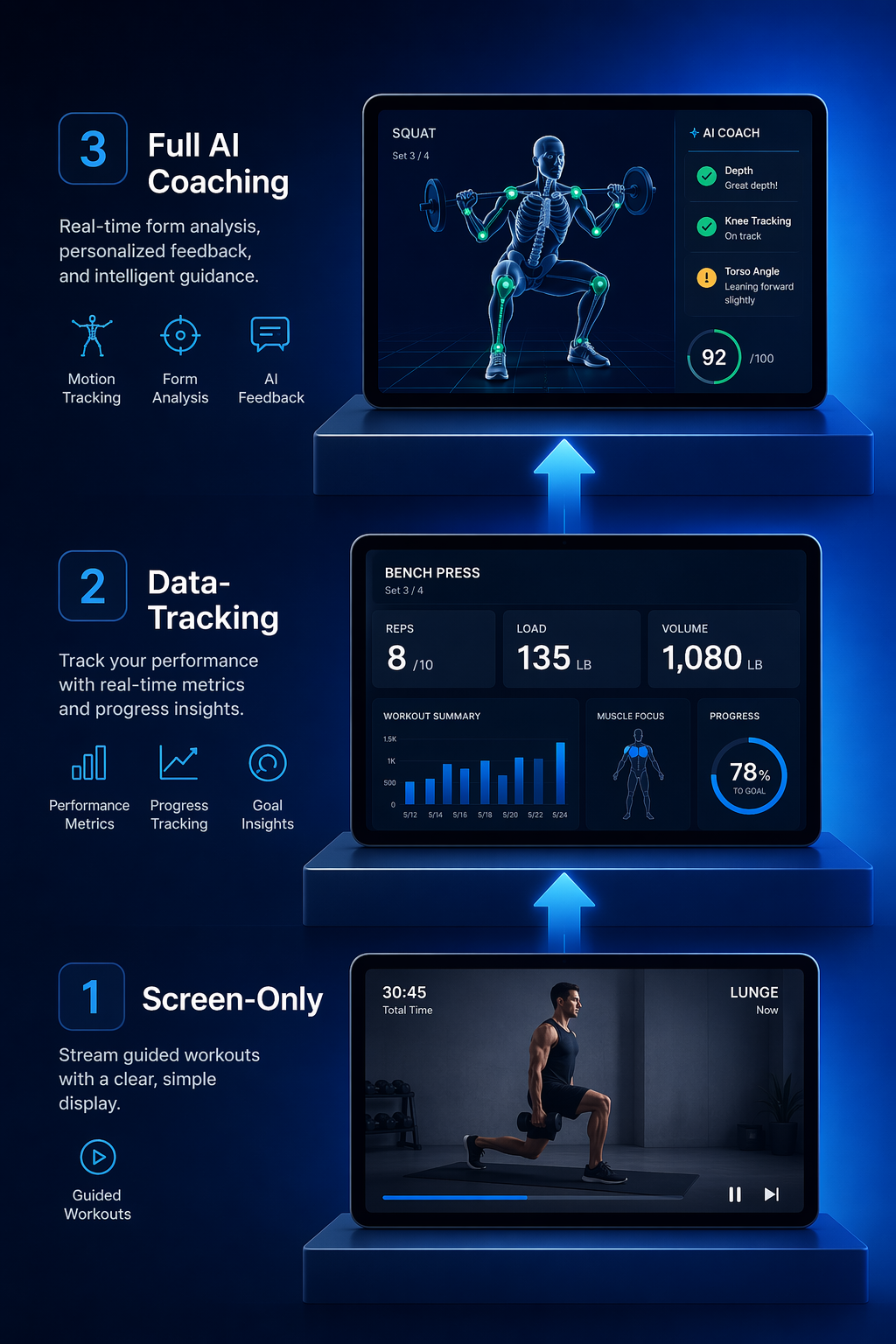
Tier 1: Screen-Only Systems
These are the most common and the most frequently mislabeled as 'smart.' A screen-only system comes with a built-in display that plays pre-recorded workout videos. You follow along, you press pause when you need a break, and when the video ends, the system has no record of what you did. It does not log your reps, track your load, or adjust anything based on your performance. Many treadmills, exercise bikes, and cable machines with attached tablets fall into this tier.
A screen-only system is not useless — it can be a perfectly good way to follow guided workouts at home. But it is not intelligent. If your goal is to have a system that learns from your training and adapts to your progress, this tier will not deliver that.
Tier 2: Data-Tracking Systems
Data-tracking systems take the next step. They log your reps, sets, load, and sometimes your range of motion or heart rate during each session. After a few workouts, the system can identify patterns — you consistently hit 10 reps on the lat pulldown at 80 pounds, so it might recommend increasing to 85 pounds next time. Some systems in this tier auto-adjust weight recommendations based on your historical performance.
This is a meaningful upgrade from screen-only. You get a training log without manual entry, and the system provides basic progression guidance. However, data-tracking systems do not analyze your form. They know what weight you lifted and how many reps you completed, but they do not know whether your squat depth was adequate or whether your left arm is doing more work than your right.
Tier 3: Full AI Coaching Systems
Full AI coaching systems represent the current ceiling of the category. These systems use skeletal tracking — either through cameras, embedded sensors, or both — to analyze your movement in real time. They detect joint angles, bilateral imbalances, and movement speed. When your form breaks down, they provide immediate feedback. When you are ready to progress, they adjust the resistance automatically.
The Tonal 2, for example, uses 13 sensors and gyroscope-equipped handles to track your technique across every rep. The system calibrates its resistance based on an initial fitness assessment and continues to adjust as you get stronger. This is not a pre-programmed workout with a timer — it is a closed feedback loop between your performance and the machine's output.
As Dr. Susie Reiner, PhD, an exercise scientist specializing in sport technology, explains: 'Smart home gym systems take the science of training and make it accessible.' These systems 'integrate machine learning algorithms that track how long you've been lifting a specific weight, how quickly you move through each rep, and whether you've completed or exceeded your target set or rep count. These data points allow the system to automatically adjust resistance and overload parameters, essentially personalizing progression in real time.'
| Tier | What It Does | Example Capabilities | Does It Coach You? |
|---|---|---|---|
| Screen-Only | Plays pre-recorded workout videos | Pause, play, volume control | No |
| Data-Tracking | Logs reps, sets, load, and performance history | Auto-adjusts weight recommendations based on past sessions | Partially — tracks data but does not analyze form |
| Full AI Coaching | Real-time skeletal tracking and form analysis | Detects joint angles, bilateral imbalances, fatigue; auto-adjusts resistance mid-set | Yes — provides real-time feedback and adaptive progression |
Digital Resistance Explained: How Electromagnetic Motors Differ from Iron
One of the most common points of confusion for new buyers is the difference between digital resistance and traditional weight stacks or free weights. Understanding this distinction is critical because digital resistance is the foundation on which most AI coaching features are built.
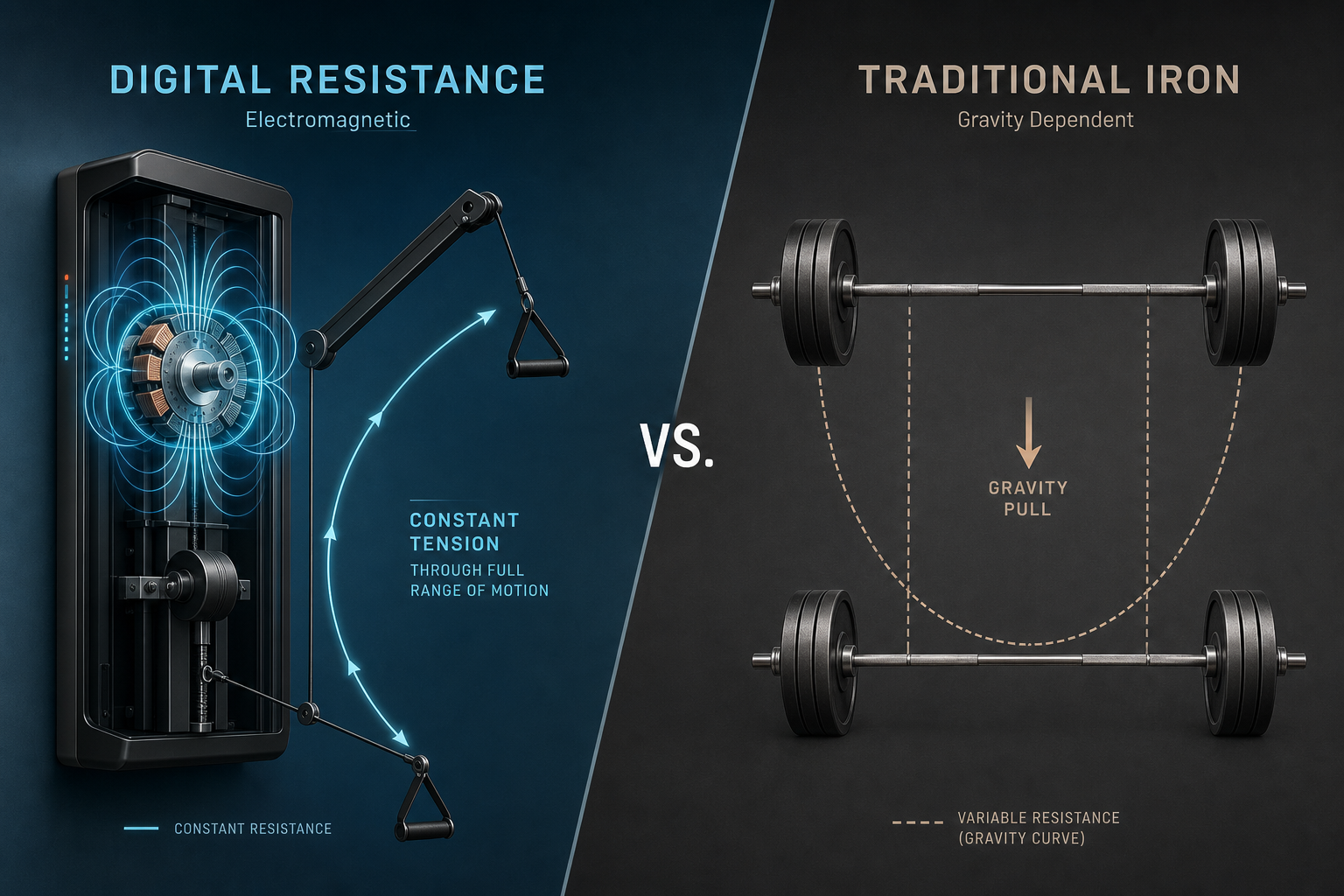
Traditional free weights and weight stacks rely on gravity. When you perform a bicep curl with a dumbbell, the resistance is highest at the bottom of the movement (where the lever arm is longest) and drops off significantly at the top. This is the natural strength curve of gravity-based resistance. It works well, but it does not match the body's actual strength curve for most exercises.
Digital resistance systems use electromagnetic motors to generate resistance. Instead of lifting a physical mass, you are pulling against magnetic force that the system controls electronically. This allows the machine to deliver constant tension through the entire range of motion — there is no 'momentum zone' at the top of a press or a 'dead spot' at the bottom of a row. The resistance profile can be shaped to match the exercise, not the physics of a falling weight.
A practical consequence of this technology is the ability to adjust resistance in very small increments. Many digital resistance systems allow changes as fine as 1 pound, compared to the 5- or 10-pound jumps typical of free weights and plate-loaded machines. For beginners and intermediate lifters, this granularity makes progressive overload more precise and sustainable.
Digital resistance also enables features that are impossible with iron. Because the system controls the resistance electronically, it can change the load mid-rep. Eccentric overload — where the resistance is higher during the lowering phase than the lifting phase — is a standard feature on many smart gyms. So is spotter mode, where the system reduces weight automatically when it detects that you are failing a rep. These capabilities are not gimmicks; they are training tools that have been used by strength coaches for years, now automated and accessible at home.
What AI Coaching Actually Does: Form Correction, Auto-Weight Adjustment, and Fatigue Detection
The term 'AI coaching' can sound like marketing hype until you understand the specific, measurable functions these systems perform. Based on the current generation of smart home gyms, AI coaching capabilities fall into three concrete categories.
Form Correction via Skeletal Tracking
Full AI coaching systems use cameras or embedded sensors to map your skeleton in real time. The system identifies key joint positions — shoulder, elbow, wrist, hip, knee, ankle — and compares your movement pattern to an ideal model for each exercise. When your elbow flares out during a tricep pushdown or your hips rise too early during a deadlift, the system flags the deviation.
According to HARISON's 2026 analysis of AI fitness technology, these systems excel at detecting gross movement patterns, joint angles, and bilateral imbalances with high precision and consistency. They are particularly effective at identifying left-right strength differences — a common issue that is difficult to self-diagnose without a coach or a mirror.
Auto-Weight Adjustment
Auto-weight adjustment is the feature most directly tied to progressive overload. The system tracks your performance across every set of every workout. When it detects that you consistently complete your target reps with good form and without slowing down, it increases the resistance for your next session. Conversely, if your form degrades or your rep speed drops, it may hold the weight steady or decrease it.
This removes one of the most common barriers to consistent strength training: the guesswork of knowing when and how much to increase the load. The system handles the decision, and it does so based on your actual performance data, not a generic schedule.
Fatigue Detection
Fatigue detection is a more advanced capability that goes beyond simple rep counting. By analyzing movement speed, range of motion, and left-right symmetry across a set, the system can identify when you are approaching failure or when your form is degrading due to fatigue. HARISON's analysis describes AI systems that detect fatigue by monitoring these variables in real time.
In practice, this means the system might prompt you to rack the weight before your form collapses, or it might automatically reduce the resistance for the final rep of a set to allow you to complete it safely. This is the digital equivalent of a good spotter — someone who watches your reps and steps in when you are about to fail.
- Form correction: Real-time analysis of joint angles, bilateral imbalances, and gross movement patterns
- Auto-weight adjustment: Performance-based load progression that removes guesswork from progressive overload
- Fatigue detection: Analysis of movement speed, range reduction, and symmetry to identify when to stop or reduce load
The Connected Ecosystem: How Hardware, Software, and AI Integrate (or Don't)
A smart home gym is not just a piece of hardware with a screen. It is a system of three layers — hardware, software, and AI — that must work together to deliver a coherent training experience. How well these layers integrate determines whether the system feels like a unified coach or a collection of disconnected features.
At the hardware layer, you have the physical machine: the frame, the electromagnetic motor, the cables or arms, the sensors, and the screen. At the software layer, you have the operating system, the workout library, the user interface, and the data storage. At the AI layer, you have the algorithms that analyze your movement, adjust resistance, and personalize your program.
In a well-integrated system, these three layers communicate seamlessly. The hardware sensors feed data to the AI layer, which processes it and sends instructions back to the hardware (adjust resistance, show a form correction alert) and to the software (log the set, update your progress chart). The user experiences this as a single, fluid interaction.
In a poorly integrated system, the layers operate independently. The screen runs a workout app, but the resistance is controlled manually. The sensors track your movement, but the data is displayed in a separate dashboard that you have to check after the workout. The AI might recommend a weight increase, but you have to adjust it yourself. These systems feel disjointed because they are — the hardware, software, and AI were not designed as a unified product.
HARISON's 2026 market analysis highlights brands like Speediance and Merach as examples of companies demonstrating all-in-one connected ecosystems at CES 2026. These systems aim to close the loop between sensing, analysis, and action. When you pull the handle, the sensor detects the force, the AI compares it to your historical data, and the software updates your workout in real time — all within a fraction of a second.
When evaluating a smart home gym, ask yourself: does the system feel like one product or three products bolted together? If you have to manually transfer data between the machine and an app, or if the AI recommendations require you to adjust settings yourself, the ecosystem is not fully connected.
Subscription Models: What You Get vs. What You Lose
Subscription costs are the single most overlooked factor in smart home gym ownership. The upfront price of the hardware is visible and easy to compare. The monthly fee — and what happens when you stop paying it — is often buried in the fine print. Understanding the subscription model is essential to evaluating total cost of ownership and long-term value.
Based on Garage Gym Reviews' testing of over 30 smart home gym units, the average subscription cost across the category is $22.81 per month. However, this average masks a wide range. Some systems charge as little as $10 per month for basic data tracking, while premium AI coaching subscriptions can exceed $60 per month. The Tonal 2, for example, requires a $59.95 monthly membership for full access to its AI coaching, workout library, and multi-user profiles.
The critical question is not just how much the subscription costs, but what features are locked behind it. The table below summarizes the typical feature breakdown across subscription models.
| Feature Category | Typically Included with Subscription | Typically Available Without Subscription |
|---|---|---|
| AI coaching (form correction, auto-weight adjustment) | Yes | No |
| Full workout library (guided classes, programs) | Yes | Limited or none |
| Multi-user profiles with individual progress tracking | Yes | Single user or none |
| Performance analytics and historical data | Yes | Basic or no logging |
| Manual resistance control | Yes | Yes (on most systems) |
| Core machine functionality (lift, lower, hold) | Yes | Yes (on most systems) |
AEKE's 2026 buying guide provides a useful long-term cost comparison. Over a 5-year period, subscription-required systems (hardware plus monthly fee) total between $6,100 and $9,600, while subscription-free systems with comparable hardware cost between $3,200 and $5,500. The difference is substantial — roughly $3,000 to $4,000 over five years — and should be factored into any purchase decision.
That said, subscription-free systems may not offer the same depth of AI coaching or the same frequency of new workout content. The trade-off is between lower long-term cost and access to continuously updated, personalized training. There is no universally correct answer — it depends on whether you value the coaching features enough to pay for them month after month.
Key Specs to Compare: Resistance Range, Exercise Library, Multi-User Profiles, and Form Feedback
Once you understand the feature tiers and the technology, the next step is evaluating specific systems on the specs that determine long-term training effectiveness. The following checklist covers the most important dimensions to compare.
Resistance Range
The maximum resistance determines how long the system will challenge you as you get stronger. AEKE recommends systems with at least 200 pounds of resistance for 3 to 5 years of effective progression for most home trainers. The Tonal 2 offers up to 250 pounds of total resistance. The Speediance Gym Monster 2 provides 220 pounds. Some compact systems max out at 100 pounds, which may be sufficient for beginners but will limit intermediate and advanced lifters.
Exercise Library Size and Variety
A large exercise library is valuable only if the exercises are well-programmed and the system provides proper form guidance for each one. Look for libraries that include compound movements (squat, deadlift, bench press, row, overhead press) as well as isolation exercises. Some systems offer hundreds of movements; others offer a more curated selection. More is not always better, but the library should cover all major muscle groups and movement patterns.
Multi-User Profiles
If multiple people in your household will use the system, multi-user profile support is essential. Each user needs their own strength assessment, progression history, and personalized recommendations. Some systems support unlimited profiles; others limit you to a small number or charge extra for additional users. This is a detail that is easy to overlook during initial research but becomes a daily frustration if the system does not handle it well.
Form Feedback Quality
Not all form feedback is created equal. Some systems provide real-time audio or visual cues during the rep. Others show a summary after the set. Some only flag major deviations; others provide granular analysis of joint angles and symmetry. The quality of form feedback is one of the hardest specs to evaluate from a spec sheet, but it is arguably the most important for injury prevention and training quality.
A/V and Display Quality
The screen and audio system matter more than you might expect. You will be looking at this display and listening to its audio for hundreds of hours. A dim, low-resolution screen or tinny speakers will degrade the experience over time. Look for bright, high-resolution displays with good viewing angles, and audio systems that are clear enough for instructional cues to be understood without straining.
| Spec | Why It Matters | What to Look For |
|---|---|---|
| Resistance range | Determines how long the system will challenge you as you progress | At least 200 lbs for 3–5 years of progression |
| Exercise library | Covers all major muscle groups and movement patterns | Includes compound and isolation exercises with form guidance |
| Multi-user profiles | Each user needs personalized assessment and progression | Unlimited or sufficient profiles for your household |
| Form feedback quality | Critical for injury prevention and training effectiveness | Real-time cues, not just post-set summaries |
| A/V quality | You will interact with the screen and audio for hundreds of hours | Bright, high-resolution display; clear audio for instructional cues |
The 2026 Market Landscape: Major Players and Their Positioning
The smart home gym market is growing rapidly. According to The Business Research Company, cited by HARISON, the global smart fitness market is projected to reach $42.15 billion in 2026, growing at a compound annual growth rate of 25.9% from 2025. This growth is driven by increasing consumer demand for personalized, data-driven training experiences at home.
Within this expanding market, several major players have established distinct positions based on their approach to smart features:
- Tonal: The premium, wall-mounted system with the most advanced sensor array (13 sensors) and the highest subscription cost ($59.95/month). Positions itself as the closest thing to a personal trainer in a box. Requires 7 feet of wall space and a dedicated 15-amp circuit.
- Speediance: A direct competitor to Tonal with a foldable design and 220 pounds of max resistance. Its AI coaching subscription costs $24.90 per month, and core functions remain accessible without a subscription. The Gym Monster 2 provides real-time feedback and imbalance correction.
- Tempo Move: The current offering from Tempo following the discontinuation of the Tempo Studio. Uses camera-based form tracking through your TV or tablet. Positioned as a more accessible entry point into AI coaching.
- NordicTrack: Leverages its existing fitness ecosystem with the X24 and other connected machines. Uses SmartAdjust technology for automatic incline and speed adjustments. Broad brand recognition and a large workout library.
- Vitruvian: A compact, floor-based system that uses electromagnetic resistance. Known for its small footprint and Trainer+ model that emphasizes progressive overload algorithms.
Each of these brands occupies a different position on the spectrum from screen-only to full AI coaching. Some prioritize sensor density and form analysis. Others prioritize content library size or ecosystem integration. None of them are wrong — but they are different, and the right choice depends on which tier of smart features actually matters for your training.
If you are ready to move from orientation to evaluation, our Smart Home Gym Comparison 2026: Head-to-Head Spec Clash of All-in-One Strength Systems provides a detailed side-by-side comparison of these systems with pricing, subscription costs, and total cost of ownership analysis.
The smart home gym category is still young, and the definition of 'smart' will continue to evolve. But the framework in this guide — three tiers of features, digital resistance as the foundation, AI coaching as the differentiator, and subscription cost as the long-term commitment — will remain relevant regardless of which specific products dominate the market next year. Use it to cut through the marketing, identify what you actually need, and make a purchase that will still feel smart five years from now.
This result comes from one real apartment under the stated conditions — it is a strong signal, not a guarantee your space will measure identically.
Builds this evidence supports
Compact Home Gym Buyer's Guide: 8 Questions to Answer Before Buying a Single Piece of Gear
Most compact home gym purchases fail not because of bad products, but because buyers skip the constraint-framing step. This guide helps complete beginners with limited space ask the right questions about noise, space, training style, budget, and growth plans before evaluating any gear.
Spot something off?
If this result didn't match your own space, let us know — floor-damage and noise claims carry real deposit-risk consequences if we get them wrong.