
Home Gym System Cost Breakdown: What You Actually Get at Every Price Tier ($300 to $6,000+)
A practical, tier-by-tier guide to home gym system costs, helping budget-conscious buyers understand what each price range delivers and avoid overspending by confusing a modular setup with an all-in-one machine.
The Real Question Isn’t Just ‘How Much’ — It’s ‘What Do You Get’
When you start searching for a home gym system, the first number you see is often the price tag. But the real trap isn’t the sticker shock — it’s the confusion between what counts as a “system” and what’s actually an all-in-one machine. That distinction matters because it determines whether you’re getting long-term value or paying a premium for convenience you might outgrow.
A home gym system can mean a modular setup — a power rack, barbell, weight plates, and a bench — that you assemble piece by piece. Or it can mean a single all-in-one machine like the Bells of Steel All-in-One or the Bowflex Xtreme 2 SE. Both are valid, but they serve different needs and different budgets. The mistake most buyers make is assuming a higher price on an all-in-one machine automatically means a better system, when a modular build at $1,500 to $2,500 often delivers more versatility, easier upgrades, and a longer useful life.
To help you cut through the noise, this guide breaks home gym systems into four clear cost tiers — budget ($300–$1,000), mid-range ($1,000–$3,000), full gym ($3,000–$6,000), and commercial-grade ($6,000+). Each tier includes specific equipment builds, honest limitations, and the hidden costs that can quietly shift the value equation. We’ll also run the numbers on how a home gym system compares to a gym membership over five years, so you can see exactly when your investment starts paying for itself.
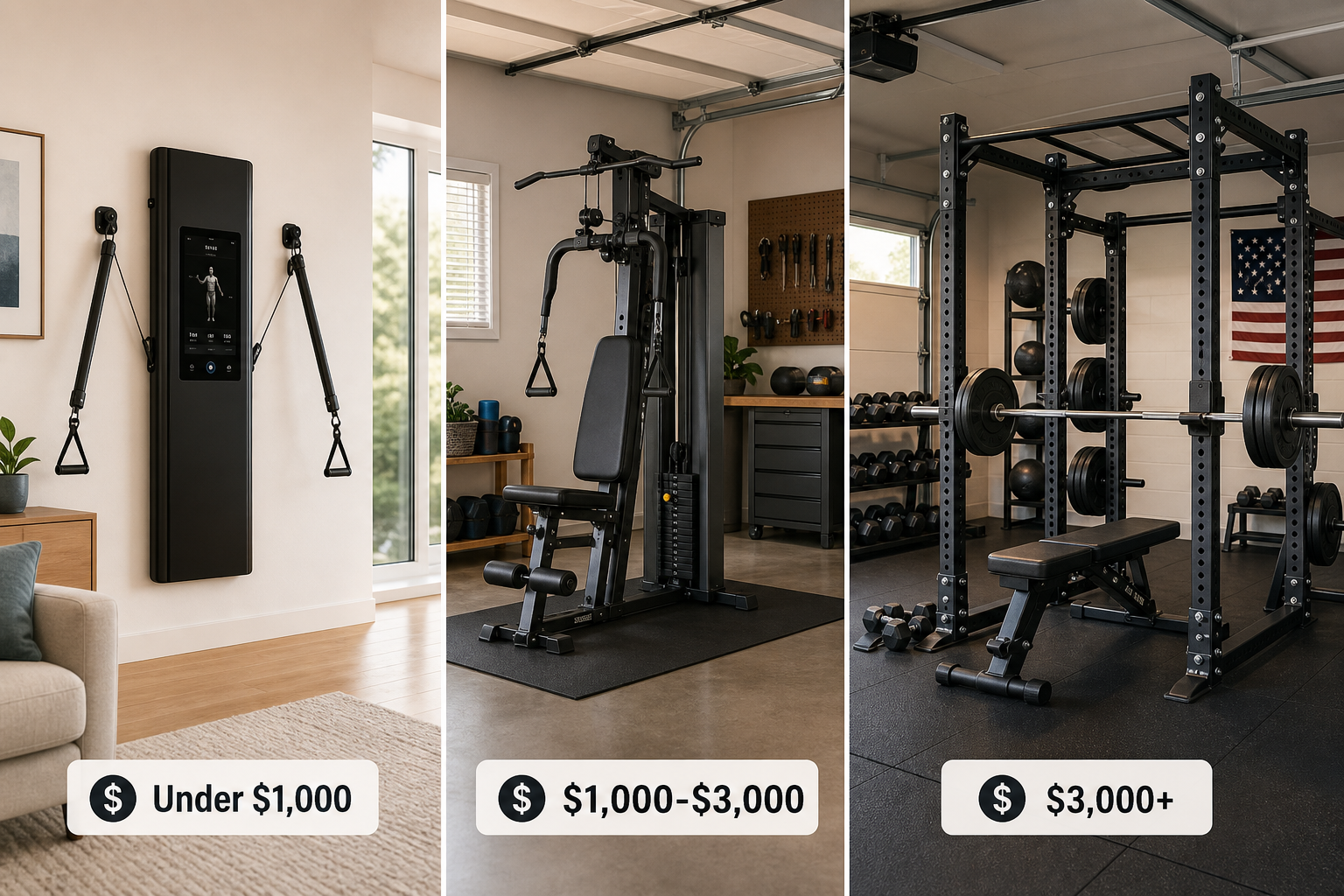
Tier 1: Budget ($300–$1,000) — What Actually Works and What to Avoid
A budget home gym system is a legitimate starting point, but only if you go in with clear expectations. At this price level, you’re not buying a complete strength-training setup that will last a decade. You’re buying a kit to test whether home fitness sticks — and that’s fine.
What a Realistic $300–$1,000 Setup Looks Like
- Adjustable dumbbells (e.g., REP QuickDraw at $335.99, 5–60 lbs per dumbbell, replaces up to 12 pairs)
- A set of resistance bands (e.g., Living.Fit set at $128.94, resistance up to 250 lbs)
- A basic weight bench (non-adjustable or simple incline)
- A jump rope and a kettlebell (53 lb kettlebell around $63)
- Optional: gymnastic rings ($40) for bodyweight pulling exercises
This combination covers the basics: you can do dumbbell presses, rows, curls, squats, lunges, and some bodyweight work. It’s enough to build a foundation for three to six months, especially if you’re new to strength training.
The Hard Limitations
The biggest gap in a budget setup is progressive overload for serious strength training. Adjustable dumbbells top out around 60 lbs per hand. Resistance bands provide variable resistance but don’t load the same way as free weights. You can’t safely perform heavy barbell squats, deadlifts, or bench presses with this gear.
Tier 2: Mid-Range ($1,000–$3,000) — The Value Sweet Spot
This is where most committed home gym buyers should land. The $1,000–$3,000 range is wide enough to accommodate three distinct build paths, each with different trade-offs. The common thread is that any of these setups can serve you for five to ten years with minimal upgrades.
Build Path 1: Modular Power Rack + Barbell + Plates + Bench
This is the classic recommendation for a reason: it offers the best combination of exercise variety, progressive overload capability, and upgradeability. A representative build includes:
- REP PR-4000 power rack (starting at $950, 4.5/5 rating)
- REP Colorado Bar ($300, lifetime warranty)
- Fringe Sport 260 lb black bumper plate set ($424, ~$1.79/lb)
- REP FB-5000 competition flat bench ($400, 1,000 lb capacity, 4.8/5 rating)
Total: approximately $2,074. This setup handles every major barbell movement — squat, bench, deadlift, overhead press, rows — plus pull-ups on the rack’s pull-up bar. You can add weight plates incrementally as you get stronger, and the rack and bar will last through multiple plate additions.
Build Path 2: All-in-One Machine
All-in-one machines trade some exercise quality for a smaller footprint and simpler setup. Two strong options in this tier:
| Machine | Price | Rating | Resistance | Footprint | Warranty |
|---|---|---|---|---|---|
| Bells of Steel All-in-One | $1,299.99–$1,900 | 4.2/5 | 300 lb cable capacity | 54.6" L x 59" W x 81" H | Limited lifetime |
| Bowflex Xtreme 2 SE | $1,499 | 3.9/5 | 210 lbs (upgradable to 410 lbs) | 63" L x 49" W x 83.25" H | 7-year machine, 5-year rod |
The Bells of Steel unit offers a higher starting cable capacity and a limited lifetime warranty, making it the better value for most buyers. The Bowflex is a proven design with a strong warranty but lower starting resistance. Both are genuine systems — they include cables, pulleys, and multiple exercise stations in one frame.
Build Path 3: Cable Tower + Free Weights
A hybrid approach: pair a cable tower with adjustable dumbbells and a bench. The Bells of Steel Cable Tower starts at $434.99 (4.3/5, 210–250 lbs resistance, limited lifetime warranty). Add the REP QuickDraw adjustable dumbbells at $335.99 and a REP AB-3000 FID adjustable bench at under $300. Total: roughly $1,070–$1,200, with room to add a barbell and plates later.
This path is ideal if you want cable exercises (lat pulldowns, rows, tricep pushdowns) but aren’t ready to commit to a full power rack. It’s also the most space-efficient option in this tier.
Tier 3: Full Gym ($3,000–$6,000) — Adding Cardio, Flooring, and Accessories
At this level, you’re no longer making compromises. The extra budget buys three things that transform a good home gym into a complete training environment: a dedicated cardio machine, proper flooring, and the accessories that make daily use more convenient.
What the Extra $2,000–$3,000 Buys
- A dedicated cardio machine: treadmill, exercise bike, or rower. A quality rower starts around $800–$1,200; a solid treadmill runs $1,200–$2,000.
- Rubber flooring: horse stall mats at roughly $80–$120 each. You’ll need two to four mats depending on your space.
- Additional weight plates: another 100–200 lbs of iron or bumper plates to support heavier deadlifts and squats.
- A fan, storage rack for plates, and a wall-mounted TV or tablet holder for following workout videos.
A representative full-gym build might start with the REP Fitness Ares 2.0 at $2,999.99 (4.5/5, dual 260 lb weight stacks upgradable to 310 lbs, limited lifetime warranty), then add a rower and flooring. Alternatively, you could build a power rack setup with a premium bar, 400+ lbs of plates, a flat and adjustable bench, a rower, and rubber flooring — all within the $4,000–$5,500 range.
Who This Tier Serves
This tier is for committed lifters who train three to five days per week and want a setup that eliminates every reason to skip a session. If you have the space (at least 100 sq ft) and the budget, this is the tier where you stop thinking about upgrades and start focusing entirely on your training.
Tier 4: Commercial-Grade ($6,000+) — Who Actually Needs This
The $6,000+ tier is where home gyms start to look like commercial facilities. This is not the territory for beginners or even most intermediate lifters. It’s for serious athletes, multi-user households, or anyone who wants a commercial feel at home and has the budget to match.
What You Get at This Level
| Equipment | Price | Key Feature | Best For |
|---|---|---|---|
| Body-Solid G9B Dual Stack Gym | $4,200 | Two independent 210 lb weight stacks, built-in leg press | Multi-user households, serious lifters |
| Tonal 2 | $4,295 (+ $59.95/month) | 250 lbs digital resistance, wall-mounted, 5.25" depth | Smart gym enthusiasts, small-space dwellers |
| Speediance Gym Monster | $3,199 | 220 lbs digital resistance, no subscription required | Smart gym buyers avoiding monthly fees |
| Major Fitness B17 | $4,199.99 | Dual weight stacks expandable to 260 lbs each, 1,500 lb J-hook capacity | Heavy-duty all-in-one with room to grow |
The Tonal 2 and Speediance represent the smart gym end of this tier. Tonal’s $4,295 price tag is followed by a $59.95/month subscription, which adds $719.40 per year to the total cost of ownership. Speediance avoids the subscription trap entirely at $3,199, making it the more cost-effective smart option over time.
For a detailed comparison of smart gyms vs. traditional weight-stack machines, see our analysis: Smart Home Gym vs. Traditional Weight-Stack Machine: Which Delivers Better Long-Term Value in 2026?.
Hidden Costs That Change the Equation
The price tag on a home gym system is never the final number. Several hidden costs can add hundreds or thousands of dollars to your total investment, especially if you’re not planning for them upfront.
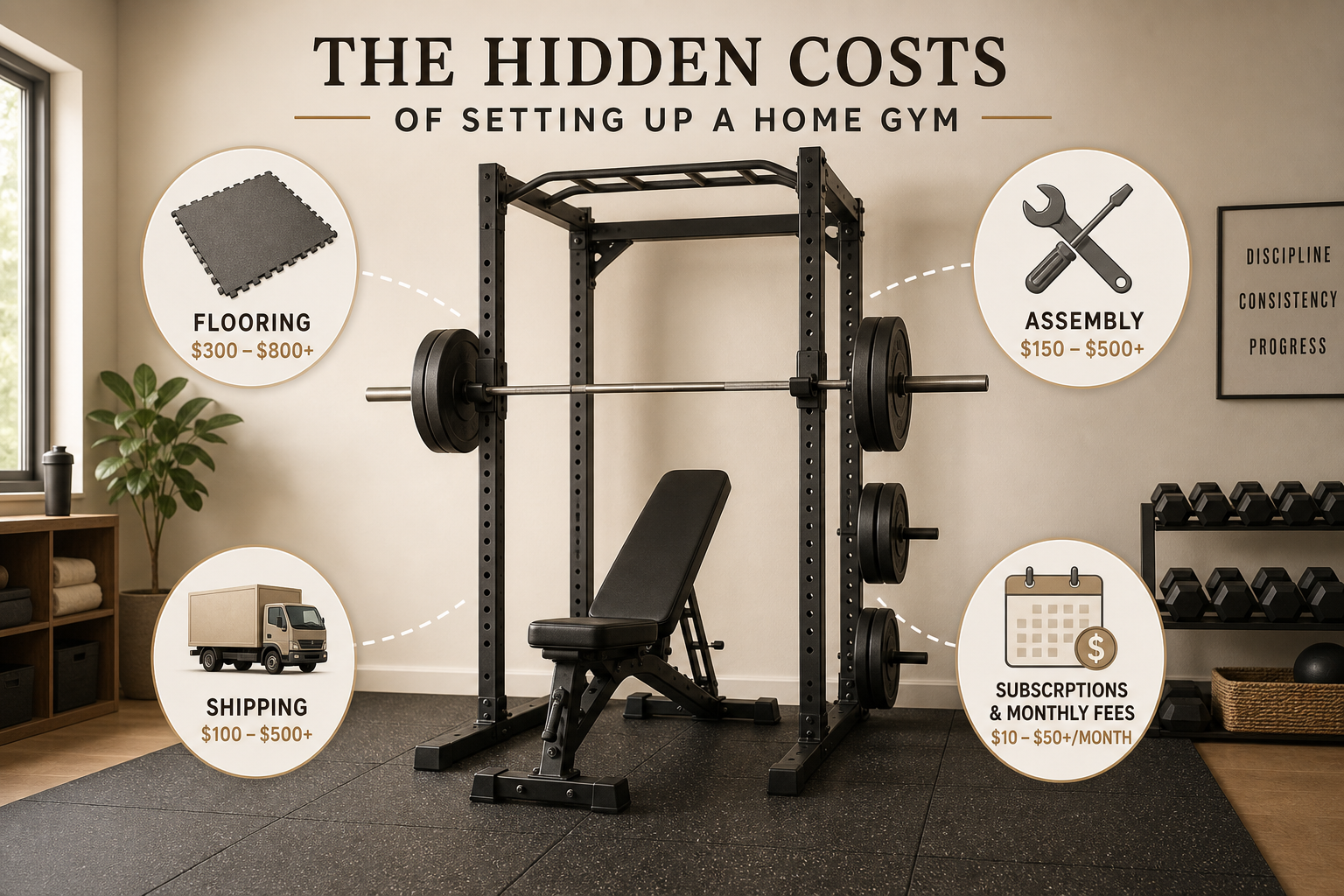
| Hidden Cost | Typical Range | Notes |
|---|---|---|
| Flooring (horse stall mats) | $80–$120 per mat | You’ll need 2–4 mats depending on gym footprint |
| Shipping and delivery | $100–$300 | Heavy all-in-one machines and racks often incur freight charges |
| Assembly (professional) | $150–$400 | DIY saves money but takes 2–6 hours for complex machines |
| Subscription (smart gyms) | $0–$719.40/year | Tonal: $59.95/month. Speediance: $0. Bowflex: $0 |
| Additional weight plates | $200–$600 | Most starter sets come with 160–260 lbs; you’ll likely want more |
To see how these costs compound over time, consider a mid-range modular build at $2,000 with $300 in flooring and shipping. Over five years, the total is $2,300 with no ongoing fees. A Tonal 2 at $4,295 plus $300 in installation and $59.95/month totals $8,192 over the same period. The smart gym costs 3.5 times more, even though its upfront price is only double.
Home Gym System vs. Gym Membership: The 5-Year Cost Comparison
The most common question buyers ask is whether a home gym system is cheaper than a gym membership. The answer depends on your tier, but for most people in the mid-range, the breakeven point arrives faster than you might expect.
According to the 2024 Health & Fitness Association report, the average gym membership cost in the U.S. is roughly $65 per month. That’s $780 per year, or $3,900 over five years. A mid-range home gym system at $1,500–$2,500 (including hidden costs) breaks even at approximately two years. After that, the home gym is essentially free to use.
| Scenario | Year 1 | Year 3 | Year 5 | 10-Year Total |
|---|---|---|---|---|
| Gym membership ($65/month) | $780 | $2,340 | $3,900 | $7,800 |
| Budget home gym ($500) | $500 | $500 | $500 | $500 |
| Mid-range home gym ($2,000) | $2,000 | $2,000 | $2,000 | $2,000 |
| Full gym ($4,500) | $4,500 | $4,500 | $4,500 | $4,500 |
| Tonal 2 ($4,295 + $59.95/month) | $5,014 | $6,454 | $7,894 | $11,494 |
The budget and mid-range tiers are clear winners over a gym membership within two to three years. The full gym tier takes longer to break even but offers equipment that a typical gym membership doesn’t include — like a premium barbell, competition-grade bench, and your own cardio machine. The Tonal 2, with its subscription, never breaks even against a gym membership over a 10-year period.
Decision Framework: Which Tier Is Right for You?
Use the framework below to match your situation to the right tier. The key is to be honest about your training goals, available space, and willingness to assemble and maintain equipment.
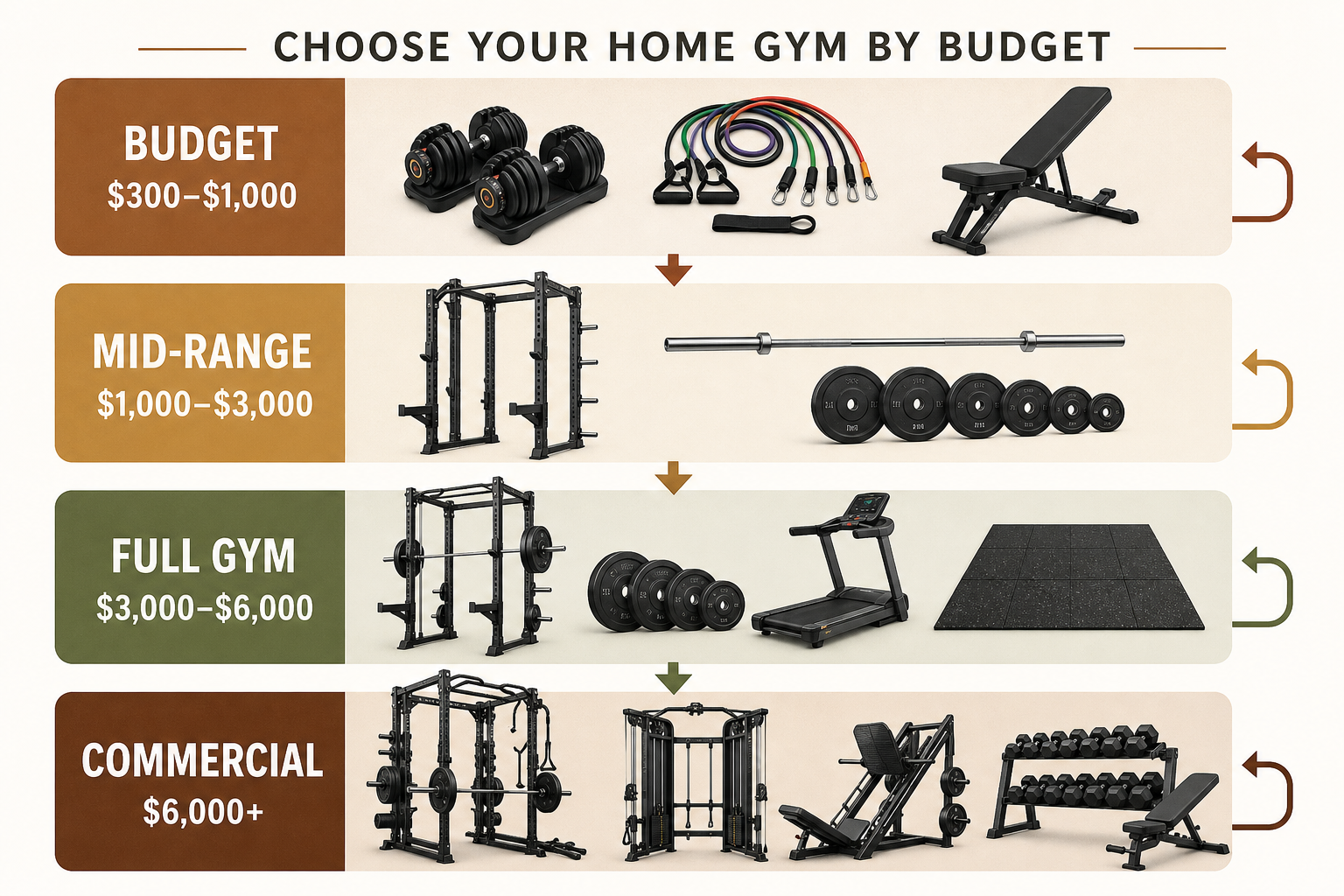
Budget ($300–$1,000)
- Best for: Beginners testing interest, people with very limited space, anyone who needs a portable setup
- Buy first: Adjustable dumbbells, resistance bands, a basic bench
- Skip: All-in-one machines (too expensive for this tier), barbell and plates (no rack to support them)
- Plan to upgrade: Within 6–12 months if you’re training consistently
Mid-Range ($1,000–$3,000)
- Best for: Committed lifters who want a permanent setup, anyone who can dedicate 50+ sq ft
- Buy first: Power rack + barbell + plates + bench (modular), or a Bells of Steel All-in-One (all-in-one)
- Skip: Smart gyms (too expensive for this tier), cheap all-in-one machines under $1,000
- Plan to upgrade: Add weight plates and accessories over time; the core setup should last 5–10 years
Full Gym ($3,000–$6,000)
- Best for: Serious lifters training 3–5 days/week, multi-user households, anyone with 100+ sq ft
- Buy first: Power rack + premium barbell + 400+ lbs plates + flat and adjustable bench + rower or treadmill + rubber flooring
- Skip: Budget cardio machines (invest in a quality rower or bike), cheap storage solutions
- Plan to upgrade: Minimal — this tier should satisfy all training needs for a decade or more
Commercial-Grade ($6,000+)
- Best for: Serious athletes, multi-user households, anyone who wants a commercial feel at home
- Buy first: Heavy-duty rack or dual-stack machine (Body-Solid G9B), premium cardio, commercial-grade flooring
- Skip: Smart gyms with subscriptions unless you specifically want digital coaching and don’t mind the ongoing cost
- Plan to upgrade: Only if your training goals change significantly (e.g., adding a specialty bar or new cardio modality)
Still unsure which system type fits your training style and space? Our Home Gym Equipment Types Explained: Which System Actually Fits Your Training Style, Space, and Budget? guide walks through each archetype in detail.
For a deeper look at how to distribute your spending across equipment categories within each tier, see How to Allocate Your Home Gym Equipment Budget: A Tier-by-Tier Guide ($200 to $5,000).
This result comes from one real apartment under the stated conditions — it is a strong signal, not a guarantee your space will measure identically.
Builds this evidence supports
Cable Machine Alternatives That Save Space and Money
Compare the best cable machine alternatives for home gyms – from resistance bands and pulley systems to suspension trainers and compact digital units – and find the right option for your space and budget.
How to Choose a Compact Home Gym That Works for Your Space, Budget, and Noise Tolerance
This article provides a structured decision framework for apartment dwellers and small-space residents to match their specific floor footprint, noise sensitivity, and budget to the most suitable compact home gym strategy — whether that's an all-in-one machine, modular build, smart digital system, or band/bodyweight setup.
The Garage Gym Reality Check: What Equipment Actually Fits in a Single-Car Garage
Most garage gym guides assume a two-car space. This article uses real dimensions, real equipment footprints, and three layout templates to show what fits—and what doesn't—in a single-car garage (10x20 to 12x20 ft).
Spot something off?
If this result didn't match your own space, let us know — floor-damage and noise claims carry real deposit-risk consequences if we get them wrong.