
Smart Home Gym vs. Traditional Weight-Stack Machine: Which Delivers Better Long-Term Value in 2026?
Comparing smart connected gyms (Tonal, Speediance) against traditional all-in-one weight-stack machines for buyers with $2,000–$5,000 to invest. We analyze total cost of ownership over five years, durability and repairability, and the hybrid accessory path to help you decide which ecosystem fits your training style and budget.
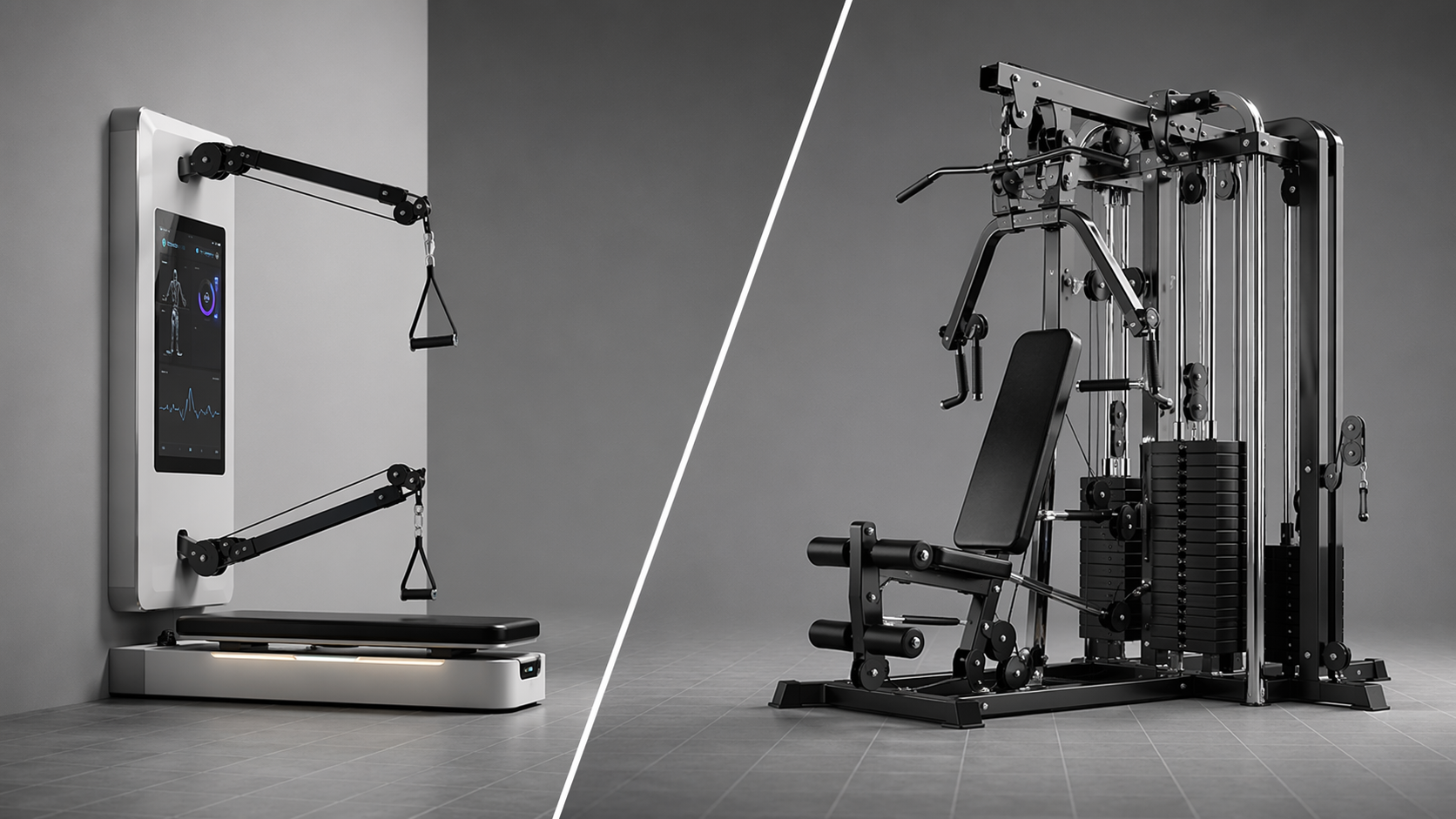
The Two Paths to an All-in-One Home Gym: Smart Ecosystem vs. Traditional Weight Stack
If you are shopping for an all-in-one home gym in 2026 with a budget between $2,000 and $5,000, you are effectively choosing between two fundamentally different product philosophies. On one side sit smart connected gyms — wall-mounted or freestanding units that use digital or magnetic resistance, a built-in touchscreen, and an app ecosystem to deliver guided workouts. On the other side are traditional all-in-one machines — steel-framed assemblies with physical weight stacks, cable pulleys, and no screen, no subscription, and no software dependency.
Both approaches promise a complete strength-training solution in a single footprint. But the similarities end there. The smart gym sells you an experience: AI coaching, form tracking, auto-adjusting resistance, and a library of on-demand classes. The traditional machine sells you a tool: mechanical resistance that will work the same way ten years from now as it does today, with no login required.
This article is not a product shootout between the Tonal 2 and the Major Fitness B17. It is a category-level comparison designed to help you decide which ecosystem — smart or traditional — aligns with your training style, your tolerance for recurring costs, and your expectations for long-term durability. If you need a broader decision framework covering space and budget first, our smart vs. traditional decision guide is the place to start.
Head-to-Head Comparison: Smart Gym vs. Traditional Weight-Stack Machine
The table below maps the key decision dimensions for representative products in each category. These are not the only options available, but they illustrate the structural differences between the two approaches.
| Dimension | Smart Gym (Tonal 2) | Smart Gym (Speediance Gym Monster) | Traditional (Major Fitness B17) | Traditional (Body-Solid EXM2500) |
|---|---|---|---|---|
| Max Resistance | 250 lbs total (125 lbs per arm) | 220 lbs total (110 lbs per arm) | 260 lbs per stack (dual stacks) | 210 lbs single stack |
| Resistance Type | Digital electromagnetic | Digital electromagnetic | Weight stack (plate-loaded) | Weight stack |
| Footprint | 5.25" D x 21.5" W x 50.9" H (requires 7'x7' clear space) | 49.2" D x 28.3" W x 72.8" H (folds to 14.9" D) | 68.1" D x 78.7" W x 88.1" H | ~60" D x 48" W x 80" H |
| Subscription Cost | $50+/month required | None | None | None |
| AI / Guidance | 13 sensors, form tracking, smart handles (optional $495), smart view camera | App-based tracking, no subscription | None | None |
| Exercise Variety | Thousands of on-demand and live workouts | App-guided programs | Unlimited via cable attachments | Standard cable exercises |
| Warranty | 2-year limited | 2-year | 1-year | 5+ years (typical) |
| Assembly | Professional installation required (wall mount) | Freestanding, minimal assembly | Significant assembly required | Moderate assembly |
| Price (MSRP) | $4,295 (on sale for $3,545) | $3,199 | $4,199.99 | ~$1,500 |
The most immediate difference is the subscription line. Tonal 2 requires a $50/month membership to access its core features — guided workouts, form tracking, and the workout library. Speediance Gym Monster offers smart features without a subscription, which is a meaningful distinction within the smart gym category. Traditional machines have no subscription cost at all, ever.
Resistance ceilings also differ. Smart gyms currently max out at 220–250 lbs total digital resistance. That is sufficient for most beginners and intermediates, but serious lifters who squat or deadlift heavy will hit that ceiling quickly. Traditional weight-stack machines, particularly dual-stack models like the Major Fitness B17, offer 260 lbs per stack — and because they use physical plates, you can always add more weight by purchasing additional plates.
Five-Year Total Cost of Ownership: Where the Real Cost Difference Lives
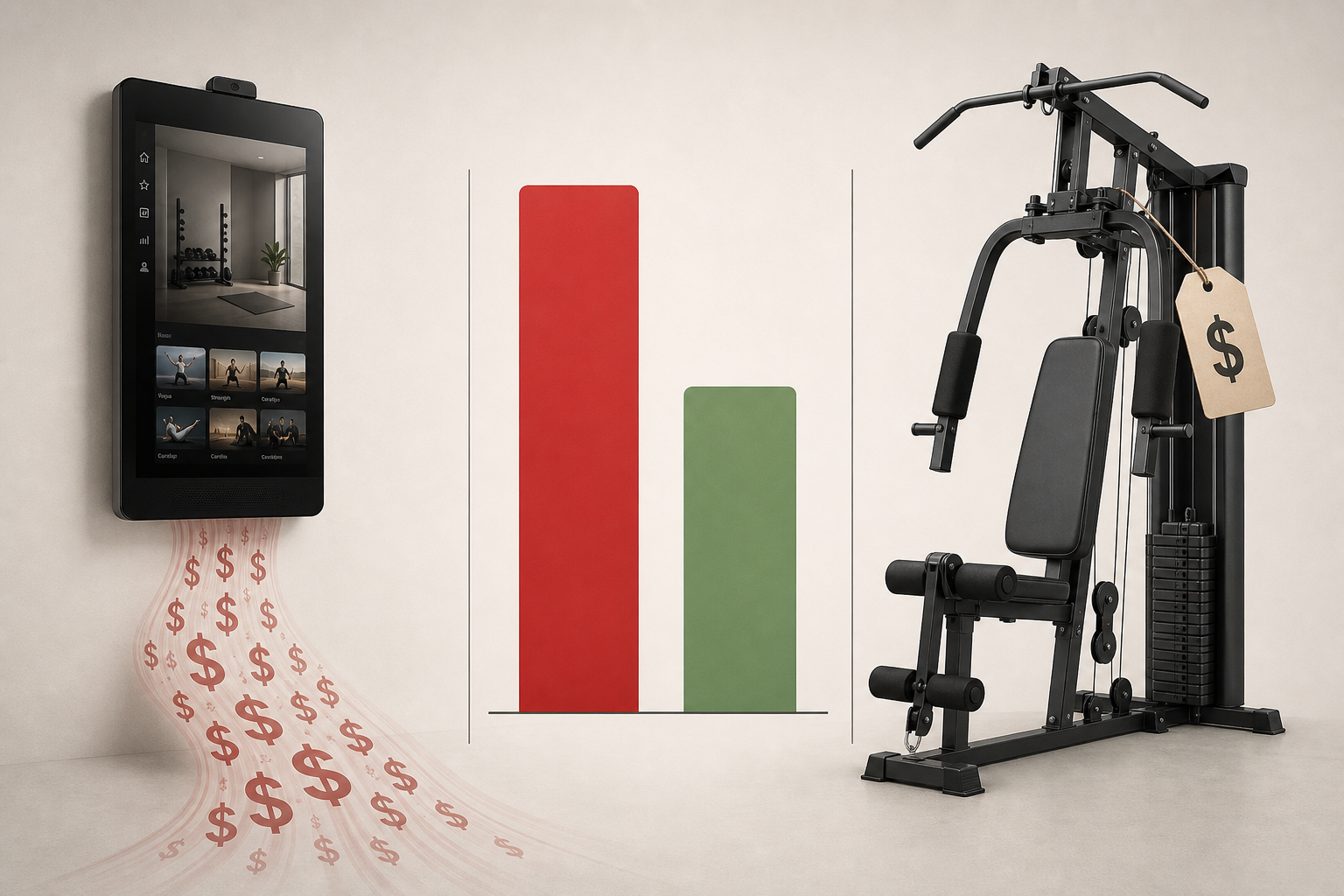
The purchase price is only the beginning. The subscription cost for a smart gym transforms a one-time equipment purchase into an ongoing expense that can exceed the machine's own price within a few years.
| Cost Component | Tonal 2 (Smart) | Speediance Gym Monster (Smart, No Sub) | Major Fitness B17 (Traditional) | Body-Solid EXM2500 (Traditional) |
|---|---|---|---|---|
| Purchase Price | $4,295 | $3,199 | $4,200 | ~$1,500 |
| Subscription (5 years) | $3,000 ($50/mo x 60 months) | $0 | $0 | $0 |
| Estimated Maintenance (5 years) | Low (electronics, minimal moving parts) | Low | Moderate (cable replacement, pulley maintenance) | Moderate |
| Total 5-Year Cost | ~$7,295 | ~$3,199 | ~$4,200 | ~$1,500 |
| Cost vs. B17 Baseline | 74% more expensive | 24% less expensive | Baseline | 64% less expensive |
The Tonal 2's five-year cost of $7,295 represents a 74% premium over the Major Fitness B17's $4,200 — and you still own a machine capped at 250 lbs of resistance. The Speediance Gym Monster, at $3,199 with no subscription, undercuts the B17 by 24% while still offering smart features, but it also caps out at 220 lbs total resistance.
For a deeper breakdown of how individual smart gym models compare on total cost of ownership, see our Tonal 2 vs Speediance Gym Monster 2 vs Tempo Move TCO analysis.
Durability and Serviceability: Can You Fix a Smart Gym When the Electronics Fail?
This is the dimension where the two categories diverge most sharply — and the one most buyer's guides gloss over. A traditional weight-stack machine is a mechanical system. When something breaks, it is almost always a cable, a pulley, or a selector pin. These parts are standardized, widely available, and replaceable with basic tools. A 5-year-old machine can be restored to like-new condition for under $100 in parts.
A smart gym is an electronic appliance. The digital resistance motor, the touchscreen, the sensor array, and the proprietary circuit boards are not user-serviceable. When they fail — and all electronics fail eventually — you are dependent on the manufacturer for repairs. If the company goes out of business, discontinues the model, or simply stops supporting it, your machine becomes a very large paperweight.
- Tonal 2 carries a 2-year limited warranty. After that, out-of-warranty repair costs are unknown and potentially significant.
- Speediance Gym Monster also has a 2-year warranty. Its freestanding design means fewer wall-mount integration points, but the digital resistance mechanism is still proprietary.
- Traditional machines from brands like Body-Solid routinely offer 5-year or lifetime warranties on frames and 1–2 years on cables and pulleys. Replacement cables cost $20–$50 and can be installed in under an hour.
- The Major Fitness B17 has a 1-year warranty, which is shorter than typical for this category. However, its mechanical design means most repairs are straightforward and parts are available through third-party suppliers.
There is also the question of software obsolescence. A smart gym's workout library, form-tracking algorithms, and user interface depend on ongoing software updates. If the manufacturer stops updating the platform — or if the company pivots to a new product line — your machine's functionality degrades over time. A weight stack does not have this problem. It does not need a firmware update to keep working.
For a deeper look at the real-world issues with all-in-one machines — including cable drag, assembly challenges, and hidden costs — read our article on what the reviews don't tell you.
Who Each Approach Suits Best: Training Style, Tech Comfort, and Budget
Neither approach is universally better. The right choice depends on how you train, how you prefer to be coached, and what you expect from your equipment over time.
| User Profile | Smart Gym (Tonal 2 / Speediance) | Traditional Weight Stack (B17 / EXM2500) |
|---|---|---|
| Training Style | Prefers guided, app-based programming; values variety and convenience | Prefers self-directed training; wants full control over sets, reps, and progression |
| Resistance Needs | Under 220–250 lbs total; beginner to intermediate strength levels | Unlimited progression; suitable for advanced lifters who need heavy loads |
| Tech Comfort | High; comfortable with subscriptions, apps, and connected devices | Low to moderate; prefers equipment that works without software or internet |
| Space Constraints | Very tight; wall-mounted or compact freestanding design is a priority | Moderate to generous; can dedicate 50+ sq ft to a permanent machine |
| Budget Approach | Willing to pay ongoing subscription for guided experience | Prefers one-time purchase with zero recurring costs |
| Longevity Expectation | 3–5 years; treats equipment as consumer electronics | 10+ years; expects equipment to outlast multiple training phases |
If you are a beginner who values guided programming, has limited space, and is comfortable with a subscription, a smart gym like the Tonal 2 or Speediance Gym Monster will deliver a better daily experience. If you are an intermediate or advanced lifter who needs heavy resistance, wants zero recurring costs, and plans to keep the same machine for a decade, a traditional weight-stack machine is the more rational investment.
For readers who need help allocating their budget across the $2,000–$5,000 range, our budget allocation guide provides a tier-by-tier breakdown.
The Hybrid Path: Traditional Rack with Smart Accessories
There is a third path that combines elements of both approaches: a traditional power rack or weight-stack machine paired with a smart accessory that adds digital resistance and app tracking without requiring a full ecosystem commitment.
The Beyond Power Voltra I ($2,199, 12.8 lbs, 200 lbs digital resistance, no subscription) is the most prominent example. It is a portable digital resistance device that attaches to a traditional rack or cable system, giving you app-based tracking and variable resistance without locking you into a subscription or a proprietary machine. It weighs under 13 pounds and can be moved between setups.
- You get the durability of a traditional rack (lifetime frame warranty, mechanical simplicity) with some smart features (digital resistance curves, app logging).
- No subscription required — the Voltra I's app and digital resistance are included in the purchase price.
- Resistance is capped at 200 lbs, which is lower than the Tonal 2's 250 lbs and well below what a weight stack can provide. This path is best for users who want smart features but do not need heavy loads.
- The hybrid approach avoids the obsolescence risk of a full smart gym: if the Voltra I stops being supported, your rack still works perfectly as a traditional setup.
This is not a compromise for everyone. But for the reader who wants the best of both worlds — the durability of traditional equipment and the engagement of smart features — the hybrid path is worth serious consideration.
Verdict: Which All-in-One Approach Wins for Long-Term Value?
There is no single winner. The answer depends on which variables you prioritize.
If you value guided training, space efficiency, and the engagement of a connected fitness experience — and you are comfortable with a subscription — a smart gym like the Tonal 2 or Speediance Gym Monster will deliver a better daily experience than any traditional machine. The Speediance Gym Monster, at $3,199 with no subscription, is the strongest value proposition in the smart gym category because it eliminates the recurring cost that makes the Tonal 2 so expensive over time.
If you prioritize unlimited resistance progression, zero recurring costs, and the confidence that your equipment will still be fully functional in 15 years, a traditional weight-stack machine is the clear choice. The Body-Solid EXM2500 at ~$1,500 offers the lowest total cost of ownership, while the Major Fitness B17 at $4,200 provides dual stacks and higher resistance capacity for serious lifters.
The hybrid path — a traditional rack paired with a smart accessory like the Beyond Power Voltra I — is the most interesting option for readers who want smart features without full ecosystem lock-in. It is not the cheapest or the most capable in any single dimension, but it may be the most future-proof.
This result comes from one real apartment under the stated conditions — it is a strong signal, not a guarantee your space will measure identically.
Builds this evidence supports
No build currently links to this specific test. Browse all builds with a matching tag.
Spot something off?
If this result didn't match your own space, let us know — floor-damage and noise claims carry real deposit-risk consequences if we get them wrong.