
Tonal 2 vs Speediance Gym Monster 2 vs Tempo Move: Total Cost of Ownership, Resistance, and Space Analysis for 2026
A transparent breakdown of upfront price, monthly subscription, max resistance, footprint, and long-term value across the top smart home gym systems, including a 1/3/5-year total cost analysis and gym-membership break-even comparison.
The Smart Home Gym Landscape in 2026 — Why Total Cost Matters More Than Sticker Price
The all-in-one smart home gym category has matured rapidly. What was once a niche dominated by a single player is now a three-way contest between wall-mounted digital resistance, freestanding electromagnetic systems, and compact free-weight platforms. Each approach delivers a genuinely different training experience, and each comes with a radically different price tag — but the sticker price tells only part of the story.
A $4,295 Tonal 2 with a $60 monthly subscription might seem like the most expensive option on paper. A $504 Tempo Move looks like the bargain. But when you model the full cost over three years — hardware, mandatory subscriptions, optional AI features, and essential accessories — the ranking flips. The system with the lowest entry price can end up costing more than a mid-range competitor, and the premium system can deliver the best per-use value for the right buyer.
This comparison focuses on three currently available systems that represent the distinct approaches to smart strength training: Tonal 2 (wall-mounted digital resistance), Speediance Gym Monster 2 (freestanding electromagnetic resistance), and Tempo Move (compact free-weight platform). We exclude the discontinued Tempo Studio and cardio-specific machines like the Peloton Bike, because the buyer evaluating an all-in-one strength system has fundamentally different needs — resistance range, progressive overload capability, and space integration — than someone shopping for a spin bike or treadmill.
Head-to-Head Comparison Table: Tonal 2, Speediance Gym Monster 2, and Tempo Move
The table below captures the core specs that matter most to a purchase decision. Use it as a quick-reference scan before diving into the detailed analysis.
| Spec | Tonal 2 | Speediance Gym Monster 2 | Tempo Move |
|---|---|---|---|
| Upfront Price | $4,295 (includes smart accessories, barbell, bench, mat, ropes, and delivery) | $2,999 (Gym Monster 2) or $2,499 (Gym Monster 2S, no screen) | $504 (includes weight plates, barbell, collars, mat, and heart rate monitor) |
| Max Resistance | 250 lbs (digital electromagnetic) | 220 lbs (Gym Monster 2) / 260 lbs (Gym Monster 2S) (digital electromagnetic) | 50 lbs (included plates); user can add own plates up to ~100 lbs |
| Subscription Cost | $60/month (Tonal+ required for core features) | $0 (basic use) / $24.90/month (AI Coach features) | $39/month (Tempo+ required for guided classes and form analysis) |
| Subscription Required? | Yes — Tonal+ is mandatory for all guided workouts and AI coaching | No — system works without subscription for manual mode | Yes — Tempo+ is required for guided classes and form feedback |
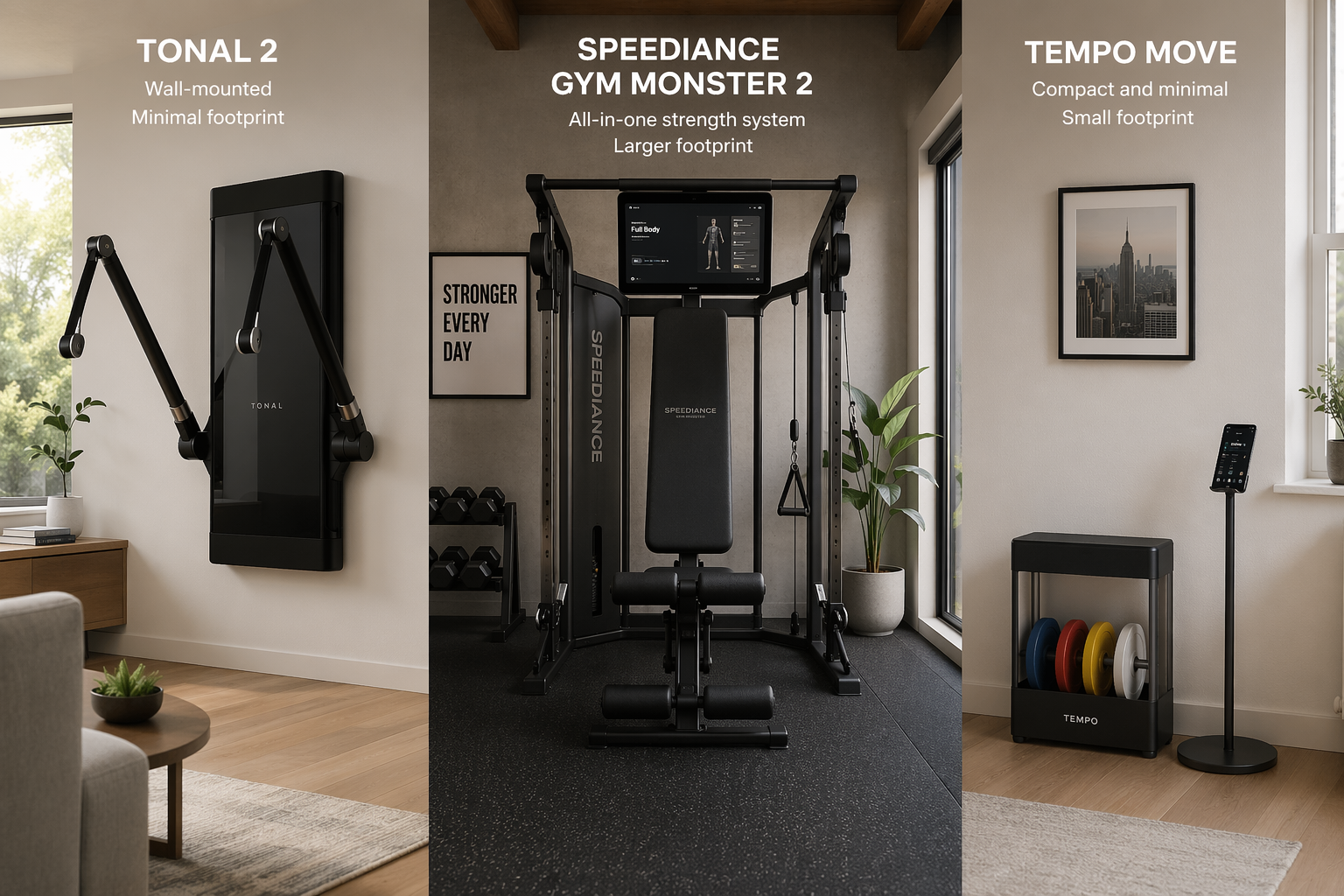
| Footprint | Wall-mounted; 21.5" wide x 47" tall; requires 7 ft ceiling height and 7 ft of clear floor space in front | Freestanding; 27" wide x 65" tall x 38" deep; requires about 6 ft x 6 ft of floor space | Compact; 24" wide x 18" deep (plate stand); requires about 4 ft x 6 ft of floor space and an iPhone 11 or newer |
| Installation | Professional installation required (stud mounting, 15A dedicated circuit); $250–$350 fee | Self-assembly (30–60 minutes); no wall mounting or electrical work needed | Self-assembly (15 minutes); no installation required |
| Warranty | 2 years parts and labor; extended warranty available | 1 year standard; extended warranty available | 1 year limited |
| Best For | Serious lifters who want digital resistance up to 250 lbs and AI coaching; have wall space and a dedicated circuit | Lifters who want digital resistance without subscription lock-in; renters who cannot mount equipment to walls | Free-weight enthusiasts on a budget; iPhone users who want guided classes with form feedback |
Deep Dive: How Each System Works and Who It's For
Tonal 2 — The Wall-Mounted Powerhouse
Tonal 2 is the most technologically sophisticated system in this comparison. It mounts directly to wall studs and uses dual digital electromagnetic arms to deliver up to 250 lbs of resistance. The system adjusts resistance in one-pound increments, tracks every rep with real-time form feedback, and uses AI to auto-regulate weight based on your performance in the previous set. The Tonal+ subscription ($60/month) is mandatory — without it, the system is essentially a very expensive wall decoration.
Who it's for: Serious lifters who want the closest thing to a full gym in a wall-mounted package. If you consistently train 4+ days per week and value AI-driven progressive overload, Tonal 2 is the best experience available. It also works well for couples or households with multiple users, since profiles and resistance settings are saved individually.
Who it's not for: Renters who cannot drill into walls, anyone without a dedicated 15-amp circuit near the installation location, or buyers who want to avoid a monthly subscription. If you're not sure you'll use it 3+ times per week, the $4,295 upfront plus $720/year in subscription fees is a steep commitment.
Speediance Gym Monster 2 — The Freestanding Value Champion
Speediance's Gym Monster 2 takes a different approach. It's a freestanding unit with a built-in 22-inch touchscreen and electromagnetic resistance that goes up to 220 lbs (260 lbs on the 2S model). The key differentiator: the subscription is optional. You can use the system in manual mode — selecting resistance, setting reps, and logging workouts — without paying a dime. The AI Coach features ($24.90/month) add guided workouts, form analysis, and auto-adjusting resistance, but they're not required to use the machine.
Who it's for: Lifters who want digital resistance without being locked into a subscription. The freestanding design makes it ideal for renters or anyone who can't mount equipment to walls. The 220–260 lb resistance range covers most home lifters well into intermediate strength levels.
Who it's not for: Buyers who want the absolute best AI coaching experience — Tonal's form feedback is more refined. Also not ideal for very small spaces, since the unit needs about 6 ft x 6 ft of clear floor area.
Tempo Move — The Compact Free-Weight Entry Point
Tempo Move is the most affordable entry point into smart home gyms, but it's a fundamentally different product. It's not a resistance machine — it's a free-weight system that uses your iPhone's camera and AI to track your form, count reps, and suggest weight adjustments. The $504 starter kit includes a plate stand, barbell, collars, weight plates (up to 50 lbs), a mat, and a heart rate monitor. You provide the iPhone (11 or newer) and the Tempo+ subscription ($39/month).
Who it's for: Free-weight enthusiasts who already own or plan to buy additional plates. The system works well for beginners and intermediate lifters who want guided classes with form feedback. The compact footprint makes it viable for apartments and small rooms.
Who it's not for: Serious strength athletes who need more than 100 lbs of resistance. The included plates top out at 50 lbs, and while you can add your own, the system's form analysis is calibrated for the included equipment. Also not ideal for Android users — the system requires an iPhone.
Total Cost of Ownership Analysis: 1-Year, 3-Year, and 5-Year Projections
This is the core of the analysis. The table below models the real cost of each system over three time horizons, including hardware, mandatory subscriptions, optional AI features (where applicable), and estimated essential accessories. We assume the buyer pays for the subscription continuously — no lapses — because the systems lose significant functionality without it.
| Cost Component | Tonal 2 | Speediance Gym Monster 2 | Tempo Move |
|---|---|---|---|
| Hardware (one-time) | $4,295 | $2,999 (GM2) / $2,499 (GM2S) | $504 |
| Installation / Setup | $300 (professional installation) | $0 (self-assembly) | $0 (self-assembly) |
| Year 1 Subscription | $720 ($60/mo x 12, mandatory) | $0 (manual mode) or $299 ($24.90/mo x 12, optional AI) | $468 ($39/mo x 12, mandatory) |
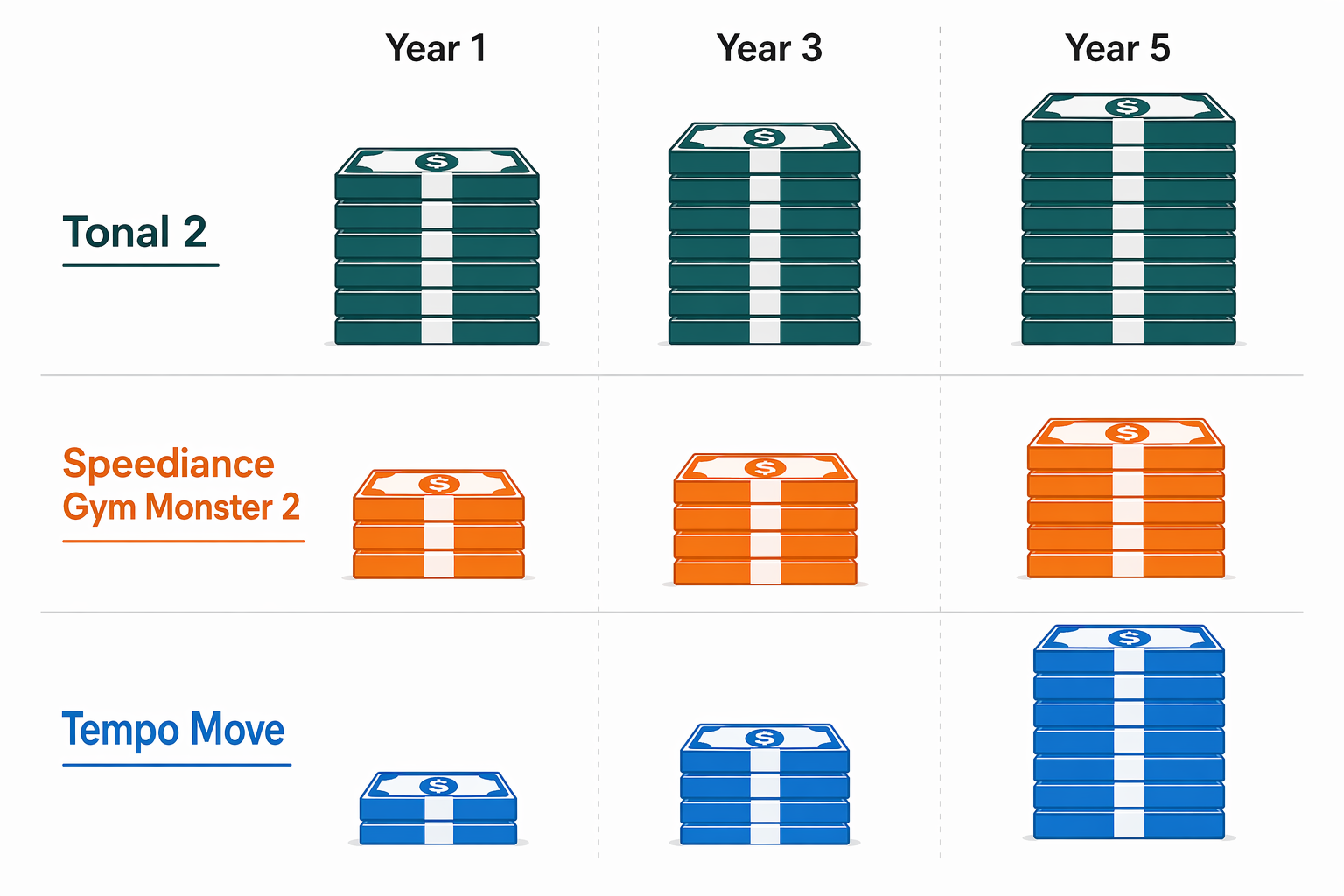
| Year 1 Total | $5,315 | $2,999 (manual) / $3,298 (with AI) | $972 |
| Year 3 Subscription (cumulative) | $2,160 ($720 x 3) | $0 (manual) / $897 ($299 x 3, optional AI) | $1,404 ($468 x 3) |
| Year 3 Total (cumulative) | $6,755 | $2,999 (manual) / $3,896 (with AI) | $1,908 |
| Year 5 Subscription (cumulative) | $3,600 ($720 x 5) | $0 (manual) / $1,495 ($299 x 5, optional AI) | $2,340 ($468 x 5) |
| Year 5 Total (cumulative) | $8,195 | $2,999 (manual) / $4,494 (with AI) | $2,844 |
The Speediance Gym Monster 2 in manual mode is the clear winner for buyers who want to avoid subscription lock-in. At $2,999 total over five years with no monthly fees, it costs less than Tonal 2's first year alone. Even with the optional AI Coach subscription, Speediance's five-year total ($4,494) is still significantly less than Tonal 2's five-year cost ($8,195).
Tonal 2's high upfront cost and mandatory subscription make it the most expensive option by a wide margin at every time horizon. However, for the buyer who trains consistently, the per-use cost can be competitive. At 4 sessions per week over 5 years (1,040 sessions), Tonal 2's cost per workout is about $7.88 — comparable to a premium gym membership.
Space and Installation Comparison: Wall-Mount vs Freestanding vs Compact
Space constraints are often the deciding factor in a smart home gym purchase. The three systems have fundamentally different installation requirements that go beyond simple footprint measurements.
| Requirement | Tonal 2 | Speediance Gym Monster 2 | Tempo Move |
|---|---|---|---|
| Mounting Type | Wall-mounted (must attach to studs) | Freestanding (no wall attachment) | Freestanding (no wall attachment) |
| Minimum Ceiling Height | 7 ft (recommended 8 ft for overhead pressing) | 7 ft | None (standard room height works) |
| Clear Floor Space | 7 ft wide x 7 ft deep in front of unit | 6 ft x 6 ft | 4 ft x 6 ft |
| Electrical Requirement | Dedicated 15-amp circuit within 6 ft of unit | Standard 120V outlet (no dedicated circuit needed) | None (iPhone battery only) |
| Flooring Consideration | Standard flooring OK; mat recommended for dropped weights | Standard flooring OK; mat recommended | Standard flooring OK; mat included |
| Noise Level | Low (digital resistance, no weight plates clanging) | Low (digital resistance, no weight plates clanging) | Moderate (free-weight plates clang on barbell) |
| Installation Complexity | High — requires professional installer, stud finder, and electrical work | Low — self-assembly with included tools | Very low — unbox and place |
For apartment dwellers and renters, the choice is straightforward: Speediance or Tempo Move. Neither requires wall mounting or electrical work. Speediance's larger footprint (6 ft x 6 ft) may be a challenge in a small apartment, but its freestanding design means you can move it between rooms or take it with you when you move. Tempo Move's compact footprint and minimal setup make it the most landlord-friendly option.
Homeowners with a dedicated space — a garage, basement, or spare room — have the most flexibility. Tonal 2's wall-mounted design saves floor space and creates a clean, permanent installation. Speediance works well in a corner or against a wall. Tempo Move can be tucked into a closet when not in use.
Training Experience: Resistance Type, AI Coaching, and Class Library Depth
The training experience varies significantly across these systems, and the right choice depends on how you prefer to train.
Resistance Type and Progressive Overload
Tonal 2 and Speediance both use electromagnetic resistance, which provides consistent tension throughout the full range of motion. This is a genuine advantage over free weights for exercises like bicep curls and shoulder raises, where cable-based resistance maintains tension at the top of the movement. Tonal 2's one-pound resistance increments allow for precise progressive overload — you can add exactly one pound per session, which is ideal for linear progression programs.
Tempo Move uses traditional free-weight resistance. This means you're limited to the plates you own (50 lbs included, up to ~100 lbs with additional plates), and progression happens in 5–10 lb jumps. For beginners, this is fine. For intermediate lifters, the gap between 50 lbs and 100 lbs may come quickly, and buying additional plates adds to the total cost.
AI Coaching and Form Feedback
Tonal 2's AI coaching is the most refined in the category. The system tracks every rep, identifies when you're struggling or accelerating through a movement, and adjusts resistance mid-set. It also offers real-time form corrections through the Tonal+ subscription. Speediance's AI Coach ($24.90/month) provides guided workouts and auto-adjusting resistance, but the form feedback is less granular than Tonal's.
Tempo Move's form analysis relies on your iPhone's camera and the Tempo+ app. It tracks your movement patterns and provides visual feedback on your phone screen. The accuracy depends on camera placement and lighting — it works best in a well-lit room with the phone positioned 6–8 feet away.
Class Library and Programming Depth
| Feature | Tonal 2 | Speediance Gym Monster 2 | Tempo Move |
|---|---|---|---|
| Class Library Size | 1,000+ workouts across strength, cardio, yoga, and recovery | 500+ workouts (growing); strength-focused | 800+ workouts; strength, HIIT, yoga, and recovery |
| Program Types | Multi-week programs, single workouts, custom routines, and live classes | Multi-week programs and single workouts; no live classes | Multi-week programs, single workouts, and live classes |
| Custom Workout Builder | Yes — build your own routines with any exercise in the library | Yes — limited custom workout creation | No — must follow guided classes or use manual mode |
| Multi-User Profiles | Yes — unlimited profiles with individual resistance settings | Yes — up to 6 profiles | Yes — unlimited profiles |
| Offline Mode | No — requires internet connection for all features | Yes — manual mode works offline; AI features require internet | No — requires internet connection for guided classes |
Decision Framework: Which System for Which Buyer?
Use the framework below to match your situation to the right system. The recommendations are based on the total cost of ownership analysis, space requirements, and training experience data above.
By Budget Tier
- Under $1,000 total (Year 1): Tempo Move ($972 Year 1). The only option that fits this budget. Accept the 50 lb resistance ceiling and mandatory subscription.
- $1,000–$3,000 total (Year 1): Speediance Gym Monster 2S ($2,499 + $0 subscription). Best value in this range — digital resistance up to 260 lbs with no monthly fees. Tempo Move also fits here but offers less resistance.
- $3,000–$5,500 total (Year 1): Tonal 2 ($5,315 Year 1). Only choose this if you're committed to 4+ sessions per week and value AI coaching. Speediance with AI Coach ($3,298 Year 1) is the smarter financial choice for most buyers in this range.
By Training Goal
- Serious strength building (progressive overload, 200+ lb resistance): Tonal 2 (250 lbs, 1 lb increments) or Speediance Gym Monster 2S (260 lbs, 5 lb increments). Tonal 2 has better progressive overload tools; Speediance has higher max resistance.
- General fitness and weight loss (guided classes, moderate resistance): Tempo Move. The class library is strong, the form feedback is helpful for beginners, and the price is accessible.
- Hybrid training (strength + cardio + recovery): Tonal 2. Its library includes yoga, mobility, and recovery workouts alongside strength programming. Tempo Move also offers a good mix.
By Space Constraint
- Apartment / small room (under 100 sq ft available): Tempo Move (4 ft x 6 ft) or Speediance Gym Monster 2 (6 ft x 6 ft). Tempo Move is more compact; Speediance offers better resistance.
- Dedicated home gym room (100+ sq ft): Tonal 2 (wall-mounted, saves floor space) or Speediance Gym Monster 2 (freestanding, easy to move). Both work well in a dedicated space.
- Rental property (cannot mount to walls): Speediance Gym Monster 2 or Tempo Move. Neither requires wall mounting or permanent installation.
Gym Membership Break-Even Analysis
One way to evaluate whether a smart home gym is worth the investment is to compare it against the cost of a traditional gym membership. The table below shows how many months of a $50/month gym membership it takes to break even on each system's total cost.
| System | Year 1 Total | Months of $50 Gym Membership to Break Even (Year 1) | Year 5 Total | Months of $50 Gym Membership to Break Even (Year 5) |
|---|---|---|---|---|
| Tonal 2 | $5,315 | 106 months (8.8 years) | $8,195 | 164 months (13.7 years) |
| Speediance GM2 (manual) | $2,999 | 60 months (5 years) | $2,999 | 60 months (5 years) |
| Speediance GM2 (with AI) | $3,298 | 66 months (5.5 years) | $4,494 | 90 months (7.5 years) |
| Tempo Move | $972 | 19 months (1.6 years) | $2,844 | 57 months (4.8 years) |
This result comes from one real apartment under the stated conditions — it is a strong signal, not a guarantee your space will measure identically.
Builds this evidence supports
Cable Machine Alternatives That Save Space and Money
Compare the best cable machine alternatives for home gyms – from resistance bands and pulley systems to suspension trainers and compact digital units – and find the right option for your space and budget.
How to Choose a Compact Home Gym That Works for Your Space, Budget, and Noise Tolerance
This article provides a structured decision framework for apartment dwellers and small-space residents to match their specific floor footprint, noise sensitivity, and budget to the most suitable compact home gym strategy — whether that's an all-in-one machine, modular build, smart digital system, or band/bodyweight setup.
The Garage Gym Reality Check: What Equipment Actually Fits in a Single-Car Garage
Most garage gym guides assume a two-car space. This article uses real dimensions, real equipment footprints, and three layout templates to show what fits—and what doesn't—in a single-car garage (10x20 to 12x20 ft).
Spot something off?
If this result didn't match your own space, let us know — floor-damage and noise claims carry real deposit-risk consequences if we get them wrong.