
Smart Home Gym vs. Traditional Weights: A Decision Guide for Your Space, Budget, and Goals
Choosing between a smart all-in-one system and a traditional rack-and-barbell setup isn't about which is 'better' — it's about which fits your space, coaching needs, resistance ceiling, and long-term costs. This guide breaks down the trade-offs across six key dimensions and helps you decide with a simple flowchart.
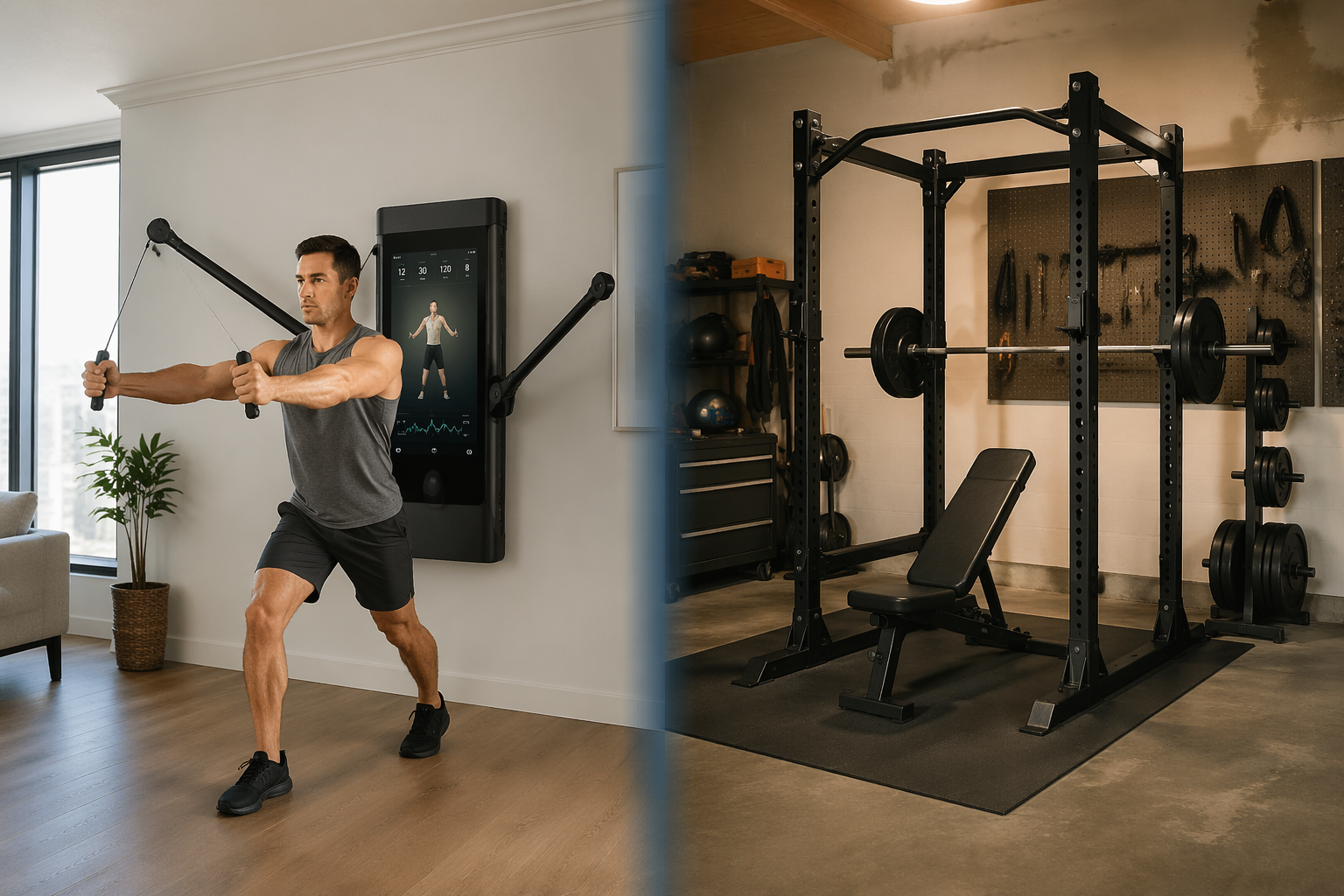
The Fundamental Question: What Do You Actually Need?
Every week, someone posts the same question in a home gym forum: "Should I buy a smart gym or just get a rack and some plates?" The replies are almost always split along tribal lines. The smart-gym crowd talks about guided coaching and a clean living-room footprint. The iron crowd talks about durability, progressive overload without a paywall, and the feel of a loaded barbell.
Both sides are right — for their own situation. The problem is that most advice frames this as a winner-take-all debate. It isn't. The right choice depends on how you answer a handful of specific questions about your space, your self-coaching ability, the resistance you need, and what you want your equipment to look like five years from now.
We will walk through the ideal user profile for each setup, compare them head-to-head across six dimensions, explore a hybrid middle ground, and finish with a five-question decision framework that routes you to a clear recommendation. No tribal allegiance required.
Smart Home Gyms: Who They Serve Best
A smart home gym system — think Tonal, Speediance, Tempo, or the AEKE K1 — is essentially a strength-training computer. It uses digital resistance (electromagnetic or motor-driven), a touchscreen interface, and software that guides you through workouts, tracks your progress, and adjusts the load automatically. Some models fold flat against a wall or store in a closet when not in use.
These systems are not designed for everyone, but they are an excellent fit for three specific profiles.
Apartment Dwellers and Small-Space Users
The most obvious advantage of a smart gym is its footprint. Most smart systems require between 10 and 50 square feet of floor space, according to the AEKE buying guide. A wall-mounted unit like the Tonal 2 takes up roughly the same wall area as a large mirror. Foldable models such as the AEKE K1 claim a storage footprint of about 3.2 square feet. Compare that to a traditional power rack, barbell, plates, and bench, which typically needs 80 to 150 square feet — roughly the size of a single-car garage bay or a spare bedroom.
If you live in an apartment and do not have a dedicated room for a gym, a smart system is often the only way to get meaningful resistance training at home without turning your living space into a weight room.
Beginners Who Want Guided Coaching
One of the strongest arguments for a smart gym is the built-in coaching layer. The software tells you which exercise to do, how many reps to aim for, when to increase or decrease weight, and often corrects your form using camera-based motion tracking or AI analysis. For someone who has never run a structured strength program, this removes the paralysis of not knowing what to do next.
If you want a deeper look at how AI coaching, digital resistance, and connected fitness features actually work, our companion guide on what makes a home gym smart in 2026 covers the technology in detail.
Households Sharing a Single System
Smart gyms handle multiple user profiles natively. Each family member can have their own login, workout history, and personalized resistance settings. The system remembers where each person left off and adjusts the load automatically. With a traditional setup, sharing means constantly changing plate loads, adjusting the bench height, and resetting the J-hooks — a minor friction that adds up over time.
Traditional Setups: Who They Serve Best
A traditional home gym — a power rack, barbell, weight plates, adjustable bench, and perhaps a set of dumbbells — is the default choice for a reason. It has been the gold standard for strength training for decades because it is simple, infinitely scalable, and built to last.
But it is not the right choice for everyone. Here is who it serves best.
Experienced Lifters Who Need Heavy Resistance
The most significant limitation of smart gyms is their resistance ceiling. Most smart systems max out between 100 and 250 pounds of resistance. The Tonal 2 tops out at 250 lbs, the Speediance Gym Monster at 220 lbs, and the average across all smart gym models is about 186 lbs, according to Garage Gym Reviews. A traditional barbell setup, by contrast, can easily handle 500 pounds or more. If you are an intermediate or advanced lifter who needs to squat, deadlift, or bench press well over 200 pounds, a smart gym will limit your progress within a year or two.
DIY Programmers Who Reject Subscription Lock-In
Traditional equipment has zero ongoing costs. You buy it once, and it works forever. A smart gym with a required subscription can cost $6,100 to $9,600 over five years when you add up the hardware and monthly fees, according to the AEKE guide. Even a subscription-free smart gym runs $3,200 to $5,500 over the same period. A traditional rack-and-barbell setup costs $1,500 to $3,000 — one time. If you already know how to program your own training and do not need software guidance, paying a monthly fee for coaching you will not use is hard to justify.
Lifters with Dedicated Space
If you have a garage, basement, or spare room that you can dedicate to training, the space argument for a smart gym disappears. A traditional setup in 80 to 150 square feet gives you full range of motion for every major compound lift, room to move around, and the ability to add accessories over time. The resale value is also a meaningful factor: traditional strength equipment holds 40 to 60 percent of its original price after three years, according to market data compiled by Chest Press Machine. Smart gyms, by contrast, carry platform dependency risk — a secondhand buyer has to factor in whether the subscription and software ecosystem will still be supported.
Head-to-Head Comparison: Six Key Dimensions
The table below summarizes the trade-offs across the six dimensions that matter most when choosing between a smart gym and a traditional setup. Cost is included, but it is one factor among several — not the headline.
| Dimension | Smart Home Gym | Traditional Setup |
|---|---|---|
| Floor space required | 10–50 sq ft (some fold to ~3 sq ft) | 80–150 sq ft |
| Resistance ceiling | 100–250 lbs typical (avg ~186 lbs) | 500+ lbs (unlimited with plate additions) |
| Coaching / guidance | Built-in AI coaching, form correction, auto-progression | Self-directed (requires programming knowledge) |
| 5-year total cost (subscription-free) | $3,200–$5,500 | $1,500–$3,000 (one-time) |
| 5-year total cost (subscription-required) | $6,100–$9,600 | N/A (no subscription option) |
| Durability / longevity | Depends on software support and hardware lifecycle | 20+ years with quality gear |
| Resale value after 3 years | Lower; platform dependency reduces buyer pool | 40–60% of original price |
The Hybrid Approach: Combining the Best of Both Worlds
You do not have to choose one camp exclusively. A growing number of home gym owners are building hybrid setups that combine a piece of smart equipment with traditional free weights. The idea is to use each tool for what it does best.
A common hybrid configuration looks like this:
- A smart cable trainer (such as the MAXPRO or Voltra I) for guided cable exercises, lat pulldowns, rows, and accessory work where the digital coaching and variable resistance add real value.
- A set of adjustable dumbbells (like the REP Fitness or Bowflex models) for compound free-weight movements — dumbbell bench press, goblet squats, rows — where you want the feel of real iron and the ability to go heavy without a subscription.
- A pull-up bar or resistance bands for bodyweight work and warm-ups.
This approach keeps the total footprint under 30 square feet, gives you guided coaching for the exercises that benefit from it, and preserves the ability to lift heavy on the movements that matter most. It also avoids the full subscription cost of an all-in-one smart gym — you pay for the smart cable trainer's subscription (if it has one) but not for the dumbbells.
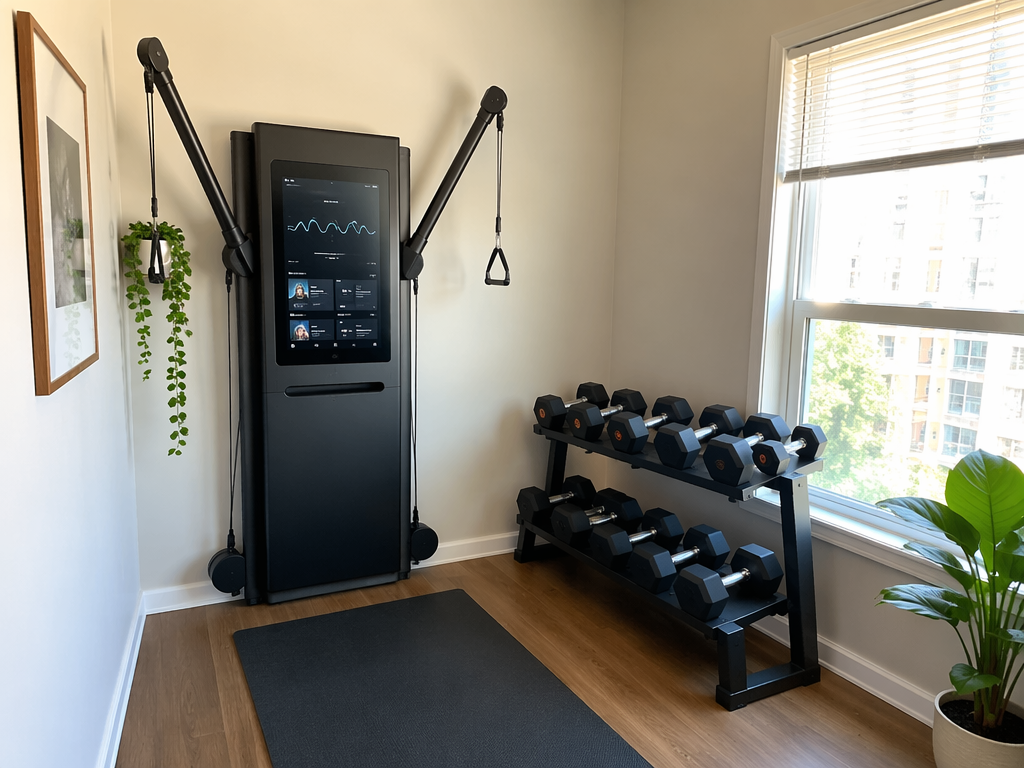
If this sounds like a viable middle ground, our comparison of all-in-one vs. modular home gym setups under $3,000 goes deeper into the cost and space trade-offs of building a modular system versus buying a single all-in-one unit.
Decision Flowchart: 5 Questions to Determine Your Path
If you are still unsure which direction to take, work through these five questions in order. Each answer narrows the field until a clear recommendation emerges.
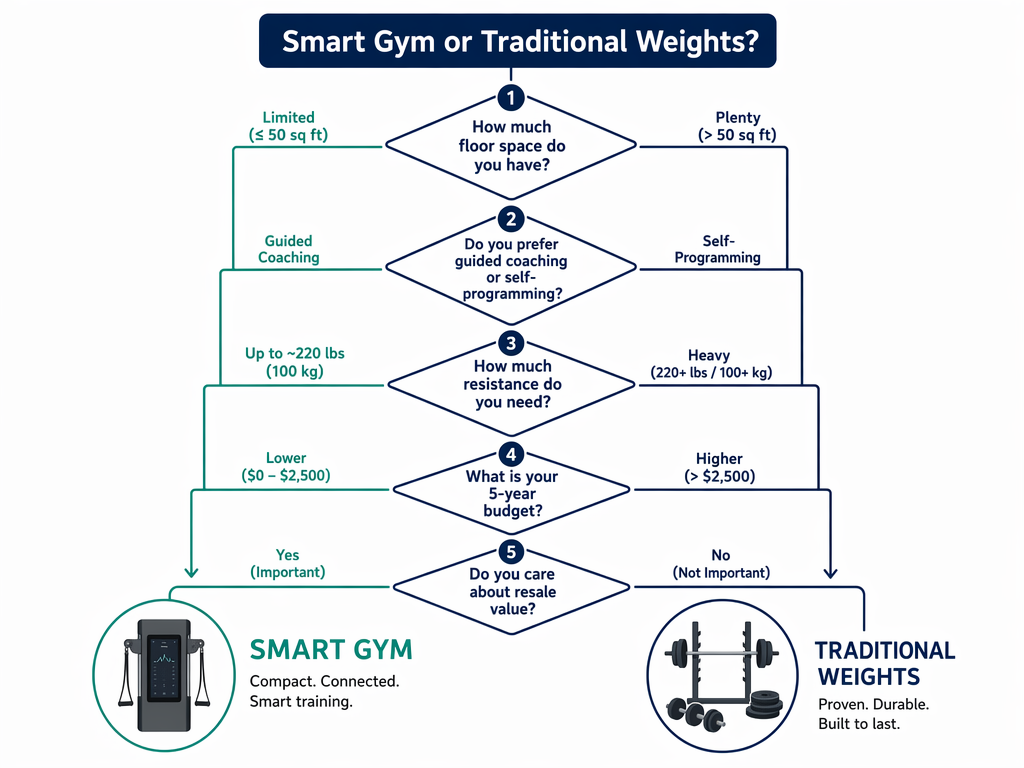
Question 1: How much dedicated floor space do you have?
If you have less than 50 square feet of usable floor space — or you need the equipment to disappear when not in use — a smart gym is the practical choice. If you have 80 square feet or more and can dedicate that space permanently, a traditional setup becomes viable.
Question 2: Do you need guided coaching to follow a program?
If you are a beginner who does not know how to structure a strength program, or you simply prefer having a coach tell you what to do each session, a smart gym's built-in guidance is a genuine advantage. If you already know how to program your own training or are willing to follow a free template from a reputable source, you do not need the coaching layer.
Question 3: Do you need more than 200 pounds of resistance?
This is the most binary question on the list. If your training requires heavy squats, deadlifts, or bench presses above 200 pounds — now or within the next year — a smart gym will not work for you. You need a traditional barbell setup. If you stay under 200 pounds for most exercises, a smart gym can handle your needs.
Question 4: What is your total budget over 5 years?
If your budget is under $3,000 total, a traditional setup is the only way to get a complete gym without compromising on quality. If you have $3,200 to $5,500 and want a subscription-free smart gym, or $6,000+ and are comfortable with a subscription, a smart system is within reach.
Question 5: How much do you care about resale value and long-term durability?
If you want equipment that will last 20 years and hold 40–60% of its value if you sell it, traditional gear wins. If you are comfortable with the possibility that a smart gym's software platform may become obsolete or unsupported within 5–10 years, and you accept that resale will be lower, a smart system is still a reasonable choice.
For a more general framework that covers the full home gym buying process — including how to match equipment to your specific goal, available days per week, and space — see our first-time home gym buyer's decision framework.
Real-World Example: Two $3,000 Budgets, Two Opposite Setups
To show how the same budget can lead to completely different — and equally valid — outcomes, here are two personas who each spend roughly $3,000 but end up with opposite setups.
Persona A: The Apartment Beginner (Smart Gym Path)
Maya lives in a 700-square-foot apartment. She has never followed a structured strength program. Her available floor space for a gym is a 4x6-foot corner of her living room. She wants equipment that does not dominate the room and that tells her what to do each session.
Her $3,000 budget goes toward a subscription-free smart gym system in the $2,500–$3,000 range (such as the Speediance Gym Monster at $3,199 with the option to skip the subscription, or a comparable model). She spends the remaining budget on a thick yoga mat for floor work and a small wall-mounted storage rack for accessories. Her total footprint is under 15 square feet. She gets guided workouts, auto-progression, and the ability to fold the unit away when guests come over.
Maya's setup works because her resistance needs are under 200 pounds for the foreseeable future, she values coaching over raw load, and her space constraint makes a traditional rack impossible.
Persona B: The Garage Lifter (Traditional Path)
Carlos has a two-car garage and has been lifting on and off for five years. He knows how to run a 5x5 program and does not want anyone telling him what to do. He needs to squat and deadlift over 300 pounds.
His $3,000 budget buys a complete traditional setup: a REP PR-4000 power rack starting around $950, a REP Fitness Colorado Bar at $300, a set of Fringe Sport Black Bumper Plates at roughly $1.79 per pound (about $540 for 300 pounds), and the Titan Fitness Titan Series Adjustable Weight Bench at $635. That totals approximately $2,425, leaving room for stall mats for flooring and a few accessories. He has zero ongoing costs, equipment that will outlast him, and the ability to add weight plates incrementally as he gets stronger.
Carlos's setup works because he has the space, the self-coaching ability, and the resistance requirements that a smart gym cannot meet.
The takeaway is straightforward: there is no universally superior setup. The best home gym is the one that matches your space, your coaching needs, your resistance requirements, and your budget — and that you will actually use consistently. Run through the five questions above, be honest about your constraints, and pick the path that fits.
This result comes from one real apartment under the stated conditions — it is a strong signal, not a guarantee your space will measure identically.
Builds this evidence supports
Cable Machine Alternatives That Save Space and Money
Compare the best cable machine alternatives for home gyms – from resistance bands and pulley systems to suspension trainers and compact digital units – and find the right option for your space and budget.
How to Choose a Compact Home Gym That Works for Your Space, Budget, and Noise Tolerance
This article provides a structured decision framework for apartment dwellers and small-space residents to match their specific floor footprint, noise sensitivity, and budget to the most suitable compact home gym strategy — whether that's an all-in-one machine, modular build, smart digital system, or band/bodyweight setup.
The Garage Gym Reality Check: What Equipment Actually Fits in a Single-Car Garage
Most garage gym guides assume a two-car space. This article uses real dimensions, real equipment footprints, and three layout templates to show what fits—and what doesn't—in a single-car garage (10x20 to 12x20 ft).
Spot something off?
If this result didn't match your own space, let us know — floor-damage and noise claims carry real deposit-risk consequences if we get them wrong.