
All-in-One vs. Modular Home Gym: Which Approach Saves You Money and Space Under $3,000?
For budget-conscious buyers with $1,000–$3,000 to spend and limited floor space, this article compares the true cost-per-exercise and space-per-exercise of an all-in-one machine versus building a modular setup piece-by-piece, including a break-even analysis against a gym membership.
The $3,000 Question: One Machine or Many?
If you have between $1,000 and $3,000 to spend on a home gym and a corner of a spare room or garage to fill, you face a fork in the road. Do you buy a single all-in-one machine that promises to handle squats, presses, rows, pulldowns, and cable work in one footprint? Or do you assemble a modular setup piece by piece — a rack, a bench, a barbell, plates, and a separate cable attachment — betting that flexibility now will pay off later?
This is not a theoretical question. According to a survey of more than 1,000 home gym owners conducted by Strong Home Gym, the average home gym costs $3,141. That figure sits right at the upper edge of our budget range, which means most buyers in this bracket are making a single, high-consideration purchase — not an open-ended collection. The choice between all-in-one and modular is the single biggest decision that determines how much usable exercise variety you get per dollar and per square foot.
This article breaks down the decision along four axes: what each approach actually includes for your money, how much floor space each consumes, the hidden costs that inflate the total, and a break-even analysis against a typical gym membership. The goal is not to declare a universal winner — it is to give you a framework that maps to your budget, your space, and your tolerance for future upgrades.
What You Actually Get for Your Money: All-in-One vs. Modular Cost Breakdown
The core difference between the two approaches is how the manufacturer allocates your budget. An all-in-one machine bundles a squat station, a cable pulley system, and often a leg press or leg extension attachment into a single welded frame. A modular setup spreads the same budget across separate components, each with its own footprint, shipping cost, and assembly requirement.
To make the comparison concrete, consider three price tiers within the $1,000–$3,000 range. The table below maps what a typical all-in-one delivers versus a modular build at each level, using real-world examples from the current market.
| Price Tier | All-in-One Example | What It Includes | Modular Equivalent | What It Includes |
|---|---|---|---|---|
| $1,000–$1,500 | Bells of Steel All-in-One Home Gym (starting at $1,299.99) | Squat rack, functional trainer with dual 200 lb. weight stacks, pull-up bar, J-hooks, dip handles. Footprint: 54.6" D x 59" W x 81" H. | Budget squat stand + Olympic barbell + 255 lb. bumper plate set + adjustable bench | Basic squat stand (no pull-up bar), standard barbell, iron plates, flat/incline bench. No cable system. |
| $1,500–$2,500 | Bells of Steel All-in-One (loaded configuration, ~$1,900) | Same frame with upgraded weight stacks, lat pulldown seat, leg hold-down, and optional cable handles. | Semi-commercial squat rack + barbell + 300 lb. plate set + adjustable bench + plate-loaded cable tower | Sturdier rack with pull-up bar, better barbell, bumper plates, adjustable bench, and a separate cable tower (often plate-loaded). Requires more floor space. |
| $2,500–$3,000 | Force USA G20 or similar multi-stack all-in-one | Integrated squat rack, dual 200 lb. weight stacks, leg press, leg extension/curl, lat pulldown, low row. 11-gauge steel frame. | Dedicated power rack + Olympic barbell + 350 lb. plate set + premium adjustable bench + selectorized functional trainer | Full power rack with safety bars, high-quality barbell, iron or bumper plates, commercial-grade bench, and a separate functional trainer with selectorized weight stacks. |
The pattern is clear: at every tier, the all-in-one machine delivers more exercise stations per dollar. At the $1,000–$1,500 level, a modular setup cannot include a cable system at all — you would need to spend at least $400–$600 on a separate cable tower, pushing the total well past $1,500. At the $2,500–$3,000 level, the modular setup finally matches the all-in-one's exercise variety, but it occupies significantly more floor space and requires assembling three or four separate pieces of equipment.
Space Showdown: 20–30 Square Feet vs. a Growing Collection
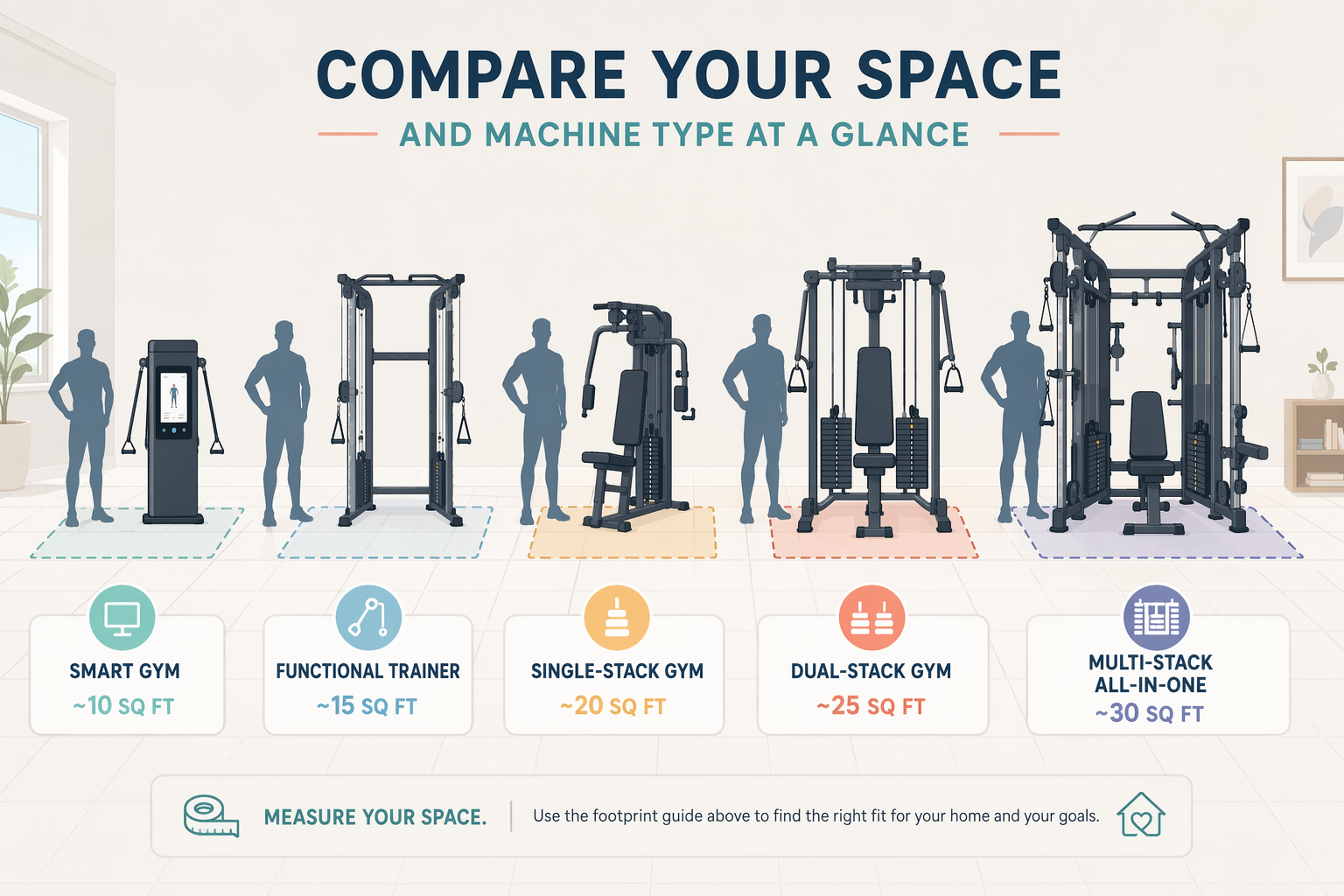
Floor space is the second non-negotiable constraint. An all-in-one machine centralizes every exercise into a single footprint. The Bells of Steel All-in-One Home Gym, for example, occupies roughly 4.5 feet by 5 feet — about 22.5 square feet. A multi-stack unit like those from Force USA or Body-Solid may require a footprint of roughly 7 feet by 10 feet, or about 70 square feet, but that single zone replaces what would otherwise be three or four separate equipment zones.
A modular setup with equivalent exercise variety — a power rack, a bench, a barbell with plates, and a separate cable tower or functional trainer — typically requires 40 to 60 square feet of dedicated floor space, and that is before accounting for the clearance needed to load plates, rerack the barbell, and move between stations. In practice, many modular setups end up occupying 50–80 square feet once you factor in the space needed to actually use the equipment.
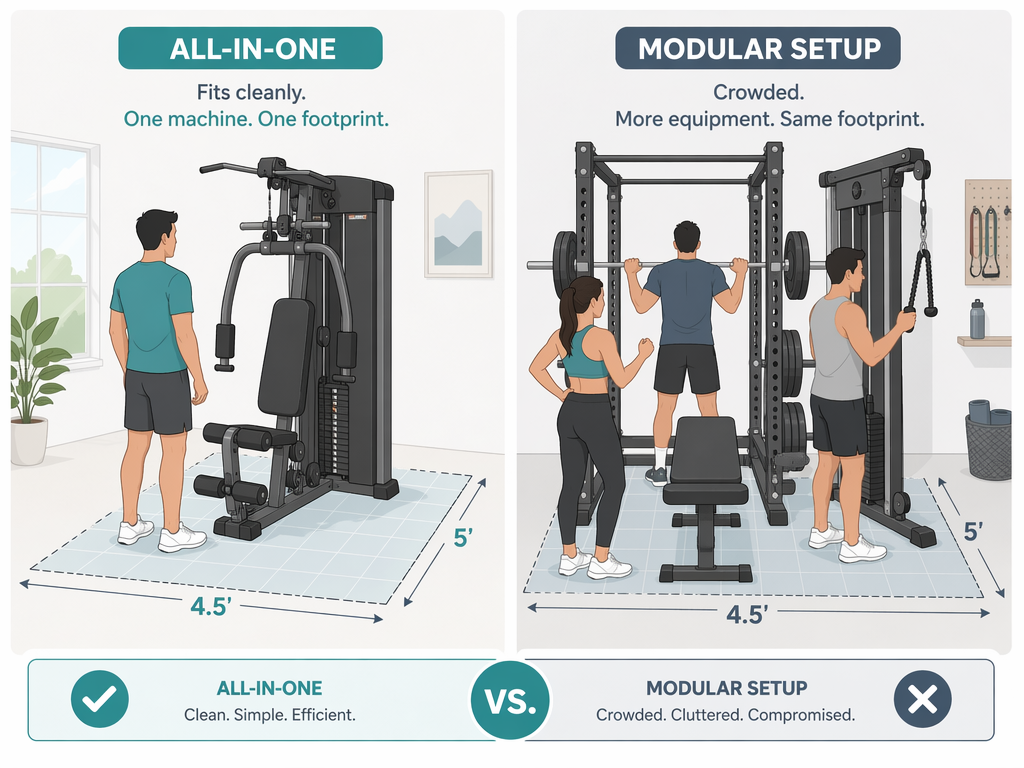
For apartment dwellers and small-space users, the all-in-one has a clear advantage: one machine, one footprint, one zone to clear. The modular approach forces you to either rearrange equipment between exercises — rolling a cable tower into position, moving a bench — or dedicate permanent floor space to each station. If your available space is under 40 square feet, the all-in-one is almost certainly the more practical choice.
The Hidden Costs Nobody Talks About: Assembly, Attachments, Subscriptions, and Warranties
The purchase price is only the beginning. Four categories of hidden cost separate the all-in-one and modular approaches, and ignoring them can turn a $1,500 budget into a $2,500 reality.
Assembly Time
Assembly is the most immediate hidden cost. The Force USA G20, a popular multi-stack all-in-one, has an assembly time that Strong Home Gym describes as "the biggest job we've ever taken on for a piece of home gym kit," estimating a solo build at around 35 hours. In contrast, smart gyms like the Speediance ship roughly 80% pre-assembled and can be set up in under 90 minutes. Modular setups fall somewhere in between: a power rack might take 2–4 hours, a cable tower another 2–3 hours, and a bench maybe 30 minutes — but you are doing that work three or four times, often with different tools and instructions.
If your time is valuable, or if you do not have a second person to help with heavy frame assembly, the all-in-one's single build — even if it is a long one — may still be preferable to coordinating multiple deliveries and builds.
Proprietary Attachment Ecosystems
This is the hidden cost that most comparison articles omit. Many all-in-one machines use proprietary upright sizing that limits your ability to add third-party attachments later. The Bells of Steel All-in-One Home Gym uses 2.3" x 2.3" uprights, while the Force USA G20 uses 2" x 2" uprights. Neither is compatible with the standard 3" x 3" or 2" x 3" uprights used by most power racks and modular systems.
This means that if you buy an all-in-one with proprietary uprights, your future attachment options are limited to what the manufacturer sells. You cannot add a landmine attachment from Rogue, a dip station from Rep Fitness, or a monolift from Titan. If you anticipate upgrading or expanding your gym over time, a modular setup with standard upright sizing gives you a much wider attachment ecosystem.
Subscription Fees
Smart all-in-one machines like the Tonal require a $50+/month membership to access their full feature set, including guided workouts, progress tracking, and the content library. Over five years, that adds $3,000 or more to the total cost of ownership — potentially doubling the machine's purchase price. Traditional weight-stack all-in-one machines and modular setups have no subscription requirement, though some modular cable towers offer optional app connectivity.
If you are budget-conscious and plan to keep your equipment for 5+ years, a subscription-free all-in-one or a modular setup will almost certainly be cheaper in the long run than a smart gym with a mandatory membership.
Warranty Differences
Warranty coverage varies dramatically between brands and approaches. The Bells of Steel All-in-One Home Gym comes with a limited lifetime warranty on the frame and a 1-year warranty on parts. The Major Fitness B17 Flying Fortress, by contrast, has only a 1-year warranty on the entire machine. Modular components from reputable brands (Rogue, Rep Fitness, Titan) typically offer 5-year to lifetime warranties on frames and 1–2 years on moving parts.
A shorter warranty on an all-in-one is riskier because the entire machine is a single integrated unit — if the cable system fails, you cannot simply replace one component; you may need to service the entire frame. With a modular setup, a failed cable tower can be replaced independently without affecting your rack, bench, or barbell.
| Hidden Cost | All-in-One Impact | Modular Impact |
|---|---|---|
| Assembly time | Single build, 2–35 hours depending on complexity | Multiple builds, 1–4 hours per component |
| Attachment ecosystem | Often proprietary sizing limits third-party compatibility | Standard sizing (3"x3" or 2"x3") allows wide attachment selection |
| Subscription fees | Smart models require $50+/month; traditional models have none | No subscription required for any component |
| Warranty coverage | Varies widely: limited lifetime to 1 year | Typically 5-year to lifetime on frames, 1–2 years on parts |
Break-Even Analysis: All-in-One vs. Gym Membership Over 3–5 Years
For many buyers, the real question is not all-in-one versus modular — it is whether buying any equipment at all makes financial sense compared to a gym membership. The break-even analysis provides a clear answer.
According to the 2024 U.S. Health & Fitness Consumer Report cited by Garage Gym Reviews, the average gym membership costs approximately $65 per month. That is $780 per year, or $3,900 over five years. A mid-range all-in-one machine at $1,800 — roughly the average price across tested home gyms according to Garage Gym Reviews — breaks even against the gym membership in about 2.3 years.
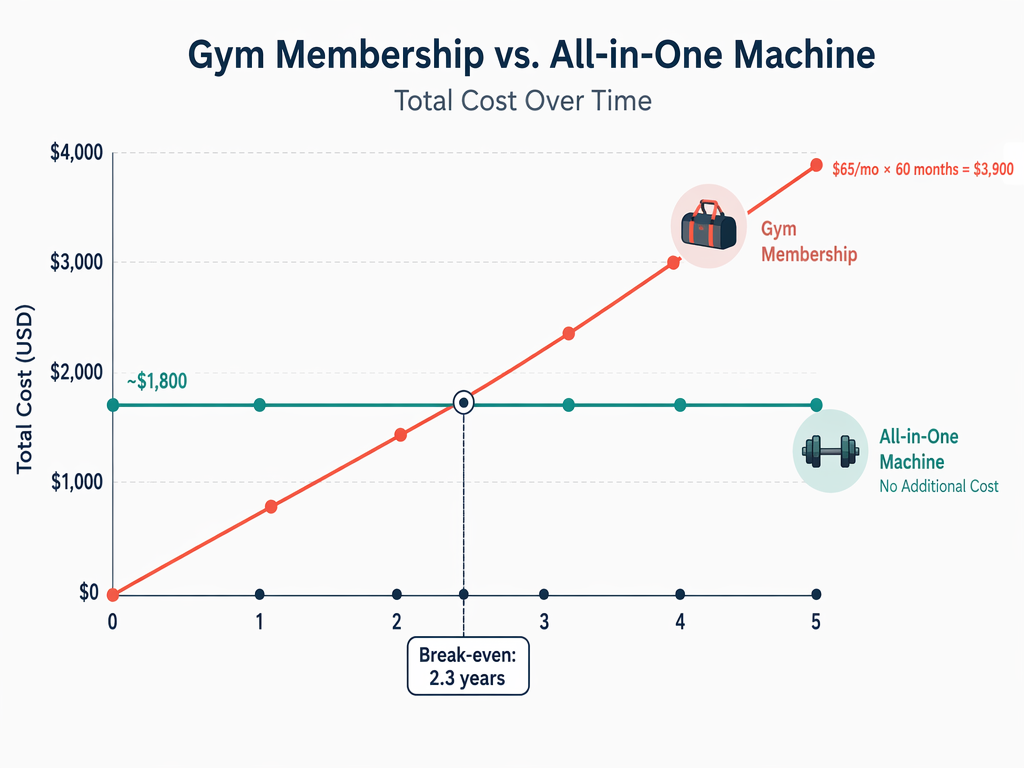
| Year | Gym Membership Cost (Cumulative) | All-in-One Machine Cost (Cumulative) |
|---|---|---|
| Year 1 | $780 | $1,800 |
| Year 2 | $1,560 | $1,800 |
| Year 2.3 | $1,800 | $1,800 |
| Year 3 | $2,340 | $1,800 |
| Year 4 | $3,120 | $1,800 |
| Year 5 | $3,900 | $1,800 |
The break-even analysis favors the all-in-one machine over a modular setup because the all-in-one's upfront cost is typically lower for equivalent exercise variety. A modular setup that matches the all-in-one's capabilities — rack, barbell, plates, bench, and cable tower — often costs $2,500–$3,500, pushing the break-even point to 3.2–4.5 years. However, the modular setup retains resale value better because individual components can be sold separately, and it offers lower upgrade costs over time.
Three Budget-Tier Recommendations: What to Buy at $1,000–$1,500, $1,500–$2,500, and $2,500–$3,000
Based on the cost, space, and hidden-cost analysis above, here are concrete recommendations for each budget tier. Each recommendation includes a specific model or setup, key specs, and a clear "who it's for" framing.
Tier 1: $1,000–$1,500 — The All-in-One Sweet Spot
At this price point, an all-in-one machine is the clear winner. A modular setup cannot include a cable system without exceeding the budget, and the all-in-one delivers a squat rack, functional trainer, pull-up bar, and multiple cable stations in a single footprint.
- Recommended: Bells of Steel All-in-One Home Gym (starting at $1,299.99)
- Footprint: 54.6" D x 59" W x 81" H (~22.5 sq ft)
- Weight capacity: Dual 200 lb. weight stacks (400 lb. total)
- Warranty: Limited lifetime on frame, 1 year on parts
- Best for: Budget-conscious buyers who want a complete strength training solution in a small footprint and do not plan to expand with third-party attachments
Tier 2: $1,500–$2,500 — The Flexibility Decision Point
This is the most competitive tier. You can either buy a fully loaded all-in-one or start a modular setup with a solid rack, barbell, plates, and bench — but you will likely have to skip the cable tower for now.
- Option A (All-in-One): Bells of Steel All-in-One Home Gym (loaded configuration, ~$1,900) — adds upgraded weight stacks, lat pulldown seat, and leg hold-down. Best for buyers who want a complete solution now with no plans to expand.
- Option B (Modular Starter): Semi-commercial power rack ($600–$800) + Olympic barbell ($200–$300) + 300 lb. plate set ($400–$500) + adjustable bench ($200–$300) = $1,400–$1,900. Leaves room in the budget to add a plate-loaded cable tower ($400–$600) later. Best for buyers who prioritize upgrade flexibility and standard attachment compatibility.
Tier 3: $2,500–$3,000 — The Modular Match
At this tier, both approaches can deliver a complete home gym. The all-in-one still wins on space efficiency, but the modular setup finally matches its exercise variety and offers superior long-term flexibility.
- Option A (All-in-One): Force USA G20 or similar multi-stack all-in-one (~$2,800–$3,000) — integrated squat rack, dual weight stacks, leg press, leg extension/curl, lat pulldown, low row. Best for buyers who want every possible exercise in one footprint and are willing to spend 35 hours on assembly.
- Option B (Modular Complete): Dedicated power rack ($800–$1,200) + Olympic barbell ($300–$400) + 350 lb. plate set ($500–$600) + premium adjustable bench ($300–$400) + selectorized functional trainer ($800–$1,200) = $2,700–$3,800. Best for buyers who want standard attachment compatibility, easier future upgrades, and the ability to sell components individually.
For alternative setups at various price points, see our Best Home Exercise Equipment for Every Budget guide.
Making the Call: Which Approach Fits Your Situation?
The decision between an all-in-one machine and a modular setup comes down to three factors: your budget, your available space, and your tolerance for future upgrades.
- Choose an all-in-one machine if: You have $1,000–$2,500 to spend, your available floor space is under 40 square feet, you want a single delivery and a single assembly, and you do not plan to expand your gym with third-party attachments over time. The all-in-one delivers more exercise variety per dollar and per square foot at this budget level.
- Choose a modular setup if: You have $2,500+ to spend, you have 50+ square feet of dedicated floor space, you anticipate upgrading components over time, or you want the flexibility to use standard-sized attachments from multiple brands. The modular setup costs more upfront but offers better long-term upgrade paths and resale value.
- Choose a gym membership if: You are unsure about your long-term commitment to home training, you have less than $1,000 to spend, or you value access to a wide variety of equipment and classes over convenience. The break-even analysis shows that a gym membership is cheaper than any equipment purchase for the first 2–3 years.
For a broader comparison of all-in-one machines versus separate equipment, see our All-in-One Exercise Machine vs. Separate Equipment article. If you are new to home gyms and still evaluating your space, start with our Compact Home Gym Buyer's Guide to answer the eight questions you should ask before buying a single piece of gear.
This result comes from one real apartment under the stated conditions — it is a strong signal, not a guarantee your space will measure identically.
Builds this evidence supports
Cable Machine Alternatives That Save Space and Money
Compare the best cable machine alternatives for home gyms – from resistance bands and pulley systems to suspension trainers and compact digital units – and find the right option for your space and budget.
How to Choose a Compact Home Gym That Works for Your Space, Budget, and Noise Tolerance
This article provides a structured decision framework for apartment dwellers and small-space residents to match their specific floor footprint, noise sensitivity, and budget to the most suitable compact home gym strategy — whether that's an all-in-one machine, modular build, smart digital system, or band/bodyweight setup.
The Garage Gym Reality Check: What Equipment Actually Fits in a Single-Car Garage
Most garage gym guides assume a two-car space. This article uses real dimensions, real equipment footprints, and three layout templates to show what fits—and what doesn't—in a single-car garage (10x20 to 12x20 ft).
Spot something off?
If this result didn't match your own space, let us know — floor-damage and noise claims carry real deposit-risk consequences if we get them wrong.