
All-in-One Exercise Machine vs. Separate Equipment: Which Actually Saves You Money and Space?
A data-backed comparison for budget-conscious home gym builders deciding between a single all-in-one machine and buying separate components. We analyze real price data, footprint requirements, and tradeoffs to help you choose the right path.
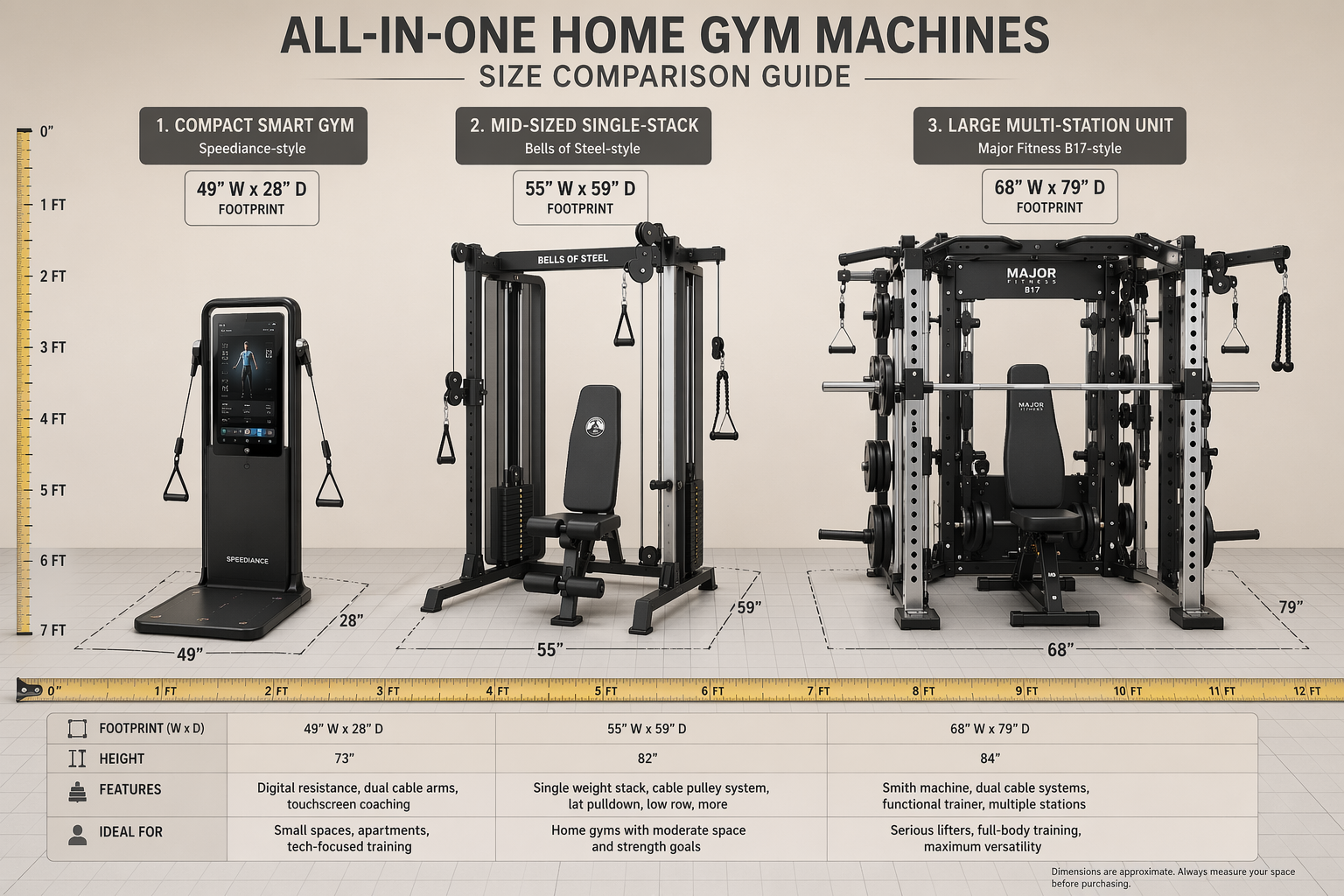
The Real Cost of an All-in-One vs. Building a Separate Setup
The conventional wisdom in home fitness is that buying separate components — a power rack, a bench, a barbell, plates, and a cable tower — gives you more for your money than a single all-in-one machine. But when you run the actual numbers, that assumption doesn't hold for most buyers. A well-chosen all-in-one machine can cost less upfront and occupy significantly less floor space than a collection of separate equipment with equivalent functionality.
Consider this direct comparison. The Bells of Steel All-in-One Home Gym starts at $1,299.99. To build a separate setup that covers the same movement categories — squat, bench, deadlift, pulldowns, rows, and cable crossovers — you'd need a squat rack (around $400), a cable tower or functional trainer (around $435), a quality adjustable bench ($200), an Olympic barbell ($150), and a set of bumper plates ($300). That totals approximately $1,485. The all-in-one is roughly $185 cheaper before you even factor in the cost of a weight plate tree or storage solution for the separate setup.
| Component | Separate Setup Cost (Est.) | All-in-One Cost |
|---|---|---|
| Squat rack / power rack | $400 | Included |
| Cable tower / functional trainer | $435 | Included |
| Adjustable bench | $200 | Included |
| Olympic barbell | $150 | Included |
| Weight plates (300 lbs) | $300 | Included |
| Total | $1,485 | $1,299.99 |
The breakeven math against a gym membership reinforces the case. A $65-per-month gym membership costs $780 per year. A home gym priced around $2,000 breaks even in roughly 2.5 years. At the $1,300 price point of a budget all-in-one, that breakeven comes even sooner — about 1.7 years — and after that, the equipment is effectively free to use.
Scenario A: Budget Setup (~$1,000)
At the $1,000 price point, the all-in-one argument is strongest. Entry-level plate-loaded machines like the Bells of Steel All-in-One give you a power rack, lat pulldown, low row, cable crossover, and dip station in a single unit. A separate-equipment build at this budget would require compromising on quality or leaving out key pieces — you might afford a basic squat stand and a cheap bench, but a dedicated cable tower alone would consume most of the budget.
| Dimension | All-in-One ($1,000–$1,300) | Separate Setup ($1,000) |
|---|---|---|
| Exercise variety | 15+ movements (squat, bench, pulldown, row, cable cross, dip, leg raise) | 5–8 movements (squat, bench, deadlift, overhead press, barbell row) |
| Max resistance | 300+ lbs plate-loaded | 300+ lbs (barbell + plates) |
| Cable exercises | Included (lat pulldown, low row, cable cross) | Not available without separate cable tower |
| Floor footprint | ~25 sq ft (e.g., 55" x 59") | ~35 sq ft (rack + bench + plate storage) |
| Upgrade potential | Limited (add more plates only) | Moderate (upgrade bar, bench, add cable tower later) |
The tradeoff at this price point is resistance ceiling and upgrade path. A plate-loaded all-in-one maxes out at whatever weight plates you load onto it, but the machine's pulley system and frame have a structural limit. Separate equipment, even at a budget level, lets you incrementally upgrade individual pieces — a better barbell, a more stable bench, additional plates. If you're certain your strength will progress beyond intermediate levels within a year, the separate path may save you from replacing the whole machine later.
For readers leaning toward separate components at this budget, our Compact Home Gym Budget Builds guide provides complete equipment lists at $500, $1,500, and $3,000 price points.
Scenario B: Mid-Range ($2,000–$3,000)
In the mid-range bracket, the cost gap narrows but the all-in-one still holds an edge on space and simplicity. The Bells of Steel All-in-One at $1,299.99 and the Force USA G3 All-In-One Trainer at approximately $2,000 represent the sweet spot for buyers who want a complete gym without the complexity of assembling multiple pieces of equipment.
| Feature | Bells of Steel All-in-One | Force USA G3 | Separate Rack + Cable Tower |
|---|---|---|---|
| Price | $1,299.99 | ~$2,000 | $1,800–$2,500 |
| Footprint | 55" x 59" | 78" x 60.5" | Varies; rack ~48" x 48" + cable tower ~44" x 64" |
| Resistance type | Plate-loaded or 210-lb weight stack | Dual 200-lb weight stacks | Plate-loaded rack + weight stack cable tower |
| Warranty | Limited lifetime | Limited lifetime (Force USA) | Varies by brand (REP: limited lifetime; Titan: 1 year) |
| Assembly time | 4–6 hours | 6–8 hours | 2–4 hours per piece |
The separate setup's advantage at this level is weight stack quality and upgrade flexibility. A dedicated cable tower with dual 200-lb weight stacks (like the Titan Fitness Functional Trainer at $2,999.99) provides smoother resistance than a plate-loaded all-in-one's cable system. And if one component fails — a cable snaps, a pulley wears out — you replace that single piece rather than losing access to your entire gym. The all-in-one is a single point of failure.
Scenario C: Premium ($3,500+)
At the premium tier, the comparison shifts from pure cost to features, technology, and user experience. Smart gyms like the Tonal 2 and Speediance Gym Monster compete with high-end separate components like a premium power rack, calibrated plates, and a commercial-grade functional trainer.
| Feature | Major Fitness B17 | Titan Functional Trainer | Speediance Gym Monster | Tonal 2 |
|---|---|---|---|---|
| Price | $4,199.99 | $2,999.99 | $3,199 | $3,545 (on sale) |
| Footprint | 68" x 79" | 44" x 64" | 49" x 28" (unfolded) | Wall-mounted; requires 7' x 7' floor space |
| Resistance | Dual weight stacks (expandable to 260 lbs each) | Dual 200-lb weight stacks (2:1 ratio) | 220 lbs total magnetic resistance | 100 lbs per arm (200 lbs total) digital resistance |
| Subscription | None | None | None required | $49/month required |
| Warranty | 1 year | 1 year | 2 years | Limited lifetime (frame) |
The Speediance Gym Monster is a standout for space-constrained buyers: it folds to just 14.96 inches deep when not in use, making it the most compact option in this tier. Its 220 lbs of magnetic resistance is adequate for most intermediate lifters, and it carries no required subscription — a significant advantage over Tonal's $49/month fee. However, the magnetic resistance system can't replicate the feel of free weights or plate-loaded cable stacks, and the 220-lb ceiling will be limiting for advanced strength training.
For a deeper dive into smart gym systems, see our Smart Home Gym Comparison 2026, which provides a head-to-head spec clash of all-in-one strength systems including Tonal 2 and Speediance.
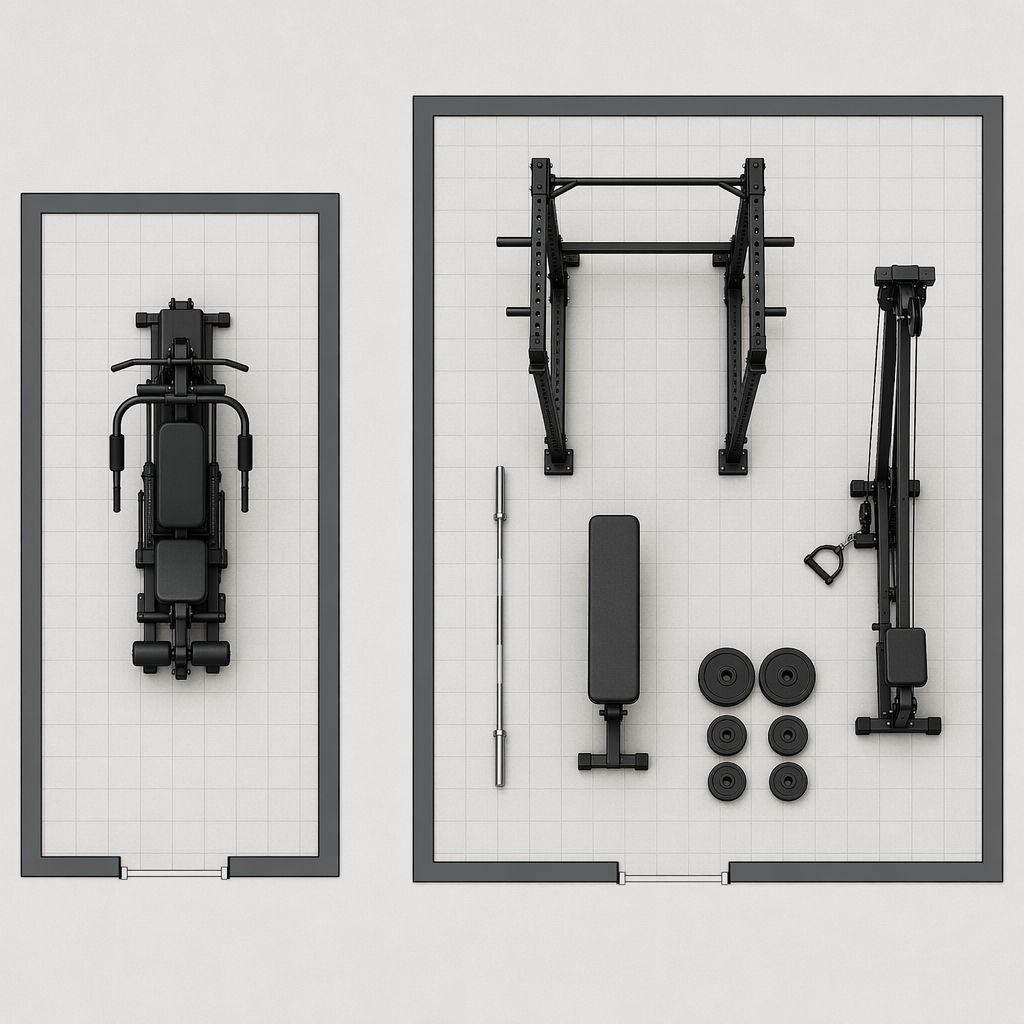
Space Comparison: One Machine vs. Multiple Pieces
Floor space is often the deciding factor for home gym builders, especially those in apartments or shared rooms. All-in-one machines typically require 37 to 50 square feet of floor space. That's a single contiguous rectangle that you can place against a wall or in a corner. Separate components, by contrast, need multiple zones: a rack footprint, a bench area, a cable tower footprint, and plate storage that often extends beyond the rack's base.
| Machine / Setup | Dimensions (W x D) | Approx. Floor Area | Notes |
|---|---|---|---|
| Bells of Steel All-in-One | 55" x 59" | 22.5 sq ft | Compact; fits in most spare rooms |
| Major Fitness B17 | 79" x 68" | 37.3 sq ft | Large; requires dedicated space |
| Titan Functional Trainer | 44" x 64" | 19.6 sq ft | Narrow but deep; good for wall placement |
| Speediance Gym Monster (unfolded) | 49" x 28" | 9.5 sq ft | Smallest footprint; folds to 15" deep |
| Separate rack + bench + cable tower | Varies | 40–60 sq ft | Requires multiple zones; less efficient layout |
The space advantage of an all-in-one isn't just about square footage — it's about layout efficiency. A single machine creates one workout zone. Separate components require you to move between stations, which means you need circulation space around each piece. A power rack needs clearance for the barbell on both sides. A cable tower needs room for the arms to extend. A bench needs to be moved and stored. All of this adds up to more usable floor area than the equipment footprints alone suggest.
For readers with severe space constraints, our Best Space-Saving Home Gym Equipment guide covers compact, foldable, and wall-mounted solutions that go beyond the all-in-one category.
The Hidden Costs: Assembly, Accessories, and Subscriptions
The purchase price of an all-in-one machine doesn't tell the full story. Several hidden costs can add hundreds of dollars and several hours to the total investment.
- Assembly time: All-in-one trainers typically take a half to a full day to assemble, according to Force USA. Multi-stack machines with multiple cable systems often require a second person to help route cables and align frames. Separate components can be assembled one at a time, which spreads the effort across multiple sessions.
- Weight plates: Plate-loaded all-in-ones don't include weight plates. A set of 300 lbs of bumper plates costs $300–$500. If you're comparing a $1,299.99 machine against a separate setup that already includes plates, factor this into the total.
- Flooring and mats: Any home gym needs protective flooring. A 4' x 6' rubber mat costs $40–$80. For a separate setup with multiple stations, you may need two or three mats.
- Ongoing subscriptions: Smart gyms like Tonal require a $49/month membership for full functionality. The Speediance Gym Monster has no required subscription, but its guided workout content may be limited without one. Traditional all-in-one machines and separate components have no subscription costs.
The Upgrade Path: All-or-Nothing vs. Piece by Piece
This is the single strongest argument for separate equipment. An all-in-one machine is a closed system. If you outgrow its resistance ceiling, want a better bench, or decide you prefer a different cable system, you don't upgrade a component — you replace the entire machine. That's a $1,300 to $4,200 decision.
With separate components, you can upgrade incrementally. Replace a $150 barbell with a $300 one. Add a $400 cable tower later. Swap a $200 bench for a $500 adjustable model. Each upgrade costs a fraction of replacing a whole machine, and you can spread the investment over years rather than making it all at once.
There's also the resale consideration. Individual components — a quality power rack, a good barbell, a set of plates — hold their value reasonably well and can be sold piece by piece. An all-in-one machine is harder to sell because it's bulky, heavy, and requires the buyer to have space for a single large unit. The resale market for all-in-ones is thinner.
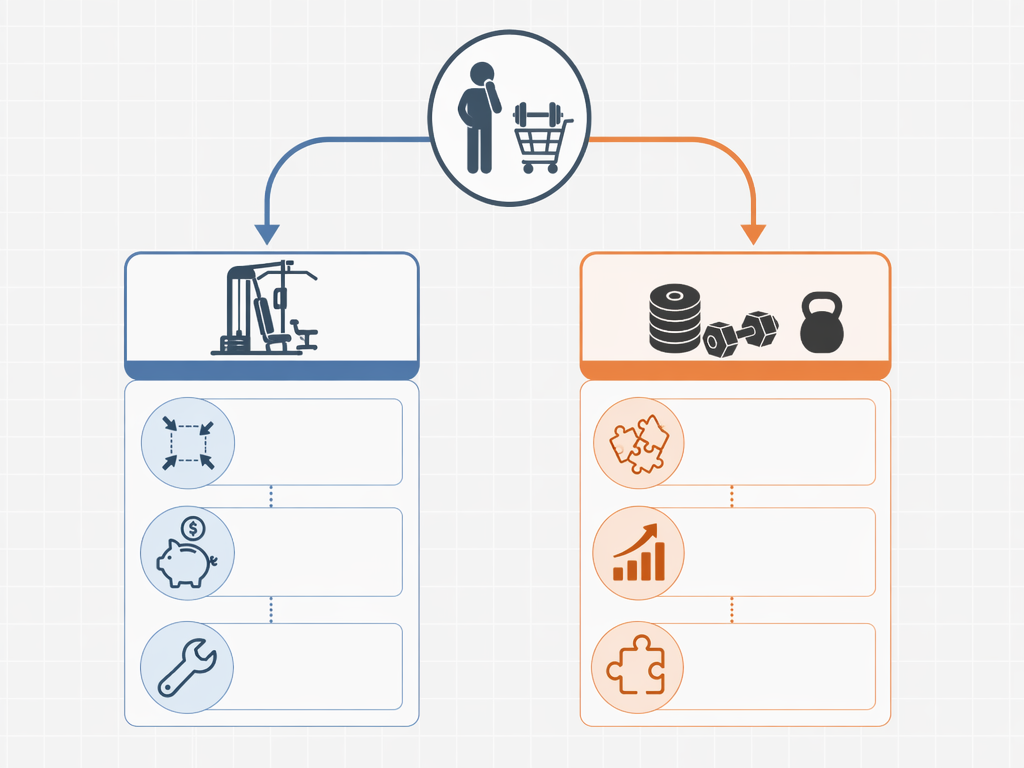
Decision Framework: Which Path Is Right for You?
The right choice depends on how you weigh five factors: budget, space, desired resistance, upgrade plans, and tolerance for assembly. Here's a framework to help you decide.
- Choose an all-in-one if: You have a budget under $2,000, limited floor space (under 40 sq ft), want a complete gym with minimal assembly complexity, and don't plan to significantly increase your strength beyond intermediate levels. The Bells of Steel All-in-One at $1,299.99 is the strongest value proposition in this category.
- Choose separate equipment if: You have a larger budget ($2,500+), have adequate floor space (40+ sq ft), plan to progressively overload into advanced strength levels, want the ability to upgrade individual components over time, or prefer the feel of free weights and dedicated cable stacks.
- Consider a smart gym if: You have a premium budget ($3,000+), are extremely space-constrained (under 20 sq ft), value guided workouts and digital resistance, and are comfortable with potential subscription costs. The Speediance Gym Monster ($3,199, no required subscription) is the best value in this category for space-conscious buyers.
- Consider a hybrid approach if: You want the space efficiency of an all-in-one but need higher resistance. Some mid-range all-in-ones like the Force USA G3 offer dual 200-lb weight stacks, which provide adequate resistance for most intermediate lifters while maintaining a single-unit footprint.
For a deeper, more neutral analysis of the same question — including detailed ROI calculations and a broader range of scenarios — see our All-in-One Exercise Machine vs. Building a Custom Home Gym: The Real Cost-Benefit Analysis. That article takes a balanced view, while this one argues the case for all-in-one machines based on the data.
This result comes from one real apartment under the stated conditions — it is a strong signal, not a guarantee your space will measure identically.
Builds this evidence supports
Cable Machine Alternatives That Save Space and Money
Compare the best cable machine alternatives for home gyms – from resistance bands and pulley systems to suspension trainers and compact digital units – and find the right option for your space and budget.
How to Choose a Compact Home Gym That Works for Your Space, Budget, and Noise Tolerance
This article provides a structured decision framework for apartment dwellers and small-space residents to match their specific floor footprint, noise sensitivity, and budget to the most suitable compact home gym strategy — whether that's an all-in-one machine, modular build, smart digital system, or band/bodyweight setup.
The Garage Gym Reality Check: What Equipment Actually Fits in a Single-Car Garage
Most garage gym guides assume a two-car space. This article uses real dimensions, real equipment footprints, and three layout templates to show what fits—and what doesn't—in a single-car garage (10x20 to 12x20 ft).
Spot something off?
If this result didn't match your own space, let us know — floor-damage and noise claims carry real deposit-risk consequences if we get them wrong.