
All-in-One Fitness Machine vs. Modular Home Gym: Which Is Cheaper Over 5 Years?
A data-driven total cost of ownership comparison for budget-conscious buyers deciding between a single all-in-one machine and a modular free-weight setup, covering upfront costs, subscription fees, floor space, upgrade paths, and resale value over a 5-year horizon.
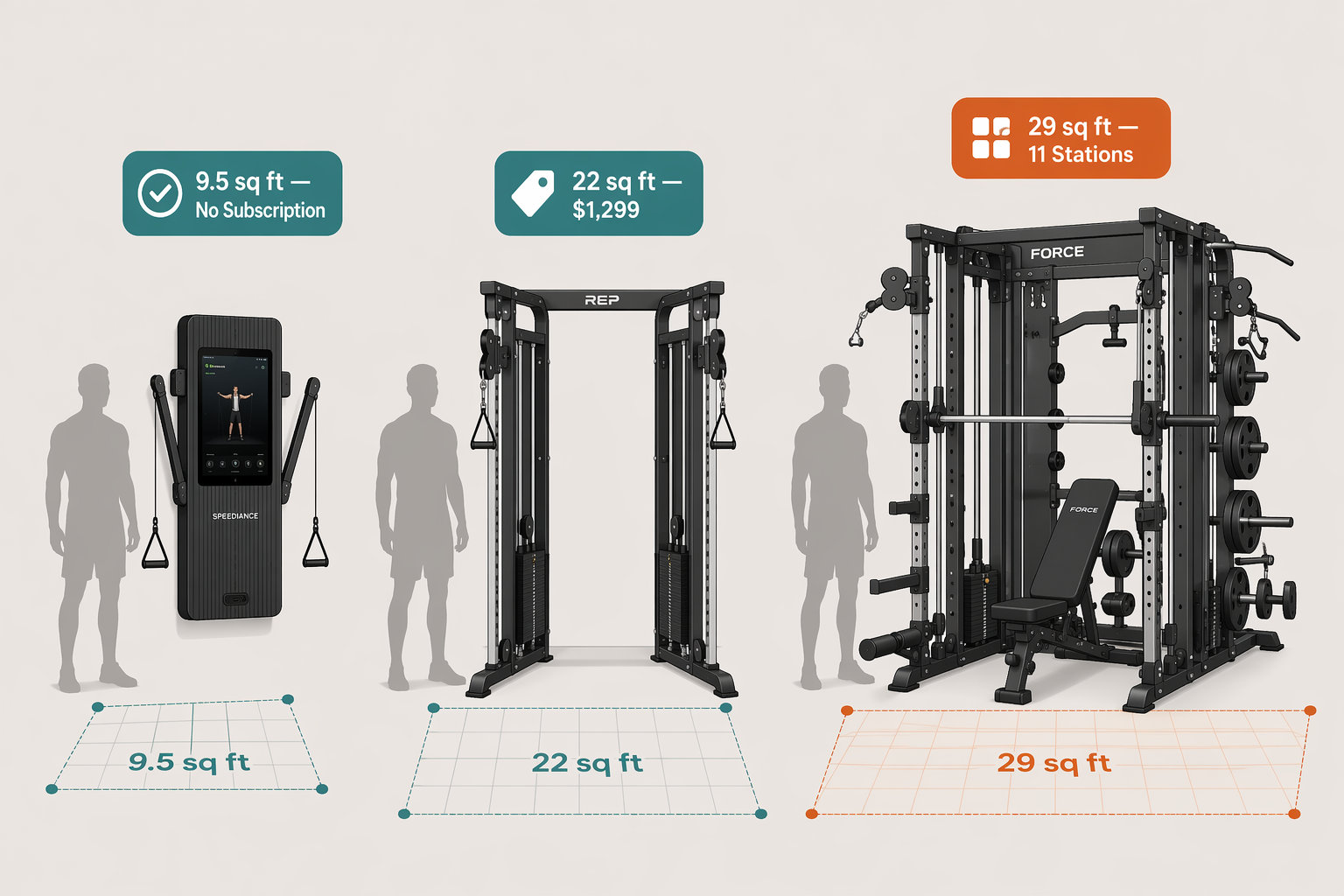
The $3,141 Question: Modular vs. All-in-One
If you are shopping for a home gym on a budget, the first fork in the road is structural: do you buy a single all-in-one machine, or do you assemble a modular setup from individual pieces — a rack, a barbell, weight plates, a bench, and a cable tower? The answer is not obvious, and the wrong choice can cost you thousands in unnecessary subscriptions or leave you without the exercises you actually need.
The most concrete data point we have comes from a survey of over 1,000 home gym owners conducted by Strong Home Gym, which found that the average cost of a modular free-weight setup — a power rack, barbell, plates, bench, and cable tower — came to $3,141. That figure is the benchmark against which every all-in-one machine must be measured.
All-in-one machines span a wide price band. At the low end, the Bells of Steel All-in-One starts at $1,299. At the premium end, the Force USA G20 costs $4,499. Smart machines like the Tonal 2 add a $4,295 purchase price plus a mandatory $59.95 monthly membership. The range overlaps the modular average so completely that the decision cannot be made on sticker price alone. You have to look at the full picture: what you get for the money, what you give up in flexibility, and what the machine costs you over five years.
Upfront Cost Breakdown: What You Actually Pay
To make a fair comparison, we need to define what a "modular setup" actually includes. The $3,141 average from the Strong Home Gym survey covers a rack, barbell, weight plates, a bench, and a cable tower. If you buy new mid-range components from brands like REP Fitness or Titan Fitness, that number is realistic. If you buy premium (Rogue, Kabuki) or shop used, the total shifts up or down.
On the all-in-one side, the market breaks into three distinct tiers: traditional selectorized machines, plate-loaded functional trainers, and smart digital machines. The table below shows representative models at each tier alongside the modular benchmark.
| Setup Type | Representative Model | Upfront Cost | Resistance Type | Max Resistance |
|---|---|---|---|---|
| Modular free-weight | Rack + barbell + plates + bench + cable tower | $3,141 (avg.) | Free weights + cables | Unlimited (plate-dependent) |
| Budget all-in-one | Bells of Steel All-in-One | $1,299 | Plate-loaded cables | 300 lbs per side |
| Mid-range all-in-one | Bowflex Xtreme 2 SE | $1,499 | Power Rod resistance | 210 lbs (upgradable to 410) |
| Mid-range all-in-one | Force USA G3 | $1,999 | Plate-loaded cables | Unlimited (plate-dependent) |
| Premium all-in-one | Force USA G20 | $4,499 | Dual selectorized stacks | 289 lbs per stack |
| Smart all-in-one | Speediance Gym Monster | $3,199 | Digital electromagnetic | 220 lbs total |
| Smart all-in-one | Tonal 2 | $4,295 | Digital electromagnetic | 250 lbs total |
This result comes from one real apartment under the stated conditions — it is a strong signal, not a guarantee your space will measure identically.
Builds this evidence supports
Cable Machine Alternatives That Save Space and Money
Compare the best cable machine alternatives for home gyms – from resistance bands and pulley systems to suspension trainers and compact digital units – and find the right option for your space and budget.
How to Choose a Compact Home Gym That Works for Your Space, Budget, and Noise Tolerance
This article provides a structured decision framework for apartment dwellers and small-space residents to match their specific floor footprint, noise sensitivity, and budget to the most suitable compact home gym strategy — whether that's an all-in-one machine, modular build, smart digital system, or band/bodyweight setup.
The Garage Gym Reality Check: What Equipment Actually Fits in a Single-Car Garage
Most garage gym guides assume a two-car space. This article uses real dimensions, real equipment footprints, and three layout templates to show what fits—and what doesn't—in a single-car garage (10x20 to 12x20 ft).
Spot something off?
If this result didn't match your own space, let us know — floor-damage and noise claims carry real deposit-risk consequences if we get them wrong.