
How to Start Working Out at Home (and Actually Stick With It)
Most beginners quit their home workout routine within a few weeks — not because they don't know which exercises to do, but because they lack the habit infrastructure to stay consistent. This guide covers the behavioral strategies, environment setup, and realistic expectations you need to build a home workout habit that lasts.
Why Most Beginners Quit (and It's Not What You Think)
If you've started a home workout routine before and stopped after two or three weeks, you're not alone — and it's not because you lack willpower. A 2023 prospective study published in PMC tracked 68 older adults (mean age 78.9) over six weeks of prescribed home exercise and found a mean adherence rate of just 65% (SD 34.3%). Only 20% of participants were fully adherent, and 8% never started at all. Adherence declined steadily week over week, regardless of initial motivation.
The broader picture is just as stark. According to CDC data from February 2026, only 46.9% of US adults meet the aerobic physical activity guidelines, and a mere 24.2% meet both aerobic and muscle-strengthening guidelines. The problem isn't that people don't know they should exercise — it's that knowing isn't enough to make it stick.
The core insight from this research is that most beginners fail not because they don't know which exercises to do, but because they lack the habit infrastructure — fixed scheduling, social support, appropriate starting intensity, and realistic progression expectations. This article is about building that infrastructure. The actual workout content (exercises, sets, reps) is already covered in our beginner bodyweight routine and 4-week cardio plan. Here, we focus on the behavioral 'how' — the part that determines whether you'll still be working out in a month.
The 4 Pillars of Exercise Habit Formation
Research on habit formation consistently points to four elements that separate people who stick with exercise from those who don't. These aren't about the workout itself — they're about the system around it.
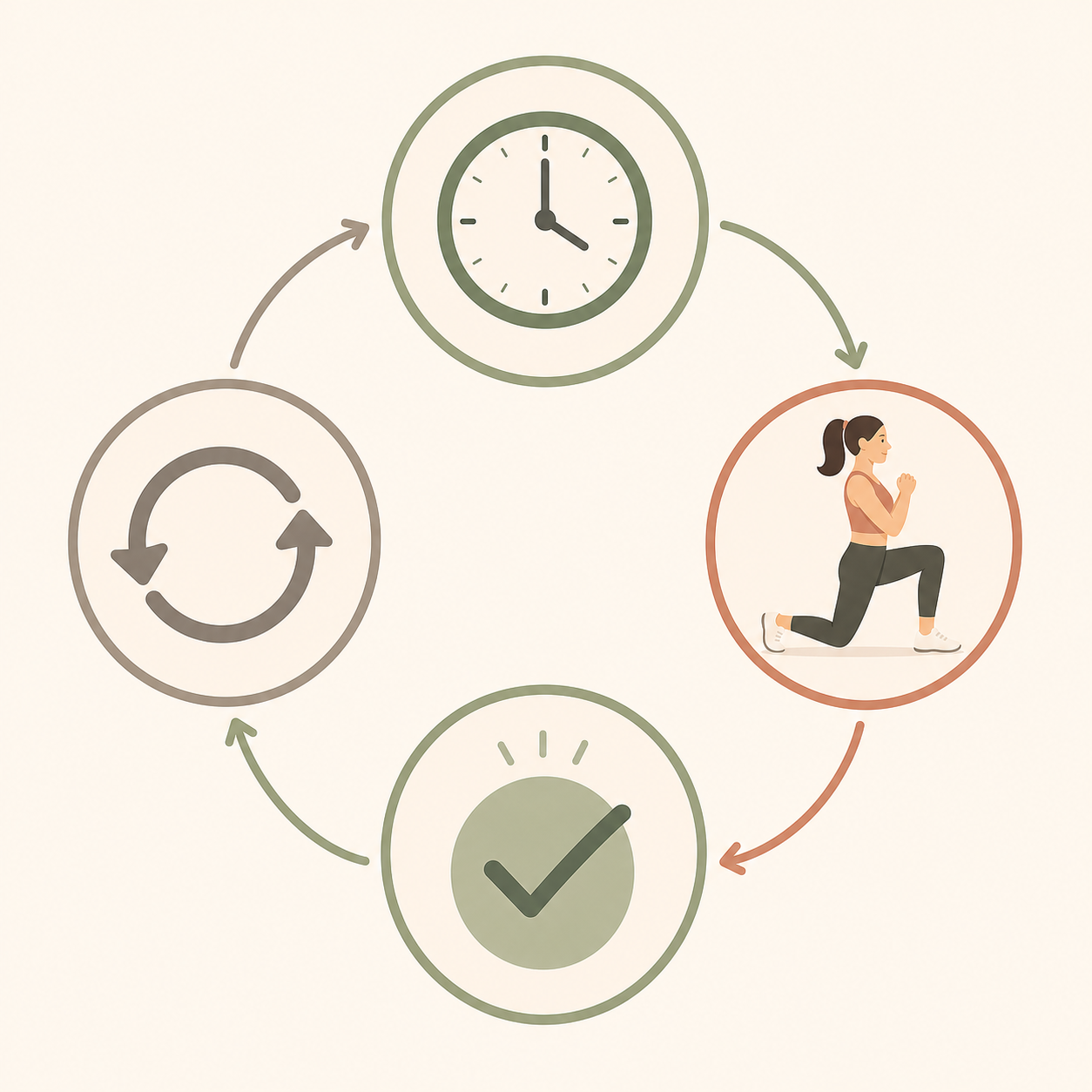
- Cue: A fixed time slot. The single strongest behavioral predictor of exercise habit maintenance is consistency of timing. Pick a time of day — first thing in the morning, right after work, during your lunch break — and treat it as a non-negotiable appointment. The cue isn't a reminder on your phone; it's the context (time, place, preceding activity) that automatically triggers the behavior.
- Routine: A 15–20 minute minimum. The workout itself doesn't need to be long or intense. In fact, starting with a short, manageable session is more effective for habit formation than an ambitious 45-minute circuit. The goal is to make the routine easy enough that you can do it even on days when you have low energy.
- Reward: Track completion as the reward. The brain needs a signal that the behavior was worthwhile. For exercise habits, the most reliable reward is simply marking it done — checking a box on a calendar, logging it in an app, or telling someone you did it. The sense of accomplishment from showing up is more motivating than any delayed physical result.
- Repetition: 3× per week for at least 4 weeks. Habit formation requires consistent repetition over time. Research suggests that a behavior needs to be performed regularly for several weeks before it becomes automatic. Three sessions per week is a sustainable frequency that builds momentum without causing burnout.
These four pillars work together as a cycle. The cue triggers the routine, the routine produces the reward, and the repetition strengthens the association. Over time, the behavior becomes less dependent on conscious motivation and more automatic.
Set Up Your Environment for Success
Willpower is a finite resource. The most effective strategy for maintaining a habit isn't to rely on motivation — it's to design your environment so that the desired behavior is the path of least resistance. Think of this as designing for the lazy version of yourself, the version that will look for any excuse to skip.
- Dedicate a small workout corner. You don't need a full home gym. A 4x6-foot area in your living room, bedroom, or hallway is enough. The key is that this space is always ready and not used for anything else. When you see it, it should trigger the thought: "That's where I work out."
- Keep equipment visible and accessible. A yoga mat and a set of resistance bands cost roughly $15–50 total and take up almost no space. Store them where you can see them — not in a closet behind other items. If you have to dig for your gear, the friction is high enough that you'll skip. If it's already on the floor, you're more likely to use it.
- Lay out clothes the night before. This sounds trivial, but it's one of the most effective friction-reduction tactics. If your workout clothes are ready to put on the moment you wake up (or the moment you get home), you remove a decision point. Fewer decisions mean less mental resistance.
- Remove obvious barriers. If your workout space is cluttered, clear it. If you need to move furniture, do it in advance. If noise is a concern (apartment living), have a plan — a quiet bodyweight routine or a low-impact option. The goal is to eliminate every excuse before it arises.
Environmental design works because it shifts the burden from motivation to friction. When starting a workout requires less effort than skipping it, you'll start.
Why Social Support Is Your Secret Weapon
One of the most surprising findings from the PMC study is what actually predicts adherence. Social support for exercise significantly predicted adherence (p=0.017), meaning that each unit increase in a person's social support score correlated with higher completion rates. Meanwhile, self-efficacy — the belief in one's own ability to exercise — was negatively associated with adherence. In other words, relying on willpower alone backfires.
This doesn't mean you need a personal trainer or a workout buddy in the same room. Social support for exercise takes many forms, and the most effective ones are surprisingly simple:
- An accountability partner. Find one friend or family member who also wants to build a habit. Agree to check in with each other after each workout — a quick text saying "Done" is enough. The act of reporting to someone else creates a sense of commitment that self-accountability doesn't.
- A shared check-in text. If you don't have a specific partner, join a group chat or online community where people post their daily workouts. Even lurking can provide a sense of shared purpose.
- A public commitment. Tell a few people that you're starting a 4-week habit ramp. The social cost of quitting after a public announcement is a powerful motivator.
The takeaway is counterintuitive but liberating: you don't need to be more self-disciplined. You need to build a support system that makes discipline less necessary.
The 4-Week Habit Ramp (Not a Workout Plan)
Most workout plans start too hard and too fast. They assume you're ready for 30-minute sessions five days a week from day one. That approach works for people who already have the habit — but for beginners, it's a recipe for burnout and dropout.
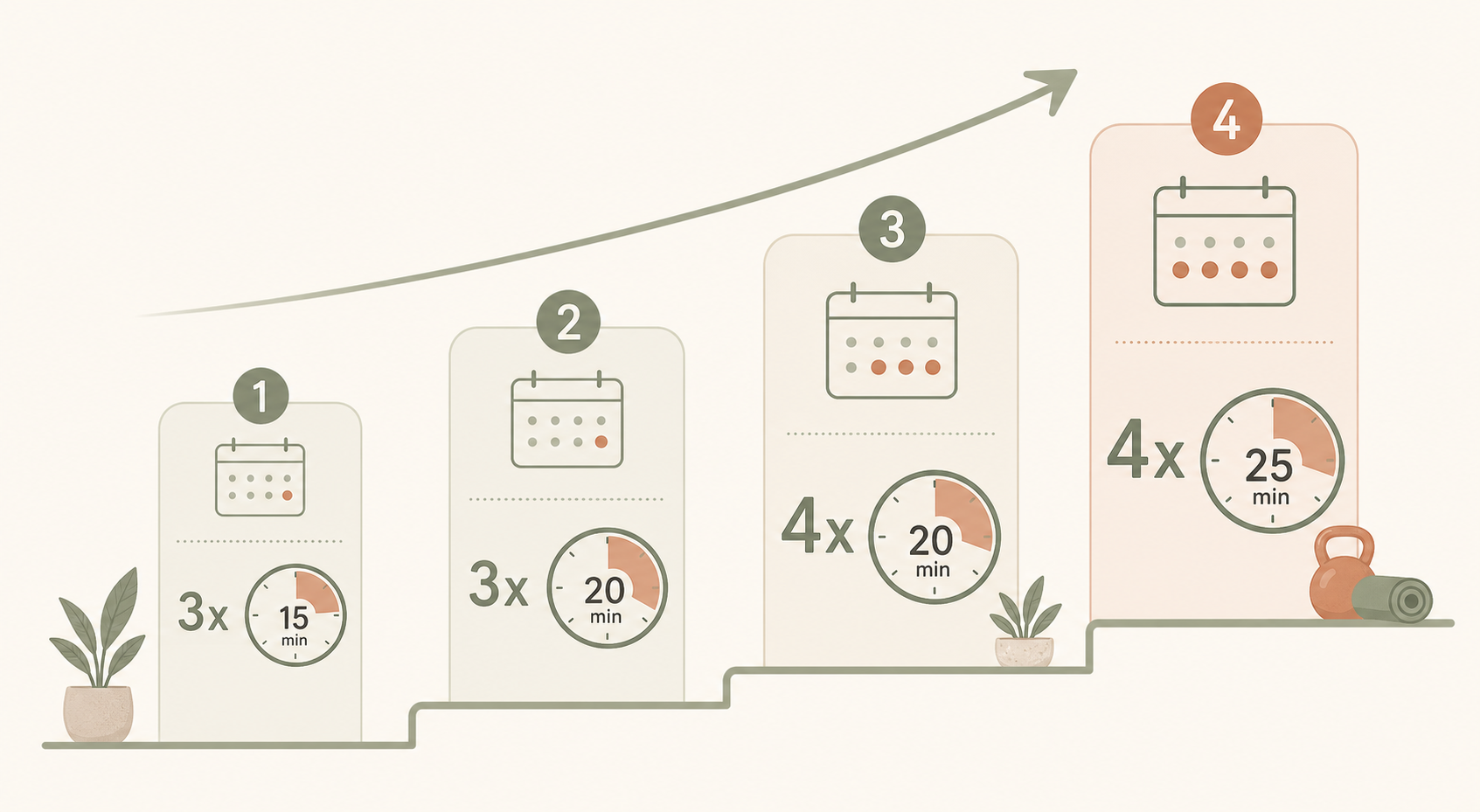
Instead, use a habit ramp: a progressive increase in frequency and duration that prioritizes showing up over performance. The specific activity is secondary. You can do bodyweight exercises, follow a guided video, go for a walk, or stretch — the point is to build the habit of showing up at your scheduled time.
| Week | Sessions per Week | Duration per Session | Total Weekly Time |
|---|---|---|---|
| 1 | 3 | 15 minutes | 45 minutes |
| 2 | 3 | 20 minutes | 60 minutes |
| 3 | 4 | 20 minutes | 80 minutes |
| 4 | 4 | 25 minutes | 100 minutes |
Notice what this ramp does not include: specific exercises, intensity targets, or progression rules. That's intentional. The habit ramp is the container; the workout content fills it. For the actual exercises to do during these sessions, see our beginner bodyweight workout routine or the 4-week beginner cardio training plan — both are designed to follow this same progressive structure.
The rule for each session is simple: if you feel good, do the full duration. If you don't feel like it, do five minutes. The five-minute minimum is non-negotiable — it preserves the habit without pushing through genuine fatigue. Most days, once you start, you'll keep going.
What to Expect Physically (Realistic Timelines)
One of the most common reasons beginners quit is that their physical experience doesn't match their expectations. They expect to feel great after a workout, but instead they feel sore, tired, or discouraged. Setting realistic physical expectations upfront prevents this mismatch.
| Timeline | What to Expect |
|---|---|
| First 24–48 hours | Soreness peaks. This is normal — it's called delayed onset muscle soreness (DOMS) and it subsides within a week of consistent activity. |
| Weeks 2–3 | Strength improvements become noticeable. You'll be able to do more reps, hold a plank longer, or feel more stable during exercises. |
| Weeks 6–8 | Body composition changes (visible muscle definition, fat loss) begin to appear. This is when most people start seeing physical results. |
| Week 4+ | The workout itself starts to feel easier. Your cardiovascular endurance improves, and the post-workout fatigue decreases. |
The "no pain, no gain" mindset is counterproductive for habit formation. Mild discomfort — the feeling of muscles working, slight breathlessness during cardio — is normal and expected. Sharp pain, joint pain, or pain that persists after the workout is a signal to stop and reassess. If something hurts, modify the exercise or skip it. There is no award for pushing through injury.
For readers who want to progress beyond the habit ramp into a structured strength program, our 8-week home strength training plan for beginners is designed to follow after the habit is established — typically around week 5 or 6 of consistent training.
How to Handle Off Days Without Derailing
Off days are inevitable. You'll get sick, have a late night at work, travel, or simply wake up feeling exhausted. The difference between people who maintain a habit and those who don't isn't whether they miss days — it's how they respond to missing them.
The most effective rule is the two-day rule: missing one day is fine. Missing two days in a row is the danger zone. After two missed sessions, the habit starts to weaken, and the likelihood of quitting altogether increases sharply.
Here's how to distinguish between the two types of off days:
- "I don't feel like it" — push through with the 5-minute minimum. This is the most common type of resistance. It's not physical exhaustion; it's motivational dip. The solution is to do five minutes of any activity. If after five minutes you still want to stop, stop — but you'll likely keep going. The hardest part is starting.
- "I need rest" — take the day, no guilt. Genuine physical exhaustion, illness, or injury requires rest. Pushing through when your body needs recovery is counterproductive and can lead to injury or burnout. The key is to frame it as a strategic rest day, not a failure. Plan to resume the next day, and do not skip two days in a row.
Off days are not failures. They are data points. The question is not whether you'll miss a day — it's whether you'll let one missed day become two, and two become a permanent stop.
Tools and Apps That Support Habit Formation
The right app can be a powerful support tool — but only if it serves the habit, not replaces it. The goal is to find an app that helps with scheduling, tracking, and accountability, not just workout content. A 2026 guide from Daily Burn recommends several apps specifically suited for beginners building a routine:
| App | Best For | Price | Key Feature for Habit Building |
|---|---|---|---|
| Daily Burn True Beginner | Absolute beginners needing structured progression | $19.95/mo | 8-week True Beginner program with visible progression |
| Apple Fitness+ | Apple Watch users who want seamless tracking | $9.99/mo | Integrates with Apple Watch for automatic workout logging |
| FitOn | Budget-conscious beginners | Free | No subscription required for core features |
| Future | 1:1 coaching and accountability | ~$200/mo | Personal coach provides daily check-ins and plan adjustments |
| Down Dog | Yoga beginners | $9.99/mo | Customizable session length (as short as 15 minutes) |
When choosing an app, look for these features: structured progression (not just a library of random workouts), visible modifications for different fitness levels, sessions that start at 15–20 minutes, and some form of tracking or logging. Avoid apps that push you into long, intense sessions from day one — they work against the habit-building process.
For a deeper comparison of free and paid fitness apps, including how to use them specifically for habit building, see our guide on how to use free fitness apps to build a home workout routine.
This is general fitness education, not medical advice. For diagnosis or treatment of pain or injury, consult a qualified clinician.
Pick your next session
Browse all routines to find an appropriately-spaced next session.
Spot something off?
This content sits adjacent to health guidance — tell us if a citation or figure needs a correction.