
8-Week Home Strength Training Plan for Beginners
A complete two-phase home strength program for true beginners: three full-body sessions per week in weeks 1–4 to build movement patterns, then a four-day upper-lower split in weeks 5–8 to increase weekly volume — all executable with bodyweight or a single pair of dumbbells, no gym required.
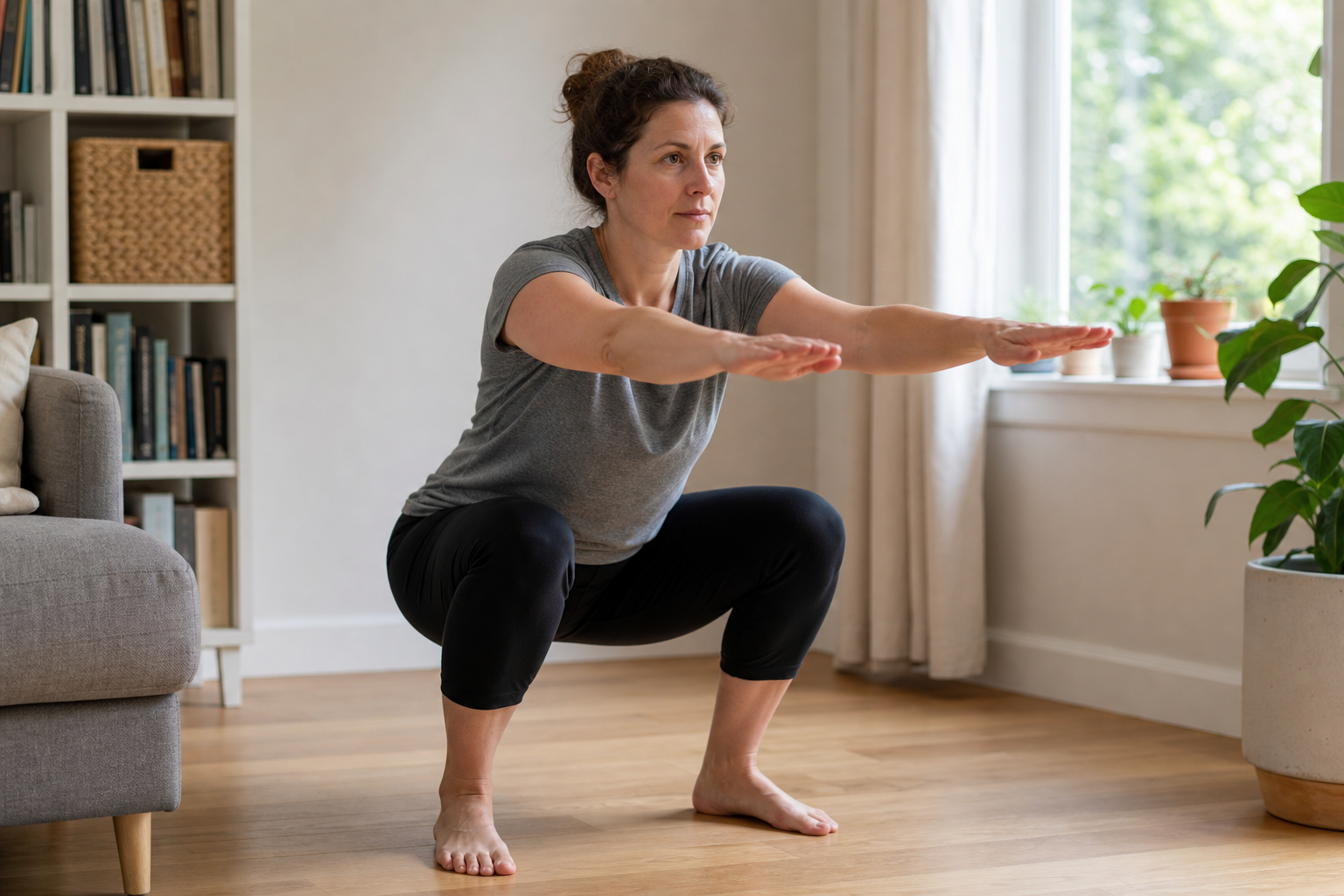
Who This Plan Is For and What You Need
This plan is written for true beginners — people who have never followed a structured strength training program and want to start at home. You do not need prior gym experience, a specific fitness level, or a dedicated workout room.
The baseline equipment requirement is bodyweight only. A single fixed-weight pair of dumbbells (anywhere from 10 to 25 lb depending on your current strength) expands your exercise options and makes progression easier, but every session in both phases has a bodyweight-only path. You do not need a barbell, a cable machine, a bench, or a gym membership.
In terms of space, you need enough room to lie flat on the floor and extend your arms overhead — roughly 6 by 4 feet of clear floor is sufficient for every movement in this program.
By the end of eight weeks, realistic outcomes for a beginner following this plan consistently include measurable increases in how many reps you can complete on bodyweight exercises, noticeably easier movement on everyday tasks like stair climbing and carrying groceries, and the ability to handle heavier dumbbells than you started with. Published research on untrained subjects training over eight weeks shows strength gains of roughly 17–28% on major movement patterns — results that are achievable at home with the same training principles.
Program Overview: Two Phases, Eight Weeks
The plan is divided into two phases that build on each other. Phase 1 establishes the movement patterns and strength base you need to handle higher training volume. Phase 2 uses that foundation to increase how much work each muscle group gets per week — which is the primary driver of continued progress after the initial adaptation period.
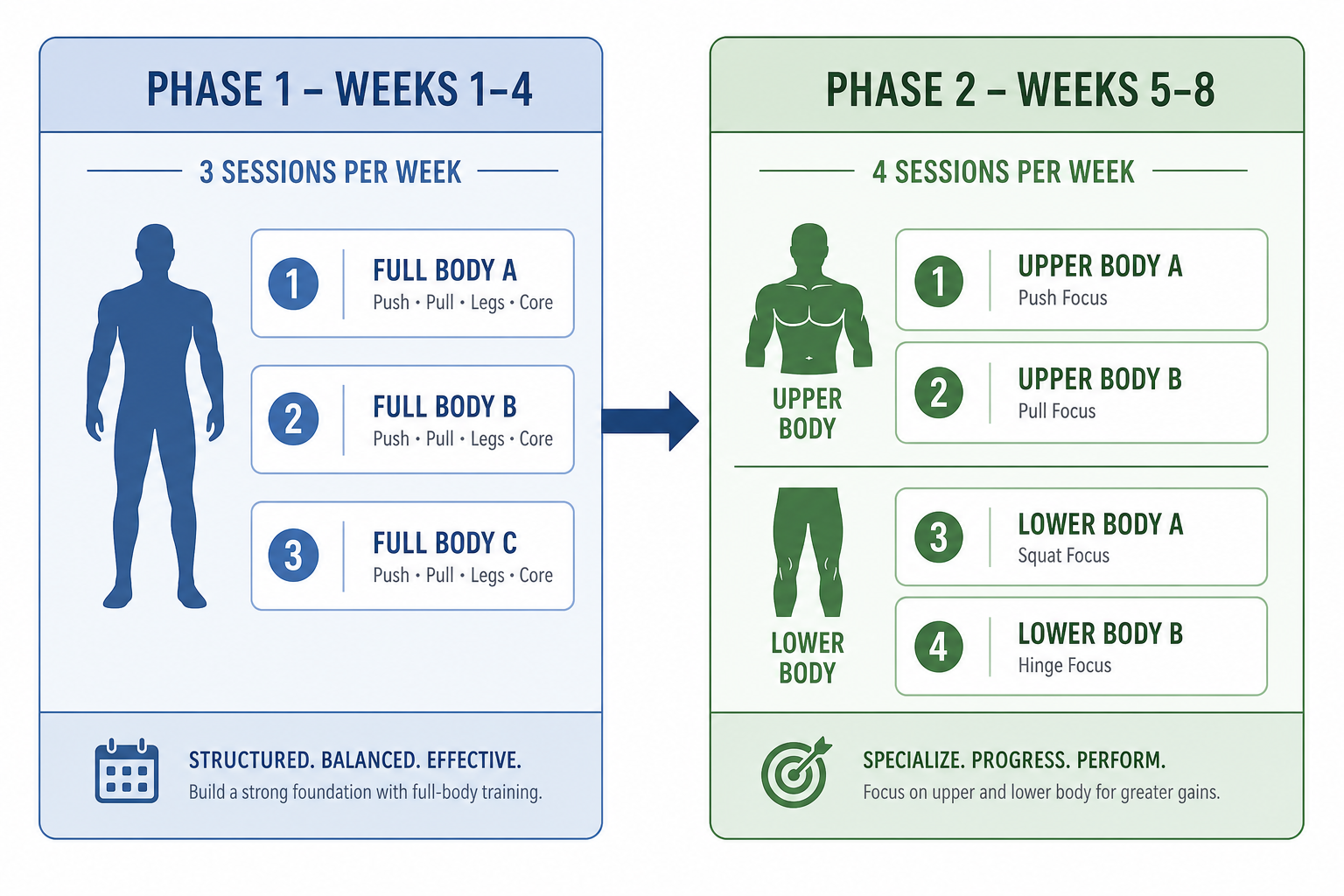
| Phase | Weeks | Sessions/Week | Session Type | Approx. Session Length | Equipment |
|---|---|---|---|---|---|
| Phase 1 | 1–4 | 3 | Full-body (Workouts A & B alternated) | 35–45 min | Bodyweight or dumbbells |
| Phase 2 | 5–8 | 4 | Upper-lower split (Upper A, Lower A, Upper B, Lower B) | 35–45 min | Bodyweight or dumbbells |
In Phase 1, you train three days per week using two alternating full-body workouts (Workout A and Workout B). A typical week looks like Monday / Wednesday / Friday, though any three non-consecutive days work. Full-body training three times per week is well-supported for beginners: research comparing full-body and split routines in untrained subjects found equivalent strength and muscle gains when weekly training volume is equated. For beginners, the neural adaptations driving early strength gains happen regardless of how sessions are split across the week.
In Phase 2, you train four days per week using an upper-lower split. Each week contains one Upper A session, one Lower A session, one Upper B session, and one Lower B session. This structure increases the total volume each muscle group receives per week without extending individual session length or requiring any new equipment.
How Progressive Overload Works at Home
Progressive overload is the principle that your muscles need a slightly greater challenge over time to keep adapting. Without it, the same workout produces diminishing returns after a few weeks. At home, without a full rack of weights, you apply overload through four practical levers.
- Reps: If a set calls for 8–12 reps and you hit 12 with good form, add a rep next session. Once you consistently reach the top of the rep range, move to the next lever.
- Sets: Once you can hit the top of the rep range on all sets, add a third set to that exercise before increasing load. This is especially useful for bodyweight-only users.
- Load: When you can complete all sets and reps cleanly, increase dumbbell weight by the smallest available increment — typically 2.5–5 lb. Drop back to the bottom of the rep range and build back up.
- Tempo: Slow the lowering (eccentric) phase of any movement. Extending a push-up descent from 2 seconds to 4 seconds meaningfully increases the difficulty without changing load or reps.
For bodyweight-only users, the rep and set levers are your primary tools in Phase 1. Tempo becomes especially valuable when an exercise starts feeling easy but you do not yet have a heavier option. The goal on every set is to finish feeling like you could do one or two more reps — not to train to complete failure, but to work hard enough that the last rep requires real effort.
If you are using a fixed-weight dumbbell pair that is too light for some exercises and too heavy for others, use tempo and extra sets to bridge the gap. The load does not need to be a specific number — what matters is reaching near-maximum effort within the rep range. Even improvised weights — a loaded backpack, water jugs, shopping bags — produce a genuine training stimulus when used near the point of muscular fatigue.
Phase 1 Workout Schedule: Weeks 1–4 (Full-Body, 3x/Week)
Train three days per week with at least one rest day between sessions. The most common schedule is Monday, Wednesday, and Friday, but Tuesday / Thursday / Saturday works equally well. Alternate Workout A and Workout B each week, so Week 1 runs A / B / A and Week 2 runs B / A / B.
Each session begins with a 5-minute warm-up: 60 seconds of marching in place, 10 leg swings per side, 10 hip circles per side, 10 arm circles per side, and 5 slow bodyweight squats. End each session with 3–5 minutes of light stretching — hold each stretch for 20–30 seconds without bouncing.
Workout A — Full-Body
| Exercise | Sets | Reps | Rest | Bodyweight Option | Dumbbell Option |
|---|---|---|---|---|---|
| Squat | 2–3 | 8–12 | 60 sec | Bodyweight squat | Goblet squat (hold one dumbbell at chest) |
| Push-up | 2–3 | 6–12 | 60 sec | Standard or kneeling push-up | Same — add slow 3-sec descent for overload |
| Hip hinge | 2–3 | 10–12 | 60 sec | Glute bridge (floor) | Single-leg glute bridge or dumbbell Romanian deadlift |
| Bent-over row | 2–3 | 8–12 | 60 sec | Resistance band or towel row (door anchor) | Two-arm dumbbell bent-over row |
| Dead bug | 2 | 6–8 per side | 45 sec | Bodyweight dead bug | Same — focus on control, not load |
Workout B — Full-Body
| Exercise | Sets | Reps | Rest | Bodyweight Option | Dumbbell Option |
|---|---|---|---|---|---|
| Reverse lunge | 2–3 | 8–10 per leg | 60 sec | Bodyweight reverse lunge | Dumbbell reverse lunge (dumbbells at sides) |
| Incline push-up / Pike push-up | 2–3 | 8–12 | 60 sec | Hands on couch for incline; pike position for shoulder emphasis | Same — adjust angle for difficulty |
| Single-leg glute bridge | 2–3 | 8–10 per leg | 60 sec | Bodyweight single-leg glute bridge | Dumbbell on hip for added load |
| Dumbbell or bag curl + press | 2–3 | 8–12 | 60 sec | Resistance band or water jug curl + overhead press | Dumbbell curl into overhead press |
| Plank | 2–3 | 20–40 sec hold | 45 sec | Forearm plank or kneeling plank | Same — increase hold duration for overload |
Phase 2 Workout Schedule: Weeks 5–8 (Upper-Lower Split, 4x/Week)
At Week 5, the plan transitions to four sessions per week organized as an upper-lower split. You now train upper body twice and lower body twice each week, which increases the total volume each muscle group receives without lengthening any single session.
A standard Phase 2 weekly schedule: Monday (Upper A), Tuesday (Lower A), Wednesday (rest or active recovery), Thursday (Upper B), Friday (Lower B), Saturday–Sunday (rest). You can shift days to fit your schedule — the key is keeping the Upper A / Lower A pairing and the Upper B / Lower B pairing on consecutive or near-consecutive days, with at least one full rest day mid-week.
Upper A
| Exercise | Sets | Reps | Rest | Bodyweight Option | Dumbbell Option |
|---|---|---|---|---|---|
| Push-up variation | 3 | 8–15 | 60 sec | Standard, decline (feet elevated), or archer push-up | Slow 4-sec descent for added difficulty |
| Bent-over row | 3 | 10–12 | 60 sec | Towel row (door anchor) | Two-arm dumbbell row |
| Pike push-up | 3 | 8–12 | 60 sec | Pike push-up (hands on floor, hips high) | Same — elevate feet for greater shoulder load |
| Dumbbell curl | 3 | 10–12 | 45 sec | Resistance band curl or water jug curl | Alternating dumbbell curl |
| Triceps dip / overhead extension | 3 | 8–12 | 45 sec | Chair dip (hands on chair seat behind you) | Dumbbell overhead triceps extension |
| Dead bug | 2 | 6–8 per side | 45 sec | Bodyweight dead bug | Same |
Lower A
| Exercise | Sets | Reps | Rest | Bodyweight Option | Dumbbell Option |
|---|---|---|---|---|---|
| Goblet squat / bodyweight squat | 3 | 10–15 | 60 sec | Bodyweight squat | Goblet squat (one dumbbell at chest) |
| Romanian deadlift | 3 | 10–12 | 60 sec | Single-leg glute bridge | Dumbbell Romanian deadlift (hip hinge, soft knee) |
| Reverse lunge | 3 | 8–10 per leg | 60 sec | Bodyweight reverse lunge | Dumbbell reverse lunge |
| Glute bridge | 3 | 12–15 | 45 sec | Double-leg glute bridge | Dumbbell on hip or single-leg variation |
| Calf raise | 3 | 15–20 | 45 sec | Bodyweight calf raise (step or floor) | Dumbbell calf raise |
| Plank | 2 | 30–45 sec | 45 sec | Forearm plank | Same |
Upper B
| Exercise | Sets | Reps | Rest | Bodyweight Option | Dumbbell Option |
|---|---|---|---|---|---|
| Decline push-up / archer push-up | 3 | 8–12 | 60 sec | Feet elevated on couch for decline; archer for unilateral load | Slow tempo or weighted vest if available |
| Single-arm row | 3 | 10–12 per side | 60 sec | Towel row (one arm, door anchor) | Single-arm dumbbell row (brace on knee) |
| Overhead press | 3 | 8–12 | 60 sec | Pike push-up or wall handstand hold | Dumbbell overhead press (seated or standing) |
| Hammer curl | 3 | 10–12 | 45 sec | Neutral-grip resistance band curl | Dumbbell hammer curl (palms facing in) |
| Triceps push-up | 3 | 8–12 | 45 sec | Close-grip push-up (hands under shoulders) | Same — add slow descent |
| Side plank | 2 | 20–35 sec per side | 45 sec | Forearm side plank or kneeling side plank | Same |
Lower B
| Exercise | Sets | Reps | Rest | Bodyweight Option | Dumbbell Option |
|---|---|---|---|---|---|
| Sumo squat | 3 | 10–15 | 60 sec | Bodyweight sumo squat (wide stance, toes out) | Dumbbell sumo squat (hold one dumbbell vertically) |
| Nordic curl progression / single-leg RDL | 3 | 6–10 | 75 sec | Assisted Nordic curl (anchor feet, slow descent) or single-leg glute bridge | Single-leg dumbbell RDL |
| Step-up | 3 | 10 per leg | 60 sec | Bodyweight step-up (use a sturdy chair or step) | Dumbbell step-up (dumbbells at sides) |
| Hip thrust | 3 | 12–15 | 60 sec | Bodyweight hip thrust (shoulders on couch edge) | Dumbbell or loaded bag on hips |
| Wall sit | 2–3 | 30–45 sec | 45 sec | Bodyweight wall sit | Same — hold dumbbell on thighs for overload |
| Bird dog | 2 | 8 per side | 45 sec | Bodyweight bird dog | Same |
Week-by-Week Progression Log
Use the template below to record your performance each session. The goal is simple: next week's entry should show at least one improvement over this week's — one more rep, one more set, a heavier dumbbell, or a slower tempo noted. If none of those changed, that is useful information too.
| Week | Workout | Exercise | Set 1 (reps × load) | Set 2 (reps × load) | Set 3 (reps × load) | Notes |
|---|---|---|---|---|---|---|
| 1 | A | Bodyweight squat | 10 × BW | 10 × BW | — | Felt easy by set 2 |
| 2 | A | Bodyweight squat | 12 × BW | 12 × BW | 10 × BW | Added 3rd set |
| 3 | A | Goblet squat | 10 × 15 lb | 10 × 15 lb | 9 × 15 lb | Switched to dumbbell |
| 4 | A | Goblet squat | 12 × 15 lb | 12 × 15 lb | 11 × 15 lb | Ready for 20 lb next phase |
What to Expect at Week 4 and Week 8
Setting honest expectations helps you stay consistent when early results feel subtle. Here is what the research and the structure of this plan suggest you should notice at each checkpoint.
Week 4 Checkpoint
- Noticeably more reps on bodyweight exercises compared to Week 1 — most beginners add 3–6 reps on push-ups and squats in the first four weeks.
- Reduced delayed-onset muscle soreness (DOMS) after sessions — your body has adapted to the movement patterns and the training stimulus.
- Improved movement confidence — squats feel more natural, push-ups feel more controlled, and the warm-up takes less effort.
- These gains are primarily neural: your nervous system has learned to recruit muscle fibers more efficiently. Visible muscle size changes are minimal at this stage, which is normal.
Week 8 Checkpoint
- Strength gains of 10–18% on major movement patterns are consistent with what published research shows in untrained subjects over eight weeks of structured resistance training — measurable as heavier dumbbells used, more reps completed, or both.
- Visible muscle thickness increases are measurable in the quads, chest, and arms by Week 8 for most beginners who train consistently — though how visible they are depends on body composition and genetics.
- The four-day upper-lower schedule in Phase 2 will feel manageable — what felt like a significant volume increase at Week 5 should feel routine by Week 8.
- Everyday tasks — carrying bags, climbing stairs, getting up from the floor — should feel easier and require less effort.
Form and Safety Notes for the Six Foundational Movements
Every exercise in this plan is built from six movement patterns. Getting these right from Week 1 protects you from injury and makes every session more effective. The notes below are not full tutorials — they are the one or two cues that matter most for each pattern, and the most common error to avoid.
- Squat: Keep your chest up and your knees tracking over your second toe throughout the descent. Push the floor away as you stand — do not think "pull yourself up." Common error: letting the heels rise or the knees cave inward as you lower.
- Hinge (glute bridge, RDL): Drive movement from the hips, not the lower back. On a glute bridge, squeeze the glutes at the top before lowering. On a Romanian deadlift, maintain a neutral spine throughout — the movement is a hip push-back, not a back bend. Common error: rounding the lower back at the bottom of the hinge.
- Push (push-up, overhead press): Keep your body in a straight line from head to heel during push-ups — no sagging hips or raised seat. On overhead press, brace your core and avoid arching the lower back as the weight goes overhead. Common error: flaring elbows excessively outward during push-ups, which stresses the shoulder joint.
- Pull (row, curl): Initiate rows by pulling the shoulder blade toward your spine before bending the elbow — this keeps the work in the back, not just the biceps. Common error: using momentum or shrugging the shoulder toward the ear during the pull.
- Lunge and single-leg work: Step back far enough that your front shin stays roughly vertical at the bottom of a reverse lunge. Keep your torso upright. Common error: letting the front knee drift far forward past the toes, which increases knee stress unnecessarily.
- Core brace (plank, dead bug, bird dog): Breathe normally during core work — do not hold your breath. Brace as if you are about to take a light punch to the stomach: a firm contraction, not a sucked-in stomach. Common error: letting the lower back arch or the hips pike up during planks and dead bugs.
Next Steps After Week 8
Completing eight weeks of consistent training puts you in a meaningfully different position than when you started. You have learned the six foundational movement patterns, built a base of strength across your whole body, and established the habit of training four days per week. The upper-lower split structure from Phase 2 is a framework you can continue using indefinitely.
Three practical options for what to do next:
- Repeat Phase 2 with increased load. If you have been using the same dumbbell weight throughout Phase 2, this is the simplest next step. Move up to the next weight increment on every exercise where you are consistently hitting the top of the rep range, and run the four-week upper-lower block again.
- Add a fifth training day. A fifth session can be a second full-body session, an active recovery day (light walking, mobility work), or a dedicated core and carry session. Keep the four primary upper-lower sessions intact and treat the fifth as supplementary.
- Move to a more advanced split. If you have access to a broader range of dumbbells or resistance bands and want to increase exercise variety, a push-pull-legs split or a three-day full-body program with higher per-session volume are natural progressions from the upper-lower foundation this plan builds.
Whatever path you choose, the habits that made this plan work — logging your sets, applying at least one overload lever each week, and prioritizing movement quality — transfer directly to any program you follow next.
What a small equipment investment adds
We don't have a build tagged to this exact tier yet. Browse all builds.
How often should you repeat this?
See our recovery and rest reference for citation-anchored rest-interval guidance.
Spot something off?
Tell us if a movement, tier assumption, or duration didn't match your experience.