
Best Home Exercise Equipment: A Constraint-Based Buying Guide for 2026
A structured guide for high-consideration buyers. Self-identify your budget, space, and fitness goal to find the right equipment category, with a total cost of ownership comparison vs. a gym membership.
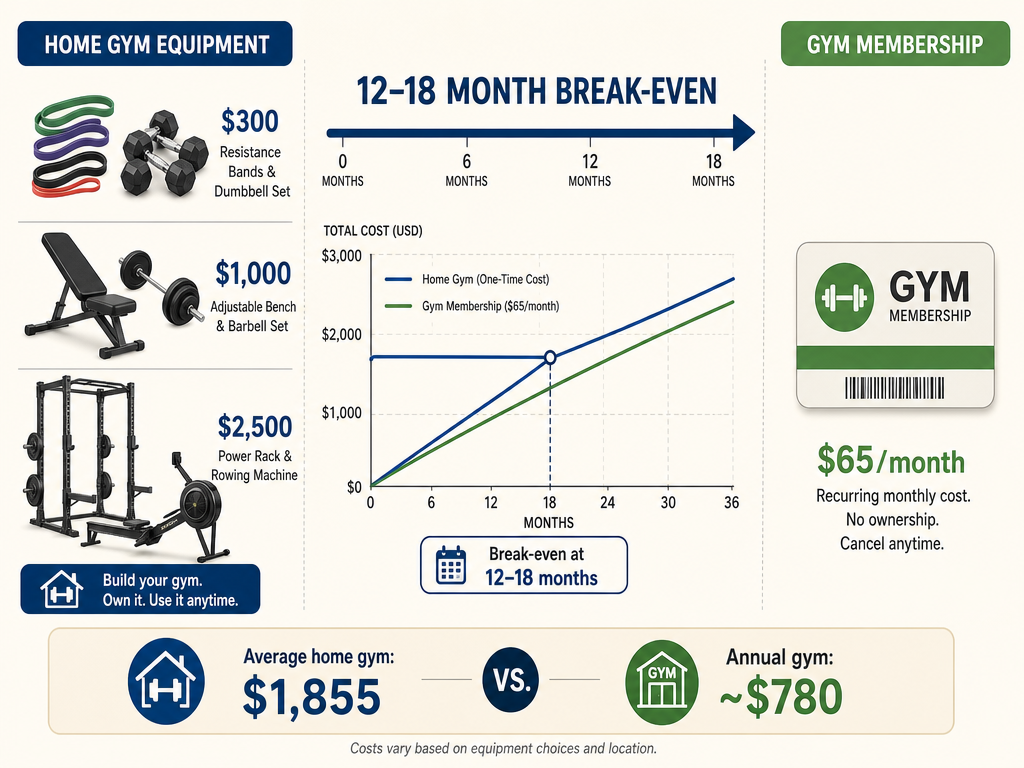
Home Gym vs. Gym Membership: Understanding the Decision
The first question most buyers face is whether the upfront cost of home equipment justifies itself against a recurring gym membership. The numbers suggest it does — but only if you train consistently. According to the 2024 U.S. Health & Fitness Consumer Report cited by Garage Gym Reviews, the average gym membership costs roughly $65 per month, or $780 per year. Against that, the average cost of a home gym across tested products is $1,855.
At those averages, a home gym reaches its break-even point in approximately 12 to 18 months. After that, the equipment is effectively paid for, and the only ongoing costs are maintenance, potential subscription fees, and electricity. A $1,500 setup, for example, breaks even against a $65/month membership in roughly two years, according to amortization data from Garage Gym Reviews.
| Scenario | Upfront Cost | Annual Cost (Year 1) | Annual Cost (Year 3) | Break-Even Point |
|---|---|---|---|---|
| Gym Membership ($65/mo) | $0 | $780 | $2,340 | N/A |
| Budget Home Gym | $500 | $500 + maintenance | $500 + maintenance | ~8 months |
| Mid-Range Home Gym | $1,500 | $1,500 + maintenance | $1,500 + maintenance | ~23 months |
| Premium Home Gym | $3,000 | $3,000 + maintenance | $3,000 + maintenance | ~46 months |
The financial case is only part of the equation. A home gym eliminates commute time, offers 24/7 access, and removes the social friction some people feel in a public gym. The CDC notes that 3 out of 4 people don't exercise as much as they should, and CivicScience polling shows people are more likely to exercise if they can do it from home. For many, the convenience factor alone justifies the investment.
Self-Diagnose Your Constraints: Budget, Space, and Goal
Before looking at any product, you need a clear picture of your own constraints. The most impactful factor in equipment selection is not your budget — it is your available floor space. Space filters out entire categories. A power rack requires a dedicated footprint. A folding squat rack or a smart gym can fit in a corner. Resistance bands and a yoga mat fit in a closet.
Assess yourself across three axes:
- Budget Tier: $0–500 (entry), $500–1,500 (mid-range), $1,500–3,000 (premium), $3,000+ (full build). Budget gyms are typically $300–$1,000, mid-range $1,000–$3,000, and full gyms $3,000–$6,000, per Garage Gym Reviews.
- Space Tier: Apartment corner (under 20 sq ft), spare room (80–150 sq ft), garage (150+ sq ft). A functional single-machine setup fits in as little as 80 sq ft, while a more complete arrangement with cardio and strength works in 120–150 sq ft, according to The Fitness Outlet. Ceiling height of 7–8 ft is the minimum for most equipment.
- Primary Fitness Goal: Strength (muscle building, powerlifting), Cardio (endurance, fat loss), Hybrid (general fitness, functional training), or Smart (data-driven, app-integrated training).
A buyer with a $1,000 budget and a garage can consider a power rack and barbell set. A buyer with the same budget and an apartment corner should look at adjustable dumbbells, a folding bench, and resistance bands. The constraint profile, not the dollar amount alone, determines the viable options.
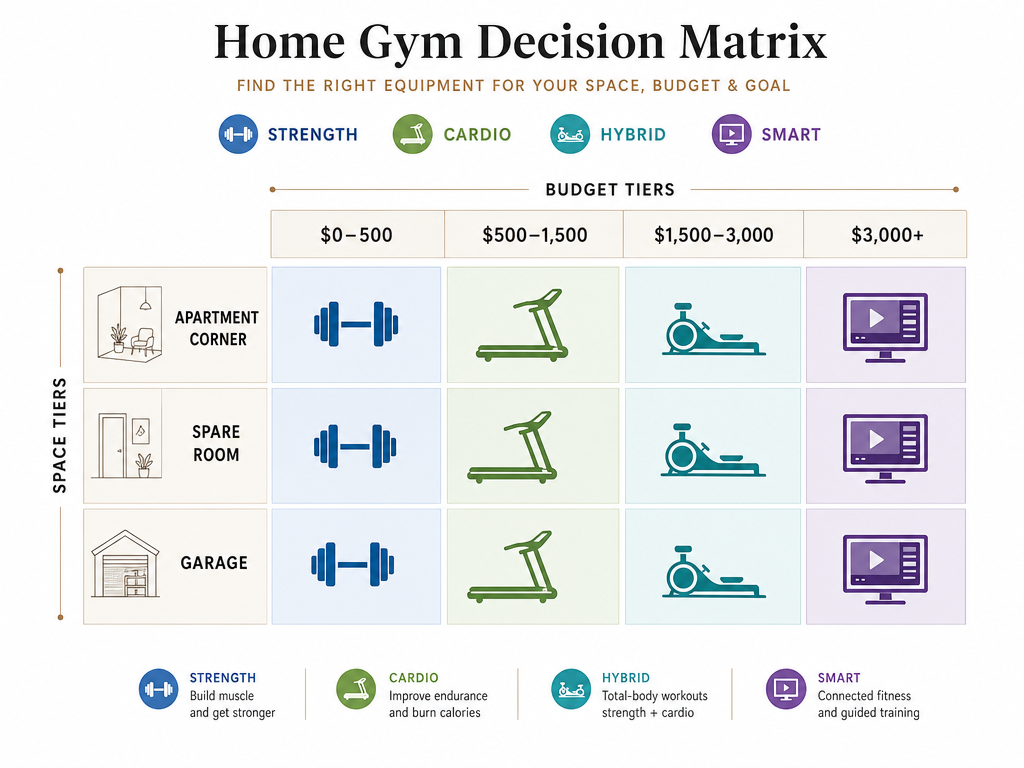
Match Your Profile to the Right Equipment Category
Once you know your budget, space, and goal, you can map your profile to an equipment category. The table below shows the primary categories and the constraint profiles they serve best.
| Equipment Category | Best Budget Range | Minimum Space | Primary Goal | Key Trade-Off |
|---|---|---|---|---|
| Strength (Power Racks, Barbells, Dumbbells) | $350–$1,500+ | 10–20 sq ft (rack) + floor space | Strength, Muscle Building | Requires multiple pieces; heavy; noisy with dropped weights |
| Cardio (Treadmills, Bikes, Rowers) | $500–$2,500 | 20–30 sq ft (treadmill); 10–15 sq ft (bike/rower) | Cardio, Endurance, Fat Loss | Bulky; can be noisy; limited strength benefit |
| Hybrid (All-in-One Machines, Functional Trainers) | $1,300–$4,200 | 10–25 sq ft | General Fitness, Functional Training | Higher upfront cost; may require subscription for digital features |
| Smart Gyms (Tonal, Speediance, Mirror) | $2,000–$4,300+ | Under 10 sq ft (wall-mounted or compact) | Smart, Data-Driven, App-Integrated | Subscription required ($40–$60/month); digital resistance maxes out at 250 lbs |
The medium price range segment ($1,000–$3,000) is projected to account for 46% of total revenue in the home gym equipment market in 2026, according to Future Market Insights. This is the sweet spot for most buyers: enough budget for quality equipment without overspending on features you may not use.
Equipment Category Deep Dives: Price, Footprint, and Trade-Offs
Strength Equipment: Power Racks, Barbells, and Dumbbells
Strength equipment is the backbone of most home gyms. A power rack is the centerpiece, providing a safe environment for squats, bench presses, and pull-ups. The REP PR-1100 Power Rack costs $380, offers a 700-lb weight capacity, and is made from 14-gauge steel — a solid entry point. The Fringe Sport Squat Rack with Pull-Up Bar costs $349. For a folding option that saves floor space, the PRx Profile PRO Squat Rack folds to 4 inches off the wall when not in use and has a 1,000-lb weight capacity.
Adjustable dumbbells are a space-efficient alternative to a full dumbbell set. The PowerBlock Pro 50 adjusts from 5 to 50 lbs and replaces 19 traditional dumbbell pairs, according to The Fitness Outlet. For barbells, the Synergee Games Cerakote Barbell costs $179.95 with a 190,000 PSI tensile strength.
| Product | Price | Weight Capacity | Footprint (W x D x H) | Best For |
|---|---|---|---|---|
| REP PR-1100 Power Rack | $380 | 700 lbs | ~48" x 48" x 84" | Budget-conscious lifters |
| PRx Profile PRO Squat Rack | ~$1,000 | 1,000 lbs | 53" x 29.25" x 89" (folds to 4" deep) | Small spaces, apartment dwellers |
| Fringe Sport Squat Rack | $349 | ~700 lbs | ~48" x 48" x 84" | Entry-level strength training |
| PowerBlock Pro 50 Dumbbells | ~$350 | 5–50 lbs per hand | Compact (replaces 19 pairs) | Space-saving strength training |
Cardio Equipment: Treadmills, Bikes, and Rowers
Cardio machines dominate the home gym market, accounting for 63% of all equipment sales in 2026. Treadmills are the most popular but require the most space — typically 20–30 sq ft. Exercise bikes and rowing machines are more compact. The Concept2 RowErg stores upright, weighs 57 lbs, and has dimensions of 95" L x 24" W x 14" H. A rowing machine activates approximately 85% of muscles with every stroke, making it an efficient full-body cardio option.
For small spaces, folding treadmills like the Echelon Stride 6s-10 fold completely flat. The Bowflex Max Trainer M6 is 46" L x 26" W x 64.2" H, offering a compact elliptical-stepper hybrid. Budget cardio machines start around $500, while premium models with smart features can exceed $2,500.
Hybrid Equipment: All-in-One Machines and Functional Trainers
All-in-one machines combine multiple exercise stations into a single footprint, making them ideal for spare rooms and garages. The Bells of Steel All-in-One starts at $1,299.99, while the Major Fitness B17 Flying Fortress costs $4,199.99. These machines typically include a cable pulley system, pull-up bar, and attachments for a wide range of exercises. The Bells of Steel Cable Tower with Weight Stack starts at $434.99 for a standalone cable unit.
Functional trainers offer similar versatility with a smaller footprint. They are well-suited for general fitness and rehabilitation goals. For a detailed comparison of all-in-one systems, see our guide on all-in-one home gym machines.
Smart Gyms: Digital Resistance and Subscription Costs
Smart gyms are the fastest-growing segment in home fitness. Over 40% of new home fitness equipment sales in 2026 include digital or smart features, and smart equipment is projected to lead the home gym equipment market with a 54.0% share in 2026, according to Future Market Insights. These machines use digital resistance, guided workouts, and app integration to deliver a connected training experience.
The Tonal 2 costs $4,295 and provides up to 250 lbs of digital resistance, with a required subscription of $59.95 per month. The Speediance Gym Monster costs $3,199 with no required subscription, though optional app features may have fees. Smart gym subscription costs range from $12.99 to $59.95 per month across the category.
Smart gyms are most competitive for small-space dwellers. The Tonal 2 measures 5.25" D x 21.5" W x 50.9" H and mounts on a wall, occupying under 10 sq ft. The Speediance Gym Monster is 49.21" D x 28.34" W x 72.83" H. For a head-to-head comparison of smart gym systems, see our 2026 smart home gym comparison.
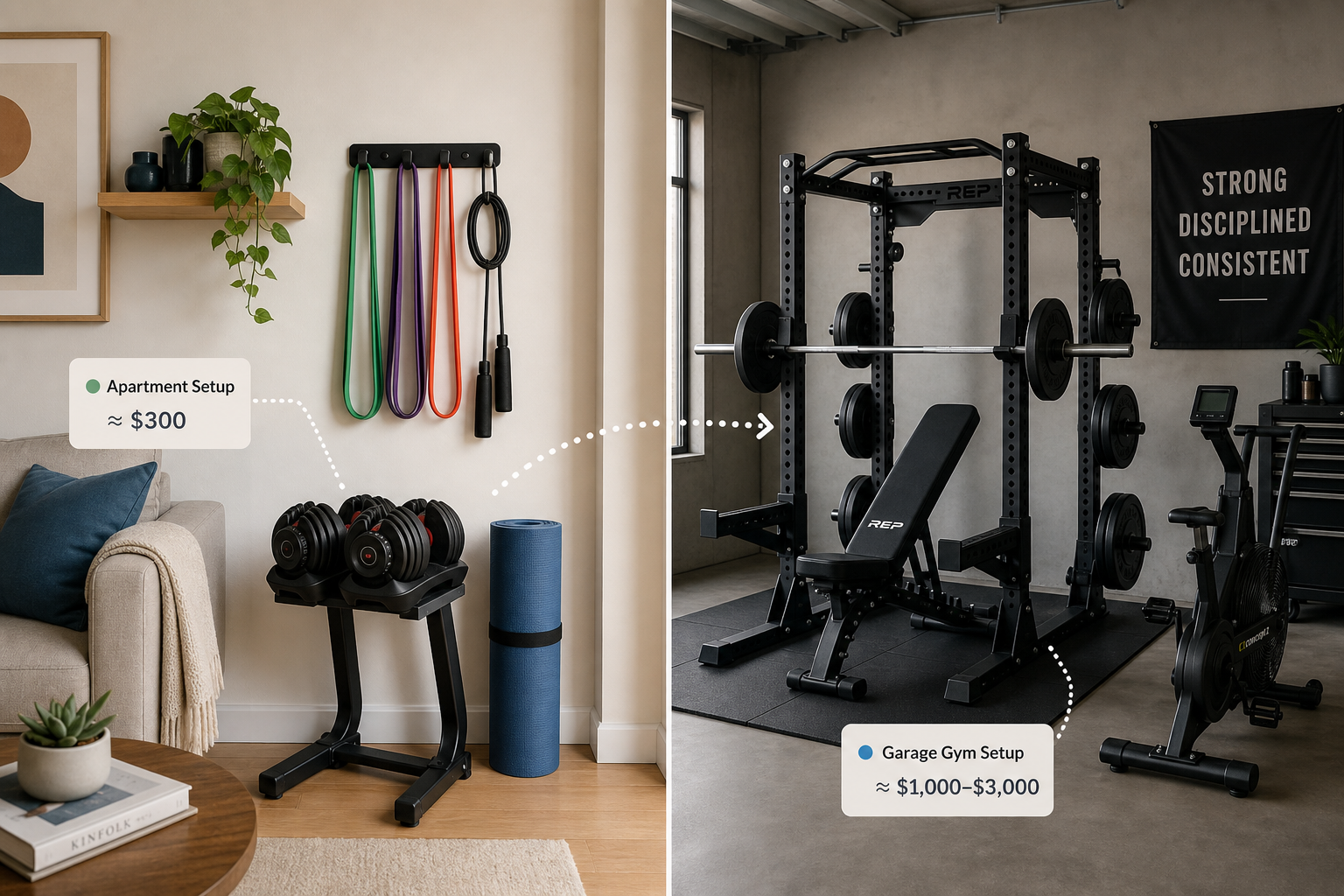
Sample Home Gym Builds at Every Budget Tier
The following builds combine equipment from the categories above into coherent, actionable setups. Each build is matched to a specific constraint profile.
$300–500 Apartment Starter Kit
For the beginner with a small budget and limited space, this kit focuses on versatility and minimal footprint. Research shows training with elastic resistance provides similar strength gains to conventional resistance training (PMID 30815260), so resistance bands are a legitimate strength tool, not a compromise.
- Resistance bands (set): $50–$130. The Living.Fit Resistance Bands offer resistance from 6 to 250 lbs and are priced at $128.94 for a set.
- Adjustable dumbbells: $200–$350. A single pair replaces multiple fixed dumbbells.
- Yoga mat: $20–$40. Provides cushioning for floor exercises and stretching.
- Jump rope: $10–$20. Compact cardio tool for warm-ups and conditioning.
Total: approximately $300–$540. This setup fits in a closet and can support a full-body strength and cardio routine for months or years.
$1,000–1,500 Spare Room Build
For the intermediate buyer with a spare room (80–120 sq ft) and a strength-focused goal.
- Power rack: $350–$400. REP PR-1100 or Fringe Sport Squat Rack.
- Barbell and weight plates: $300–$500. A 7-ft Olympic bar and 255–300 lbs of iron or bumper plates.
- Adjustable bench: $150–$300. For bench press, rows, and dumbbell work.
- Pull-up bar (if not on rack): $30–$50.
Total: approximately $830–$1,250. This is a classic strength training setup that can support linear progression for 12–24 months.
$2,500–3,000 Garage Gym
For the enthusiast with a garage or dedicated room (150+ sq ft) who wants both strength and cardio.
- Functional trainer or all-in-one machine: $1,300–$2,000. Bells of Steel All-in-One or similar.
- Rowing machine: $900–$1,200. Concept2 RowErg is the gold standard.
- Kettlebells (set of 2–3): $100–$200.
- Flooring (stall mats): $100–$200.
Total: approximately $2,400–$3,600. This build covers strength, cardio, and functional training with minimal overlap.
$3,000+ Smart Gym Setup
For the tech-forward buyer who values guided programming and a compact footprint.
- Smart gym machine: $3,199–$4,295. Speediance Gym Monster (no subscription required) or Tonal 2 ($59.95/month).
- Adjustable dumbbells: $200–$350. For accessory work and warm-ups.
- Compact cardio (optional): $500–$1,000. Folding treadmill or exercise bike.
Total: approximately $3,400–$5,645 without subscription costs. This setup occupies under 20 sq ft and provides a complete, app-guided training experience. For a comparison of smart vs. traditional equipment for small spaces, see our guide on smart compact home gyms vs. traditional strength equipment.
Decision Flowchart: Your Next Step
Use this checklist to trace your path from constraint profile to recommended equipment category and sample build.
- Step 1: Identify your budget tier. $0–500, $500–1,500, $1,500–3,000, or $3,000+.
- Step 2: Measure your available floor space. Apartment corner (under 20 sq ft), spare room (80–150 sq ft), or garage (150+ sq ft). Include ceiling height.
- Step 3: Define your primary fitness goal. Strength, Cardio, Hybrid, or Smart.
- Step 4: Match your profile to a category. Use the decision matrix above.
- Step 5: Select a sample build. Choose the build that matches your budget and space, then adjust based on your specific preferences.
- Step 6: Explore detailed comparisons. Visit our Equipment Comparisons section for side-by-side spec tables, tiered recommendations, and total cost of ownership notes on specific products.
If you are still unsure about your space constraints, start with our Small-Space & Home Gym Setup guides, which include space requirement tables and budget-tiered build recommendations. For a comparison of different compact home gym approaches, see modular vs. all-in-one vs. smart gym.
This result comes from one real apartment under the stated conditions — it is a strong signal, not a guarantee your space will measure identically.
Builds this evidence supports
Cable Machine Alternatives That Save Space and Money
Compare the best cable machine alternatives for home gyms – from resistance bands and pulley systems to suspension trainers and compact digital units – and find the right option for your space and budget.
How to Choose a Compact Home Gym That Works for Your Space, Budget, and Noise Tolerance
This article provides a structured decision framework for apartment dwellers and small-space residents to match their specific floor footprint, noise sensitivity, and budget to the most suitable compact home gym strategy — whether that's an all-in-one machine, modular build, smart digital system, or band/bodyweight setup.
The Garage Gym Reality Check: What Equipment Actually Fits in a Single-Car Garage
Most garage gym guides assume a two-car space. This article uses real dimensions, real equipment footprints, and three layout templates to show what fits—and what doesn't—in a single-car garage (10x20 to 12x20 ft).
Spot something off?
If this result didn't match your own space, let us know — floor-damage and noise claims carry real deposit-risk consequences if we get them wrong.