
Is Commercial-Grade Equipment Worth It for a Home Gym? Complete 2026 Cost-Benefit Analysis
A data-backed decision framework for intermediate and advanced home gym enthusiasts evaluating whether commercial-grade equipment justifies its premium. Covers construction differences, a usage-based threshold (4+ days/week), remanufactured savings, resale value, and space myths — helping buyers choose based on their actual training frequency and goals.
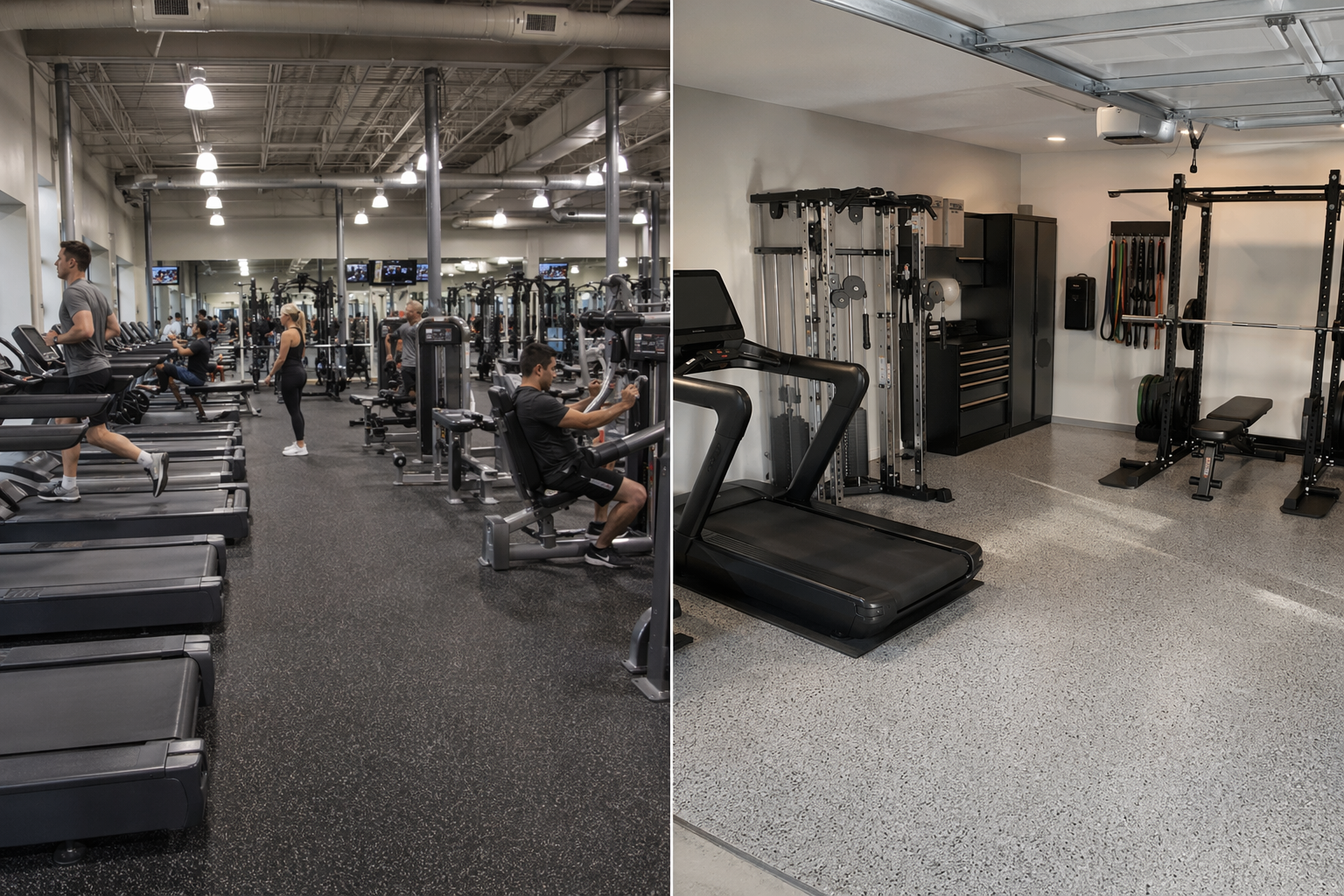
The Home Gym Buyer’s Commercial Dilemma
You’ve been training at home for a year — maybe two. Your mid-range treadmill feels wobbly at speed. The cable stack on your all-in-one machine maxes out before your working sets do. You start browsing commercial-grade equipment and immediately hit sticker shock: $3,000 for a refurbished elliptical, $4,000 for a treadmill that looks like it belongs in a Gold’s Gym, $2,500 for a functional trainer with dual weight stacks.
The question isn’t whether commercial equipment is better — it’s whether it’s better for you. The answer depends almost entirely on one variable: how many days per week you train.
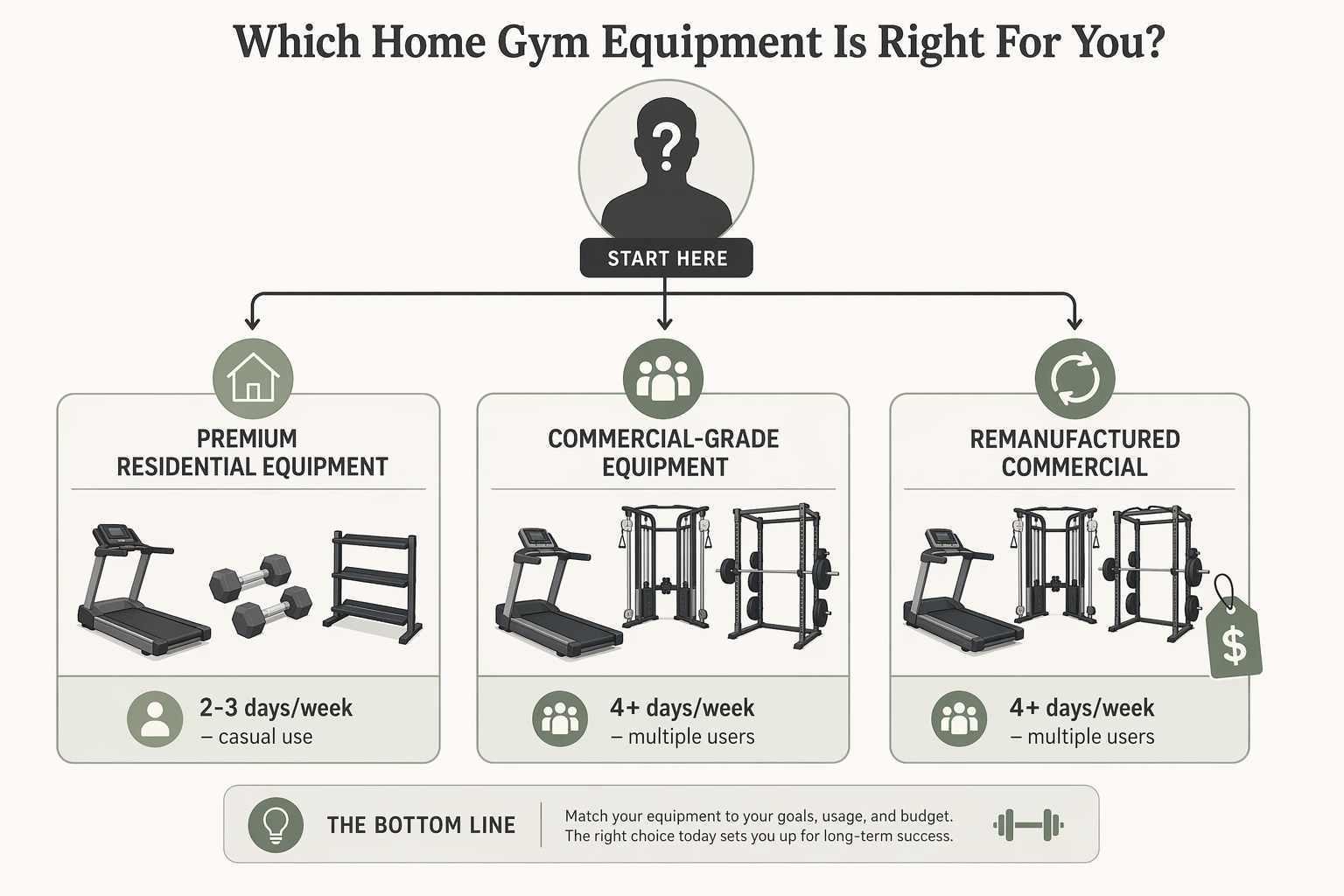
This article builds a usage-based decision framework. If you train 4 or more days per week, have multiple household users, or are pursuing progressive strength goals that will outgrow consumer-grade weight stacks, commercial equipment delivers better long-term value through durability, safety, and resale retention. If you train casually 2–3 times per week, you’ll likely overpay for capacity you never use — and you’re better served by the premium residential picks covered in our Best Home Gym Equipment guide.
What ‘Commercial’ Actually Means in Construction Terms
The term “commercial-grade” gets thrown around loosely in fitness marketing, but the actual engineering differences are measurable and consistent across brands. Commercial equipment is built to withstand 12–16 hours of daily use in facilities where machines are rarely idle. Consumer equipment is designed for 1–3 hours of daily use in a single-user home. Those usage assumptions drive every material and design decision downstream.
Here’s how the specs break down across the most important dimensions:
| Spec Dimension | Commercial-Grade | Consumer / Home-Grade |
|---|---|---|
| Steel frame gauge | 11–14 gauge | 16–18 gauge |
| Weight capacity (strength) | 800–1,500+ lbs | 300–700 lbs |
| Weight capacity (cardio) | 400–500+ lbs | 250–350 lbs |
| Designed lifespan | 10–15+ years | 3–7 years |
| Motor type (treadmills) | Industrial-grade, continuous duty | Consumer-grade, intermittent duty |
| Running surface (treadmills) | 22" x 60" | 18" x 55" |
| Speed range (treadmills) | 0.5–12+ MPH | 0.8–10 MPH |
| Incline range (treadmills) | -3% to 15% | 0–12% |
| Warranty (frame / motor) | Lifetime to 10 years | 2–5 years |
| Service frequency | Annual preventive | Frequent repairs common |
The gauge difference alone tells a meaningful story. Commercial frames use 11–14 gauge steel — thicker, heavier, and significantly more resistant to flexing under load. Consumer frames use 16–18 gauge steel, which is adequate for occasional use but will develop wobble and joint fatigue over time, especially if you’re lifting near the machine’s rated capacity. Reinforced welds, industrial-grade bearings, and sealed electronics are standard on commercial units and rare on consumer models.
The running surface difference on treadmills is another concrete example. A 22" x 60" belt accommodates a natural stride for users over 6 feet tall. The narrower 18" x 55" belt common on consumer treadmills forces a shorter, more constrained stride that can feel unstable at higher speeds. If you’re doing intervals or running at 10+ MPH, that extra 4 inches of width and 5 inches of length isn’t a luxury — it’s a safety margin.
The Decision Matrix: When Commercial Makes Sense for Your Home Gym
Rather than a blanket “commercial is better” or “commercial is overkill,” the right recommendation depends on four variables: training frequency, number of users, intensity level, and budget. The matrix below maps each combination to the appropriate equipment tier.
| Training Frequency | Users | Intensity Level | Recommended Tier | Rationale |
|---|---|---|---|---|
| 2–3 days / week | 1 | Low to moderate | Premium residential | Consumer equipment will last 5–7 years at this usage level; commercial premium never pays back |
| 2–3 days / week | 2+ | Moderate | Light commercial or premium residential | Multiple users accelerate wear; light commercial adds durability without full commercial cost |
| 4–6 days / week | 1 | Moderate to high | Commercial-grade | Usage crosses the threshold where per-year cost of commercial is lower than consumer replacement cycles |
| 4–6 days / week | 2+ | Moderate to high | Commercial-grade (remanufactured recommended) | Multiple high-frequency users justify full commercial; remanufactured saves 40–60% vs. new |
| 6–7 days / week | 1–2 | High (progressive overload, heavy lifts) | Full commercial (new or remanufactured) | Consumer weight stacks and frames will fail under progressive loading; safety risk increases |
| Any frequency | Any | Rehab / low-impact only | Premium residential or light commercial | Intensity is low enough that consumer durability is sufficient; invest in comfort features instead |
The 4+ days-per-week threshold is the tipping point. At that frequency, a consumer treadmill rated for 3–7 years of light use will show significant wear within 2–3 years. A commercial treadmill designed for 12–16 hours of daily operation will barely break a sweat. The per-year cost math flips in favor of commercial at this usage level — and we’ll walk through those numbers in the next section.
The Hidden Cost of Upgrading Later: Replacement Cycle Math
The most common mistake home gym buyers make is treating initial purchase price as the total cost. Equipment doesn’t just wear out — it wears out on a schedule, and that schedule determines whether the cheaper upfront option actually costs more over time.
Consider a treadmill. A remanufactured commercial treadmill at $2,195 is designed to last 15 years under heavy use. That works out to $146 per year. An $800 consumer treadmill designed for lighter use will typically need replacement after 4 years at the same usage level. That’s $200 per year — and that’s assuming you only replace it once. Over 15 years, the consumer path requires 3–4 replacements, pushing the total cost to $2,400–$3,200, while the commercial unit is still running on its original motor and deck.
| Scenario | Initial Cost | Lifespan | Per-Year Cost | 15-Year Total |
|---|---|---|---|---|
| Remanufactured commercial treadmill | $2,195 | 15 years | $146 | $2,195 |
| Consumer treadmill (single replacement) | $800 | 4 years | $200 | $2,400 (3 replacements) |
| Consumer treadmill (mid-range) | $1,500 | 5 years | $300 | $4,500 (3 replacements) |
| Entry-level home unit (GearForFit scenario) | $1,200–$1,800 | 2–4 years | $300–$900 | $3,500–$5,400+ |
The 5-year scenario from GearForFit tells a similar story. An entry-level home unit costing $1,200–$1,800 is often replaced after 2–4 years, bringing the 5-year total to $2,500–$3,500 or more. A commercial-grade unit costing $3,000–$4,500 is unlikely to need replacement in that window, making the 5-year total $3,000–$4,500. The gap narrows significantly — and if you factor in the superior experience, stability, and resale value of the commercial unit, the value proposition tilts further.
For a deeper dive on general home gym cost factors beyond the commercial-vs-residential comparison — including flooring, assembly, subscriptions, and resale — see our 5-Year Total Cost of Ownership Guide.
Remanufactured Commercial Equipment: The Sweet Spot for Home Buyers
New commercial equipment is expensive — often $5,000–$10,000 for a single treadmill or elliptical — and lead times can stretch 2–8 months for factory orders. Remanufactured equipment offers a way to access the same build quality at 40–60% off new commercial pricing, with delivery in days rather than months.
Remanufacturing is not the same as used. Reputable dealers strip the machine to the frame, replace all worn components (belts, decks, bearings, electronics, upholstery), repaint or powder-coat the frame, and test the unit to meet original manufacturer specifications. The result is a machine that performs like new but costs thousands less.
- Cost savings: 40–60% below new commercial MSRP. A Precor EFX 835 that retailed for $6,000+ new can be purchased remanufactured for approximately $2,595.
- Availability: Remanufactured units are typically in stock and ship within days, compared to 2–8 month lead times for new commercial orders from manufacturers.
- Build quality: Same 11–14 gauge steel frames, industrial motors, and reinforced welds as new commercial units. The difference is cosmetic and warranty-related, not structural.
- Warranty trade-off: Remanufactured units typically carry 1–3 year warranties vs. 5–10 years on new commercial. For home use at 4–6 days per week, this is usually adequate — failure rates on commercial frames are very low after the initial burn-in period.
- Aesthetic trade-off: Remanufactured units may have older console designs, fewer digital features (no touchscreen, no app integration), and cosmetic blemishes from the original use. If having the latest screen and software ecosystem matters to you, new commercial or premium residential may be a better fit.
Space Myths: Modern Commercial Equipment That Fits in a Home Gym
The assumption that commercial equipment requires a warehouse-sized space is outdated. Modern commercial cardio machines have footprints comparable to their consumer counterparts, and all-in-one strength systems have become significantly more compact in recent years.
- Commercial treadmills: A typical commercial treadmill occupies roughly the same floor space as a consumer model — approximately 30–35 square feet. The difference is in the running surface (22" x 60" vs. 18" x 55"), not the overall footprint. Many commercial models are now available with folding or lift-assist mechanisms for easier storage.
- Commercial ellipticals: The Precor EFX 835, a staple of commercial gyms worldwide, has a footprint of approximately 30" x 70" — comparable to most consumer ellipticals. The difference is in the stride mechanism, bearing quality, and weight, not the floor space required.
- All-in-one strength systems: Modern multi-station units combine a Smith machine, power rack, functional trainer, lat pulldown, and low row in a single footprint designed for basements and garage gyms. These units typically require 40–60 square feet and an 8-foot ceiling — well within the range of a standard residential garage or spare room.
- Functional trainers: Dual-adjustable pulley systems like the Titan Fitness Functional Trainer (82-inch height, dual 200-lb weight stacks) fit under standard 8-foot ceilings and occupy roughly 4' x 4' of floor space. They replace multiple pieces of cable equipment in a single compact station.
For a detailed comparison of specific all-in-one models and their space requirements, see our All-in-One Home Gym Machines Comparison Guide. If you’re weighing smart compact solutions against traditional commercial-grade equipment for a small space, our Smart Compact vs. Traditional Strength Equipment article covers that trade-off in depth.
Real-World Cost Comparison: Precor EFX 835 vs. Consumer Ellipticals Over 10 Years
A concrete example helps illustrate how the long-term math plays out. The Precor EFX 835 is one of the most widely used commercial ellipticals in the industry — found in thousands of health clubs, hotel gyms, and corporate fitness centers. A remanufactured unit costs approximately $2,595.
Over 10 years of use at 4–5 days per week, a consumer elliptical in the $600–$800 range will typically need replacement every 3–4 years. That means 3 consumer units over the decade, totaling approximately $2,400 — nearly the same as the single commercial unit. But the comparison doesn’t end at the purchase price.
| Cost Factor | Remanufactured Precor EFX 835 | 3 Consumer Ellipticals (10 Years) |
|---|---|---|
| Total purchase cost | $2,595 | $2,400 (3 units at ~$800 each) |
| Resale value after 5 years | $1,038–$1,298 (40–50% retention) | $80–$160 (10–20% retention) |
| Net cost after 5-year resale | $1,297–$1,557 | $2,240–$2,320 |
| Annual maintenance cost | $50–$100 (belt, rollers, cleaning) | $100–$200 (repairs, parts, service calls) |
| 10-year total cost (estimated) | $2,800–$3,200 | $3,400–$4,000+ |
| Experience difference | Commercial stride, stability, durability | Diminishing quality with each replacement |
The resale retention difference is particularly striking. A 5-year-old commercial treadmill or elliptical retains 40–50% of its original value because commercial buyers (hotels, apartment gyms, studios) actively seek used commercial equipment. Consumer equipment retains only 10–20% after 5 years because the resale market is thin — most buyers want new, and used consumer machines have a reputation for being near the end of their service life.
Recommended Commercial Pieces for a Home Gym
Not every piece of commercial equipment translates well to a home setting. Some are too large, too specialized, or require three-phase power. The categories below are the ones that offer the best return on investment for home users training 4+ days per week.
| Category | What to Look For | Why It Works at Home | Example Models |
|---|---|---|---|
| Treadmill | 3.0+ CHP continuous-duty motor, 22" x 60" belt, -3% to 15% incline, 400+ lb capacity | Superior deck cushioning, longer belt life, quieter operation at speed | Life Fitness 95T, Precor 956i, True PS100 |
| Elliptical / AMT | Commercial-grade stride mechanism, sealed bearings, 350+ lb capacity | Smoother stride, no wobble at high resistance, 10+ year service life | Precor EFX 835, Cybex 750A, True ES900 |
| Functional trainer | Dual weight stacks (150–200 lbs each), 82–84 inch height, cable change system | Replaces 4–5 cable machines in one footprint; fits under 8-ft ceilings | Titan Fitness Functional Trainer, Hoist V5, Life Fitness G7 |
| Multi-station / all-in-one | Combines Smith, power rack, lat pulldown, low row, functional trainer | Complete strength gym in 40–60 sq ft; ideal for garage gyms | Inspire FTX, Body-Solid G9S, Force USA G20 |
| Power rack | 11-gauge steel, 1,000+ lb capacity, Westside hole spacing, 10-year+ warranty | Indestructible for heavy squats and bench; lifetime investment | Rogue R-3, REP PR-4000, Titan X-3 |
| Air bike / rower | Industrial-grade chain/belt drive, aluminum or steel frame, 500+ lb capacity | Simple mechanics, minimal maintenance, 15+ year lifespan | Concept2 RowErg, Assault AirRunner, Schwinn Airdyne AD Pro |
If you’re building a garage gym from scratch and need to prioritize your purchases, our Garage Gym Equipment Priority Tier List covers what to buy first, what to skip, and when to upgrade — including where commercial-grade pieces fit in the build order.
Where to Buy: New, Remanufactured, and Certified Pre-Owned
Once you’ve decided on commercial-grade, the next question is which purchasing channel fits your budget, timeline, and tolerance for risk. Each path has distinct trade-offs.
| Channel | Typical Savings vs. New MSRP | Lead Time | Warranty | Best For |
|---|---|---|---|---|
| New (direct from manufacturer) | 0% (full MSRP) | 2–8 months | 5–10 years (frame), 2–5 years (parts) | Buyers who want latest features, full warranty, and specific color/customization options |
| Remanufactured (specialized dealer) | 40–60% off new MSRP | Days to 2 weeks | 1–3 years (parts and labor) | Buyers who prioritize value and build quality over aesthetics and digital features |
| Certified pre-owned (fitness liquidator) | 50–70% off new MSRP | Days to 2 weeks | 30–90 days (limited) | Budget-focused buyers comfortable with cosmetic wear and shorter warranty coverage |
| Used / private party (Facebook, Craigslist) | 70–90% off new MSRP | Immediate (local pickup) | None (as-is) | Buyers with technical knowledge who can inspect and transport equipment themselves |
For most home buyers training 4–6 days per week, remanufactured equipment from a reputable dealer offers the best balance of cost, quality, and peace of mind. The 40–60% savings versus new commercial pricing is substantial, and the 1–3 year warranty covers the period when infant mortality failures are most likely. Certified pre-owned is a viable option if you’re comfortable with cosmetic imperfections and a shorter warranty window. New direct from the manufacturer makes sense only if you need specific customization, the latest console technology, or the longest possible warranty.
This result comes from one real apartment under the stated conditions — it is a strong signal, not a guarantee your space will measure identically.
Builds this evidence supports
Cable Machine Alternatives That Save Space and Money
Compare the best cable machine alternatives for home gyms – from resistance bands and pulley systems to suspension trainers and compact digital units – and find the right option for your space and budget.
How to Choose a Compact Home Gym That Works for Your Space, Budget, and Noise Tolerance
This article provides a structured decision framework for apartment dwellers and small-space residents to match their specific floor footprint, noise sensitivity, and budget to the most suitable compact home gym strategy — whether that's an all-in-one machine, modular build, smart digital system, or band/bodyweight setup.
The Garage Gym Reality Check: What Equipment Actually Fits in a Single-Car Garage
Most garage gym guides assume a two-car space. This article uses real dimensions, real equipment footprints, and three layout templates to show what fits—and what doesn't—in a single-car garage (10x20 to 12x20 ft).
Spot something off?
If this result didn't match your own space, let us know — floor-damage and noise claims carry real deposit-risk consequences if we get them wrong.