
Smart Compact Home Gyms vs. Traditional Strength Equipment: What Small-Space Buyers Should Know Before Investing
For apartment dwellers and small-space buyers, choosing between a smart compact gym (like Tonal or Speediance) and a traditional setup (foldable rack, adjustable dumbbells, bench) is about more than price. This guide compares space efficiency, resistance adequacy, subscription costs, and digital dependency head-to-head to help you decide which path fits your constraints.
- Budget tier
- $1,000–$3,000
- Space type
- apartment
Items included: —
The Smart Gym Boom and the Small-Space Buyer
If you live in an apartment or a home without a spare room to dedicate to fitness, the rise of smart compact gyms looks like a perfect solution. A sleek, wall-mounted unit that delivers guided strength training in a footprint measured in inches rather than feet is an appealing proposition. Brands like Tonal and Speediance have built entire product lines around this promise, and their marketing makes the choice seem obvious: why would anyone with limited space choose a traditional rack and dumbbells over a digital system that fits flush against the wall?
The reality is more nuanced. Smart gyms trade one set of constraints for another. They offer exceptional space efficiency and polished programming, but they come with recurring subscription fees, a ceiling on how much resistance they can provide, and a dependency on software and internet connectivity. Traditional compact setups — a foldable wall-mounted rack, a quality bench, and a set of adjustable dumbbells — avoid those trade-offs entirely but require you to manage your own programming and store multiple pieces of gear.
This article is written for the small-space buyer who is tech-curious but wants a structured, head-to-head comparison before making a multi-thousand-dollar decision. We are going to compare these two categories on the dimensions that matter most when square footage is tight: physical footprint, resistance adequacy, total cost of ownership over five years, and the degree of digital dependency you are signing up for. By the end, you should have a clear sense of which path — smart, traditional, or a hybrid of both — fits your actual constraints.
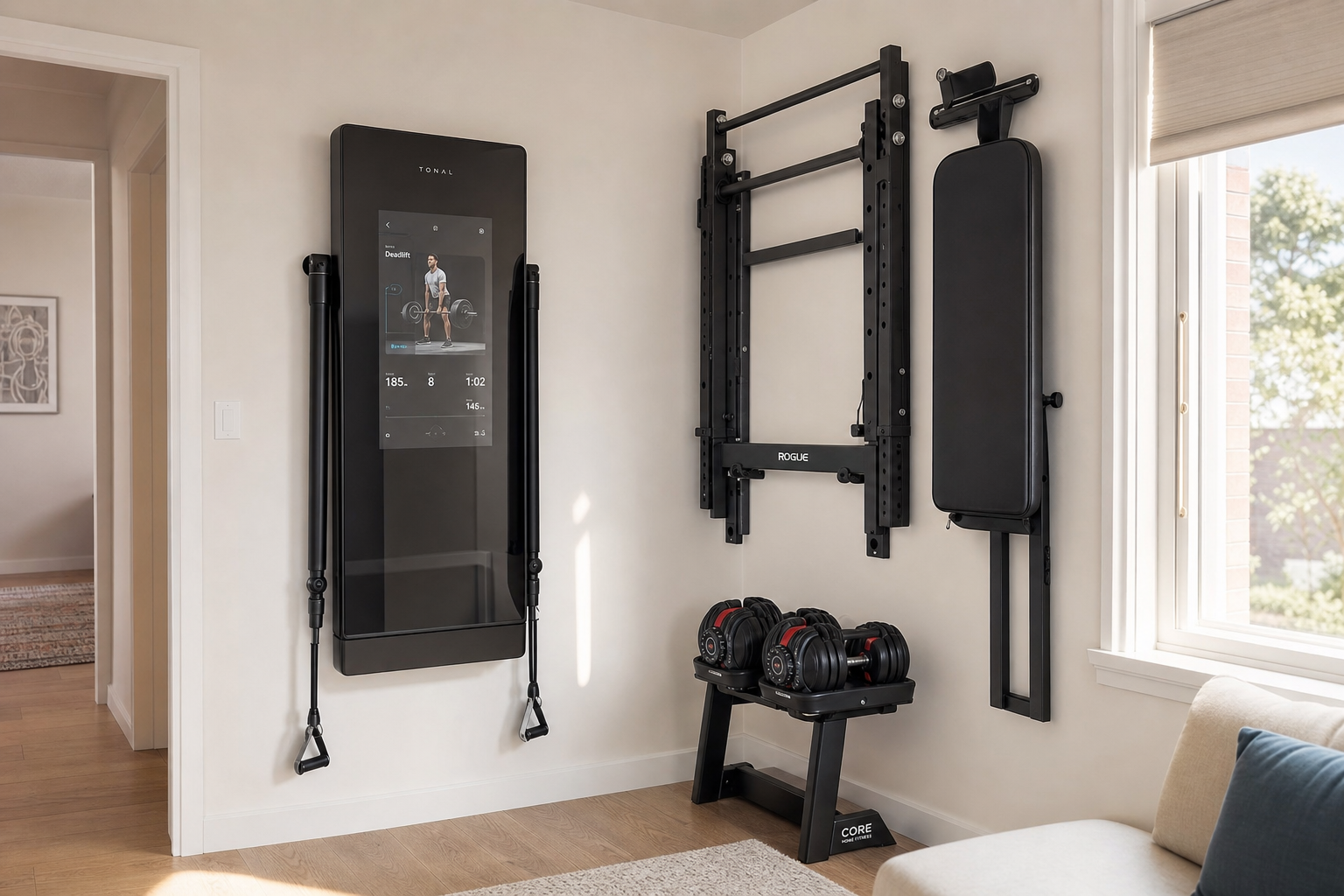
Category Comparison: Smart Mirrors and Wall Units vs. Traditional Compact Setups
Before we dive into the specifics, it helps to see the two categories laid out side by side. The table below summarizes the flagship options from each camp, using data from hands-on testing published by Garage Gym Reviews in June 2026. The smart gym category is represented by the Tonal 2 and the Speediance Gym Monster. The traditional category is represented by the PRx Profile PRO foldable rack paired with a bench and adjustable dumbbells — a combination that represents a realistic, high-quality small-space setup.
| Feature | Tonal 2 (Smart) | Speediance Gym Monster (Smart) | PRx Rack + Bench + Dumbbells (Traditional) |
|---|---|---|---|
| Price | $4,295 | $3,199 | ~$2,000 ($1,099 rack + $400–600 bench + $300–500 dumbbells) |
| Subscription | $49/month required | None | None |
| Max Resistance | 250 lbs digital | 220 lbs digital | 1,000+ lbs plate-loaded |
| Footprint (Unfolded) | 5.25" deep x 21.5" wide x 50.9" tall (wall-mounted) | 49.21" L x 28.34" W x 72.83" H | Rack folds to < 4" from wall; bench and dumbbells stored separately |
| Footprint (Stored) | 5.25" deep (always mounted) | Folds to 14.96" deep | < 4" deep (rack folded); bench vertical; dumbbells on stand |
| Best For | Guided programming, minimal depth | No subscription, compact all-in-one | Maximum weight, no recurring costs, versatility |
The core trade-off is immediately visible. Smart gyms win on depth and integrated programming. The Tonal 2, for instance, protrudes only 5.25 inches from the wall, which is barely more than a picture frame. The traditional setup, when folded, is even thinner — the PRx rack sits under 4 inches from the wall — but it requires you to store a bench and dumbbells separately. The smart gyms also cap out at 220 to 250 pounds of digital resistance, while a plate-loaded rack can handle over 1,000 pounds. That difference matters if your training goals involve heavy compound lifts.
Space Comparison: Footprint, Depth, and Clearance Requirements
For the small-space buyer, the physical footprint of the equipment is often the deciding factor. But footprint is not just about how much floor space the equipment occupies when in use. It also includes how much clearance you need to operate it safely, how it looks when stored, and whether it can coexist with other furniture in a multi-purpose room.
The Tonal 2 is the clear winner in terms of permanent depth. At 5.25 inches deep, it is essentially flush with the wall. You do not need to fold it, move it, or make room for it when not in use. However, you do need about 7 feet of clearance in front of the unit to perform exercises like rows and overhead presses safely. That means the wall it is mounted on needs to face an open area — you cannot mount it behind a couch or a desk.
The PRx Profile PRO rack, when folded, is even thinner at under 4 inches from the wall. When you need to use it, you pull it down, and it extends into the room. The bench and dumbbells need their own storage — a vertical bench rack and a dumbbell stand add perhaps 2 to 3 square feet of floor space. The advantage is that the rack itself disappears almost completely when not in use, and the bench and dumbbells can be tucked into a corner or a closet.
The Speediance Gym Monster is the bulkiest of the three when unfolded, with a footprint of 49.21 inches by 28.34 inches. That is roughly 9.6 square feet of floor space. It folds to a depth of about 15 inches, which is still substantial. If you need to reclaim the floor space for other activities, you will be moving a 200-plus-pound machine.
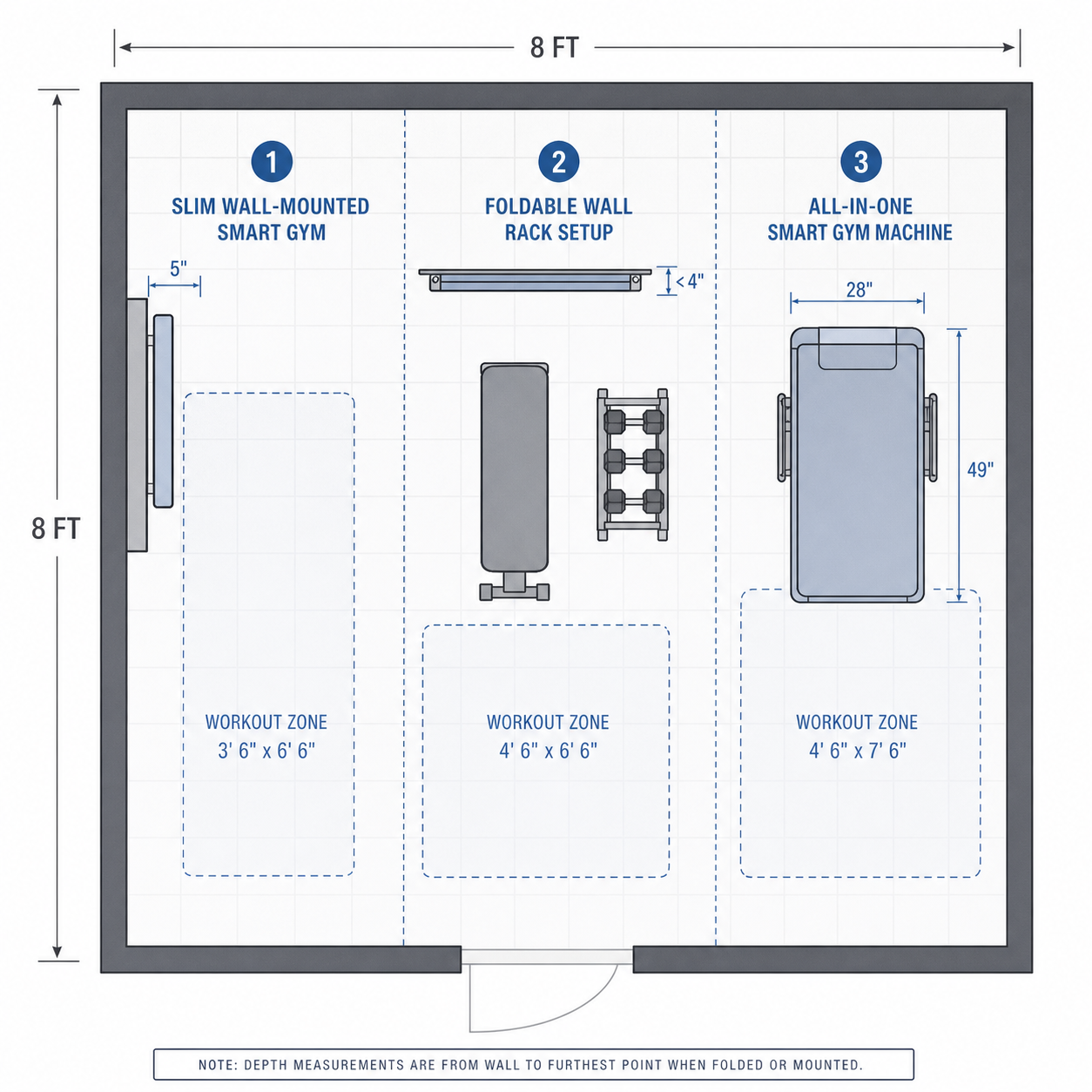
| Equipment | Depth (Stored) | Depth (In Use) | Floor Space (In Use) | Clearance Needed |
|---|---|---|---|---|
| Tonal 2 | 5.25" (permanent) | 5.25" | ~1 sq ft (wall-mounted) | ~7 ft in front |
| Speediance Gym Monster | ~15" (folded) | 49.21" x 28.34" | ~9.6 sq ft | Standard room height |
| PRx Rack + Bench + Dumbbells | < 4" (rack folded); bench/dumbbells stored separately | Rack extends ~3 ft; bench adds ~4 ft | ~4–6 sq ft total | Standard room height |
Resistance Comparison: Digital Maxes vs. Plate-Loaded Capacity
This is where the two categories diverge most sharply. Smart gyms use electromagnetic resistance to simulate weight. The Tonal 2 tops out at 250 pounds, and the Speediance Gym Monster at 220 pounds. For a significant portion of the population — especially beginners and intermediate lifters — those numbers are more than adequate for building muscle and improving strength. The guided programming and automatic progression that come with these systems can also help users train more effectively than they might on their own.
But if your goals include heavy compound lifts like squats, deadlifts, or bench presses with significant load, 220 to 250 pounds will be a ceiling you hit relatively quickly. A 180-pound male lifter with a year of consistent training can often squat more than 250 pounds. Once you reach that limit, a smart gym becomes a maintenance tool rather than a progressive overload machine.
A traditional plate-loaded rack, by contrast, has no practical ceiling. The PRx Profile PRO supports up to 1,000 pounds. You can add weight plates incrementally for years without ever outgrowing the rack. The trade-off is that you need to buy the plates, store them, and manage your own programming. There is no AI coach telling you when to increase the load or correcting your form.
| Equipment | Max Resistance | Resistance Type | Progressive Overload Path |
|---|---|---|---|
| Tonal 2 | 250 lbs | Digital electromagnetic | Automatic via software; capped at 250 lbs |
| Speediance Gym Monster | 220 lbs | Digital electromagnetic | Manual or app-guided; capped at 220 lbs |
| PRx Rack + Plates | 1,000+ lbs | Plate-loaded iron or bumper plates | Unlimited; limited only by plate availability and your own strength |
Subscription Cost Analysis Over 5 Years
The purchase price is only part of the story. Smart gyms, particularly the Tonal 2, require an ongoing membership to access their full feature set — guided workouts, progress tracking, and the library of classes. The Tonal 2 membership costs $49 per month. Over five years, that adds $2,940 to the initial $4,295 purchase price, bringing the total to $7,235.
The Speediance Gym Monster has no subscription fee. Its total cost is the upfront $3,199. The traditional PRx setup, at roughly $2,000 for the rack, bench, and dumbbells, also has no recurring costs. You will need to buy weight plates separately, but those are a one-time expense that can be spread out over time.
| Setup | Upfront Cost | Monthly Fee | 5-Year Total |
|---|---|---|---|
| Tonal 2 | $4,295 | $49 | $7,235 |
| Speediance Gym Monster | $3,199 | $0 | $3,199 |
| PRx Rack + Bench + Dumbbells | ~$2,000 | $0 | ~$2,000 (plus plates) |
This is not to say the Tonal 2 is a bad value. The subscription buys you a constantly updated library of classes, automatic progression algorithms, and a polished user experience that many people find motivating enough to stick with their training long-term. For some users, that accountability is worth the $49 per month. But if you are budget-conscious or prefer to own your equipment outright, the subscription model is a significant long-term cost.
For a deeper dive into the financial side of this decision, including a comparison against gym membership costs, see our Smart Home Gym Total Cost of Ownership: 5-Year Breakdown article. That piece focuses purely on the financial analysis; this article adds the space and resistance dimensions that are critical for small-space buyers.
The Hybrid Approach: Traditional Rack with a Smart Add-On
The smart-versus-traditional binary is useful, but it is not the only option. A third path exists: pair a traditional foldable rack with a portable smart resistance device. The Beyond Power Voltra I is a compelling example of this hybrid approach.
The Voltra I is a shoebox-sized unit measuring 12.71 inches by 5.49 inches by 3.94 inches and weighing just 12.8 pounds. It provides up to 200 pounds of digital resistance with no subscription fee. You can attach it to a rack, a door anchor, or use it as a standalone device for cable-style exercises. It costs $2,199.
Here is how the hybrid setup compares to the pure smart and pure traditional options:
| Setup | Total Cost | Max Resistance | Subscription | Space Requirement |
|---|---|---|---|---|
| Tonal 2 (Pure Smart) | $7,235 (5-year) | 250 lbs | $49/mo | 5.25" deep, wall-mounted |
| PRx Rack + Voltra I (Hybrid) | ~$4,200 ($1,099 rack + $2,199 Voltra + bench/dumbbells) | 1,000+ lbs (rack) + 200 lbs (Voltra) | None | Rack folds to < 4"; Voltra is portable |
| PRx Rack + Bench + Dumbbells (Pure Traditional) | ~$2,000 | 1,000+ lbs | None | Rack folds to < 4"; bench/dumbbells stored separately |
The hybrid approach gives you the best of both worlds if you are willing to manage two systems. You get the unlimited progressive overload of a plate-loaded rack for heavy compound lifts, plus the guided programming and cable-style exercises of the Voltra I for accessory work and variety. The total cost is higher than a pure traditional setup but lower than a Tonal 2 over five years, and there is no subscription lock-in.
Decision Flowchart: Which Path Fits Your Priorities?
The right choice depends on which constraint matters most to you. Use the framework below to route yourself to the best option.
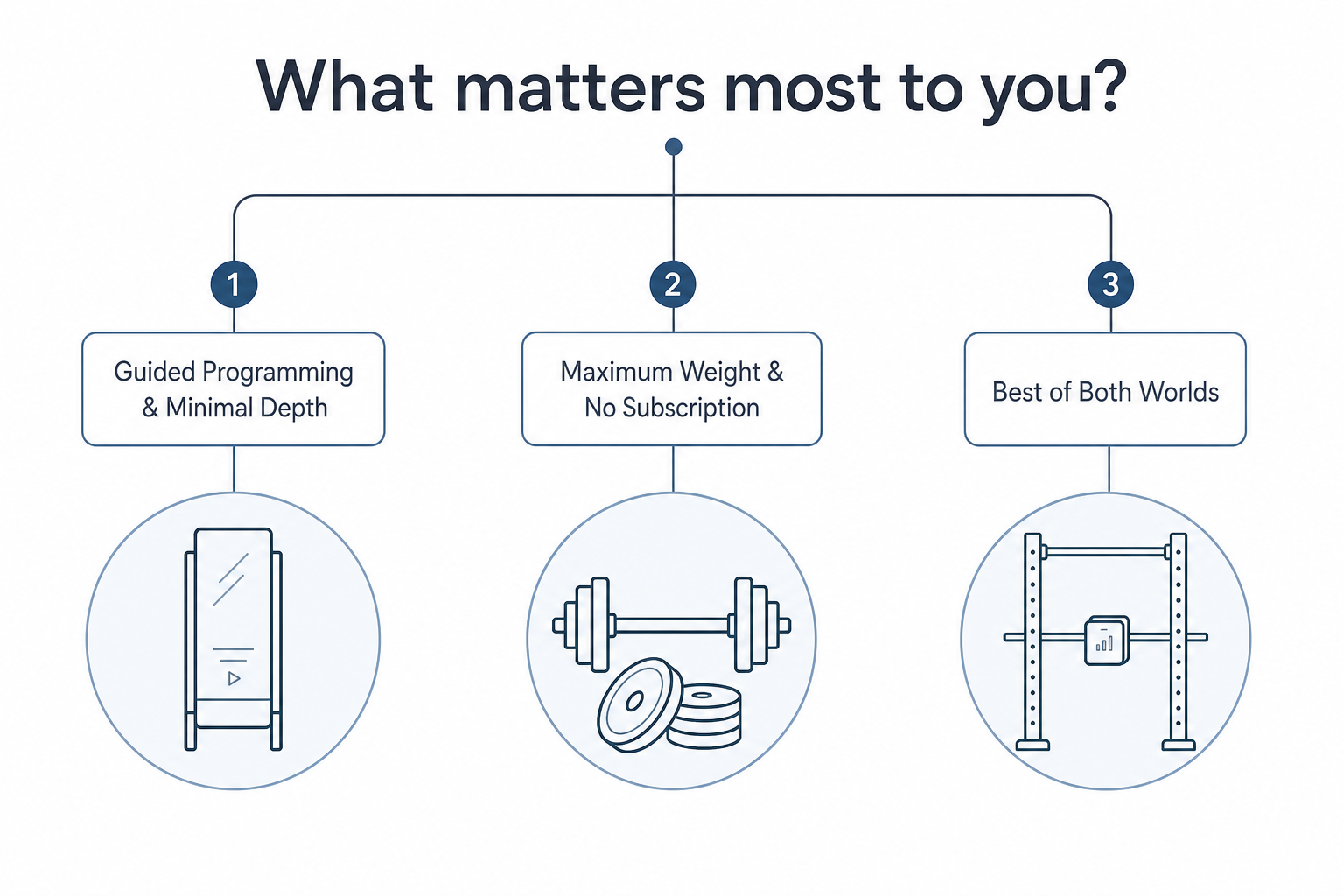
- Choose a smart gym (Tonal 2 or Speediance) if: guided programming and minimal permanent depth are your top priorities, and you are comfortable with a subscription (Tonal) or a lower max resistance (Speediance).
- Choose a traditional setup (foldable rack + bench + dumbbells) if: you want maximum weight capacity, no recurring costs, and the freedom to design your own programming, and you have a small amount of storage space for a bench and dumbbells.
- Choose the hybrid approach (traditional rack + Voltra I) if: you want the heavy lifting capacity of a rack but also want guided programming and cable exercises without a subscription, and you are willing to manage two systems.
No single setup is right for everyone. The best choice is the one that aligns with your training goals, your tolerance for recurring costs, and the specific dimensions of your space. If you are still unsure, our Best Home Exercise Equipment: A Budget, Space, and Goal Guide for 2026 covers a wider range of equipment types and may help you explore options beyond the smart-versus-traditional comparison.
Some links on this page are affiliate links — they may earn us a commission at no extra cost to you. Our tier and tests are decided before we ever check which links pay; see our full affiliate disclosure.
Spot something off?
Noise and floor-damage claims carry real deposit-risk consequences if we get them wrong — tell us if your experience with this build didn't match what's above.