
Best Home Exercise Equipment: A Budget, Space, and Goal Guide for 2026
Instead of a ranked list, this guide helps you find the right home exercise equipment by filtering across three real constraints at once — your budget tier, available floor space, and primary fitness goal — so you can make a confident purchase decision without overspending or buying gear that won't fit your space.
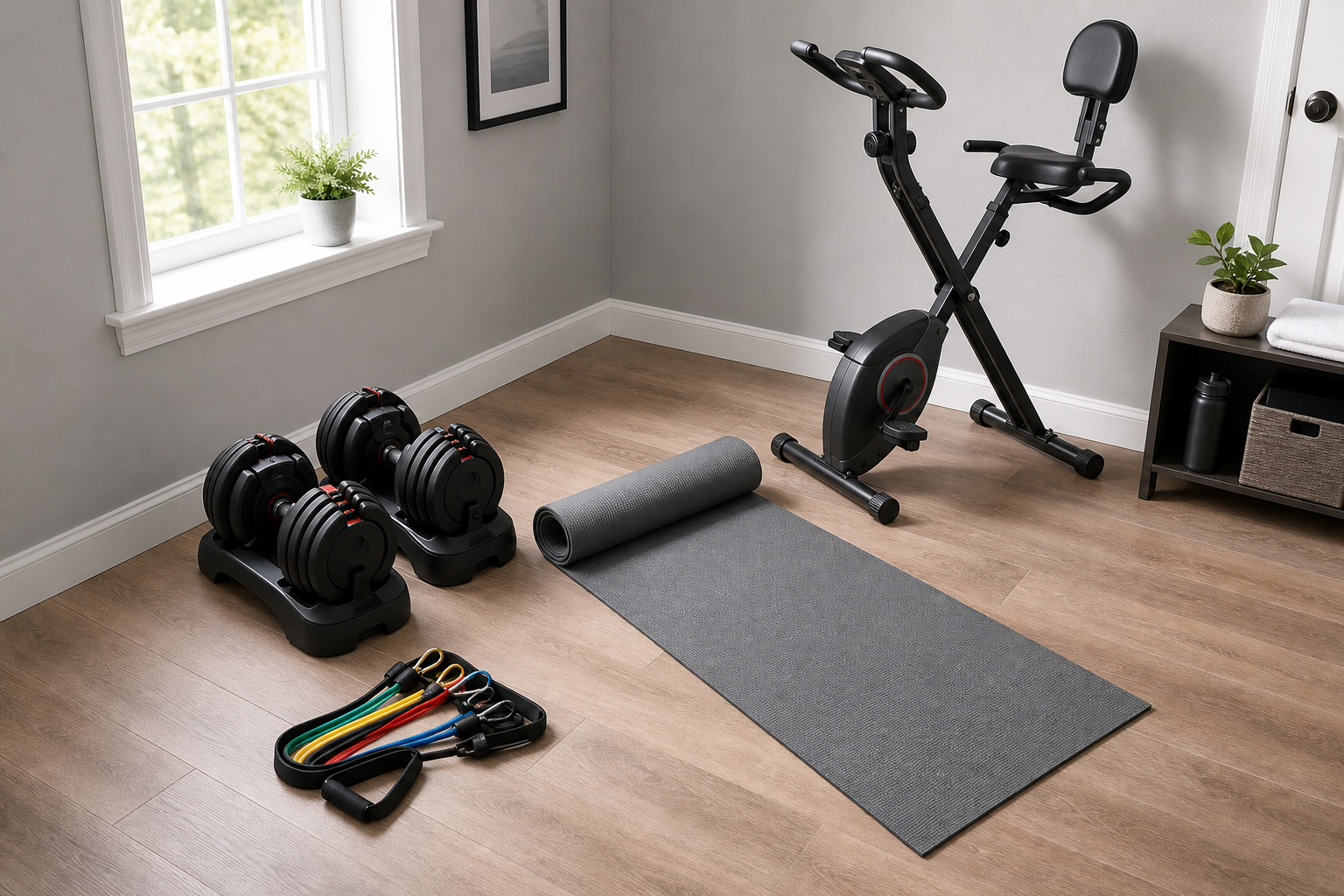
Why Ranked Lists Fail Home Equipment Buyers
Every major fitness site publishes a version of the same article: "The 10 Best Home Exercise Equipment Picks of 2026." The list opens with a $3,000 smart gym, includes a $25 resistance band somewhere in the middle, and ends with a treadmill that requires a dedicated room. A reader in a 400-square-foot apartment with a $300 budget and a goal of building basic strength cannot use that list. It collapses three completely independent decision axes — budget, available space, and fitness goal — into a single ranking that matches almost no real buyer's situation.
The problem is structural. A flat ranked list assumes one optimal answer. Home equipment decisions don't work that way. The best piece of equipment for someone with 200 square feet, a $1,200 budget, and a strength goal is a different product than the best pick for someone with 40 square feet, $150, and a cardio goal. Both buyers are real. Neither is served by the same rank-ordered list.
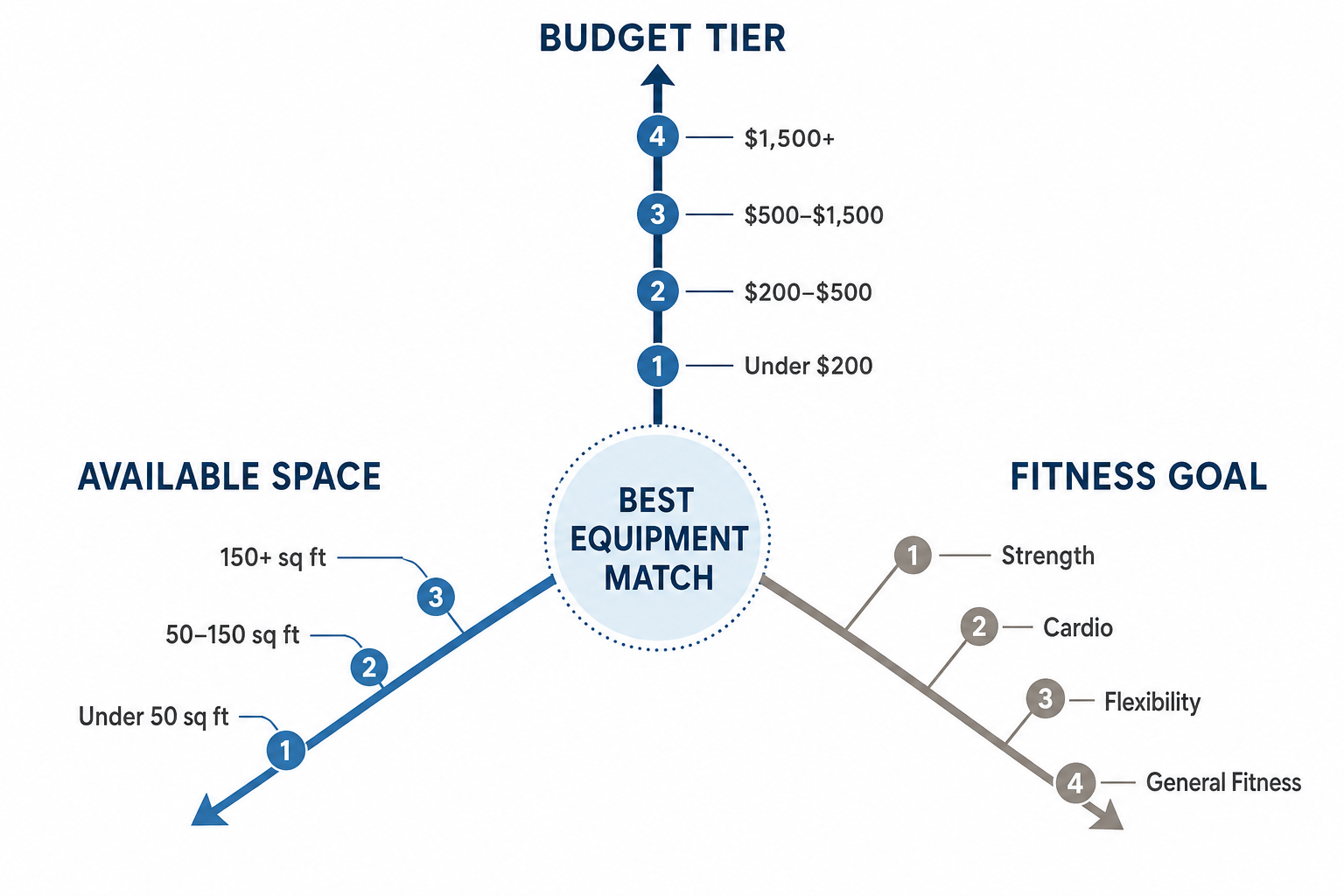
This guide is organized around three constraint axes instead: budget tier, available floor space, and primary fitness goal. Identify your position on each axis first, then use the relevant sections to find equipment that actually fits your situation. You don't need to read everything — jump to the section that matches your constraints.
How to Use This Guide: Identify Your Budget, Space, and Goal
Before reading the comparison tables, answer three questions. Your answers will tell you which sections apply to you and which you can skip.
- Budget tier: Under $200 / $200–$500 / $500–$1,500 / $1,500+
- Available floor space: Under 50 sq ft / 50–150 sq ft / 150+ sq ft
- Primary fitness goal: Strength and muscle building / Cardio and weight loss / Flexibility and mobility / General fitness
For floor space: measure the room or area you plan to use. Don't count the full room if furniture limits the usable zone. A 10×10 spare room with a bed and desk may have only 40–50 usable square feet for equipment. For budget: use your total available spend including any delivery or installation costs, not just the sticker price.
| Your situation | Start with this section |
|---|---|
| Limited budget, any space | Budget-Tiered Comparison |
| Hard space constraint (apartment, shared room) | Space-Constraint Recommendations |
| Clear goal (strength, cardio, mobility) | Goal-Based Routing |
| Considering a smart gym or connected equipment | Total Cost of Ownership |
| Unsure where to start | Equipment Category Map, then Budget-Tiered Comparison |
Equipment Category Map: Strength, Cardio, and Hybrid Types Explained
Home exercise equipment falls into five broad categories. Understanding the category before comparing specific products prevents mismatches between what you buy and what you actually need.
- Free weights and adjustable dumbbells: Fixed dumbbells, adjustable dumbbell systems (like the Bowflex SelectTech 552), kettlebells, and barbells with plates. Primary use: strength training across a wide range of exercises. Adjustable systems compress 15+ fixed pairs into roughly 2 sq ft of floor space.
- Resistance bands and bodyweight tools: Loop bands, tube bands with handles, mini bands, pull-up bars, suspension trainers (like TRX), and ab wheels. Primary use: strength and mobility work with minimal floor space. Most viable option under 50 sq ft.
- Cable and functional trainers: Floor-standing cable towers and wall-mount cable systems. Primary use: strength training with a wide exercise range and smooth resistance curve. Compact cable towers (like Bells of Steel) can fit in 50–100 sq ft; full functional trainers need more room.
- Cardio machines: Exercise bikes (upright and recumbent), treadmills, rowing machines, and ellipticals. Primary use: cardiovascular fitness. Footprints vary dramatically — a compact exercise bike can occupy 15–20 sq ft while a treadmill with safety clearance needs 40–60+ sq ft. Many carry optional or mandatory subscription fees.
- All-in-one smart gyms and multi-gyms: Wall-mount systems (Tonal 2), cable-based all-in-ones (Speediance Gym Monster), and traditional multi-station machines. Primary use: broad exercise coverage in a single footprint. Most smart gyms carry subscription fees that significantly affect total cost of ownership.
Budget-Tiered Comparison: Under $200, $200–$500, $500–$1,500, and $1,500+
Each budget tier enables a meaningfully different type of home gym setup. The tier boundaries below reflect where the practical capabilities of available equipment change, not arbitrary price points.
Under $200: Bands, Mat, and Jump Rope
A complete strength-and-cardio setup is achievable at this tier. A set of resistance bands ($15–$50), a quality exercise mat ($20–$50), and a jump rope ($10–$30) covers the basics for both strength work and cardiovascular conditioning. This combination fits in under 50 sq ft and stores in a single drawer or small bag when not in use.
The limitation is load ceiling. Resistance bands top out at roughly 50–100 lbs of equivalent resistance depending on the set, which limits progressive overload for experienced lifters. For beginners establishing a habit, this is rarely a constraint in the first several months.
The $200–$500 Tier: Adjustable Dumbbells
This tier's standout purchase is a quality adjustable dumbbell set. The Bowflex SelectTech 552 covers 5–52.5 lbs per dumbbell (roughly 15 fixed pairs' worth of weight range) in a footprint of approximately 15.8 × 8 inches per dumbbell. Pricing at time of research was approximately $399 for the pair. For buyers prioritizing strength work, this is the highest exercises-per-dollar and exercises-per-square-foot ratio of any single equipment category.
At this tier you can also add a quality pull-up bar ($30–$80) and a suspension trainer ($80–$150) to significantly expand your exercise range without adding meaningful floor space.
The $500–$1,500 Tier: Cable Towers and Foldable Racks
This tier opens up cable-based training and barbell work. Two specific products have reliable spec data worth referencing directly.
The Bells of Steel Cable Tower starts at approximately $435, occupies a footprint of 31 inches deep × 28.5 inches wide, and supports up to 250 lbs of resistance. It is one of the most compact floor-standing cable machines with verified dimensions available in this price range.
The PRx Profile PRO Squat Rack (approximately $1,100) folds to 4 inches off the wall when stored, with an unfolded depth of roughly 39.5 inches. This is the most space-efficient barbell rack option with published fold dimensions. It carries a 10-year warranty.
The $1,500+ Tier: All-in-One Systems and Smart Gyms
At this tier, the most important variable is not the hardware price — it is whether the system requires an ongoing subscription. Two contrasting examples illustrate the range.
The Tonal 2 carries a list price of approximately $4,295 and requires professional installation not included in that price. Its subscription is mandatory for full functionality at approximately $59 per month. Over five years, the total cost exceeds $7,000.
The Speediance Gym Monster is priced at approximately $3,199 and carries no subscription fee. It earned strong versatility marks in independent testing. For buyers who want a capable all-in-one system without ongoing fees, this is the primary subscription-free smart gym option currently available.
| Budget Tier | Recommended Setup | Approx. Floor Space Needed | Subscription Required | Best For |
|---|---|---|---|---|
| Under $200 | Resistance bands + mat + jump rope | 30–50 sq ft | No | Beginners, habit-building, travel-friendly |
| $200–$500 | Adjustable dumbbells (e.g., Bowflex SelectTech 552) + pull-up bar | ~10–15 sq ft for equipment | No | Strength training, space-constrained buyers |
| $500–$1,500 | Cable tower (e.g., Bells of Steel ~$435) or foldable rack (e.g., PRx ~$1,100) | 50–100 sq ft (cable tower); 40–60 sq ft folded | No | Intermediate lifters, small dedicated spaces |
| $1,500+ | Smart gym (subscription-free: Speediance ~$3,199) or smart gym (subscription: Tonal 2 ~$4,295 + ~$59/mo) | ~15–25 sq ft wall-mount; varies by unit | Varies — check before buying | Serious home gym users, guided training seekers |
Space-Constraint Recommendations: Under 50 sq ft, 50–150 sq ft, and 150+ sq ft
Floor space is a hard constraint — unlike budget, you cannot stretch it. The recommendations below use actual equipment footprint dimensions rather than vague descriptors like "compact" or "space-saving."
Under 50 sq ft: Bands, Dumbbells, and Bodyweight
At this space tier, floor-standing machines are not viable. The equipment that works here stores vertically or stows completely when not in use.
- Resistance bands: near-zero storage footprint, hang on a hook or fold into a bag
- Jump rope: ~1 sq ft when in use, stores in a drawer
- Adjustable dumbbells: approximately 15.8 × 8 inches per dumbbell on a floor rack — roughly 2 sq ft for a pair with a compact rack
- Pull-up bar (door-mounted): no floor footprint, stores off the floor
- Suspension trainer: anchors to a door or wall, folds to bag size when stored
- Exercise mat: ~2 × 6 ft when unrolled, rolls up to minimal storage
50–150 sq ft: Cable Towers and Foldable Racks
This space tier opens up floor-standing equipment with a defined footprint. The key is choosing equipment whose dimensions — including the clearance zone needed during use — fit within your available area.
| Equipment | Footprint (depth × width) | Clearance Needed | Approx. Price |
|---|---|---|---|
| Bells of Steel Cable Tower | 31" D × 28.5" W | ~3–4 ft in front | ~$435 |
| PRx Profile PRO Squat Rack (folded) | 4" off wall | ~4–5 ft in front when unfolded | ~$1,100 |
| Compact exercise bike (upright) | ~20" D × 18" W | Minimal side clearance | $300–$800 |
| Adjustable dumbbells + bench | ~2 sq ft for dumbbells + ~4 sq ft for bench | ~3 ft in front of bench | $400–$700 combined |
The PRx foldable rack deserves specific attention for this space tier. At 4 inches off the wall when folded, it effectively disappears from the room. Unfolded depth is approximately 39.5 inches — you need that clearance available during use, but you reclaim the floor space when the rack is folded.
150+ sq ft: Functional Trainers and All-in-One Systems
At 150 square feet and above, you have enough room for a dedicated training area with multiple pieces of equipment. Treadmills become viable here, but note that a treadmill's listed dimensions do not include the required safety clearance behind the belt — add at least 3 feet to the listed length. A standard treadmill with clearance typically requires 40–60+ sq ft of dedicated floor space.
Full functional trainers and all-in-one smart gym systems also become practical at this tier. Wall-mount smart gyms (like Tonal 2) have a small wall footprint but require clear floor space in front for safe use — typically 6–8 feet of depth.
Goal-Based Routing: Matching Equipment to What You Actually Want
Budget and space narrow your options. Your fitness goal determines which of those remaining options you should actually buy.
Strength and Muscle Building
The equipment hierarchy for strength goals, ordered by exercises-per-dollar value:
- Adjustable dumbbells: highest exercises-per-dollar and exercises-per-square-foot ratio. Cover push, pull, hinge, squat, and isolation patterns across dozens of movements.
- Resistance bands: lower absolute load ceiling but cover the same movement patterns at a fraction of the cost and zero floor space.
- Cable tower: adds smooth resistance curves and cable-specific exercises (rows, pull-downs, cable flyes) that bands and dumbbells replicate imperfectly.
- Barbell + rack: best for progressive overload at higher loads. Requires the most space and the largest upfront investment but is the most efficient tool for building strength long-term.
Cardio and Weight Loss
Cardio equipment spans an enormous range of footprints and price points. Filter by space first, then by budget.
- Under 50 sq ft: jump rope (with ceiling clearance), bodyweight HIIT circuits, resistance band circuits with elevated heart rate
- 50–150 sq ft: compact upright exercise bike (~18–20" wide), rowing machine (~20" wide but 8+ feet long)
- 150+ sq ft: treadmill (with 3 ft rear clearance), full-size exercise bike, elliptical
Flexibility and Mobility
This goal requires the least equipment investment and the least floor space. A quality exercise mat ($25–$60), a foam roller ($20–$40), and a set of resistance bands for assisted stretching covers the full range of common mobility and flexibility work. A yoga block set ($15–$25) adds useful support for floor-based flexibility work.
If flexibility is your primary goal, there is no equipment in the $500+ range that meaningfully improves outcomes over this minimal setup. Redirect that budget toward a quality mat and a structured mobility program.
General Fitness
For buyers without a specific goal — or buyers who want a mix of strength, cardio, and flexibility — the most versatile starting point at any budget tier is adjustable dumbbells plus resistance bands. This combination covers strength, cardiovascular circuits (via higher-rep band and dumbbell work), and mobility assistance. It fits in under 15 sq ft of floor space and requires no subscription.
| Primary Goal | Best Equipment at Under $200 | Best Equipment at $200–$500 | Best Equipment at $500–$1,500 | Best Equipment at $1,500+ |
|---|---|---|---|---|
| Strength / Muscle | Resistance bands + pull-up bar | Adjustable dumbbells (e.g., Bowflex SelectTech 552) | Cable tower or foldable rack + barbell | Smart gym (subscription-free preferred) or functional trainer |
| Cardio / Weight Loss | Jump rope + bodyweight HIIT | Compact exercise bike or add jump rope to dumbbell setup | Rowing machine or quality upright bike | Treadmill (150+ sq ft) or connected bike with app |
| Flexibility / Mobility | Mat + foam roller + bands | Mat + foam roller + bands + yoga blocks | Same as $200–$500 tier (no meaningful upgrade) | Same — redirect budget to programming, not hardware |
| General Fitness | Bands + mat + jump rope | Adjustable dumbbells + bands | Dumbbells + cable tower or foldable rack | All-in-one smart gym (check subscription terms) |
Total Cost of Ownership: What Smart Gym Subscriptions Actually Cost Over Time
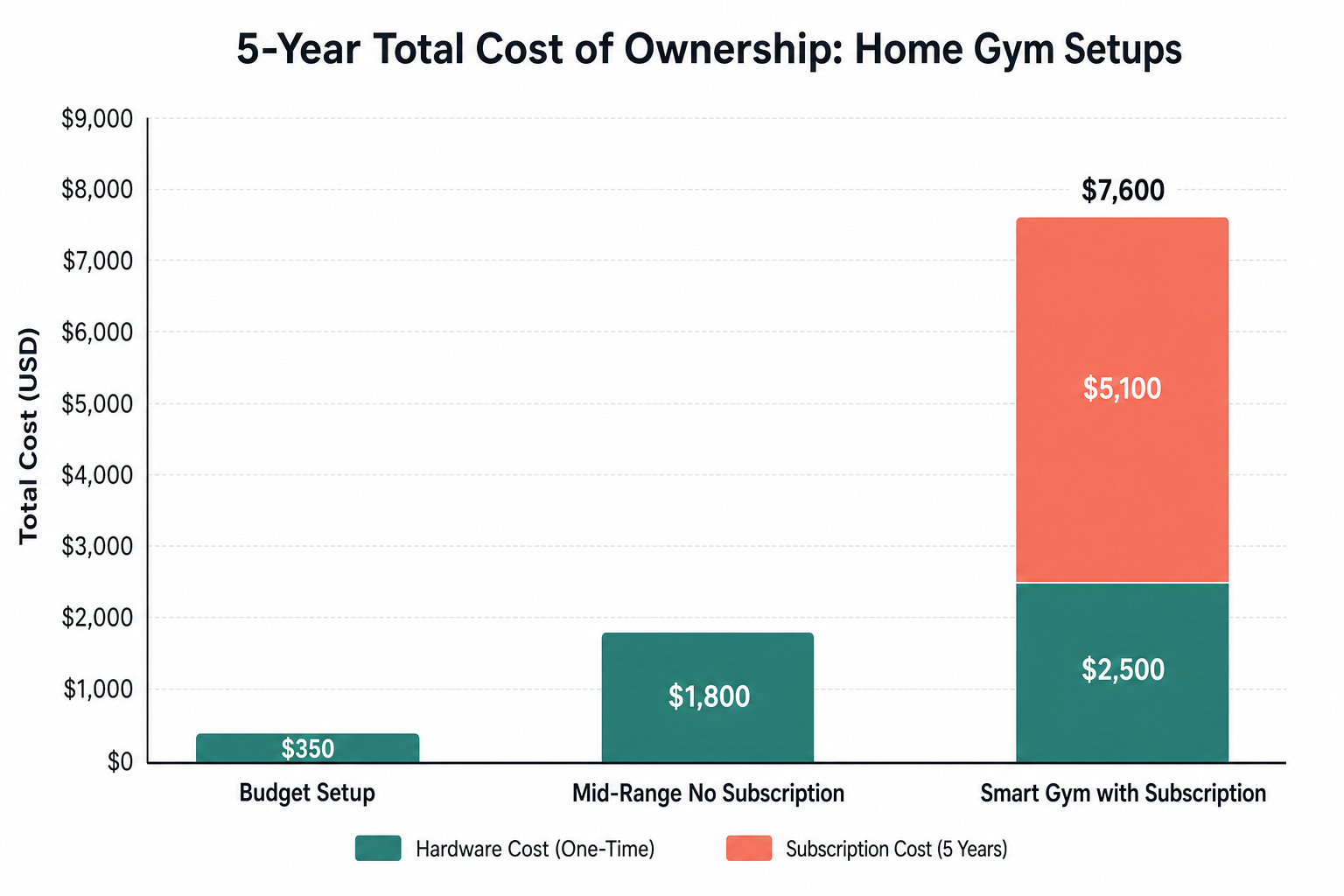
Most equipment guides list a purchase price and move on. For smart gym equipment with mandatory or near-mandatory subscriptions, that approach produces a significant underestimate of what you will actually spend. Subscription costs should be treated as a primary evaluation axis, not a footnote.
| Equipment | Hardware Cost | Subscription (per month) | Year 1 Total | Year 3 Total | Year 5 Total |
|---|---|---|---|---|---|
| Budget setup (bands + mat + rope) | ~$80–$130 | None | ~$130 | ~$130 | ~$130 |
| Adjustable dumbbells + pull-up bar | ~$450 | None | ~$450 | ~$450 | ~$450 |
| Speediance Gym Monster (no subscription) | ~$3,199 | None | ~$3,199 | ~$3,199 | ~$3,199 |
| Tonal 2 (subscription required) | ~$4,295 + installation | ~$59/month | ~$5,003 | ~$6,419 | ~$7,835 |
| Peloton bike + All-Access membership | ~$1,445 (bike) | ~$44/month | ~$1,973 | ~$3,029 | ~$4,085 |
The breakeven comparison with a gym membership is also worth running. A baseline home gym at approximately $1,098 in equipment breaks even against a $25-per-month gym membership (Gold's Gym pricing at time of research) in roughly four years. After that point, the home gym costs nothing while membership fees continue to accumulate.
For buyers considering smart gym platforms, the subscription-free segment is growing. The Speediance Gym Monster is the clearest current example — it delivers comparable exercise versatility to subscription-required competitors without the ongoing fee. Over five years, choosing a subscription-free smart gym over a subscription-required equivalent can save $1,500–$3,500 depending on the platform.
Common Buying Mistakes at Each Budget Tier
Each budget tier has a characteristic purchase regret pattern. These are not hypothetical — they show up consistently in how buyers describe their equipment decisions after the fact.
Under $200: Buying Too Little to Be Useful
The mistake here is buying a single item (one set of bands, one kettlebell) without a plan for how to use it. Equipment without a training structure gets used twice and then stored. The fix is to pair any equipment purchase with a specific routine you intend to follow, not just an intention to "work out more."
The $200–$500 Tier: Buying Cardio Equipment Before Establishing Habits
A $350 exercise bike sounds like a reasonable first purchase for someone who wants to get in shape. The problem is that cardio machines require consistent, motivated use to justify their footprint and cost. Most beginner buyers generate more consistent use from adjustable dumbbells or resistance bands — tools that support short, varied strength sessions — than from a single-mode cardio machine. Strength tools at this tier also deliver a higher exercises-per-dollar ratio.
The $500–$1,500 Tier: Ignoring Clearance Zone Requirements
At this tier, buyers often measure the equipment's listed dimensions and confirm it fits in their space — then discover that the clearance zone required for safe use doesn't fit. A cable tower with a 31-inch depth needs 3–4 feet of clear space in front of it for cable exercises. A squat rack needs 4–5 feet in front for safe barbell movement. Measure your available working zone, not just the equipment footprint.
The $1,500+ Tier: Underestimating Subscription Lock-In
High-budget buyers frequently focus on hardware quality and overlook the subscription structure. A $4,295 smart gym with a mandatory $59/month subscription is not a $4,295 purchase — it is a $7,835 five-year commitment if you keep it. Buyers who cancel the subscription often find the device's functionality significantly reduced. Before purchasing any smart gym system, confirm the subscription terms, what the device does without a subscription, and whether the subscription rate is locked in or subject to increases.
Frequently Asked Questions
What is the minimum space needed to start a home workout routine?
A mat-based bodyweight or resistance band routine requires approximately 6 × 3 feet of clear floor space — enough for a standard exercise mat with room to extend arms and legs. This fits in most apartment bedrooms, living rooms, or even a cleared hallway. You do not need a dedicated room to start.
What should a beginner buy first?
For most beginners, the best first purchase is a set of resistance bands ($20–$50) or adjustable dumbbells ($350–$450 for a quality pair) combined with a quality exercise mat. This combination covers strength training, basic cardio circuits, and mobility work across dozens of exercises. It requires minimal space, carries no subscription cost, and supports consistent use without requiring a dedicated gym room. Avoid buying cardio machines as a first purchase — they require more commitment and space than most beginners are ready to commit to before establishing a training habit.
Which equipment type offers the most versatility?
Measured by exercises-per-dollar and exercises-per-square-foot, adjustable dumbbells rank highest among single-piece strength equipment. A set covering 5–52.5 lbs supports dozens of exercises across push, pull, hinge, squat, and isolation patterns — replacing 15+ fixed pairs in roughly 2 sq ft. At higher budgets, cable towers add exercise variety that dumbbells cannot fully replicate (smooth resistance curves, cable-specific movements). All-in-one smart gyms offer broad exercise variety but at a significantly higher total cost when subscription fees are included.
How do I evaluate subscription vs. no-subscription smart gym options?
Ask three questions before purchasing any connected equipment: (1) Is the subscription mandatory for the device's core functionality, or optional? (2) What does the device do if you cancel the subscription? (3) What is the total cost over three and five years including the subscription? A subscription-free smart gym at $3,199 may cost less over five years than a subscription-required system at $3,545 hardware cost plus $59/month. Run the math for your expected ownership period before comparing sticker prices. The Total Cost of Ownership table earlier in this guide provides a starting framework for that calculation.
This result comes from one real apartment under the stated conditions — it is a strong signal, not a guarantee your space will measure identically.
Builds this evidence supports
Cable Machine Alternatives That Save Space and Money
Compare the best cable machine alternatives for home gyms – from resistance bands and pulley systems to suspension trainers and compact digital units – and find the right option for your space and budget.
How to Choose a Compact Home Gym That Works for Your Space, Budget, and Noise Tolerance
This article provides a structured decision framework for apartment dwellers and small-space residents to match their specific floor footprint, noise sensitivity, and budget to the most suitable compact home gym strategy — whether that's an all-in-one machine, modular build, smart digital system, or band/bodyweight setup.
The Garage Gym Reality Check: What Equipment Actually Fits in a Single-Car Garage
Most garage gym guides assume a two-car space. This article uses real dimensions, real equipment footprints, and three layout templates to show what fits—and what doesn't—in a single-car garage (10x20 to 12x20 ft).
Spot something off?
If this result didn't match your own space, let us know — floor-damage and noise claims carry real deposit-risk consequences if we get them wrong.