
Modular vs. All-in-One vs. Smart Gym: Which Compact Home Gym Approach Is Right for You?
Compare three distinct philosophies for building a compact home gym — modular (adjustable dumbbells + bench), all-in-one mechanical machines, and smart/digital systems — with a decision framework based on space, budget, training style, and upgradeability.
- Budget tier
- $300–$1,000
- Space type
- apartment
Items included: —
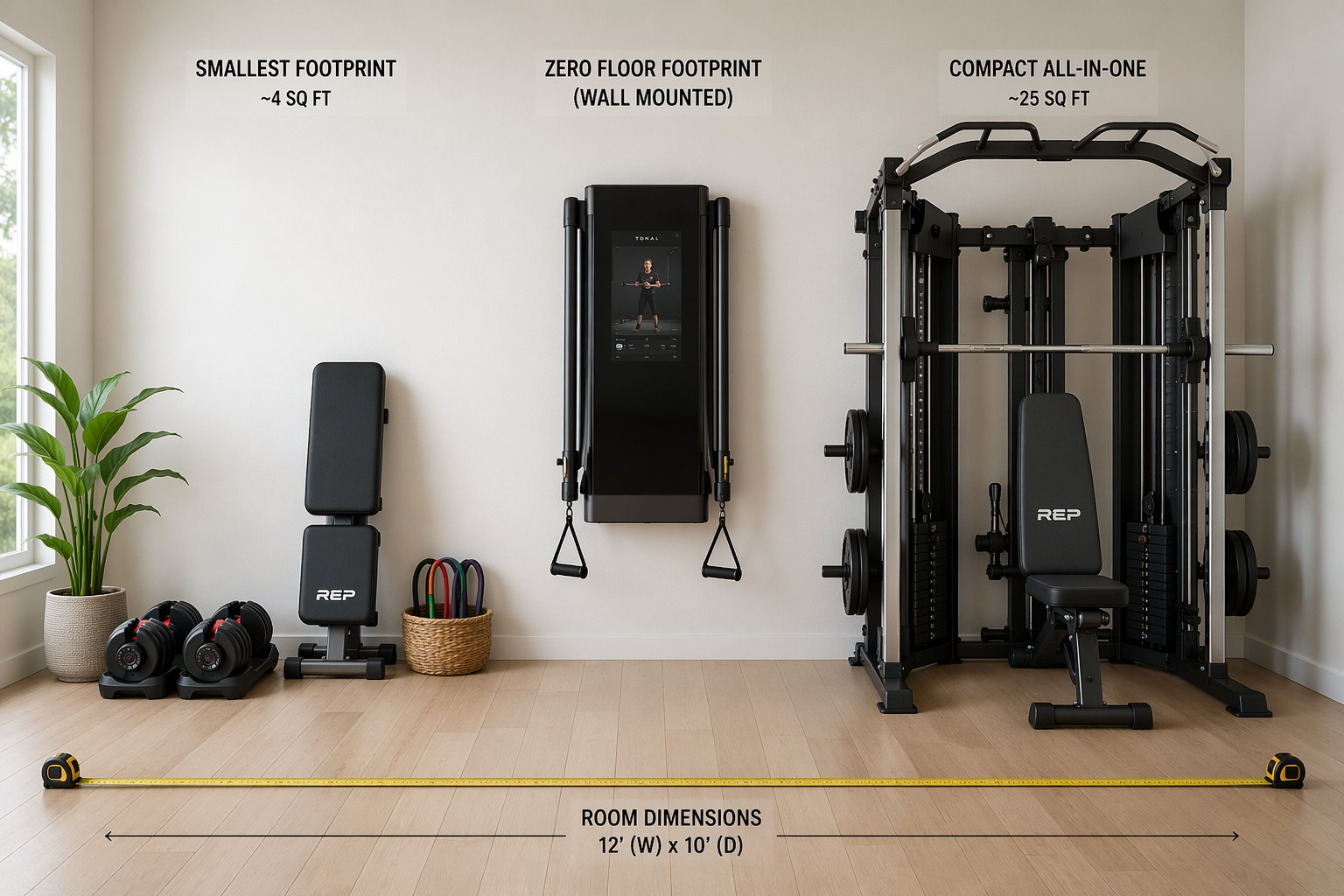
Three Philosophies for a Compact Home Gym
If you are researching compact home gym setups, you have likely noticed that the market does not offer one type of solution. There are three fundamentally different approaches, and each one prioritizes a different set of trade-offs. Understanding which philosophy aligns with your training style, space, and budget is the difference between a setup you use daily and one that collects dust.
The three approaches are:
- Modular: A collection of separate, high-quality pieces — typically adjustable dumbbells, an adjustable bench, and resistance bands or a pull-up bar. This approach prioritizes exercise variety and upgradeability above all else.
- All-in-One Mechanical: A single machine that integrates a weight stack, cables, and often a pull-up bar and Smith machine into one frame. This approach prioritizes true weight stack resistance and a consolidated footprint.
- Smart / Digital: A wall-mounted or freestanding unit that uses electromagnetic resistance and a digital interface to provide guided workouts. This approach prioritizes space savings and a connected training experience.
Each philosophy solves a different problem. The modular setup gives you the most freedom to swap, upgrade, and customize your gear over years. The all-in-one mechanical machine delivers the feel of a commercial gym cable crossover in a single package. The smart gym eliminates the need for multiple pieces of hardware entirely, replacing them with a slim wall panel and a subscription.
Before we dive into the specifics, it is worth noting that this is not a binary all-in-one versus separate equipment debate. That comparison exists, and it is useful, but it misses the third category that has reshaped the compact home gym market over the last three years. If you are earlier in your research, our Home Gym Equipment Types Explained guide provides a broader overview of all equipment archetypes. This article is for readers who have narrowed their search to compact setups and need to decide which philosophy fits their specific constraints.
Compact Home Gym Approaches: Side-by-Side Comparison
The table below compares the three approaches across the dimensions that matter most for a compact home gym decision: footprint, maximum resistance, total cost of ownership over three years (including subscriptions), exercise variety, and upgradeability. The specific products listed are representative examples of each philosophy, not an exhaustive list.
| Dimension | Modular (Dumbbells + Bench + Bands) | All-in-One Mechanical (Major Fitness B17) | All-in-One Mechanical (Bells of Steel) | Smart / Digital (Tonal 2) | Smart / Digital (Speediance) |
|---|---|---|---|---|---|
| Footprint (floor space) | Under 8 sq ft | 68.1" D x 78.7" W (approx. 37 sq ft) | 54.6" D x 59" W (approx. 22 sq ft) | Wall-mounted; requires 7x7 ft clear space for safe use | 49.21" L x 28.34" W unfolded (approx. 9.7 sq ft); 14.96" deep folded |
| Max Resistance | Up to 60 lbs per dumbbell (REP QuickDraw); can be upgraded to heavier dumbbells later | Dual 260 lb weight stacks (expandable per side) | 300 lb cable capacity; optional weight stack up to 210 lbs | 250 lbs total (125 lbs per arm), digital resistance | 220 lbs total (110 lbs per arm), digital resistance |
| Upfront Cost | As low as $835 (REP QuickDraw 5-60 lbs at $336 + Ironmaster Super Bench Pro V2 at $499) | $4,199.99 | Starting at $1,299.99 | $4,295 (current sale $3,545) | $3,199 |
| Subscription Cost | None | None | None | $59.95/month | None |
| Total Cost Over 3 Years | $835 (no subscription) | $4,199.99 (no subscription) | $1,299.99 (no subscription) | $4,295 + $2,158.20 = $6,453.20 | $3,199 (no subscription) |
| Exercise Variety | Very high (any dumbbell, bench, or band exercise) | High (cable crossovers, lat pulldowns, rows, presses, leg extensions, pull-ups) | High (similar to B17 but fewer stations) | Moderate (guided digital workouts, cable-based movements) | Moderate (guided digital workouts, cable-based movements) |
| Upgradeability | Very high (swap dumbbells, upgrade bench, add barbell, add rack) | Low (machine is a single unit; limited add-ons) | Low (machine is a single unit; limited add-ons) | None (hardware is fixed; software updates only) | None (hardware is fixed; software updates only) |
The Modular Approach: Adjustable Dumbbells, Bench, and Bands
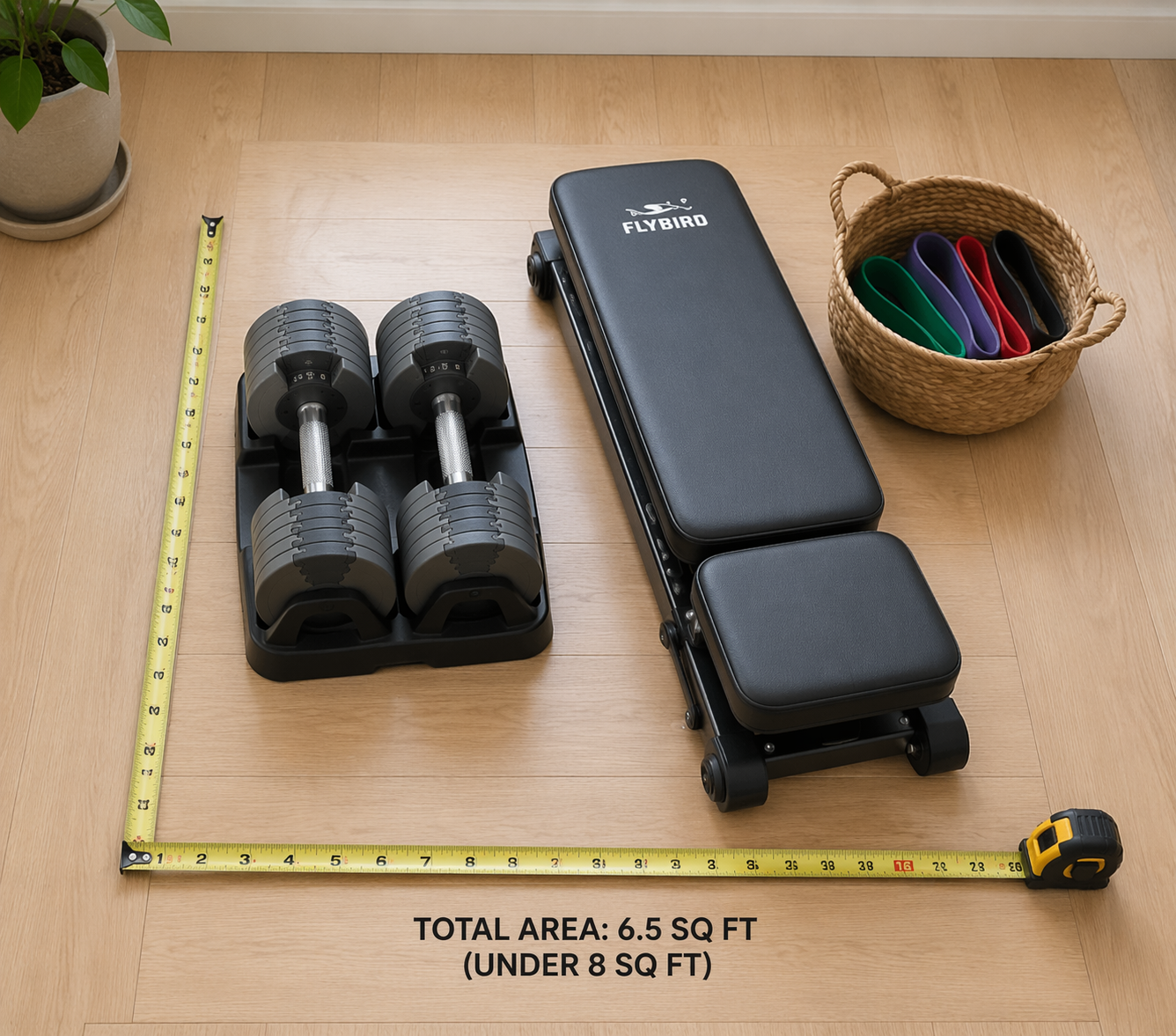
The modular approach is the most flexible and cost-effective entry point into a compact home gym. A core setup consisting of a pair of adjustable dumbbells and a quality adjustable bench can cost as little as $835. The REP QuickDraw adjustable dumbbells, available in a 5-60 lb pair for $336, and the Ironmaster Super Bench Pro V2 at $499, together occupy under 8 square feet of floor space. Add a set of resistance bands for another $30–$50, and you have a full-body strength setup that fits in a corner of a bedroom or living room.
The primary advantage of the modular approach is upgradeability. You can start with a 5-60 lb dumbbell pair and later upgrade to heavier dumbbells, add a barbell and plates, or incorporate a foldable squat rack like the PRx Profile PRO, which folds to 12 inches of depth. The Ironmaster Super Bench Pro V2 supports up to 1,000 lbs flat and 600 lbs in the incline position, meaning it will not become a bottleneck as you progress. The REP QuickDraw dumbbells carry a lifetime warranty and are drop-tested, which adds confidence for heavier lifts.
The trade-offs are real. The maximum resistance per dumbbell is 60 lbs in the base QuickDraw set, which may be insufficient for lower-body exercises like goblet squats or lunges for intermediate lifters. You can address this by purchasing heavier dumbbells later, but that adds cost and storage. The modular approach also requires more coordination — you need to set up and break down your equipment for each session, and you do not have the convenience of a single machine with multiple stations.
- Best for: Beginners to intermediate lifters who value exercise variety, want to upgrade over time, and have a tight budget.
- Not ideal for: Lifters who need more than 60 lbs per dumbbell for lower-body work, or those who want a single, always-set-up machine.
- Space requirement: Under 8 sq ft for the dumbbells and bench; add storage for bands and a mat.
- Subscription cost: $0.
All-in-One Mechanical Machines: Weight Stack Power in a Single Frame
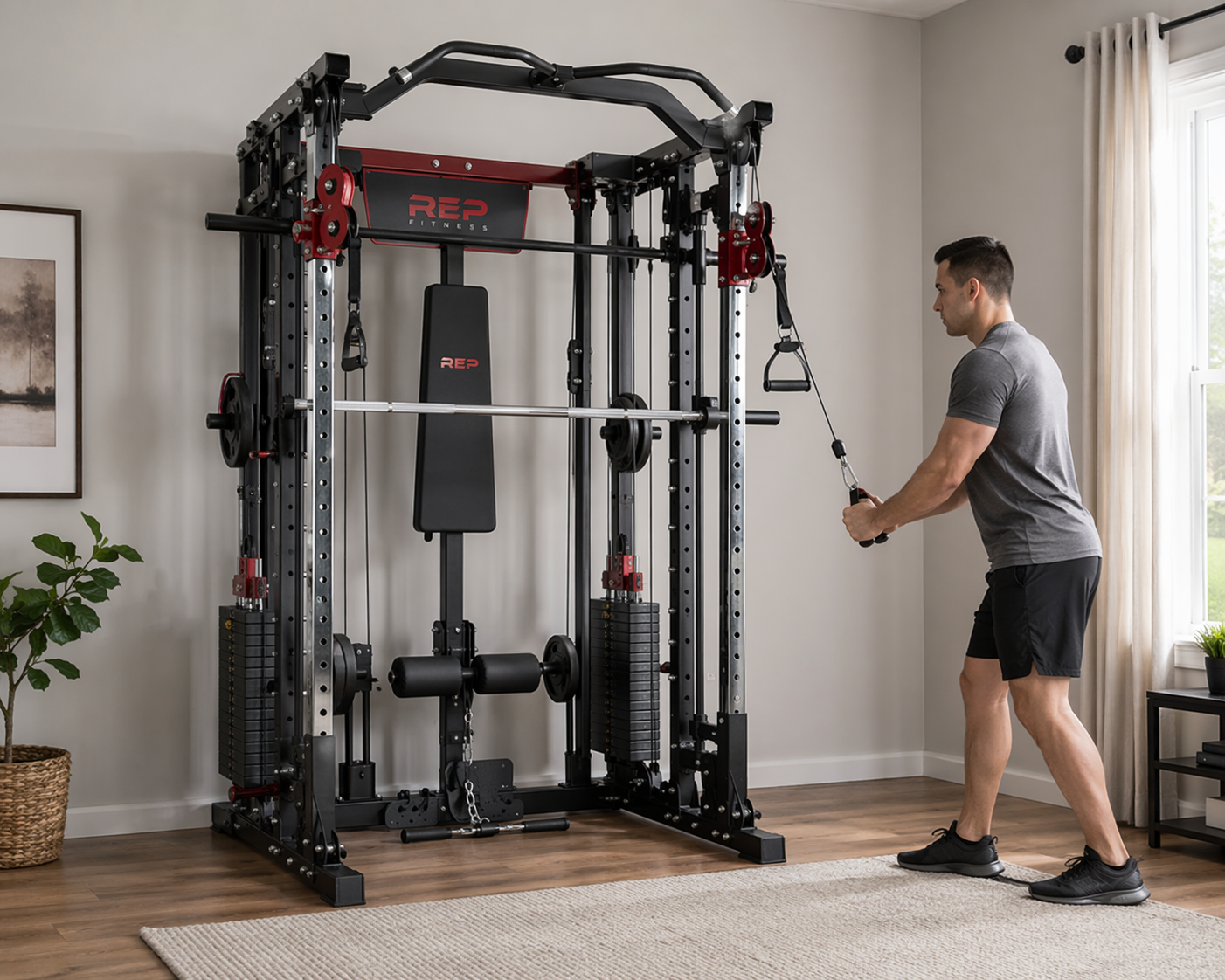
All-in-one mechanical machines represent the traditional home gym approach scaled down for smaller spaces. These machines integrate a weight stack, cable pulley system, pull-up bar, and often a Smith machine or leg press attachment into a single welded frame. The two most representative examples in the compact category are the Major Fitness B17 and the Bells of Steel All-in-One Home Gym.
The Major Fitness B17 is priced at $4,199.99 and occupies a footprint of 68.1 inches deep by 78.7 inches wide — roughly 37 square feet. It features dual weight stacks that are expandable to 260 lbs each, a 1,500-lb J-hook weight capacity, and a 4.2 rating from Garage Gym Reviews. The Bells of Steel machine starts at $1,299.99 with a more compact footprint of 54.6 inches deep by 59 inches wide (approximately 22 square feet), a 300 lb cable capacity, and an optional weight stack upgrade up to 210 lbs. It also carries a 4.2 rating and a limited lifetime warranty.
The key advantage of all-in-one mechanical machines is true weight stack resistance. Unlike digital resistance or free weights, weight stacks provide consistent, predictable resistance throughout the full range of motion. They also eliminate the need to change plates or adjust dumbbells between exercises — you simply move the selector pin. For lifters who prioritize compound cable movements like lat pulldowns, seated rows, and cable crossovers, an all-in-one machine is the most efficient option.
The trade-offs are footprint and upgradeability. The B17 requires 37 square feet, which is more than double the space of a modular setup. The Bells of Steel machine is more compact but still requires 22 square feet. Neither machine is easily upgradeable — you are buying a fixed set of stations. If you outgrow the weight stack capacity, you cannot simply swap a component; you would need to replace the entire machine.
| Feature | Major Fitness B17 | Bells of Steel All-in-One |
|---|---|---|
| Price | $4,199.99 | Starting at $1,299.99 |
| Footprint (D x W) | 68.1" x 78.7" | 54.6" x 59" |
| Weight Stack Capacity | Dual 260 lbs (expandable per side) | 300 lb cable capacity; optional stack up to 210 lbs |
| Warranty | 1 year | Limited lifetime |
| Rating (Garage Gym Reviews) | 4.2 / 5 | 4.2 / 5 |
For readers who want a deeper dive into the all-in-one category, our complete 2026 comparison guide covers more machines across different price points and space requirements.
Smart and Digital Gyms: Wall-Mounted Resistance with Subscription Math
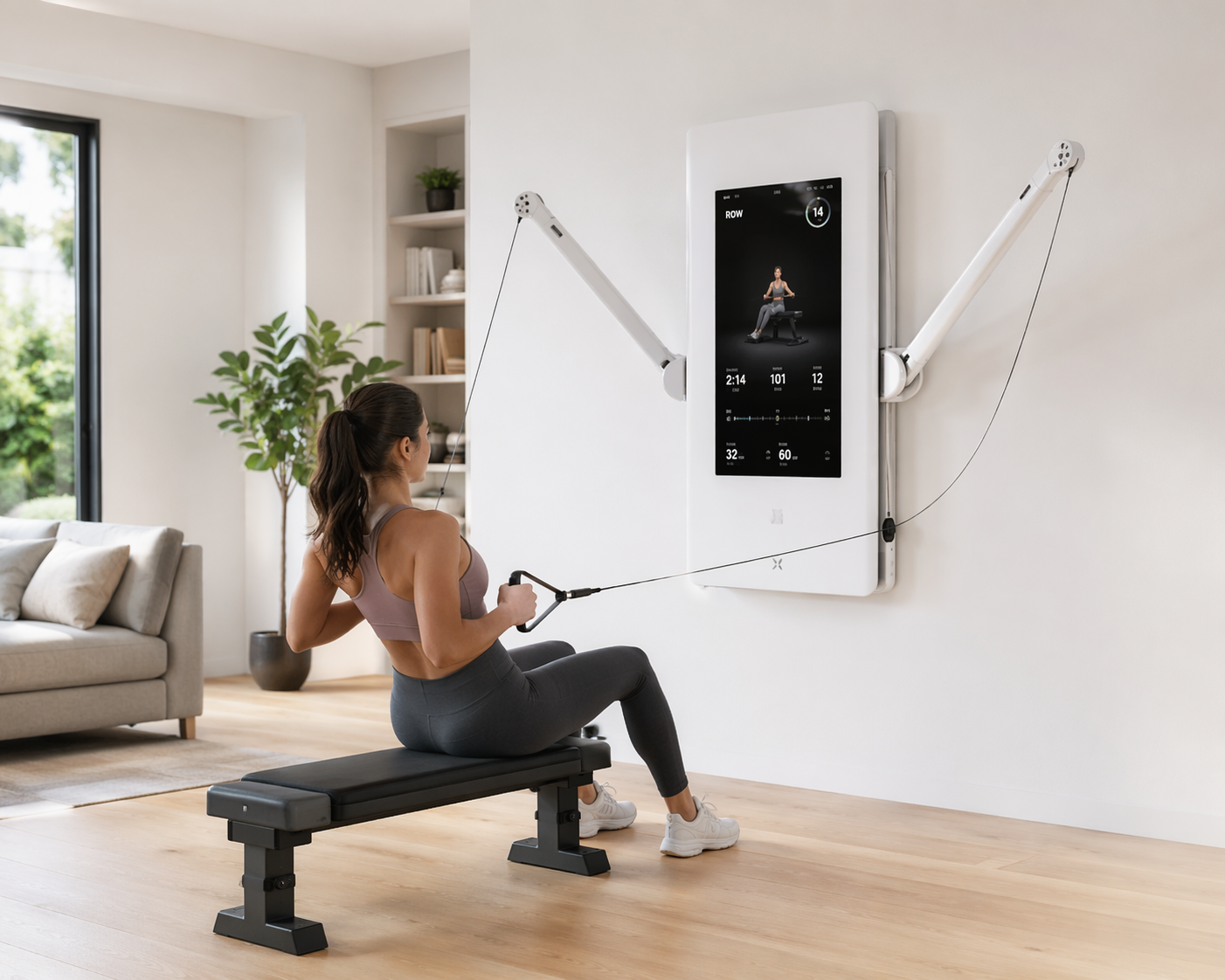
Smart and digital gyms are the newest of the three philosophies, and they solve the space problem in a fundamentally different way. Instead of occupying floor space with a machine or a collection of equipment, they mount to the wall and use electromagnetic resistance controlled by a digital interface. The two leading products in this category are Tonal 2 and Speediance.
Tonal 2 costs $4,295 (with a current sale price of $3,545) and requires professional installation. The unit itself measures just 5.25 inches deep, 21.5 inches wide, and 50.9 inches tall. However, Tonal recommends a 7x7 foot clear space for safe use, which accounts for the range of motion of the arms and the user's movement. The monthly membership is $59.95, bringing the total cost of ownership over three years to $6,453.20. Tonal provides up to 250 lbs of total digital resistance (125 lbs per arm) and includes an "Aero" feature for HIIT classes, an upgraded camera, and cables that are 75% stronger than the original Tonal.
Speediance takes a different approach. Priced at $3,199 with no subscription fee, it offers 220 lbs of total digital resistance (110 lbs per arm). Its unfolded footprint is 49.21 inches long by 28.34 inches wide (approximately 9.7 square feet), and it folds to just 14.96 inches deep for storage. Speediance carries a 4.0 rating from Garage Gym Reviews and a 2-year warranty.
A critical distinction of digital resistance is how it feels compared to free weights or weight stacks. As Garage Gym Reviews notes, digital resistance feels heavier than free weights because there is no momentum. When you lift a dumbbell or a weight stack, the initial part of the movement is easier due to momentum. Digital resistance applies constant tension throughout the entire range of motion, which means 110 lbs per arm on Speediance may feel significantly more challenging than 110 lbs on a cable machine. This is an advantage for time under tension but a consideration if you are used to the feel of free weights.
| Feature | Tonal 2 | Speediance Gym Monster |
|---|---|---|
| Upfront Price | $4,295 (sale $3,545) | $3,199 |
| Subscription | $59.95/month | None |
| Total Cost Over 3 Years | $6,453.20 | $3,199 |
| Max Resistance | 250 lbs total (125 lbs per arm) | 220 lbs total (110 lbs per arm) |
| Footprint (unfolded) | Wall-mounted; requires 7x7 ft clear space | 49.21" x 28.34" (approx. 9.7 sq ft) |
| Warranty | 2 years | 2 years |
| Rating (Garage Gym Reviews) | 4.3 / 5 | 4.0 / 5 |
For a deeper spec-level comparison between Tonal 2, Speediance, and other smart gyms, our Smart Home Gym Comparison 2026 article provides a head-to-head spec clash.
Decision Flowchart: Which Approach Matches Your Priorities?
The decision between the three approaches comes down to four questions. Answer them in order, and the right philosophy will become clear.
- What is your total budget for the next three years? If it is under $1,500, the modular approach is your only realistic option. If it is between $1,500 and $4,000, you can consider Bells of Steel (all-in-one mechanical) or Speediance (smart/digital). If it is over $4,000, all three approaches are accessible.
- How much floor space can you dedicate permanently? If you have less than 10 square feet, the modular approach or a smart gym (Speediance) are the best fits. If you have 10–25 square feet, Bells of Steel or Speediance work. If you have 25–40 square feet, the Major Fitness B17 becomes viable.
- Do you want guided workouts and digital coaching, or do you prefer to design your own training? If you want guided programming, a smart gym (Tonal 2 or Speediance) is the clear choice. If you prefer to design your own workouts, the modular or all-in-one mechanical approach gives you more freedom.
- How important is upgradeability? If you plan to grow your home gym over several years and want the ability to add a barbell, rack, or heavier dumbbells, the modular approach is the only one that supports that path. All-in-one mechanical and smart gyms are fixed systems.
The matrix below summarizes the best-fit approach for common reader profiles.
| Reader Profile | Best Approach | Why |
|---|---|---|
| Budget-conscious beginner, under $1,000, small apartment | Modular (dumbbells + bench + bands) | Lowest upfront cost, under 8 sq ft, no subscription, upgradeable over time |
| Intermediate lifter, $1,500–$3,000, spare room or garage | All-in-one mechanical (Bells of Steel) | True weight stack resistance, no subscription, compact footprint for a machine |
| Tech-savvy user, $3,000–$4,000, limited floor space, wants guided workouts | Smart/digital (Speediance) | No subscription, folds to 15 inches deep, digital resistance feels heavier than spec |
| Serious lifter, $4,000+, dedicated home gym space | All-in-one mechanical (Major Fitness B17) | Dual 260 lb weight stacks, multiple stations, no subscription |
| Premium buyer, $4,000+, wall-mounted, wants ecosystem and coaching | Smart/digital (Tonal 2) | Slim wall mount, guided programs, Aero feature for HIIT, but requires $60/month subscription |
When to Mix Approaches: Building a Hybrid Compact Gym
The three philosophies are not mutually exclusive. Many home gym owners find that a hybrid approach — combining elements from two philosophies — gives them the best of both worlds. Here are the most common hybrid scenarios.
- Smart gym + adjustable dumbbells: Owners of Tonal 2 or Speediance often add a pair of adjustable dumbbells for free-weight work. Digital resistance is excellent for cable-based movements and time under tension, but free weights provide a different stimulus for compound lifts like dumbbell bench press and rows. A compact dumbbell pair like the REP QuickDraw 5-60 lbs adds under 8 sq ft and fills the gap.
- All-in-one mechanical + foldable bench: The Major Fitness B17 and Bells of Steel machines include a bench, but some users prefer a dedicated adjustable bench for better ergonomics on certain exercises. A foldable bench like the Ironmaster Super Bench Pro V2 can be stored against a wall when not in use.
- Modular + wall-mounted pull-up bar: A modular setup of dumbbells and a bench can be supplemented with a wall-mounted pull-up bar for vertical pulling exercises. This adds minimal floor space and significantly expands exercise variety.
For readers who want a deeper dive into the all-in-one versus separate equipment debate, our All-in-One Home Gym vs. Separate Equipment article provides a detailed cost-benefit analysis of that specific trade-off.
The key to a successful hybrid setup is understanding which philosophy serves as your primary training method and which one fills the gaps. If you buy a smart gym first and later add dumbbells, you are a smart gym user who supplements with free weights. If you start with dumbbells and a bench and later add a Bells of Steel machine, you are a modular user who consolidated into an all-in-one. There is no wrong order, as long as each purchase solves a specific problem in your training.
Some links on this page are affiliate links — they may earn us a commission at no extra cost to you. Our tier and tests are decided before we ever check which links pay; see our full affiliate disclosure.
Spot something off?
Noise and floor-damage claims carry real deposit-risk consequences if we get them wrong — tell us if your experience with this build didn't match what's above.