
All-in-One Exercise Machines: The Complete Buyer's Guide for 2026 — Formats, Trade-offs, and What to Buy
This guide helps home fitness buyers navigate the three distinct categories of all-in-one exercise machines in 2026: traditional weight-stack multi-gyms, smart digital-resistance units, and power-rack/functional-trainer hybrids. It provides a decision framework to help you pick the right category before comparing specific models.
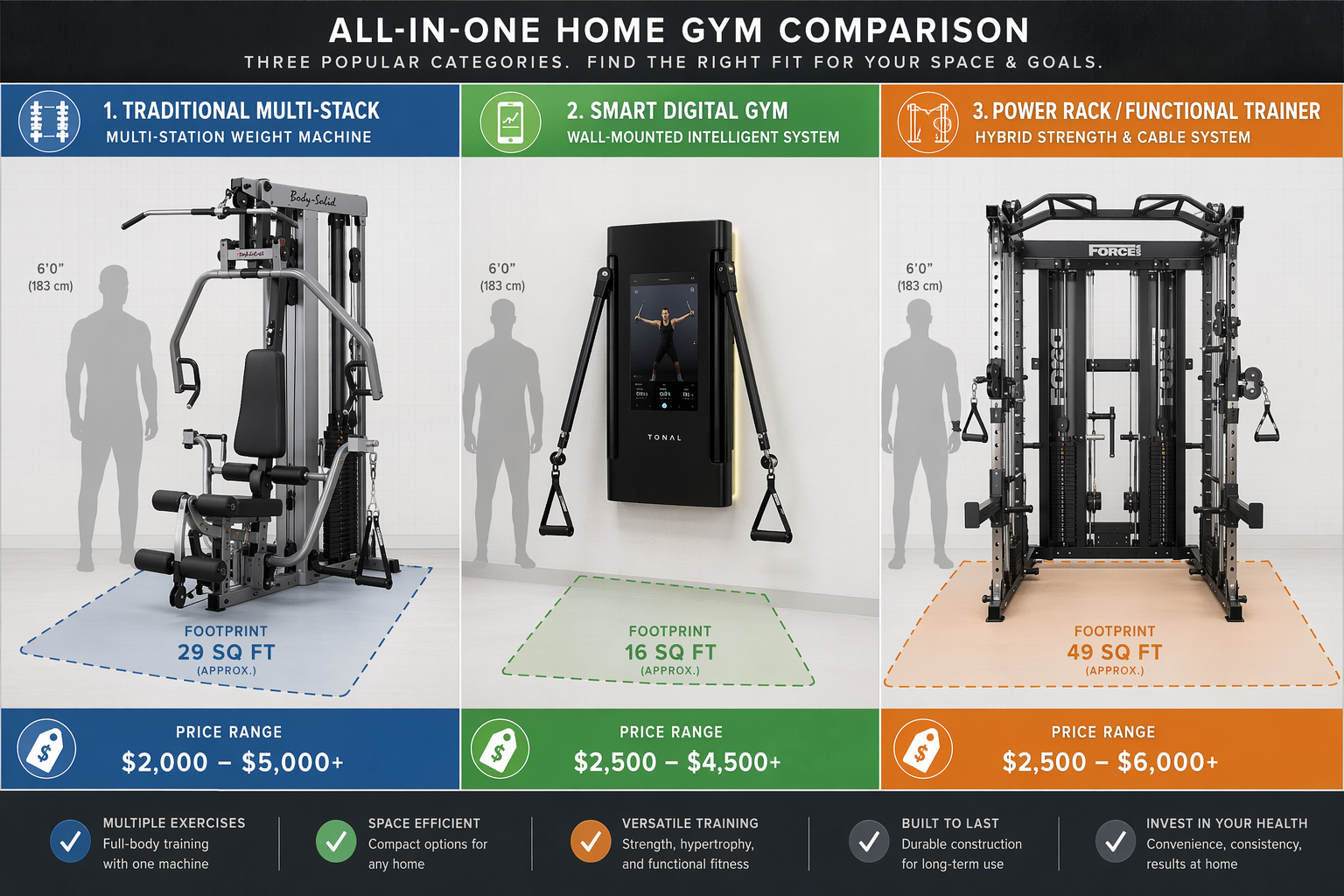
Introduction: The All-in-One Machine Market Has Fragmented
If you search for "all in one exercise machine" in 2026, you'll find everything from a $1,300 plate-loaded tower to a $4,295 wall-mounted digital system. The term has become so broad that it's nearly useless on its own. A traditional multi-station weight-stack machine, a smart digital-resistance gym, and a power-rack/functional-trainer hybrid are all called "all-in-one," but they serve fundamentally different buyers.
The core problem is that most buyers pick the wrong category before they compare specific models. They compare a Tonal 2 against a Bowflex Xtreme 2SE as if those are direct competitors, when in reality one is a subscription-based digital system for small apartments and the other is a weight-stack machine for a dedicated room. The decision that matters most isn't which model — it's which format.
This guide breaks the all-in-one market into three distinct categories, explains who each one serves, and provides a decision framework to help you identify your category before you start comparing price tags. If you need a refresher on how resistance types differ, see our comparison of weight stack vs. plate-loaded vs. digital resistance vs. power rod systems.
The Three Categories of All-in-One Exercise Machines in 2026
Every all-in-one machine on the market today falls into one of three format classes. The table below summarizes the key differences at a glance.
| Dimension | Traditional Multi-Stack | Smart Digital-Resistance | Power-Rack / Functional-Trainer Hybrid |
|---|---|---|---|
| Price Range | $1,000 – $1,800 | $3,000 – $4,300 | $1,300 – $4,500 |
| Resistance Type | Selectorized weight stacks | Digital electromagnetic | Dual weight stacks + free-weight capability |
| Typical Footprint | 20–30 sq ft | 9.5 sq ft (wall-mounted) | 20–33 sq ft |
| Resistance Ceiling | 150–260 lbs per stack | 220–250 lbs total | 260–289 lbs per stack |
| Subscription Required? | No | Often ($50–$60/month) | No |
| Best For | Budget buyers who want a commercial-gym feel | Small-space dwellers who want guided programming | Versatility seekers who want the most exercise options |
Each category has a distinct trade-off profile. Traditional machines give you the most resistance for the lowest price but limit you to predefined stations. Smart digital gyms save space and offer coaching but cap your strength ceiling and lock you into a subscription. Hybrids offer the most versatility and no subscription but demand the most floor space and assembly time.
Category 1: Traditional Multi-Station Weight-Stack Machines
These are the machines that defined the "home gym" category for decades. A single frame houses multiple exercise stations — chest press, lat pulldown, leg extension, seated row — each connected to a selectorized weight stack via cables and pulleys. You change exercises by moving a pin in the weight stack and switching to a different station.
The Body-Solid EXM2500 is a representative example. Listed at $1,795 on FitnessFactory, it features a 210-lb weight stack and a compact footprint that fits most home gym spaces. The Bowflex Xtreme 2SE uses power rods instead of weight stacks but occupies the same category slot at a similar price point. These machines are built for buyers who want a commercial-gym feel — smooth, predictable resistance with no screens, no subscriptions, and no firmware updates.
Who This Category Serves
- Budget-conscious buyers who want the most machine for under $2,000.
- Users who prefer analog resistance — no screens, no apps, no connectivity.
- People with a dedicated room or garage who can accommodate a 20–30 sq ft footprint.
- Lifters who want a predictable, repeatable resistance curve without digital lag or electromagnetic noise.
Pros and Cons
- Pros: Lowest cost per exercise station; no subscription; weight stacks provide smooth, reliable resistance; minimal maintenance; long warranty periods (Bowflex offers 7 years on the machine, 5 years on rods).
- Cons: Limited exercise variety compared to hybrids; predefined station layout may not fit all body types; weight stack increments (typically 5–10 lbs) limit progressive overload granularity; larger footprint than smart gyms.
Category 2: Smart Digital-Resistance Gyms
Smart digital-resistance gyms represent the most recent evolution of the all-in-one concept. Instead of weight stacks or rods, they use electromagnetic resistance controlled by software. The machine detects your rep speed, adjusts resistance in real time, and delivers guided workouts through a built-in screen. The two dominant players in this category are the Speediance Gym Monster and the Tonal 2.
The Speediance Gym Monster is priced at $3,199 and occupies just 9.5 sq ft of floor space — it folds to a depth of 14.96 inches when not in use. Its digital resistance maxes out at 220 lbs. GGR named it the "Best Home Gym for Small Spaces" in their 2026 testing. The Tonal 2 costs $4,295, delivers up to 250 lbs of digital resistance, and requires a $59.95/month subscription for full functionality. GGR named it the "Best Smart Home Gym" for 2026.
Who This Category Serves
- Apartment dwellers and small-space users who cannot dedicate 20+ sq ft to a machine.
- Users who want guided programming — the machine tells them what to do, tracks their progress, and adjusts weight automatically.
- Tech-forward buyers who are comfortable with a subscription model and app-based training.
- People who prioritize aesthetics and a clean, wall-mounted or foldable design.
Pros and Cons
- Pros: Smallest footprint of any all-in-one category; guided programming reduces decision fatigue; digital resistance enables eccentric overload and adaptive weight; sleek, modern design.
- Cons: Highest total cost of ownership when subscription is factored in ($3,199 + $0 for Speediance, $4,295 + $59.95/month for Tonal 2); resistance ceiling of 220–250 lbs may limit advanced lifters; digital resistance feels different from weight stacks — some users describe it as less "natural"; electronics can fail; warranty periods are shorter (Tonal 2 offers 2 years).
For a deeper comparison of the two leading smart gyms, see our head-to-head spec clash of Speediance vs. Tonal. For a full review of the Tonal 2's true cost and who it's actually for, read our Tonal 2 buyer's guide.
Category 3: Power-Rack / Functional-Trainer Hybrids
Power-rack/functional-trainer hybrids are the most versatile all-in-one machines on the market. They combine a full power rack (for squats, bench press, pull-ups) with dual weight stacks and cable arms (for lat pulldowns, rows, flyes, and hundreds of cable exercises). Many also include a Smith machine, dip station, and landmine attachment. The result is a single frame that can replace an entire gym's worth of equipment.
The Force USA G20 is the current top performer in this category. Strong Home Gym scored it 90/100, citing its 2:1 cable ratio, dual 289-lb weight stacks, and 11-gauge steel frame. It replaced the G15, which was discontinued in May 2026. The Major Fitness Heritage Series B17 Flying Fortress earned a 4.2/5 rating from GGR, with dual 260-lb weight stacks expandable per side, a 1,500-lb J-hook capacity, and both 1:1 and 2:1 cable ratios. At the budget end, the Bells of Steel All-in-One starts at $1,300 and offers either a plate-loaded or 210-lb weight stack configuration with a 300-lb cable capacity and a limited lifetime warranty.
Who This Category Serves
- Versatility seekers who want the widest possible range of exercises from a single machine.
- Lifters who want both free-weight capability (barbell squats, bench press) and cable-based isolation work.
- Users with a dedicated space (garage, spare room) who can accommodate 20–33 sq ft.
- Buyers who want no subscription and the longest possible warranty (Force USA offers lifetime frame, 10-year parts).
Pros and Cons
- Pros: Most exercise variety of any all-in-one category (up to 11 stations on some models); dual weight stacks allow independent arm movement; free-weight capability for barbell training; no subscription; longest warranty periods (lifetime frame on Force USA and REP).
- Cons: Largest footprint (20–33 sq ft); heaviest machines (500–800 lbs); longest assembly time (6–35 hours depending on model); highest upfront cost for premium models (Force USA G20 at ~$4,500).
Decision Framework: Which Category Is Right for You?
The following decision matrix maps your personal constraints — budget, space, training style, and subscription preference — to the right category. Identify your profile in the left column, then read across to see which category fits.
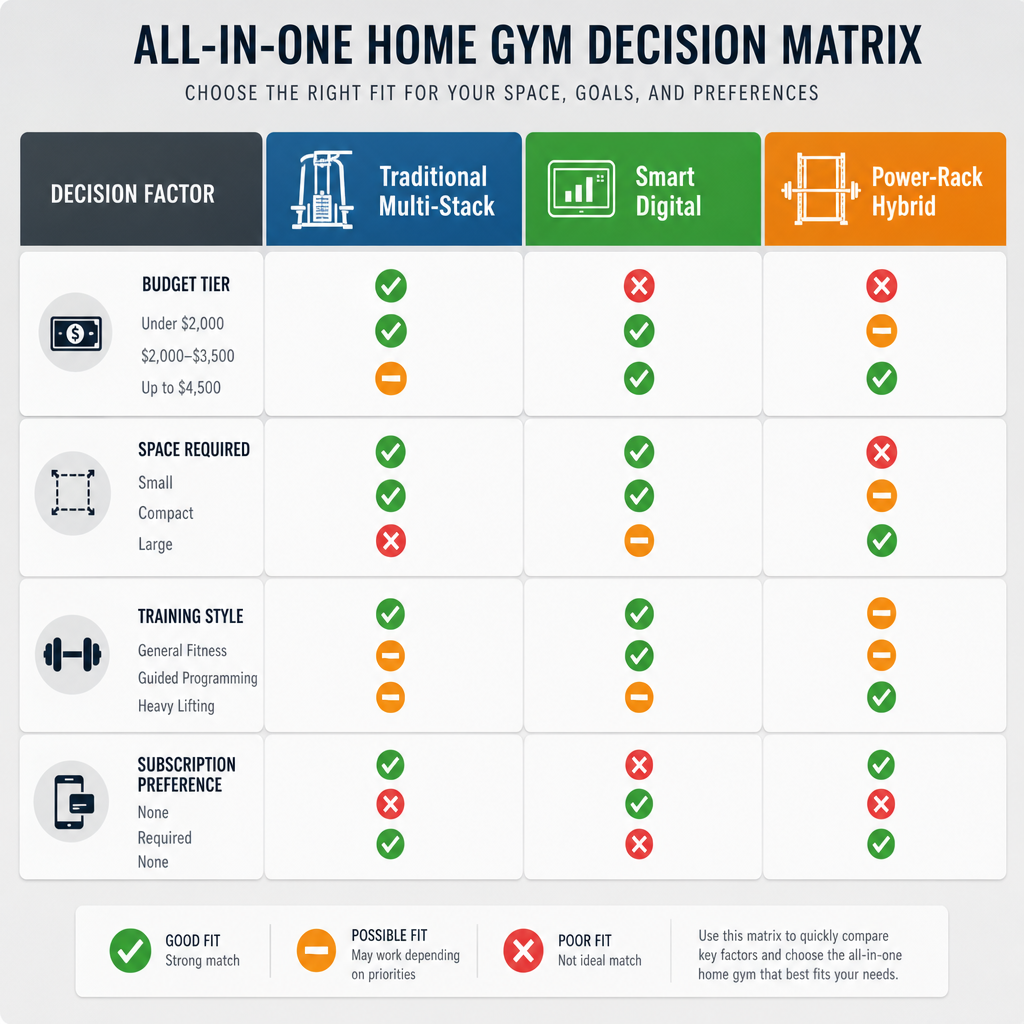
| Your Profile | Traditional Multi-Stack | Smart Digital-Resistance | Power-Rack / Functional-Trainer Hybrid |
|---|---|---|---|
| Budget under $2,000 | Best fit | Out of budget | Bells of Steel at $1,300 fits |
| Budget $2,000–$4,500 | Possible, but you can afford more | Speediance at $3,199 fits | Major Fitness B17 at $4,200 fits |
| Space under 15 sq ft | Tight fit | Best fit (9.5 sq ft) | Does not fit |
| Space 20–33 sq ft | Fits | Fits (wall-mounted) | Best fit |
| Training style: bodybuilding | Good for isolation work | Good with guided programs | Best fit (most exercise variety) |
| Training style: powerlifting | Limited (no free-weight barbell) | Not suitable (resistance ceiling too low) | Best fit (free-weight capable) |
| Training style: general fitness | Good | Best fit (guided programming) | Good (most versatile) |
| No subscription wanted | Best fit | Speediance only (no subscription) | Best fit |
| Subscription OK | Possible but unnecessary | Best fit (Tonal 2, others) | Possible but unnecessary |
If you're still unsure which category fits your broader training style and budget, our home gym equipment types explained guide provides a broader overview of all home gym systems before you narrow down to an all-in-one.
Category-Specific Product Highlights with Tested Data
Once you've identified your category, the next step is comparing specific models. The table below highlights the top picks in each category based on verified test data from GGR and Strong Home Gym.
| Product | Category | Price | Key Specs | Score / Rating | Best For |
|---|---|---|---|---|---|
| Body-Solid EXM2500 | Traditional Multi-Stack | $1,795 | 210-lb weight stack, 20–30 sq ft | N/A (well-established model) | Budget buyers wanting commercial-gym feel |
| Speediance Gym Monster | Smart Digital | $3,199 | 220-lb digital resistance, 9.5 sq ft, folds to 14.96" | GGR: Best for Small Spaces | Small-space dwellers, no subscription wanted |
| Tonal 2 | Smart Digital | $4,295 + $59.95/mo | 250-lb digital resistance, wall-mounted, 2-year warranty | GGR: Best Smart Home Gym | Guided programming, subscription OK |
| Force USA G20 | Power-Rack Hybrid | ~$4,500 | Dual 289-lb stacks, 2:1 cable ratio, lifetime frame warranty | Strong Home Gym: 90/100 | Serious lifters wanting maximum versatility |
| Major Fitness B17 | Power-Rack Hybrid | $4,200 | Dual 260-lb stacks (expandable), 1,500-lb J-hook capacity, 1-year warranty | GGR: 4.2/5, Best All-In-One | Versatility seekers wanting dual stacks |
| Bells of Steel All-in-One | Power-Rack Hybrid | $1,300+ | Plate-loaded or 210-lb stack, 300-lb cable capacity, limited lifetime warranty | GGR: Best Budget Home Gym | Budget buyers wanting hybrid versatility |
The average home gym price across all tested machines in GGR's 2026 database is $1,855. That number is useful as a benchmark: if you're spending significantly more than the average, you should be getting a clear benefit — either smart features (Tonal 2, Speediance) or maximum versatility (Force USA G20, Major Fitness B17). If you're spending significantly less, you're likely in the budget category (Bells of Steel, Body-Solid), which still delivers excellent value for the right user.
Frequently Asked Questions
Can one all-in-one machine replace a full gym?
It depends on the category. A power-rack/functional-trainer hybrid like the Force USA G20 or Major Fitness B17 can replace a squat rack, bench, cable crossover machine, lat pulldown, and low row — that covers 80–90% of what most home gym users need. A traditional multi-stack machine replaces multiple cable stations but cannot replace free-weight barbell training. A smart digital gym replaces cable-based exercises and guided cardio but cannot replicate the feel of a heavy barbell squat. No all-in-one machine fully replaces a dedicated deadlift platform or specialty equipment like a leg press.
How much assembly is needed?
Assembly time varies dramatically by category. Traditional multi-stack machines typically require 2–4 hours of assembly. Smart digital gyms like Tonal 2 require professional wall mounting (included in the purchase price). Power-rack hybrids require the most assembly — the Force USA G20 can take 6–10 hours, and some larger models can take up to 35 hours. If you're not comfortable with DIY assembly, factor in the cost of hiring a local handyman or professional assembler.
What about warranty differences?
Warranty is one of the most important differentiators between brands. Force USA offers a lifetime frame warranty and 10-year parts — the best in the industry. Bells of Steel offers a limited lifetime warranty. Bowflex offers 7 years on the machine and 5 years on the rods. Tonal 2 offers 2 years. Major Fitness offers only 1 year. If you're making a $4,000+ investment, a longer warranty provides significant peace of mind and correlates strongly with customer satisfaction.
Do I need a subscription?
Only if you choose a smart digital-resistance gym. The Tonal 2 requires a $59.95/month subscription for full functionality. The Speediance Gym Monster does not require a subscription. Traditional multi-stack machines and power-rack hybrids never require subscriptions. If subscription costs are a dealbreaker, eliminate the Tonal 2 and most other smart gyms from your consideration set.
Final Recommendation: Which All-in-One Machine Should You Buy?
The best all-in-one machine for you depends entirely on which category matches your constraints. Here are our tiered recommendations for each buyer profile.
- Budget buyer (under $2,000): Choose a traditional multi-stack machine like the Body-Solid EXM2500 at $1,795, or the Bells of Steel All-in-One at $1,300 if you want hybrid versatility on a budget.
- Small-space dweller (under 15 sq ft): Choose a smart digital-resistance gym. The Speediance Gym Monster at $3,199 offers the best space-to-value ratio with no subscription. The Tonal 2 at $4,295 is the premium option if you want guided programming and are willing to pay $59.95/month.
- Versatility seeker (20+ sq ft, no subscription): Choose a power-rack/functional-trainer hybrid. The Force USA G20 at ~$4,500 is the top performer (90/100 from Strong Home Gym) with lifetime frame warranty. The Major Fitness B17 at $4,200 is GGR's "Best All-In-One" pick with dual 260-lb stacks.
- Serious lifter (powerlifting or strongman): Choose a power-rack hybrid with free-weight capability. The Force USA G20 or REP Ares 2.0 will allow you to squat, bench, and deadlift with a barbell while also providing cable-based accessory work.
- General fitness / guided programming: Choose a smart digital-resistance gym. The Tonal 2's guided programs and automatic weight adjustment reduce decision fatigue and keep you consistent.
The single most important takeaway from this guide is this: pick the right category first, then compare models within that category. A buyer who needs a power-rack hybrid will never be happy with a smart digital gym's 220-lb resistance ceiling. A buyer who lives in a 500 sq ft apartment will never fit a Force USA G20. Match the format to your constraints, and the model decision becomes straightforward.
This result comes from one real apartment under the stated conditions — it is a strong signal, not a guarantee your space will measure identically.
Builds this evidence supports
Where to Spend vs. Save on Affordable Home Gym Equipment: A Quality Tradeoff Guide
A practical guide for budget-conscious buyers (under $1,000) that reveals which equipment categories demand a higher investment for safety and durability, and where cutting costs is a smart move.
Spot something off?
If this result didn't match your own space, let us know — floor-damage and noise claims carry real deposit-risk consequences if we get them wrong.