
The $500 Home Gym Dilemma: Three Very Different Paths
If you have exactly $500 to spend on a home gym, you face a decision that most buyer guides ignore. At this price, you are not choosing between similar machines. You are choosing between three fundamentally different training philosophies, each with its own trade-offs in resistance type, exercise variety, and long-term growth potential.
The three contenders are: a selectorized weight-stack all-in-one (the Marcy 150lb Stack Home Gym), a power-rod system (the Bowflex Xtreme 2 SE, though it stretches the budget), and a traditional budget power rack setup with a barbell and plates. Each one serves a different primary goal, and none of them does everything well. This comparison breaks down exactly what $500 buys you in each camp so you can match the setup to your actual training priorities — not to a marketing promise.
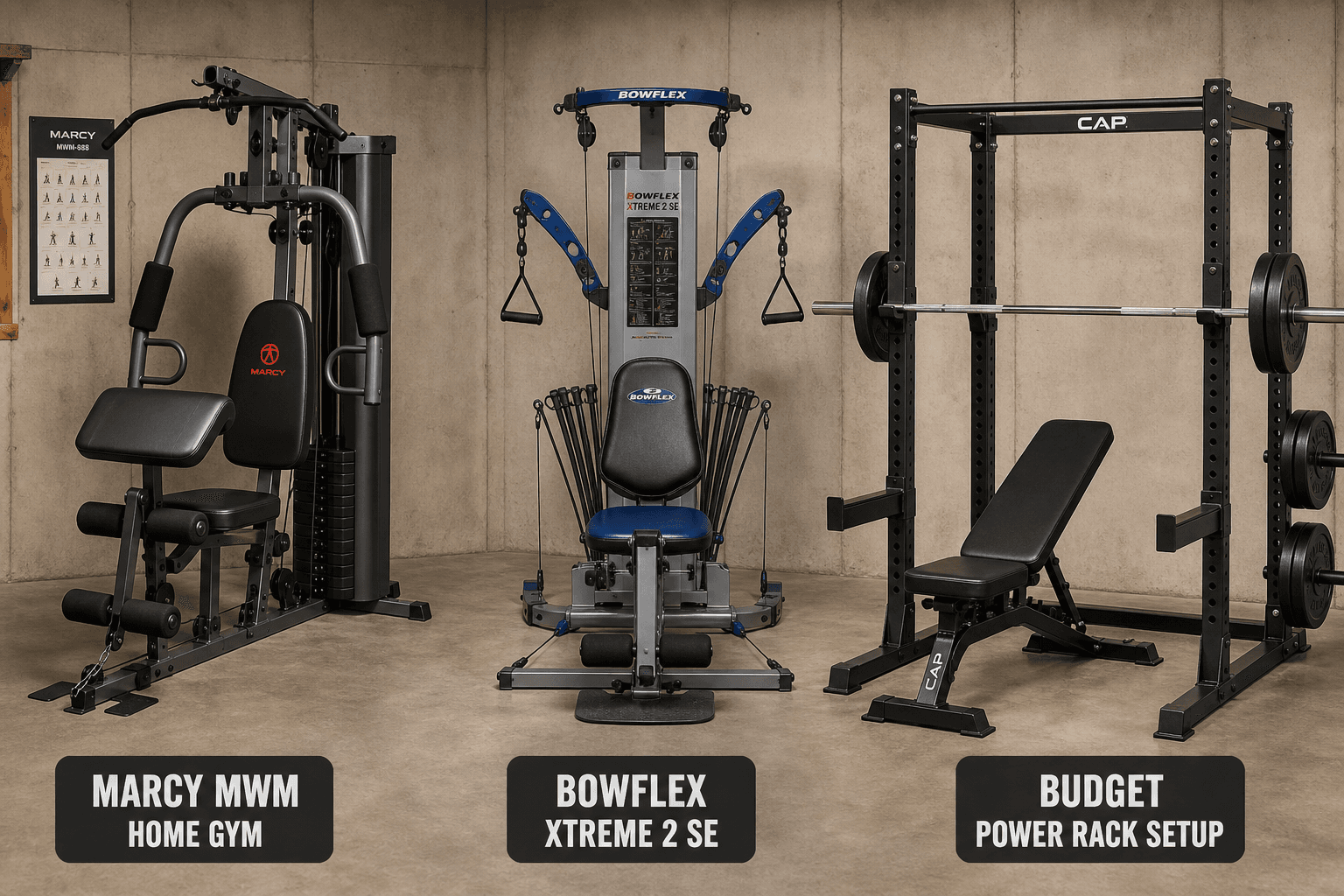
Cost Comparison: What $500 Actually Buys You
The headline numbers tell a straightforward story, but the fine print matters. Here is what each setup costs and what you actually get for the money.
| Setup | Price | What's Included | Notes |
|---|---|---|---|
| Marcy MWM-4965SC (Sam's Club) | $449 | 150lb weight stack, dual-action press arms, leg developer, lat bar, preacher curl pad, ankle/wrist straps, center pulley with ab attachment | Only brand-new weight-stack machine under $500. Sam's Club exclusive model. MarcyPro lists the nearly identical MWM-990 at $749.99. |
| Bowflex Xtreme 2 SE | $1,499 | 210lb Power Rod resistance (upgradable to 410lb), lat bar, leg extension/curl, 63"L x 49"W x 83.25"H footprint | Well above the $500 budget. Included as an aspirational comparison for readers considering saving up or financing. |
| Budget Power Rack + Bar + Plates + Bench | ~$500–600 | Basic power rack (or squat stands), Olympic barbell, 255lb cast iron plate set, flat bench | Cost depends heavily on quality tier and sales. No cable functionality included. A plate-loaded cable tower like the Bells of Steel Cable Tower starts at $435 but adds to the total. |
For readers who want a deeper dive into how these cost differences play out over several years, our all-in-one vs. separate equipment cost analysis breaks down the long-term financial picture.
Resistance Type Comparison: Weight Stack vs. Power Rods vs. Iron Plates
The resistance mechanism is not a minor spec — it defines how every exercise feels, how your muscles adapt, and how much you can progress. These three systems could not be more different.
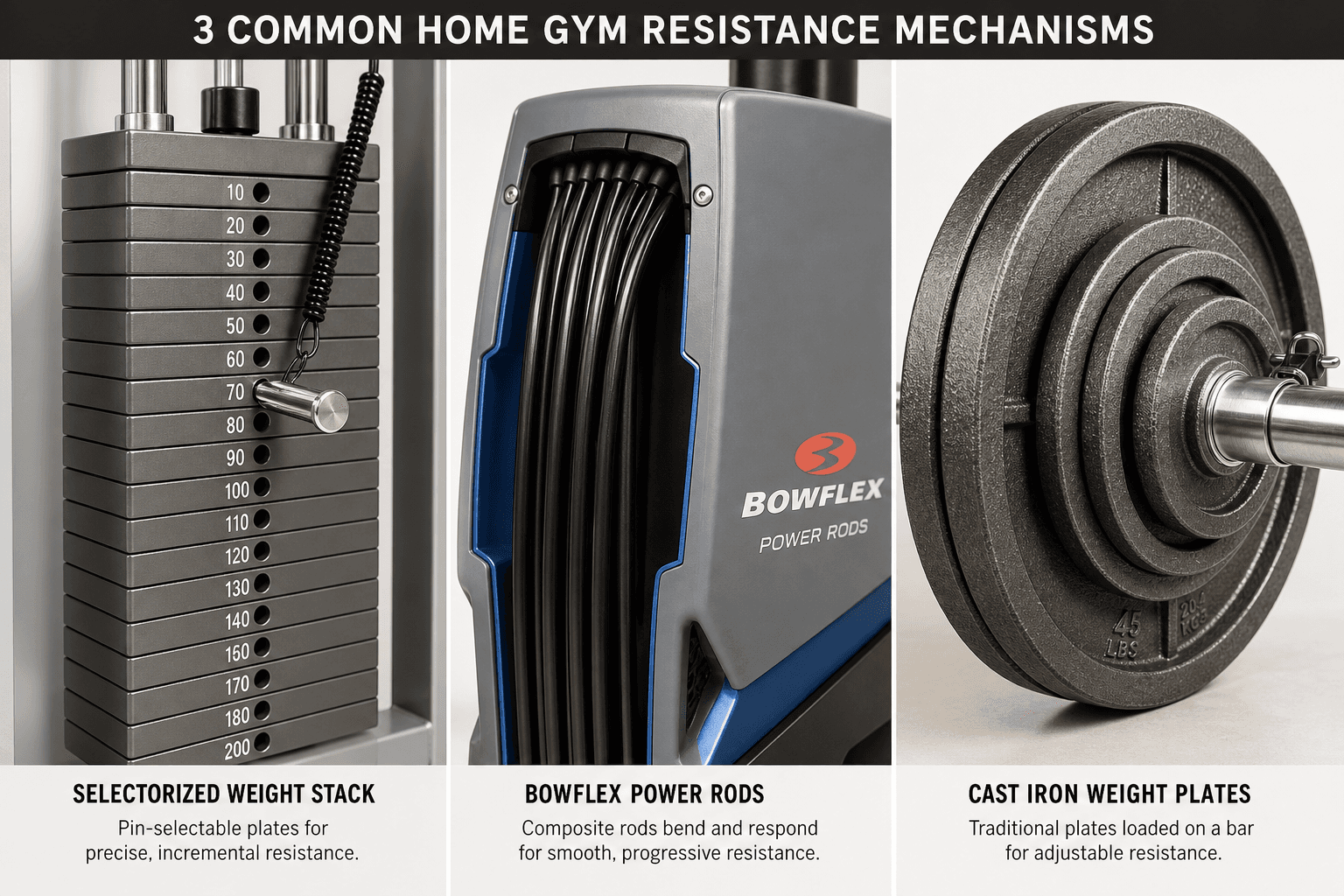
| Resistance Type | How It Works | Feel | Key Limitation |
|---|---|---|---|
| Selectorized Weight Stack (Marcy) | Stack of metal plates lifted via cable and pulley; pin selects the load | Smooth, constant tension throughout the range of motion. Cable pulleys can add ~50lb effective resistance on press moves (up to 200lb effective load per BarBend). | Capped at 150lb stack weight. Not upgradeable — confirmed by Marcy. |
| Power Rods (Bowflex) | Composite rods that flex under tension; resistance increases as rods bend | Progressive resistance — gets harder as you push/pull further. Some users find the feel less natural than a weight stack. | Rod fatigue over time. Bowflex offers a 5-year rod warranty. Upgradable from 210lb to 410lb. |
| Iron Plates (Rack Setup) | Cast iron or bumper plates loaded onto an Olympic barbell | Traditional free-weight feel. Requires control of the bar path. No cable assistance. | No cable functionality — no lat pulldowns, tricep pushdowns, or cable flyes without additional equipment. |
For a more detailed breakdown of how each resistance type performs across different exercises, see our full resistance type comparison guide.
What Each Setup Does Well — and What It Cannot Do
No $500 setup covers every training need. Understanding the strengths and gaps of each option is the key to making the right choice.
Marcy 150lb Stack Home Gym
- Excels at: Cable isolation work — lat pulldowns, seated rows, tricep pushdowns, cable flyes, leg extensions, leg curls, and preacher curls. The dual-action press arms allow chest press and butterfly movements. Over 30 exercises are possible.
- Cannot do: Heavy compound lifts (squats, deadlifts, bench press with a barbell). The 150lb stack is insufficient for most intermediate lifters on lower-body or pulling exercises. No free-weight functionality at all.
- Best for: Beginners to intermediate users focused on general fitness, muscle tone, and cable-based training who do not plan to lift heavy.
Bowflex Xtreme 2 SE
- Excels at: Providing a wide range of cable-style exercises with upgradable resistance. The 210lb base resistance can be expanded to 410lb, which covers a broader strength range than the Marcy.
- Cannot do: Traditional free-weight compound lifts. The power rod resistance curve feels different from both weight stacks and iron plates, which some users find less satisfying for heavy pulling movements.
- Best for: Users who want cable variety with room to grow, and who are willing to spend significantly more upfront.
Budget Power Rack Setup
- Excels at: Heavy compound lifting — squats, deadlifts, bench press, overhead press, rows. The ability to add plates indefinitely means you will never outgrow the resistance.
- Cannot do: Cable isolation work without additional equipment. No lat pulldowns, no tricep pushdowns, no cable flyes. You would need to add a cable tower or resistance bands for those movements.
- Best for: Lifters who prioritize strength and muscle mass through compound movements and are willing to sacrifice cable variety.
Space and Footprint: Which Fits Your Room?
All three setups require dedicated floor space, but their shapes and clearance needs differ significantly.
| Setup | Footprint (L x W x H) | Square Footage | Ceiling Height Needed | User Height Limit |
|---|---|---|---|---|
| Marcy MWM-4965SC | 68" x 42" x 78" | ~22 sq ft | At least 84" (7 ft) | ~6'1" for full lat pulldown range of motion (per BarBend and GXMMAT) |
| Bowflex Xtreme 2 SE | 63" x 49" x 83.25" | ~21 sq ft | At least 90" (7.5 ft) | No specific limit reported; taller users may find some exercises constrained |
| Budget Power Rack Setup | Varies (typical rack: ~48" x 48" x 84") | ~16–25 sq ft | At least 90" (7.5 ft) for overhead pressing inside the rack | No limit — barbell exercises accommodate all heights |
The Marcy and Bowflex machines are comparable in footprint, but the Marcy's lower height requirement (78" vs. 83.25") makes it a better fit for standard 8-foot basement ceilings. The power rack setup is the most flexible in terms of user height but requires more vertical clearance for overhead pressing.
Users over 6'1" should pay close attention to the Marcy's lat pulldown range of motion — both BarBend and GXMMAT note that taller users may find the movement limited. The seat positioning on the MWM-4965SC and MWM-990 is similar, so this limitation applies to both models.
Upgrade Path: Which Setup Can Grow With You?
This is the single most important long-term consideration. The upgradeability of each setup determines whether you will need to replace the entire system or simply add to it as you get stronger.
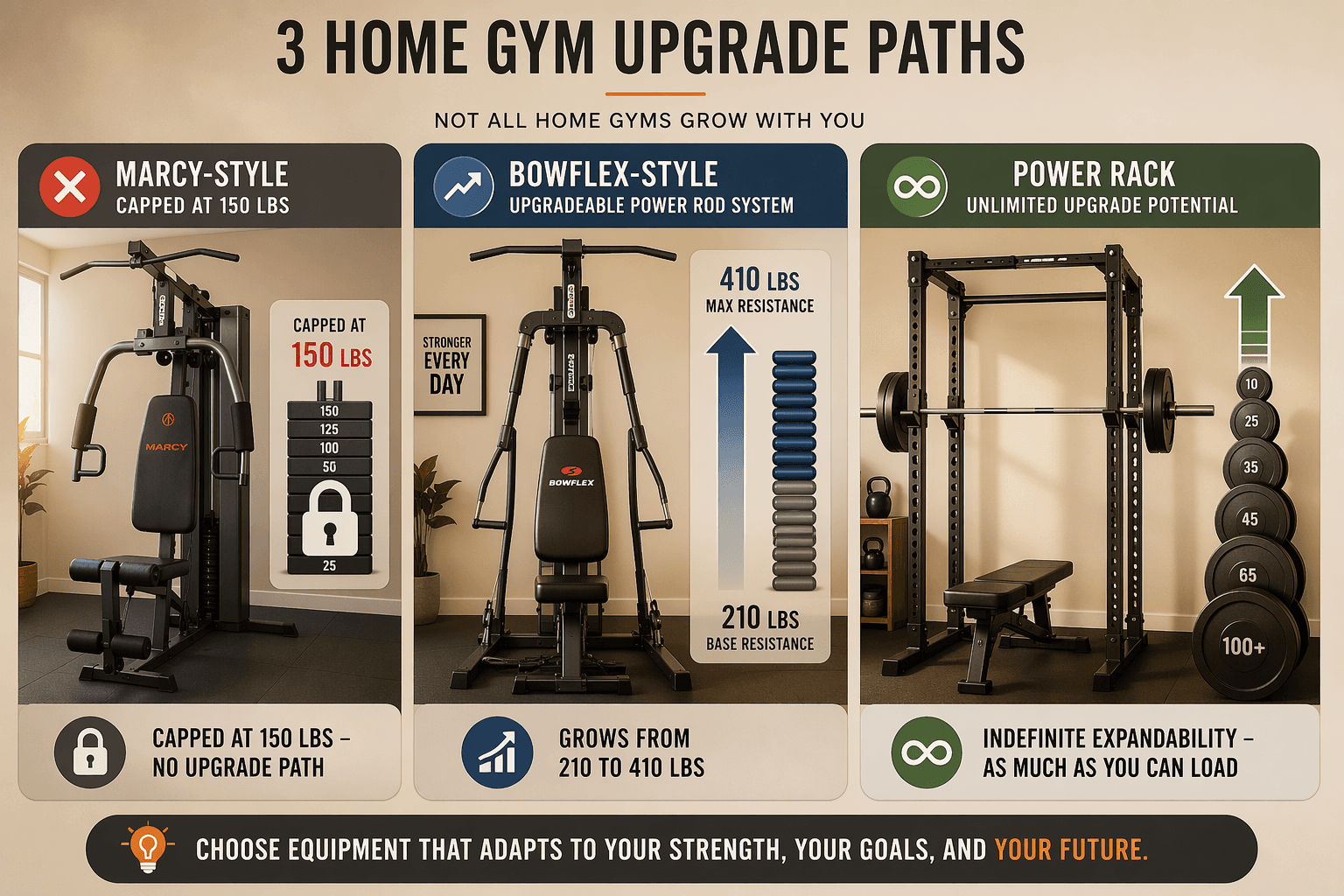
| Setup | Maximum Resistance | Upgradeable? | Cost to Upgrade | What Happens When You Outgrow It |
|---|---|---|---|---|
| Marcy MWM-4965SC | 150lb stack (effective ~200lb on press moves) | No — Marcy confirms no add-weight option exists | Not applicable | Must replace the entire machine |
| Bowflex Xtreme 2 SE | 210lb base, upgradable to 410lb | Yes — purchase additional rod sets | ~$200–300 for upgrade kit | Add rods; machine remains the same |
| Budget Power Rack Setup | Unlimited (limited only by rack weight capacity and plate availability) | Yes — buy more plates | ~$1–2 per lb for cast iron plates | Add plates; rack and bar remain |
Long-Term Value: Which Setup Are You Most Likely to Outgrow?
Long-term value is not just about upfront cost — it is about how long the setup remains useful before you need to spend more money.
- Marcy 150lb Stack: Strong value for the first 6–18 months for a beginner. Once you can comfortably press the full stack on chest and shoulder movements, you have hit the ceiling. At that point, the entire machine must be replaced. The resale value of used Marcy units is modest.
- Bowflex Xtreme 2 SE: Higher upfront cost, but the upgrade path extends its useful life significantly. The 210lb to 410lb range covers most non-competitive lifters. The 7-year machine warranty and 5-year rod warranty add peace of mind.
- Budget Power Rack Setup: The highest long-term ceiling. You can start with a 255lb plate set and add weight as needed. The rack and bar can last decades. The trade-off is the lack of cable work — if you eventually want cables, you will need to add a separate cable tower or lat pulldown attachment.
For a detailed 5-year cost projection comparing all-in-one machines against modular setups, read our all-in-one vs. modular home gym cost analysis.
Final Verdict: Which $500 Home Gym Should You Buy?
There is no universal winner at $500. The right choice depends entirely on your primary training goal and how you answer the upgradeability question.
- Choose the Marcy 150lb Stack if: You are a beginner or intermediate focused on general fitness, muscle tone, and cable-based training. You want the widest variety of exercises for the lowest price, and you do not plan to lift more than 150lb on any single movement. The Marcy is the only brand-new weight-stack machine under $500, and for cable isolation work at this price, it has no direct competitor.
- Choose the Bowflex Xtreme 2 SE if: You are willing to save up or finance a higher upfront cost in exchange for upgradable resistance. The ability to go from 210lb to 410lb means you will not outgrow the machine as quickly. Be prepared for the power rod feel, which differs from both weight stacks and free weights.
- Choose the Budget Power Rack Setup if: Your primary goal is building strength and muscle mass through heavy compound lifts. You are willing to forgo cable work in exchange for unlimited upgrade potential. This is the only setup that will never cap your strength progression.
If you are still unsure which resistance type suits you best, our resistance type comparison guide provides a deeper look at how each system performs across different exercises.
Comments
Join the discussion with an anonymous comment.