
Full Body Workout Machine vs. Free Weights: The Big Picture
If you are an intermediate home fitness enthusiast looking to upgrade your setup, you have likely faced this fork in the road: invest in a full-body workout machine — a functional trainer, multi-stack gym, or smart gym — or build a free-weight setup around a barbell, rack, and adjustable dumbbells. Neither path is universally superior, and the right answer depends on how you train, where you train, and what you want from your sessions.
This comparison breaks down the decision across seven dimensions: muscle activation, progressive overload, safety when training alone, space efficiency, cost per pound of resistance, exercise variety, and learning curve. By the end, you will have a clear framework for choosing the modality that aligns with your constraints and goals.
| Dimension | Full-Body Workout Machine | Free Weights |
|---|---|---|
| Stabilizer muscle recruitment | Lower — guided movement paths reduce stabilizer demand | Higher — free paths require active stabilization throughout each rep |
| Progressive overload granularity | Varies by type: digital resistance (Tonal) offers 1-lb increments; weight stacks jump by 5–10 lbs per pin | Unlimited — add 1.25-lb plates or micro-loading collars for precise jumps |
| Safety training alone | High — built-in spotter modes, catch arms, and guided paths reduce risk of failed reps | Moderate to low — heavy squats and bench presses require a spotter or safety bars for failure protection |
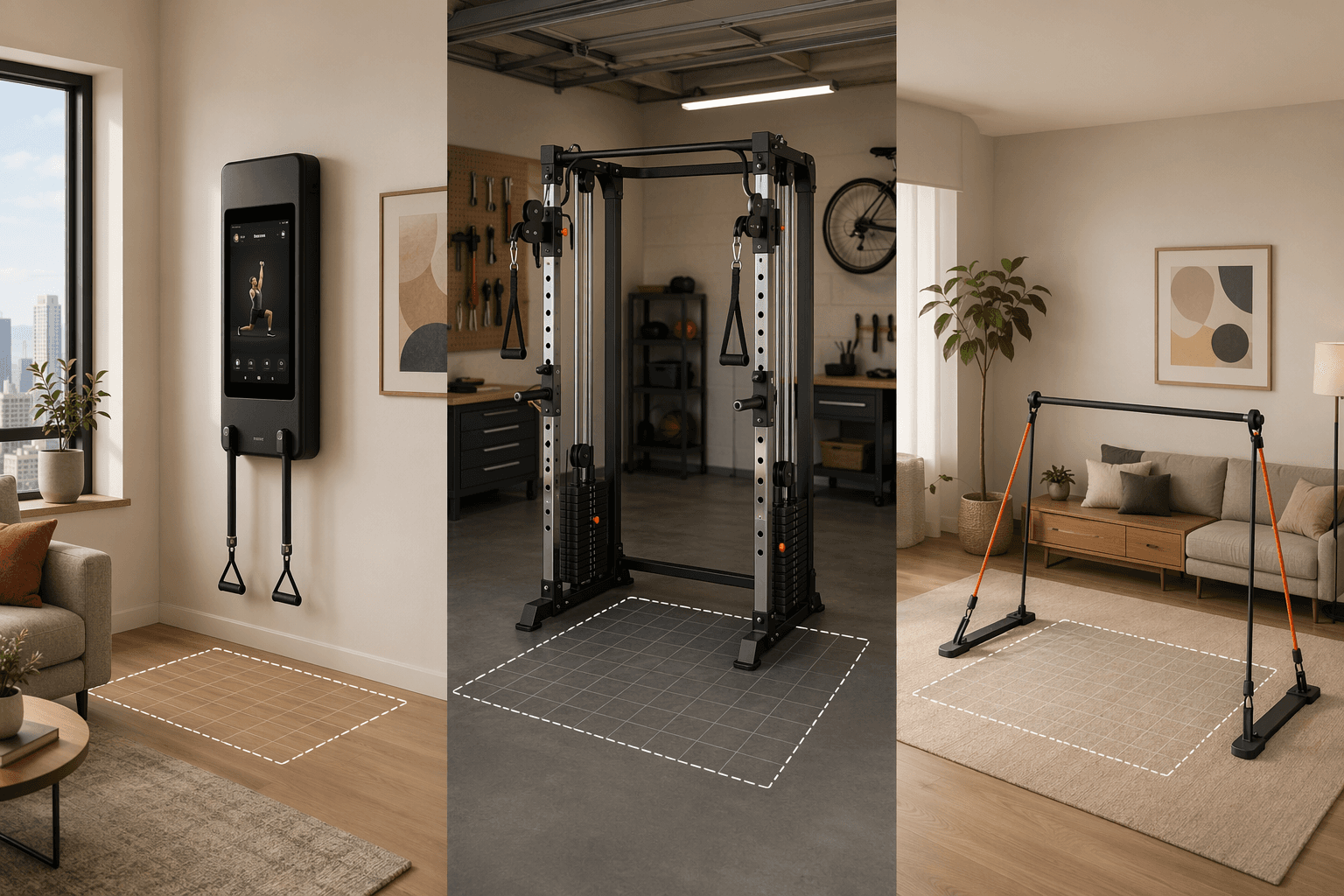
| Floor space required | 4–20 sq ft depending on type (wall-mounted smart gyms are most compact) | 10–25 sq ft for a rack, bench, and plates; folding racks reduce footprint to 9 inches when stored |
| Cost for 200+ lbs of resistance | $1,499 (Bowflex Xtreme 2 SE) to $4,295 (Tonal 2) plus potential monthly subscription | $500–$800 for a barbell, plates, and a basic rack |
| Exercise variety | 70+ exercises in one footprint (Bowflex Xtreme 2 SE); cable attachments enable hundreds of angles | Limited to compound lifts and their variations unless you add dumbbells, bands, or a cable attachment |
| Learning curve | Low to moderate — guided paths and preset programs reduce technique demands | Moderate to high — compound lifts require coaching on form, bracing, and bar path |
The Case for Full Body Workout Machines
Full-body workout machines excel in three areas that matter deeply to home gym owners: safety when training alone, guided form that reduces injury risk, and rapid transitions between exercises that keep workouts efficient.
Safer Solo Training
When you train alone at home, a failed rep on a barbell bench press or squat can be dangerous. Machines eliminate that risk through built-in safety mechanisms. The Tonal 2, priced at $4,295 with a $59.95/month membership, uses electromagnetic resistance with a digital spotter mode that automatically reduces resistance when it detects you are struggling. The REP Ares 2.0 ($2,999.99) is a functional trainer add-on for REP PR-4000 and PR-5000 racks with dual 260-lb weight stacks at a 2:1 ratio, swiveling pulleys, and a lifetime warranty — the cable path guides the movement, so you never have to worry about a bar pinning you.
Even budget-friendly options like the Bowflex Xtreme 2 SE ($1,499) provide 210 lbs of Power Rod resistance (upgradable to 410 lbs) across over 70 exercises in a single 53" x 49" footprint. The Power Rod system eliminates the need for a spotter entirely — if you fail on a rep, the rods simply stop moving.
Guided Form and Faster Learning
Machines constrain the movement path, which means you can train with good form from session one without spending weeks learning bar path, bracing, and hip hinge mechanics. This is especially valuable for intermediate lifters who want to add isolation work — lateral raises, face pulls, triceps pushdowns — without the technique overhead of free-weight variations.
Smart gyms take this further. The Tonal 2's 24-inch touchscreen provides AI-assisted form correction and auto-progression, adjusting weight based on your performance in real time. The LIT Method Strength Machine ($2,000–$2,698) combines a rower, reformer, and strength trainer with water resistance (10–40 lbs) and guided programming. For lifters who want coaching without hiring a coach, these platforms deliver structured progression out of the box.
Quick Transitions and Workout Density
With a dual-stack functional trainer like the REP FT-3000 ($1,999.99, dual 187-lb stacks at a 2:1 ratio), you can superset exercises by moving from one cable station to the other without changing weights. A chest press on the left cable, immediately followed by a row on the right cable, keeps rest periods short and workout density high. This is harder to replicate with free weights, where you must re-rack plates, swap dumbbells, or move between stations.
- REP Ares 2.0: $2,999.99, dual 260-lb stacks (upgradable to 310 lbs), lifetime warranty, 2:1 cable ratio
- Bowflex Xtreme 2 SE: $1,499, 210 lbs resistance (upgradable to 410 lbs), 70+ exercises, 7-year machine warranty
- Tonal 2: $4,295, 250 lbs digital resistance (125 lbs per arm), $59.95/month membership, AI coaching
- REP FT-3000: $1,999.99, dual 187-lb stacks (90 lbs actual per side at 2:1 ratio), lifetime warranty
- X3 Bar: $549, 300 lbs band resistance (600 lbs with Elite Band), 19" x 10" footprint
The Case for Free Weights
Free weights have been the backbone of strength training for a reason: they force your stabilizer muscles to work throughout every rep, they allow unlimited load progression, and they cost significantly less per pound of resistance than any machine.
Greater Stabilizer Recruitment and Functional Transfer
When you bench press with a barbell, your shoulders, rotator cuff, and core must actively stabilize the bar throughout the movement. On a Smith machine or cable press, the machine handles that stabilization. This difference matters for overall strength development: free-weight compound lifts recruit more total muscle mass per rep, which drives greater systemic adaptation over time. The principle of neuromuscular adaptation specificity means that strength gained through free-weight training transfers more directly to real-world movements and athletic performance.
Lower Cost Per Pound of Resistance
A barbell, a set of plates, a rack, and a bench can be assembled for roughly $1,000 and provide 300+ lbs of resistance for the core compound lifts — squat, bench press, deadlift, overhead press, and rows. Compare that to the Bowflex Xtreme 2 SE at $1,499 for 210 lbs of resistance, or the Force USA G20 at roughly $5,999 with dual 289-lb stacks. Free weights deliver more resistance for fewer dollars.
Adjustable dumbbells further improve the value proposition. The REP QuickDraw adjustable dumbbells start at $335.99 for a pair (5–60 lbs) with fast Lock-N-Load weight changes and a lifetime warranty. A single pair replaces 12+ pairs of fixed dumbbells, saving both money and floor space.
Unlimited Load Variability
With free weights, you can increase load in 1.25-lb increments using micro-plates — essential for intermediate lifters who need small jumps to continue progressing on the bench press or overhead press. Weight-stack machines typically jump by 5–10 lbs per pin, which can be too large for upper-body lifts. Digital resistance systems like the Tonal 2 offer 1-lb increments, but they come with a monthly subscription cost that adds up over time.
- Barbell + rack + bench: ~$1,000 for 300+ lbs of compound-lift capacity
- REP QuickDraw adjustable dumbbells: $335.99+ for 5–60 lbs per pair, lifetime warranty
- PRx Profile PRO folding rack: $1,099.99, folds to 9" depth, 1,000-lb capacity, 10-year warranty
- Bells of Steel Cable Tower (plate-loaded): $434.99, 250 lbs capacity, 31" x 28.5" footprint — a hybrid option that adds cable work to a free-weight setup
The Hybrid Approach: Combining Machines and Free Weights
Many experienced home gym owners do not choose one modality — they build both over time. A staged approach lets you start with the system that addresses your most urgent need and add the other later as your training evolves.
Stage 1: Free Weights First, Add a Cable Machine Later
Start with a barbell, rack, bench, and adjustable dumbbells. This covers the core compound lifts that drive the most muscle growth. After 6–12 months, add a compact cable tower like the Bells of Steel Cable Tower ($434.99 plate-loaded version, 250 lbs capacity, 31" x 28.5" footprint) or the REP FT-3000 ($1,999.99) for cable flyes, face pulls, triceps pushdowns, and lat pulldowns — exercises that are difficult to replicate with free weights alone.
Stage 2: Machine First, Add a Barbell Later
If safety and guided form are your top priorities — especially if you train alone and are new to strength training — start with a full-body machine like the Bowflex Xtreme 2 SE or a smart gym like the Tonal 2. After you build foundational strength and technique, add a barbell and squat stand for heavy compound work. The PRx Profile PRO folding rack ($1,099.99, folds to 9" depth) is an excellent second-stage addition because it takes almost no floor space when not in use.
- Free weights first → add cable tower: ~$1,000 (barbell setup) + $435–$2,000 (cable tower) = $1,435–$3,000 total
- Machine first → add barbell: $1,499–$4,295 (machine) + $1,100 (folding rack + bar + plates) = $2,599–$5,395 total
- Both paths give you compound lifts + cable isolation work, but the order affects your upfront cost and training experience
What the Research Says: Machines vs. Free Weights for Muscle Growth
The scientific literature does not crown a clear winner between machines and free weights for muscle hypertrophy. A 2019 meta-analysis by Lopes et al. published in SAGE Open Medicine found that elastic resistance training produces similar strength gains to free-weight training, supporting the case for band-based systems like the X3 Bar ($549, 300 lbs of band resistance). This suggests that the mechanism of resistance — whether weight stack, digital electromagnet, or elastic band — matters less than the consistent application of progressive overload.
Where machines do have an edge is in isolation work. Targeting a specific muscle group — say, the lateral deltoid with a cable lateral raise or the hamstrings with a lying leg curl — is easier on a machine because the movement path is fixed and the target muscle is isolated. Free-weight variations of these exercises often require more balance and coordination, which can limit the load you can use and the stimulus you deliver to the target muscle.
For compound lifts, free weights likely have a slight advantage for overall strength development because they recruit more stabilizer muscles and allow heavier loads. But the difference is small enough that for most intermediate lifters, the modality you enjoy and will stick with consistently will produce better results than the theoretically optimal one you abandon after three months.
Decision Flowchart: Which Path Fits Your Goals?
Use the following questions to guide your choice:
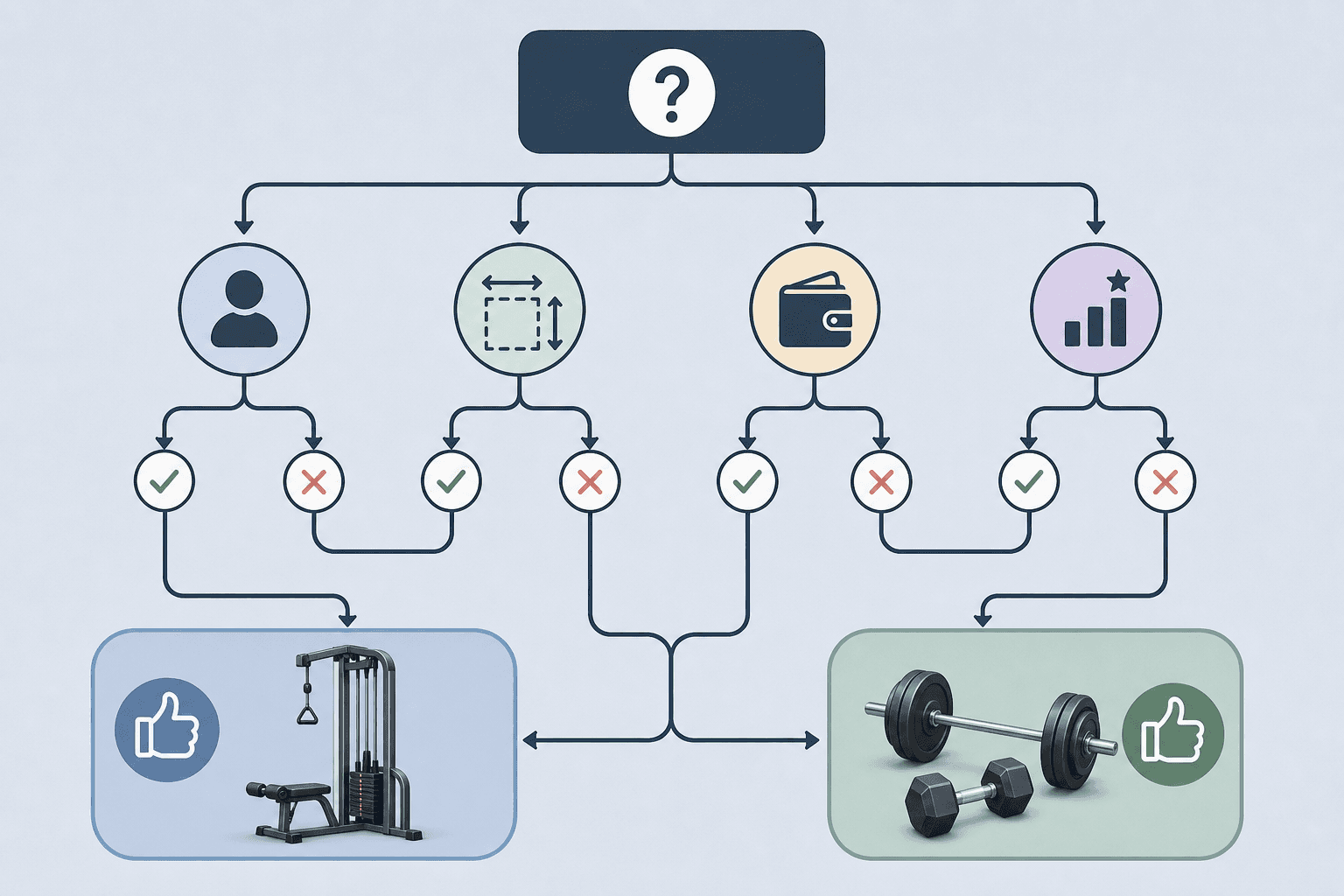
- Do you train alone? If yes, machines offer a safety advantage for heavy pressing and squatting. If you have a training partner, free weights become more viable for compound lifts.
- Is your floor space limited to under 15 sq ft? Wall-mounted smart gyms (Tonal 2) and portable band systems (X3 Bar) are the most space-efficient. Free-weight setups with a folding rack (PRx Profile PRO) also work in tight spaces.
- Is your budget under $1,500? Free weights deliver more resistance per dollar. A barbell setup + adjustable dumbbells will take you further than a machine at this price point.
- Are you an intermediate lifter focused on hypertrophy? Both modalities work, but machines allow easier isolation of specific muscle groups. Free weights build more overall strength through compound lifts.
- Do you want guided programming and form feedback? Smart gyms (Tonal 2, LIT Method) provide structured programs and real-time coaching. Free weights require you to design your own program or follow a written plan.
If you are still unsure after working through these questions, our First-Time Home Gym Buyer's Decision Framework provides a step-by-step process for matching equipment to your budget, space, and training goals.
For a detailed breakdown of what you actually get at every price tier — from $300 to $6,000+ — see our Home Gym System Cost Breakdown: What You Actually Get at Every Price Tier. That article maps specific machine and free-weight configurations to each budget level, so you can see exactly what your money buys.
Comments
Join the discussion with an anonymous comment.