
Walking Pad vs. Treadmill: Which One Actually Belongs in Your Home?
Walking pads and treadmills serve fundamentally different purposes. This head-to-head comparison helps apartment dwellers, remote workers, and small-space home gym builders decide which machine fits their actual workout habits, space, and budget.
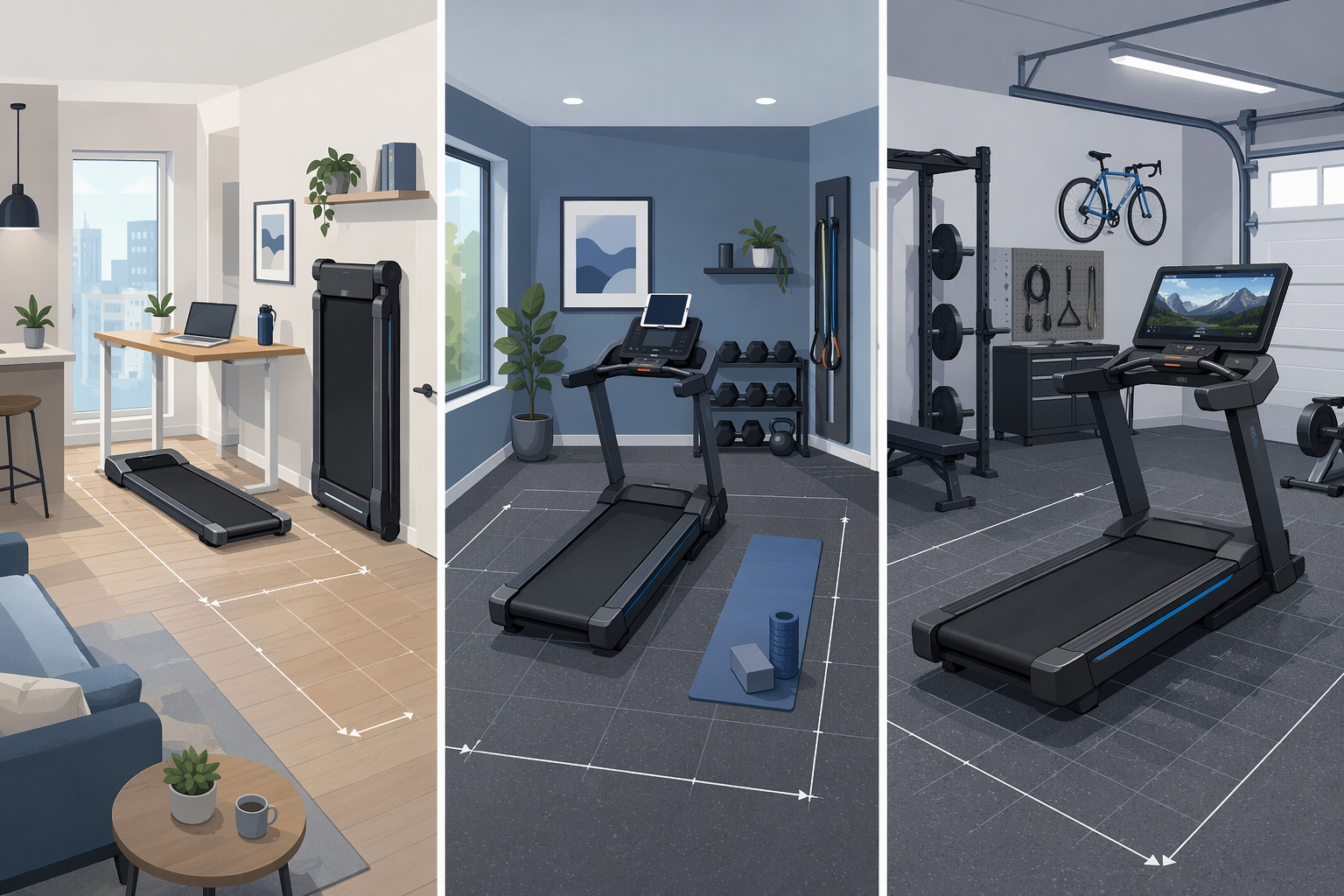
The Core Distinction: Step Accumulation vs. Structured Training
The most common mistake people make when shopping for home cardio equipment is treating walking pads and treadmills as interchangeable products that differ only in size and price. They are not the same category of machine. They serve fundamentally different use patterns, and choosing the wrong one means you will either outgrow it in a few months or find yourself paying for features you never use.
A walking pad is a step-accumulation tool. It is designed for one activity: walking at a steady, moderate pace — typically between 0.5 and 4 mph — while you are otherwise occupied. The primary use case is under a standing desk during work hours, or in front of a television during passive downtime. Walking pads have no incline capability, their decks are short and narrow, and their motors are not built to sustain the higher speeds and impact forces of jogging or running.
A treadmill, by contrast, is a structured training tool. It is designed to support a full range of cardio activity: walking, brisk walking, jogging, interval training, hill climbs, and sustained running. A standard home treadmill reaches speeds of 10 to 12 mph, offers incline grades of 10 to 15 percent, and provides a deck long and wide enough to accommodate a natural running stride. The motor, frame, and cushioning system are all engineered to handle repeated impact at speed.
This distinction matters because your choice determines not just what you can do today, but what you will be able to do six months from now. If your goal is to increase your daily step count from 5,000 to 10,000 while you answer emails, a walking pad is the right tool. If your goal is to build cardiovascular fitness through progressive jogging or running, a walking pad will limit you almost immediately.
| Dimension | Walking Pad | Full Treadmill |
|---|---|---|
| Primary use | Passive step accumulation (desk work, TV) | Structured cardio training (walk, jog, run) |
| Max speed | 3.7 – 4.0 mph | 10 – 12 mph |
| Incline | None | 0 – 15% |
| Typical deck size | 40″ – 47″ long, 15″ – 17″ wide | 55″ – 60″ long, 20″ – 22″ wide |
| User weight limit | 220 – 265 lbs | 300 – 400+ lbs |
| Machine weight | 25 – 55 lbs | 180 – 450+ lbs |
| Motor power | 1.0 – 2.5 CHP | 2.5 – 4.25+ CHP |
| Warranty (typical) | 1 year | Lifetime frame/motor, 2–15 years parts |
Activity Envelope Comparison: Speed, Incline, and Deck Size
The activity envelope — the range of speeds, inclines, and stride lengths a machine can accommodate — is where walking pads and treadmills diverge most sharply. These are not minor spec differences; they determine whether the machine can support the activity you actually want to do.
Speed Range
Walking pads typically top out between 3.7 and 4.0 mph. The WalkingPad C2, one of the most popular models, has a maximum speed of 3.7 mph. The UREVO Strol 2E, often categorized as a compact treadmill but functionally a walking pad, reaches 6.2 mph — enough for a light jog, but still well short of the 8–12 mph range that most runners need for interval work or sustained pace training. A standard home treadmill like the Horizon T101 reaches 10 mph, and premium models like the NordicTrack Commercial 1750 hit 12 mph.
The practical implication: if your comfortable walking pace is 3.5 mph, a walking pad gives you almost no headroom. You are operating near the machine's limit from day one, with no ability to increase intensity through speed alone.
Incline Availability
No walking pad on the market offers incline. This is not an oversight — it is a design constraint. Walking pads are built thin enough to slide under furniture, and adding an incline mechanism would increase height, weight, and cost. But the absence of incline is a real training limitation. Walking at a 5–10 percent grade significantly increases calorie expenditure and engages the posterior chain (glutes, hamstrings, calves) in a way that flat walking does not. For runners, incline work is essential for building leg strength and simulating outdoor terrain. A treadmill like the Sole F80 offers 0–15 percent incline, and the NordicTrack Commercial 1750 adds a decline feature down to -3 percent for downhill simulation.
Deck Dimensions
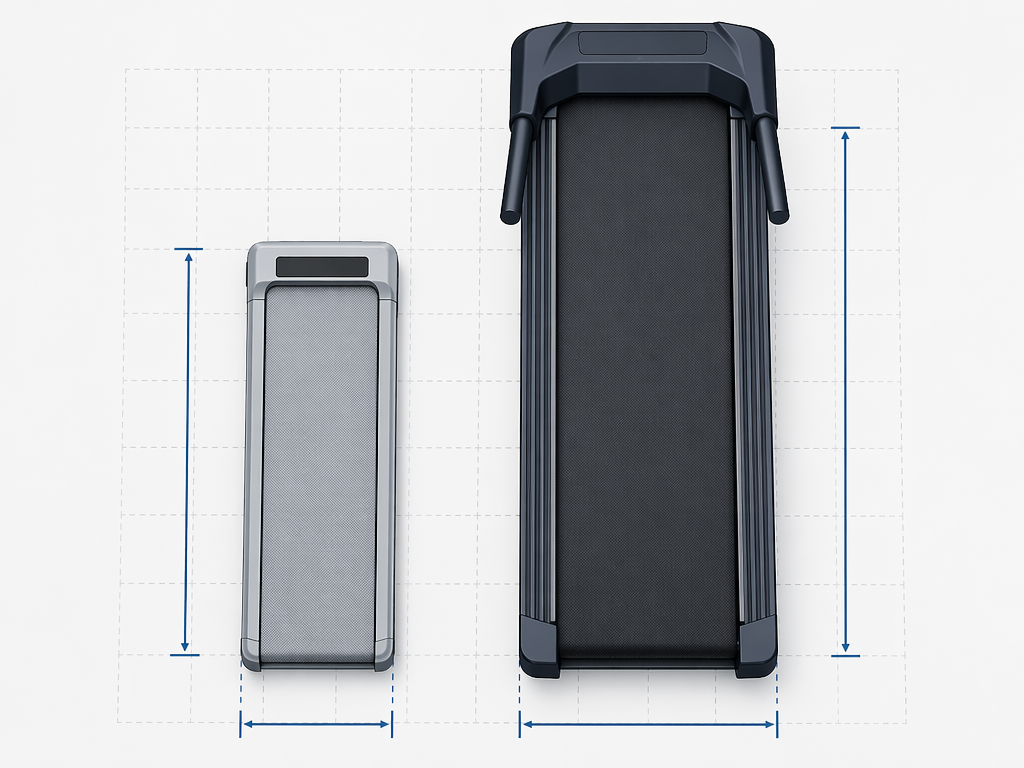
Deck size is the most overlooked spec in the walking pad vs. treadmill debate, and it is the one that most directly affects running safety and comfort. The WalkingPad C2 has a deck that measures 47.2 inches long by 15.8 inches wide. The UREVO Strol 2E is even shorter at 40.2 inches long. Compare that to a standard treadmill deck: the Horizon T101 offers 55 inches by 20 inches, and the Sole F80 provides 60 inches by 22 inches.
For a runner with a natural stride length, a 47-inch deck forces you to shorten your stride or risk stepping off the back of the belt. The narrow 15–17 inch width means your feet have less lateral room, which can feel unstable at any speed above a brisk walk. Industry guidelines recommend a minimum 55-inch deck for runners and 60 inches for runners over six feet tall. Walking pads fall well short of both thresholds.
| Model | Type | Max Speed | Incline | Deck Size | Weight Limit |
|---|---|---|---|---|---|
| WalkingPad C2 | Walking pad | 3.7 mph | None | 47.2″ x 15.8″ | 220 lbs |
| UREVO Strol 2E | Compact / hybrid | 6.2 mph | None | 40.2″ x 15″ | 265 lbs |
| Horizon T101 | Budget treadmill | 10 mph | 0–10% | 55″ x 20″ | 300 lbs |
| Sole F80 | Mid-range treadmill | 12 mph | 0–15% | 60″ x 22″ | 350 lbs |
| NordicTrack Commercial 1750 | Premium treadmill | 12 mph | -3% to 12% | 60″ x 22″ | 400 lbs |
Space and Portability: Floor Footprint, Weight, and Storage
This is the one area where walking pads have a clear and unambiguous advantage. If your primary constraint is physical space — a small apartment, a shared room, or a desk area that must remain usable for other purposes — a walking pad may be the only realistic option.
Weight and Portability
Walking pads weigh between 25 and 55 pounds. The WalkingPad C2, for example, weighs 55 pounds — heavy enough to require two hands to carry, but light enough that one person can move it from under a desk to a closet. Most walking pads fold flat and can be stored vertically against a wall, under a bed, or in a shallow closet.
Full treadmills are in a different weight class entirely. The Horizon T101 weighs 180 pounds. The Sole F80 weighs approximately 260 pounds. Premium models like the NordicTrack Commercial 1750 can exceed 300 pounds. Moving one of these machines requires planning, and in many cases, two people. Once positioned, a full treadmill is effectively a permanent fixture in the room.
Floor Footprint
A standard home treadmill requires a floor footprint of roughly 7 feet long by 3 feet wide. That is the space the machine occupies when in use. You also need clearance behind and to the sides — at least 2 feet on each side and 6 feet behind — for safe mounting, dismounting, and emergency egress. In practice, a treadmill needs a dedicated zone of about 8 feet by 5 feet.
A walking pad, by contrast, occupies roughly 4 feet by 2 feet when in use and can be stored in a footprint of essentially zero — under a desk, behind a door, or in a closet. For apartment dwellers who cannot dedicate a room or even a corner to cardio equipment, this is the deciding factor.
Folding Treadmills: A Middle Ground
Many modern treadmills, including the Horizon T101 and the Sole F80, feature folding decks that lift and lock into a vertical position, reducing the floor footprint by roughly half when not in use. A folding treadmill still requires a permanent home — you cannot easily move it between rooms — but it makes the space usable for other purposes when the machine is stowed. For a detailed breakdown of folding vs. non-folding tradeoffs, see our guide to matching treadmill storage type to your space.
| Factor | Walking Pad | Folding Treadmill | Non-Folding Treadmill |
|---|---|---|---|
| Machine weight | 25 – 55 lbs | 180 – 260 lbs | 250 – 450+ lbs |
| In-use footprint | ~4′ x 2′ | ~7′ x 3′ | ~7′ x 3′ |
| Stored footprint | Under desk or in closet | ~3′ x 3′ (folded vertical) | Same as in-use |
| Portability | Can be moved between rooms | Difficult to move once placed | Permanent placement |
| Ceiling height needed | None (no incline) | Standard (8′+ for incline use) | Standard (8′+ for incline use) |
Motor and Durability: CHP, Weight Capacity, and Warranty
The motor is the heart of any treadmill or walking pad, and the difference in motor quality between the two categories is one of the strongest arguments for choosing a full treadmill — even if you only plan to walk.
Continuous Horsepower (CHP)
Walking pads typically use motors rated between 1.0 and 2.5 CHP. These motors are adequate for sustained walking at low speeds, but they lack the torque and thermal capacity to maintain higher speeds or support heavier users over time. The WalkingPad P1, for example, uses a 1.0 CHP motor. Industry guidelines recommend at least 2.5 CHP for jogging and 3.0 CHP for running. The Horizon T101 delivers 2.5 CHP, the Sole F80 delivers 3.5 CHP, and the NordicTrack Commercial 1750 delivers 4.25 CHP.
A motor running near its continuous duty limit will overheat faster, wear out sooner, and produce more noise. Walking pad motors are not designed for the sustained load of a 30-minute jog at 6 mph — they are designed for hours of low-speed walking, which is a much lower thermal demand.
Weight Capacity
User weight limits tell you a lot about the structural integrity of a machine. The WalkingPad C2 has a 220-pound limit. The UREVO Strol 2E supports up to 265 pounds. Compare that to the Horizon T101 at 300 pounds, the Sole F80 at 350 pounds, and the NordicTrack Commercial 1750 at 400 pounds. A higher weight capacity means a sturdier frame, a wider belt, and a motor that can handle the additional torque demand. If you weigh more than 220 pounds, most walking pads are simply not an option.
Warranty as a Durability Signal
Warranty terms are one of the best proxies for manufacturer confidence in a machine's durability. Walking pads typically carry a 1-year warranty on the entire unit. The WalkingPad C2 and UREVO Strol 2E both offer 1-year warranties. Budget treadmills like the Horizon T101 offer a lifetime warranty on the frame and motor, with 1–2 years on parts and labor. Mid-range and premium treadmills like the Sole F80 extend that to lifetime coverage on the frame, motor, and deck, with 2–3 years on parts and 1–2 years on labor.
A lifetime frame and motor warranty is a strong signal that the manufacturer expects the machine to last 10–15 years with normal use. A 1-year warranty on a walking pad signals an expected lifespan of 1–3 years — which aligns with the real-world experience of many users who report motor or belt issues after 12–18 months of regular use.
| Model | CHP | Weight Capacity | Frame Warranty | Motor Warranty | Parts/Labor |
|---|---|---|---|---|---|
| WalkingPad C2 | ~1.0 CHP | 220 lbs | 1 year | 1 year | 1 year |
| UREVO Strol 2E | ~1.5 CHP | 265 lbs | 1 year | 1 year | 1 year |
| Horizon T101 | 2.5 CHP | 300 lbs | Lifetime | Lifetime | 1 year |
| Sole F80 | 3.5 CHP | 350 lbs | Lifetime | Lifetime | 3 years / 1 year |
| NordicTrack Commercial 1750 | 4.25 CHP | 400 lbs | Lifetime | Lifetime | 2 years / 1 year |
Cost Comparison: Purchase Price, Operating Cost, and Total Ownership
On the surface, the cost comparison seems straightforward: walking pads cost $200 to $600, while treadmills range from $600 to $1,500 for entry-level models and $1,500 to $4,500 or more for premium machines. But the total cost of ownership — factoring in lifespan, maintenance, and the cost of replacing a machine you outgrow — tells a different story.
Upfront Cost
Walking pads occupy the lowest price tier. The UREVO Strol 2E is available for under $300. The WalkingPad C2 typically sells for $400 to $500. At these prices, the barrier to entry is low, which makes walking pads an easy impulse purchase for remote workers who want to add movement to their desk day.
Entry-level treadmills start around $600. The Horizon T101, for example, is priced at $649. Mid-range models like the Sole F80 run $1,899. Premium connected treadmills like the NordicTrack Commercial 1750 are in the $2,000 to $3,000 range. The upfront cost difference is significant, but it must be weighed against the expected lifespan.
Operating Cost
Modern treadmills consume approximately 600 to 700 watts per hour of use. At the U.S. average electricity rate of $0.14 per kWh, a 30-minute daily session costs roughly $2 per month. Walking pads, with smaller motors, consume less power — likely $1 to $1.50 per month for the same usage. The difference is negligible in the context of the overall purchase decision.
The Replacement Trap
The most expensive walking pad is not the one you buy — it is the one you replace with a treadmill six months later. This pattern is common enough that it is worth naming explicitly: many people buy a walking pad because it is cheap and compact, discover within a few months that they want to jog or run, and then spend another $600 to $1,500 on a treadmill. The total cost in that scenario is $800 to $2,000, which is more than the cost of buying a quality treadmill upfront.
If you are confident that walking is and will remain your only cardio activity, a walking pad is the more economical choice. If there is any chance you will want to progress to jogging or running, the treadmill is the cheaper option over a 3- to 5-year horizon.
| Cost Factor | Walking Pad | Entry Treadmill | Mid-Range Treadmill |
|---|---|---|---|
| Purchase price | $200 – $600 | $600 – $1,500 | $1,500 – $4,500+ |
| Monthly electricity (30 min/day) | ~$1 – $1.50 | ~$2 | ~$2 |
| Expected lifespan | 1 – 3 years | 5 – 10 years | 10 – 15 years |
| Replacement risk | High if user progresses to jogging | Low | Very low |
| 5-year total cost (no progression) | $200 – $600 + operating | $600 – $1,500 + operating | $1,500 – $4,500 + operating |
| 5-year total cost (with progression) | $800 – $2,100 (pad + treadmill) | $600 – $1,500 | $1,500 – $4,500 |
Who Should Buy Which: A Decision Framework
The decision between a walking pad and a treadmill comes down to three questions, in order of importance:
- What is your primary activity goal? If your goal is to accumulate more steps during desk work or TV time, and you have no intention of jogging or running, choose a walking pad. If your goal includes jogging, running, interval training, or hill work, choose a treadmill.
- What is your space constraint? If you cannot dedicate a 7′ x 3′ floor area to cardio equipment and need a machine that stores completely out of sight, a walking pad may be your only option. If you have a corner, a spare room, or a garage where a treadmill can live permanently, the treadmill is the better investment.
- What is your budget — and are you accounting for the replacement trap? If your budget is under $600 and you are certain you will never want to run, a walking pad is the right choice. If your budget is under $600 but you think you might want to run in the future, save until you can afford a $600–$1,000 treadmill. The walking pad will cost you more in the long run.
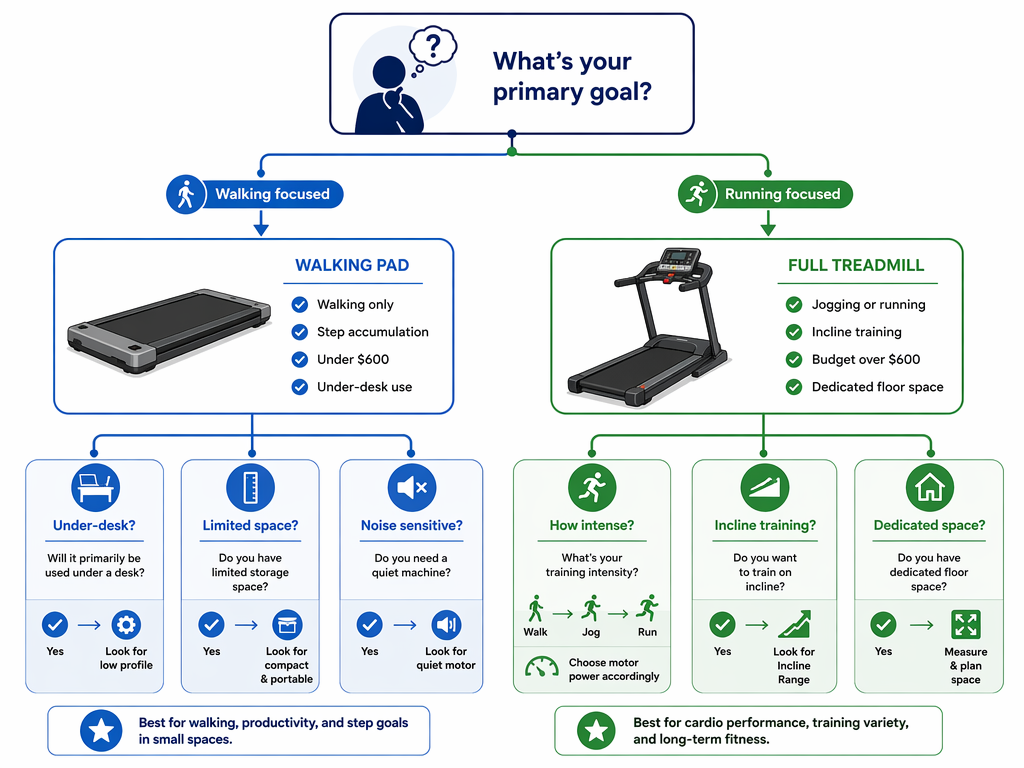
For a broader framework that helps you match equipment to your specific space, budget, and fitness goals, see our complete small-space home gym buyer's decision guide.
Hybrid Options: Compact Treadmills That Blur the Line
Not every machine fits neatly into the walking pad or treadmill category. A small but growing number of compact models are designed to serve both roles — and they deserve honest acknowledgment, even if they come with compromises on both sides.
The UREVO 2-in-1 is a notable example. It functions as a walking pad when the handlebar is folded down (low profile, under-desk use) and converts to a compact treadmill when the handlebar is raised, adding a display and speed controls. Its top speed of 6.2 mph is enough for a light jog, but its deck is still only 40 inches long — too short for a natural running stride. It is a better walking pad than most, and a worse treadmill than any dedicated model.
The WalkingPad C2 is available with an optional handlebar attachment that adds handrails and a remote control holder. Even with the handlebar, the C2 remains a walking pad at heart: 3.7 mph max speed, no incline, 47-inch deck. The handlebar improves safety and stability for walking, but it does not turn the C2 into a running machine.
Where do these hybrids fit in the decision framework?
- If your primary need is under-desk walking but you want the option to do occasional light jogging (under 6 mph, short duration), a hybrid like the UREVO 2-in-1 may be a reasonable compromise.
- If you plan to run regularly, do interval training, or progress to faster paces over time, a hybrid will limit you. Buy a proper treadmill with a 55-inch or longer deck and at least 2.5 CHP.
- If you are unsure which camp you fall into, err on the side of the treadmill. The hybrid's compromises are acceptable only if you are certain your activity level will never exceed a light jog.
For a broader look at compact, folding, and walking pad options organized by space constraint, see our best treadmill for small spaces roundup.
The Verdict: Match the Machine to Your Actual Habit
Walking pads and treadmills are not competing products. They are tools for different jobs, and the only way to choose correctly is to be honest about what job you actually need done.
Buy a walking pad if: you want to increase your daily step count while working at a desk or watching TV, you have no interest in jogging or running, your space cannot accommodate a permanent treadmill footprint, and your budget is under $600. The walking pad will serve you well for years if you stay within its design envelope.
Buy a treadmill if: you want to jog, run, do hill intervals, or follow structured cardio programs; you have a dedicated floor area of roughly 7 feet by 3 feet (or can use a folding model); and you want a machine that will last 10 to 15 years with a lifetime frame and motor warranty. Even if you only walk today, the treadmill gives you room to grow — and it costs less than buying a walking pad now and a treadmill later.
This result comes from one real apartment under the stated conditions — it is a strong signal, not a guarantee your space will measure identically.
Builds this evidence supports
Cable Machine Alternatives That Save Space and Money
Compare the best cable machine alternatives for home gyms – from resistance bands and pulley systems to suspension trainers and compact digital units – and find the right option for your space and budget.
How to Choose a Compact Home Gym That Works for Your Space, Budget, and Noise Tolerance
This article provides a structured decision framework for apartment dwellers and small-space residents to match their specific floor footprint, noise sensitivity, and budget to the most suitable compact home gym strategy — whether that's an all-in-one machine, modular build, smart digital system, or band/bodyweight setup.
The Garage Gym Reality Check: What Equipment Actually Fits in a Single-Car Garage
Most garage gym guides assume a two-car space. This article uses real dimensions, real equipment footprints, and three layout templates to show what fits—and what doesn't—in a single-car garage (10x20 to 12x20 ft).
Spot something off?
If this result didn't match your own space, let us know — floor-damage and noise claims carry real deposit-risk consequences if we get them wrong.