How to Choose a Small Treadmill for Your Home: Match the Storage Type to Your Space
This guide helps apartment dwellers and small-space homeowners select a treadmill based on its storage mechanism — flat-fold, vertical-fold, double-fold, or auto-fold — rather than just budget or motor power. Matching the storage type to your specific living situation is the key to ensuring your treadmill gets used, not abandoned.
- Budget tier
- under $1,000
- Space type
- apartment
Items included: —
Why “Small” Means Different Things for Different Spaces
When you search for a “small treadmill for home,” nearly every review site will show you a ranked list of compact models sorted by price, motor power, or max speed. That approach misses the single most important factor for apartment dwellers and small-space homeowners: how the treadmill stores between uses.
A treadmill that technically fits your square footage but requires you to wrestle a 156-pound machine into a closet every morning will end up collecting dust within two weeks. The real question isn't “Is this treadmill small enough?” It's “Does this treadmill's storage mechanism match the way I actually live?”
This guide is not another “best of” listicle. It is a decision framework built around four distinct storage types — flat-fold, vertical-fold, double-fold, and auto-fold. By the end, you will know exactly which storage type fits your specific space constraint, and you will have a shortlist of tested models that match it.
If you are still in the early research phase and want a broader overview of treadmill buying, our Best Treadmill for Home: Tiered Picks by Budget, Space, and Subscription Cost guide covers general categories. This article is the deep dive into storage-type selection.
The Four Storage Types for Small Treadmills
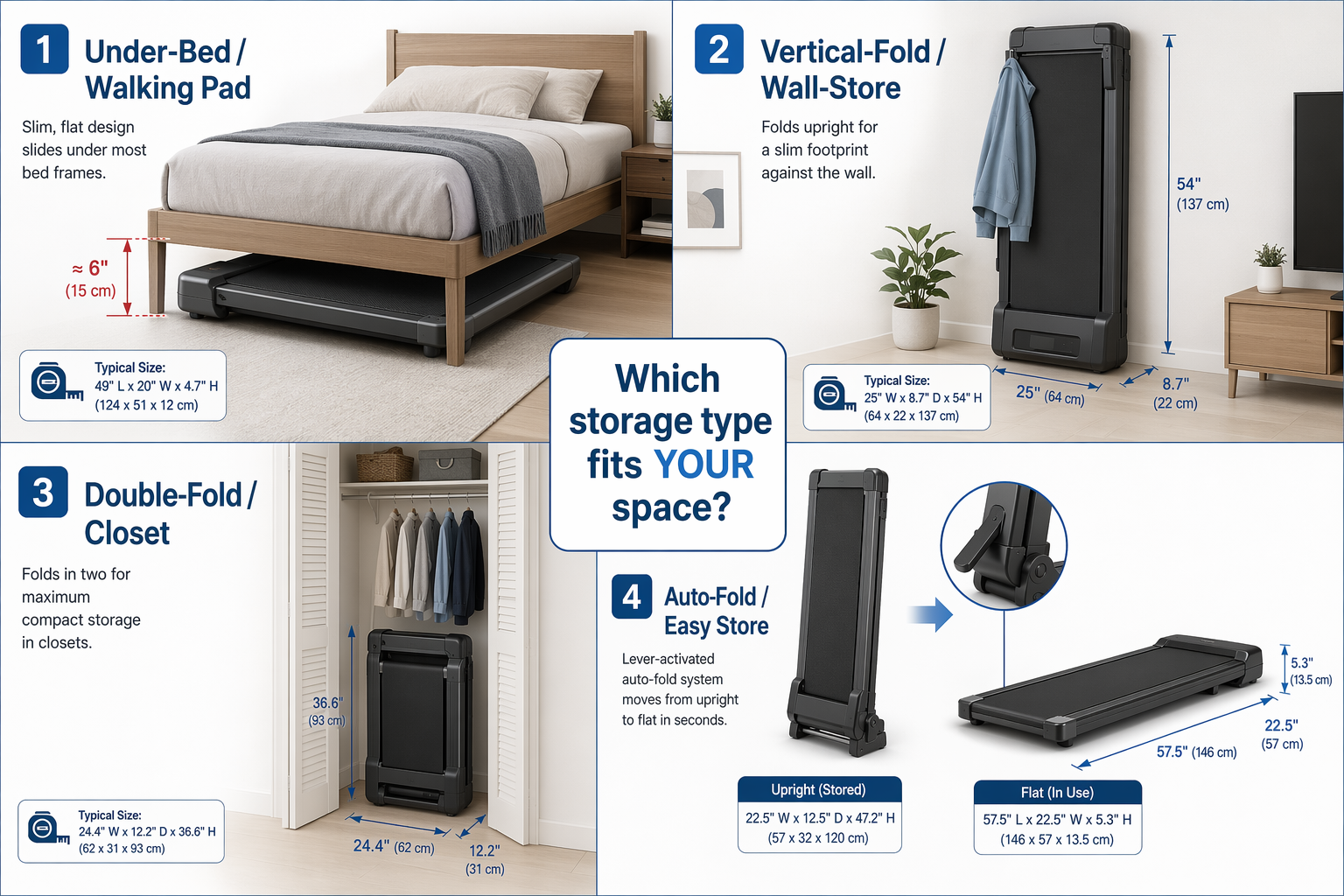
Every compact treadmill on the market falls into one of four storage categories. The differences go beyond folded dimensions — each type has a distinct daily-use friction level, a different space requirement, and a specific user scenario where it makes sense.
Flat-Fold (Under-Bed Storage)
Flat-fold treadmills collapse to a low profile — typically under 10 inches tall — and slide under a bed, couch, or desk. These are the most space-efficient option for people who have zero floor space to dedicate to a treadmill.
Key examples from tested models:
- WalkingPad R2 Pro: folds to 6.3 inches tall, weighs 80 lbs, max speed 7.45 mph. Multiple testers confirm this as the most storage-flexible option in the category.
- DeerRun A1 Pro: folds to 8 inches tall, weighs 86 lbs, has a 3 HP motor and 350-lb weight capacity — the strongest power-to-compactness ratio in its class per TreadmillReviews.com testing.
- UREVO Strol 2E: folds to 5.1 inches tall, weighs 59 lbs, but has a 40-inch deck and max speed of 6.2 mph — best for walkers and light joggers.
Vertical-Fold (Against-Wall Storage)
Vertical-fold treadmills lift the deck upright so the machine stands on its end, typically occupying a footprint of about 10 square feet against a wall. These are the right choice when you have a corner or wall section you can dedicate to storage but cannot leave the treadmill fully assembled on the floor.
The Horizon T101 folds to 46 inches long by 34 inches wide by 61 inches high when upright, weighs 180 lbs, and has a 20-inch by 55-inch deck with a lifetime frame and motor warranty. The Horizon 7.0 AT folds to 44 inches long and offers a 20-inch by 60-inch deck with a 3.0 HP motor and 15% incline.
Double-Fold (Closet Storage)
Double-fold treadmills fold in two places — the deck folds up, and then the entire unit folds again to create a compact package that can fit into a standard closet. This is the most storage-dense option but comes with a weight penalty.
The WalkingPad X25 weighs 104 lbs, has a 47.24-inch deck, a top speed of 10 mph, and a 300-lb weight capacity. Its two-stage fold creates a package small enough for most closets, but at 104 lbs, moving it in and out daily requires real effort.
Auto-Fold (Lever-Based Storage)
Auto-fold treadmills use a gas-shock or lever mechanism to fold the deck down flat with minimal effort. These are the heaviest and most expensive option, but they offer the lowest daily-use friction — you press a lever and the treadmill folds or unfolds in seconds.
The Echelon Stride-6S weighs 156 lbs, has a 3 HP brushless motor, a 20.5-inch by 60-inch deck, a top speed of 12.5 mph, and 12 incline levels. Runner's World testing confirms it can be stored vertically and requires no assembly. The tradeoff is clear: you get a full-size running experience with near-zero setup time, but you need floor space for the unfolded footprint of 64.25 inches by 32 inches.
Decision Framework: Which Storage Type Fits Your Space?
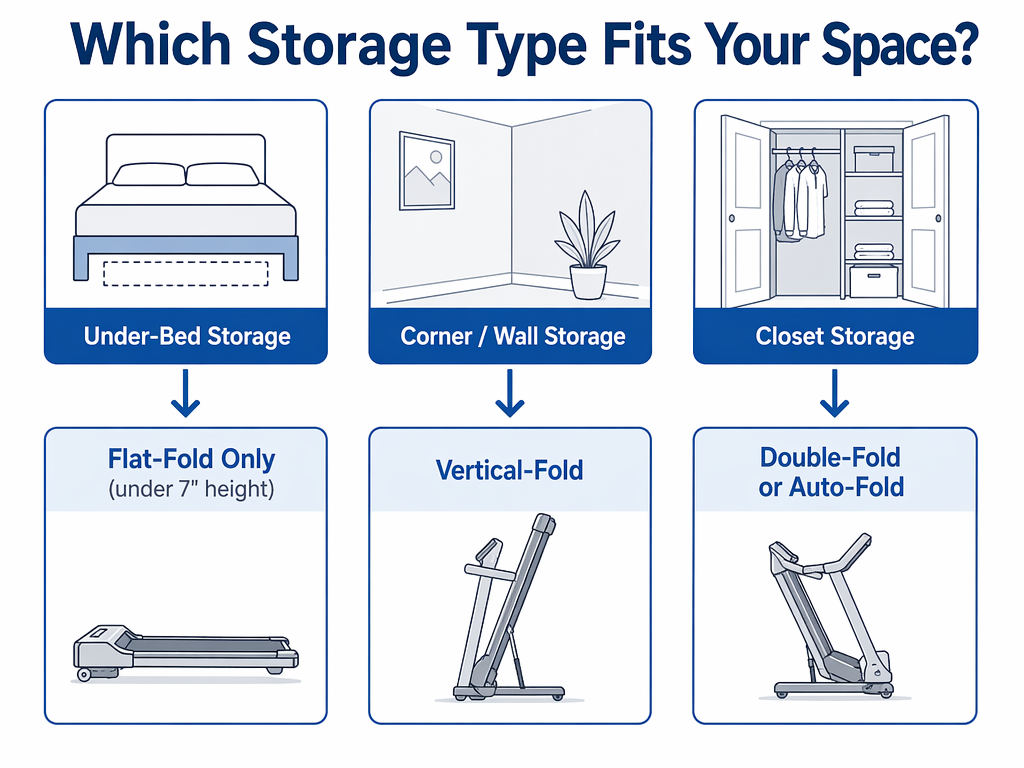
The fastest way to narrow your options is to identify your primary storage constraint. Use the table below to match your living situation to the storage type that will actually work day after day.
| Your Space Constraint | Storage Type | Why It Works | Example Models |
|---|---|---|---|
| Under-bed clearance of 7+ inches | Flat-fold | Slides completely out of sight; zero floor space used during storage | WalkingPad R2 Pro, DeerRun A1 Pro, UREVO Strol 2E |
| Corner or wall section you can dedicate to storage | Vertical-fold | Stands upright against wall; takes ~10 sq ft of wall space | Horizon T101, Horizon 7.0 AT |
| Closet with 24+ inches of depth | Double-fold | Folds into a compact package that fits in a standard closet | WalkingPad X25 |
| Dedicated floor space for unfolded use; want minimal daily effort | Auto-fold | Lever-based fold/unfold in seconds; full-size deck and motor | Echelon Stride-6S |
If you are still unsure, ask yourself one question: Where will this treadmill live when I am not using it? If the answer is “under my bed,” you need a flat-fold model under 7 inches tall. If the answer is “in the corner of my living room,” a vertical-fold model is your best bet. If the answer is “in a closet,” look at double-fold options. If you have the floor space and want the least friction, go auto-fold.
Key Spec Tradeoffs: Deck Length vs. Folded Height vs. Motor Power
Once you have identified your storage type, the next step is understanding the tradeoffs within that category. No compact treadmill delivers a full-size deck, a powerful motor, and a paper-thin folded profile. Every model makes compromises, and knowing which compromises matter for your use case is the difference between a purchase you love and one you regret.
| Model | Storage Type | Folded Height | Deck Length | Motor Power | Max Speed | Weight Capacity | Weight |
|---|---|---|---|---|---|---|---|
| UREVO Strol 2E | Flat-fold | 5.1" | 40" | 2.5 CHP | 6.2 mph | 265 lbs | 59 lbs |
| WalkingPad R2 Pro | Flat-fold | 6.3" | 47" (approx) | N/A | 7.45 mph | 240 lbs | 80 lbs |
| DeerRun A1 Pro | Flat-fold | 8" | 54.1" | 3.0 HP | 10 mph | 350 lbs | 86 lbs |
| WalkingPad X25 | Double-fold | N/A (closet-fit) | 47.24" | N/A | 10 mph | 300 lbs | 104 lbs |
| Horizon T101 | Vertical-fold | 46"L (upright) | 55" | N/A | N/A | N/A | 180 lbs |
| Horizon 7.0 AT | Vertical-fold | 44"L (upright) | 60" | 3.0 HP | 12 mph | 325 lbs | N/A |
| Echelon Stride-6S | Auto-fold | 64.25"L (unfolded) | 60" | 3.0 HP brushless | 12.5 mph | 300 lbs | 156 lbs |
The pattern is clear: the flattest fold (UREVO Strol 2E at 5.1 inches) comes with the shortest deck and lowest motor power. The DeerRun A1 Pro trades an extra 1.7 inches of folded height for a 54.1-inch deck and a 3 HP motor that supports runners up to 350 lbs. The Echelon Stride-6S offers a full 60-inch deck and 12.5 mph top speed but requires significant floor space and weighs 156 lbs.
Noise and Floor Protection for Apartment Living
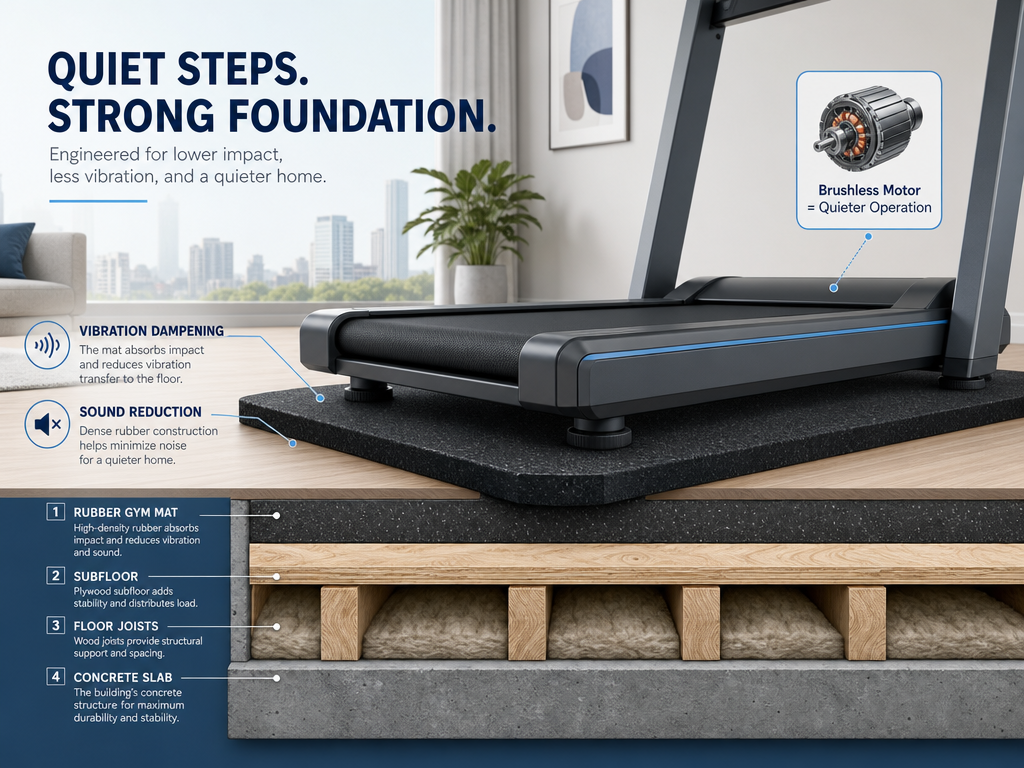
If you live in an apartment or condo, noise transmission to downstairs neighbors is a real concern. A treadmill running at 6 mph generates impact and vibration that travels through floor joists. Two factors determine how much of that noise reaches your neighbors: the motor type and the floor protection you use.
Brushless Motors Are Quieter
Brushless DC motors run more quietly and efficiently than traditional brushed motors because they have fewer moving parts and generate less friction. The Echelon Stride-6S uses a 3 HP brushless motor, and the Sunny Health & Fitness Interactive Slim Treadmill also uses a 2.0 HP brushless motor. If noise is a primary concern, prioritize models with brushless motors.
A Rubber Gym Mat Is Non-Negotiable
A high-density rubber gym mat (at least 6mm thick) serves two purposes: it protects your floor from scratches and sweat, and it dampens vibration before it reaches the subfloor. Without a mat, the treadmill's frame transmits impact directly to the floor, which amplifies noise in the unit below. A mat is a $30 to $60 investment that makes a measurable difference in neighbor relations.
For a full breakdown of flooring, noise reduction, and other small-space considerations, see our Best Home Fitness Equipment for Small Spaces: A Space-Tiered Buying Guide.
Recommendation Tiers by Storage Type
Based on the storage-type decision framework, spec tradeoffs, and noise considerations, here are the best models for each space scenario.
Best Flat-Fold for Under-Bed Storage: WalkingPad R2 Pro
At 6.3 inches folded height and 80 lbs, the WalkingPad R2 Pro is the most storage-flexible option verified by multiple testers. It slides under virtually any bed frame, supports running up to 7.45 mph, and weighs little enough that one person can pull it out and push it back. The tradeoff is a 240-lb weight capacity and a shorter deck that is better suited to jogging than full-speed running.
Best Flat-Fold for Runners: DeerRun A1 Pro
If you need a flat-fold treadmill that can handle serious running, the DeerRun A1 Pro is the strongest option in its category. It folds to 8 inches tall — still slim enough for most under-bed clearance — but packs a 3 HP motor, a 54.1-inch deck, and a 350-lb weight capacity. TreadmillReviews.com testing confirms it has the best power-to-compactness ratio among flat-fold models.
Best Vertical-Fold for Wall Storage: Horizon T101
The Horizon T101 folds to 46 inches long and stands upright against a wall with a minimal footprint. It has a 20-inch by 55-inch deck and a lifetime frame and motor warranty, which is rare at this price point. The 180-lb weight makes it harder to move than flat-fold models, but if you have a dedicated wall spot, you only need to move it once.
Best Double-Fold for Closet Storage: WalkingPad X25
The WalkingPad X25 is the only widely tested double-fold treadmill that fits in a standard closet. Its two-stage fold creates a compact package, and its 47.24-inch deck and 10 mph top speed make it capable for most runners. The 104-lb weight is the main drawback — moving it in and out daily requires effort. This model is best for users who store the treadmill in a closet and only pull it out a few times per week.
Best Auto-Fold for Low-Friction Daily Use: Echelon Stride-6S
The Echelon Stride-6S is the premium choice for anyone who has the floor space and wants the least daily friction. Its lever-based auto-fold mechanism lets you transition from storage to use in seconds. The 60-inch deck, 3 HP brushless motor, and 12.5 mph top speed deliver a full-size running experience. Runner's World testing confirms it stores vertically and requires no assembly. The 156-lb weight and $1,000+ price tag are the tradeoffs.
Related Reading
This guide focused specifically on matching treadmill storage type to your space. For broader context on treadmill buying — including budget tiers, subscription costs, and motor comparisons — see our Best Treadmill for Home: Tiered Picks by Budget, Space, and Subscription Cost guide.
If you are planning a complete small-space home gym — not just a treadmill — start with The Complete Small-Space Home Gym Buyer's Decision Guide: Match Equipment to Your Space, Budget, and Goals for a step-by-step planning framework.
Some links on this page are affiliate links — they may earn us a commission at no extra cost to you. Our tier and tests are decided before we ever check which links pay; see our full affiliate disclosure.
Spot something off?
Noise and floor-damage claims carry real deposit-risk consequences if we get them wrong — tell us if your experience with this build didn't match what's above.