
Best Treadmill for Home: Tiered Picks by Budget, Space, and Subscription Cost
A structured buyer's guide for home treadmill shoppers comparing options across the $600–$3,500 range — organized by user type and use intensity, with full subscription cost transparency so you can see the true 3-year cost before you buy.
Why Most Treadmill Roundups Fail Buyers
Most treadmill roundups are built around a simple ranked list: best overall, best budget, best for runners. That structure looks useful until you realize what it leaves out.
The biggest omission is subscription cost. When you buy a NordicTrack, Peloton, or Echelon treadmill, the sticker price is not what you'll actually pay. iFit runs $39 per month. Peloton's All-Access membership runs $44–$50 per month. Over three years, those fees add $1,400–$1,800 or more to your total spend — a figure almost never shown in the comparison tables that rank these machines.
The second omission is storage mechanics. Most roundups label a treadmill as "folding" without explaining that there are two fundamentally different fold types — one that lets you slide the machine under a bed, and one that simply tilts the deck upright while still occupying most of your floor. For apartment buyers, this distinction is the entire decision.
The third omission is user-type matching. A walker, a beginner jogger, and a serious runner have different motor, deck, and durability requirements. A ranked list that leads with the best overall machine for a 40-miles-per-week runner is useless for someone who wants to walk 30 minutes a day.
This guide addresses all three. Every recommendation is anchored to a specific user type, every product that requires a subscription shows the monthly cost and the 3-year total, and the space planning section draws a hard line between flat-fold and vertical-fold storage.
Quick-Pick Table: Best Treadmill by User Type
Use this table to find your starting point. Each pick is matched to a specific use case and budget reality, not just a generic performance ranking.
| User Type | Recommended Pick | Price (approx.) | Subscription Required? | One-Line Rationale |
|---|---|---|---|---|
| Walker / light jogger (budget) | Horizon T101 | ~$649 | No | Adequate deck and motor for walking and occasional jogging; no ongoing fees |
| Walker / light jogger (value) | Sole F63 | ~$1,199 | No | Lifetime frame/motor warranty, full running deck, no subscription — best durability per dollar |
| Regular runner (no subscription) | Horizon 7.0 AT | ~$1,099 on sale | No | Full running capability, grip-based speed controls, works with Zwift and third-party apps |
| Regular runner (subscription OK) | NordicTrack Commercial 1750 | ~$2,499 | Yes — iFit $39/mo | Most consistently top-rated overall pick across major testing sources; auto-adjusts with iFit |
| Studio class experience | Peloton Tread | ~$3,495 | Yes — $44–50/mo required | Best live and on-demand class library; note: severely limited without an active subscription |
| Small space / apartment | Echelon Stride 6 | ~$1,599 | Optional — $40/mo | Only full-size treadmill that folds flat to ~12 inches deep and slides under a bed |
| Budget buyer (under $1,000) | Bowflex T6 | ~$999 on sale ($1,299 MSRP) | Optional — JRNY $20/mo | Strong incline range and solid build at sale price; verify current pricing before buying |
| Subscription-free buyer | Horizon 7.0 AT or Sole F63 | ~$1,000–$1,299 | No | Both function fully without any paid service; built-in programs included |
Under $800: Best Budget Pick — Horizon T101
The Horizon T101 is the most defensible entry-level pick for buyers who primarily want to walk or jog occasionally and are not ready to commit $1,000 or more. At around $649, it delivers a 20" × 55" deck, a 2.5 CHP motor, and a 300 lb weight capacity — with a lifetime frame and motor warranty that is unusual at this price.
It folds vertically, which reduces the in-use footprint when stored but does not allow under-bed storage. The console is basic: speed, incline, and a few preset programs. There is no subscription required and no screen beyond a simple display.
Where it falls short: the 55-inch deck is adequate for walking and short-stride jogging but is at the lower boundary for running. The 2.5 CHP motor handles moderate use but is not designed for sustained high-speed running or high-mileage weeks. If you plan to run more than occasionally, the mid-range tier is a better fit.
- Best for: walking, light jogging, beginners building a cardio habit
- Deck: 20" × 55" — adequate for walking and short-stride jogging
- Motor: 2.5 CHP — appropriate for walking and light use
- Subscription: none required; no connected platform
- Warranty: lifetime frame and motor, limited parts and labor
- Not suited for: sustained running, high-mileage training, users over 6 feet tall
$800–$1,500: Best Value Without a Subscription — Sole F63 and Horizon 7.0 AT
This is the tier where most home treadmill buyers will find the right balance. Both the Sole F63 and the Horizon 7.0 AT offer full running capability, folding designs, no mandatory subscription, and lifetime frame and motor warranties — at prices that leave room in the budget for actual running shoes.
The Sole F63 is the more durability-focused pick. Its warranty is among the strongest in the category: lifetime coverage on the frame and motor, three years on parts, deck, and electronics, and one year on labor. The deck is 20" × 60", which is long enough for most runners. It connects to third-party apps via Bluetooth but does not require any paid service to function fully.
The Horizon 7.0 AT takes a different approach to usability. Its standout feature is grip-based speed and incline controls — knobs built into the handrails that let you adjust pace without breaking stride or reaching for the console. It is compatible with Zwift, Peloton's app, and other third-party platforms via Bluetooth, which means you can bring your own workout content without paying the machine's manufacturer a monthly fee.
| Spec | Sole F63 | Horizon 7.0 AT |
|---|---|---|
| Price (approx.) | ~$1,199 | ~$1,099 on sale |
| Motor | 3.0 CHP | 3.5 CHP |
| Deck size | 20" × 60" | 20" × 60" |
| Max speed | 12 mph | 12 mph |
| Max incline | 15% | 15% |
| Fold type | Vertical fold | Vertical fold |
| Subscription required | No | No |
| Built-in programs | Yes | Yes |
| Third-party app compatibility | Bluetooth (Zwift, etc.) | Bluetooth (Zwift, Peloton app, etc.) |
| Warranty — frame/motor | Lifetime | Lifetime |
| Warranty — parts | 3 years | 3 years |
| Weight capacity | 325 lbs | 325 lbs |
The Bowflex T6 is worth a mention in this tier as an incline-value option. It regularly sells for around $999 — down from a $1,299 MSRP — and includes a 0–15% incline range and JRNY compatibility at $20/month (optional, not required). The sale pricing pattern is consistent, but you should verify the current price before buying rather than assuming the discount is permanent.
$1,500 and Up: Premium Picks — NordicTrack 1750, Peloton Tread, Echelon Stride 6
The premium tier is where the subscription question becomes the central buying decision. Each of these machines has a genuinely strong hardware case — but the ongoing cost and the degree of subscription dependency differ significantly.
NordicTrack Commercial 1750 — Best Overall (With Subscription)
The NordicTrack Commercial 1750 is the most consistently top-rated home treadmill across major testing sources in 2026. It earns high marks for its 4.25 CHP motor, a 14-inch tilting touchscreen, a 22-inch wide belt (measured at 21.5 inches in OutdoorGearLab's lab testing), a 60-inch deck, and a -3% to 15% incline range that includes decline capability.
The iFit subscription ($39/month) unlocks the machine's best features: automatic speed and incline adjustment during instructor-led workouts, outdoor route simulation, and the full class library. Without it, the 1750 runs in a basic manual mode — functional, but significantly reduced. Budget $39/month explicitly when you price this machine.
- Who it's for: Regular runners and serious home gym users who want guided workouts with automatic adjustment and are willing to pay for the subscription
- Price: ~$2,499 + $39/month iFit (3-year total: approximately $3,905 including subscription)
- Motor: 4.25 CHP — appropriate for high-mileage running
- Deck: 60" × 21.5" (tested) — full running length
- Noise: approximately 62 dB at 18 inches (per OutdoorGearLab measurements)
- Fold type: Vertical fold — deck tilts upright but retains floor footprint
Peloton Tread — Best Studio Class Experience (Subscription Required to Function)
The Peloton Tread delivers the best live and on-demand studio class experience available on a home treadmill. The 23.8-inch HD touchscreen, the instructor quality, and the community features are genuinely differentiated from anything in the mid-range tier.
The subscription dependency, however, is more severe here than on any other machine in this guide. Without an active All-Access membership ($44–$50/month), the Peloton Tread is limited to a basic manual mode that removes most of what makes the hardware worth buying. This is not a minor limitation — it is a structural design choice.
Without a subscription, the Tread is essentially bricked into a basic manual mode, lacking the standalone versatility of the Horizon.
- Who it's for: Buyers who genuinely want the Peloton class library and community features, and who will maintain the subscription for the life of the machine
- Price: ~$3,495 + $44–50/month All-Access (3-year total: approximately $5,000–$5,300)
- Motor: 3.5 CHP
- Deck: 59" × 20"
- Noise: approximately 65 dB at 18 inches — among the loudest tested in its class
- Fold type: Does not fold — fixed footprint
- Not suited for: Buyers who may cancel their subscription, apartment dwellers sensitive to noise, or buyers who want a machine that functions fully without an ongoing fee
Echelon Stride 6 — Best for Small Spaces (Flat-Fold Storage)
The Echelon Stride 6 earns its place in the premium tier not through raw performance but through a storage capability no other full-size treadmill on the major roundups matches: it folds flat to approximately 10–12 inches deep and can slide under a standard bed frame or stand upright in a closet.
For apartment buyers or anyone with a dedicated space that doubles as living space, this is a fundamentally different product category from a vertical-fold machine. The Echelon Stride 6 also measured as the quietest treadmill in its class in OutdoorGearLab's testing at approximately 60 dB — a meaningful advantage in shared-wall living situations.
- Who it's for: Apartment dwellers and small-space users who need a full-size treadmill that genuinely disappears when not in use
- Price: ~$1,599 + optional Echelon Premier subscription at $40/month
- Folded dimensions: approximately 12" deep × 31.5" wide × 64.75" tall — slides under a bed
- Noise: approximately 60 dB at 18 inches — quietest in its class per OutdoorGearLab measurements
- Subscription: optional, not required for full manual operation
- Deck: 20" × 55" — adequate for jogging; shorter than the Sole F63 or NordicTrack 1750 for tall runners
| Model | Price | Motor (CHP) | Deck (L × W) | Fold Type | Subscription | Noise (dB) |
|---|---|---|---|---|---|---|
| NordicTrack Commercial 1750 | ~$2,499 | 4.25 | 60" × 21.5" | Vertical fold | iFit $39/mo | ~62 |
| Peloton Tread | ~$3,495 | 3.5 | 59" × 20" | No fold | All-Access $44–50/mo | ~65 |
| Echelon Stride 6 | ~$1,599 | 3.0 | 55" × 20" | Flat fold (~12" deep) | Optional $40/mo | ~60 |
The Real Cost: Subscription Transparency Table
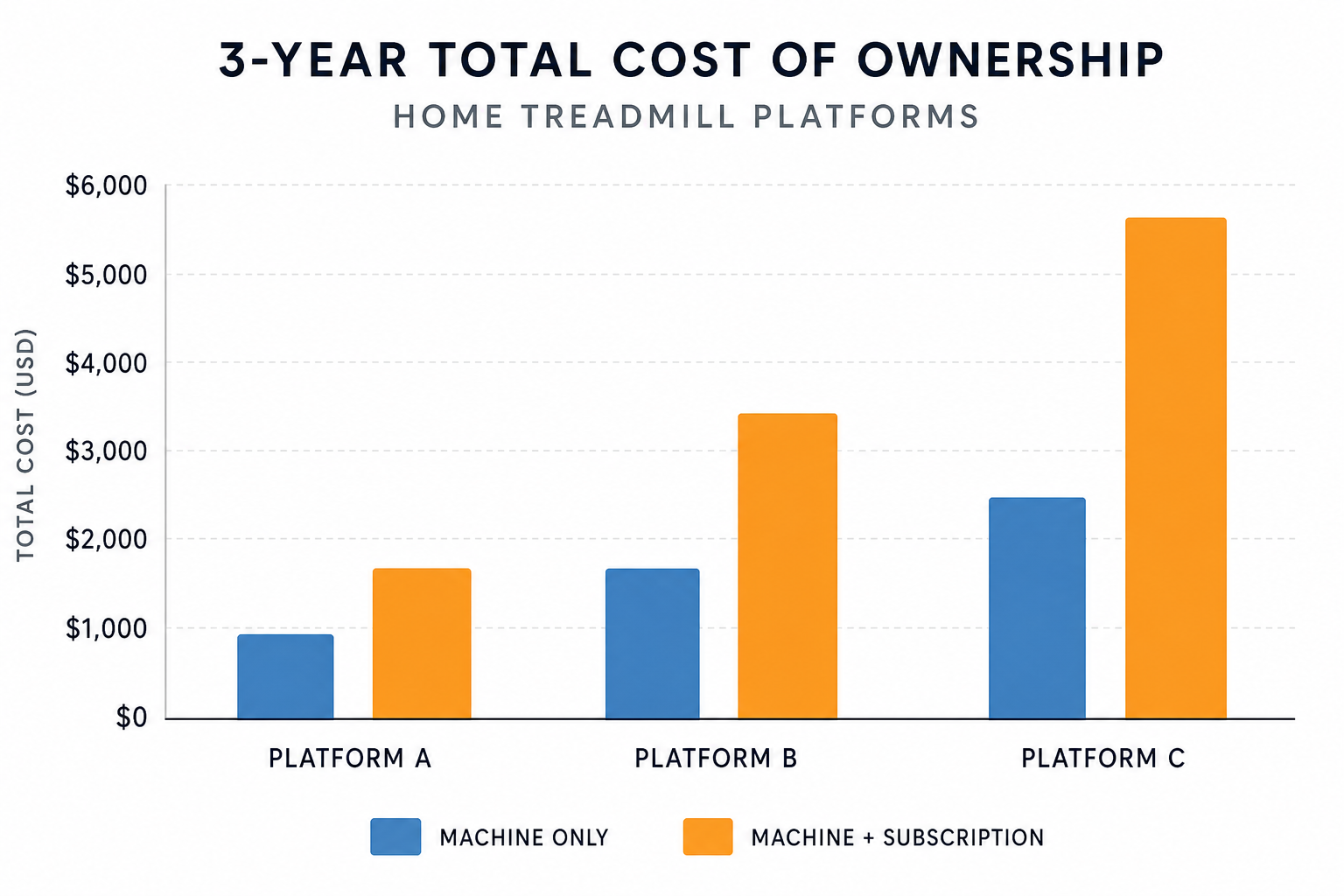
The most important number in any treadmill purchase is not the sticker price — it is the 3-year total cost of ownership. For machines tied to mandatory or near-mandatory subscriptions, that number can be dramatically higher than the price tag suggests.
The table below shows what you will actually spend over three years, combining the machine's purchase price with cumulative subscription fees. These figures use street prices and Q2 2026 subscription rates — verify current pricing before you buy, as subscription rates change.
| Platform / Machine | Machine Price | Monthly Sub Cost | Annual Sub Cost | 3-Year Sub Total | 3-Year TCO |
|---|---|---|---|---|---|
| Peloton Tread (All-Access) | ~$3,495 | $44–50 | $528–600 | $1,584–1,800 | ~$5,079–5,295 |
| NordicTrack 1750 (iFit) | ~$2,499 | $39 | $468 | $1,404 | ~$3,903 |
| Echelon Stride 6 (Premier) | ~$1,599 | $40 | $480 | $1,440 | ~$3,039 |
| Bowflex T6 (JRNY) | ~$999 | $20 | $240 | $720 | ~$1,719 |
| Horizon 7.0 AT (no sub) | ~$1,099 | $0 | $0 | $0 | ~$1,099 |
| Sole F63 (no sub) | ~$1,199 | $0 | $0 | $0 | ~$1,199 |
| Horizon T101 (no sub) | ~$649 | $0 | $0 | $0 | ~$649 |
To put those numbers in context: a Peloton Tread buyer who maintains an All-Access subscription for five years reaches a total spend that testing sources have documented above $5,600 — compared to roughly $2,400 for a subscription-free Horizon over the same period. That gap is not a footnote; it is a second treadmill.
A note on Zwift: at $14.99/month, Zwift is the most affordable subscription option and works with most Bluetooth-enabled treadmills including the Horizon 7.0 AT and Sole F63. However, Zwift does not auto-adjust treadmill speed or incline — it reads your pace but does not control the machine. iFit's auto-adjustment only works on iFit-enabled NordicTrack and ProForm machines.
Space Planning: Flat-Fold vs. Vertical-Fold (and Why It Matters)
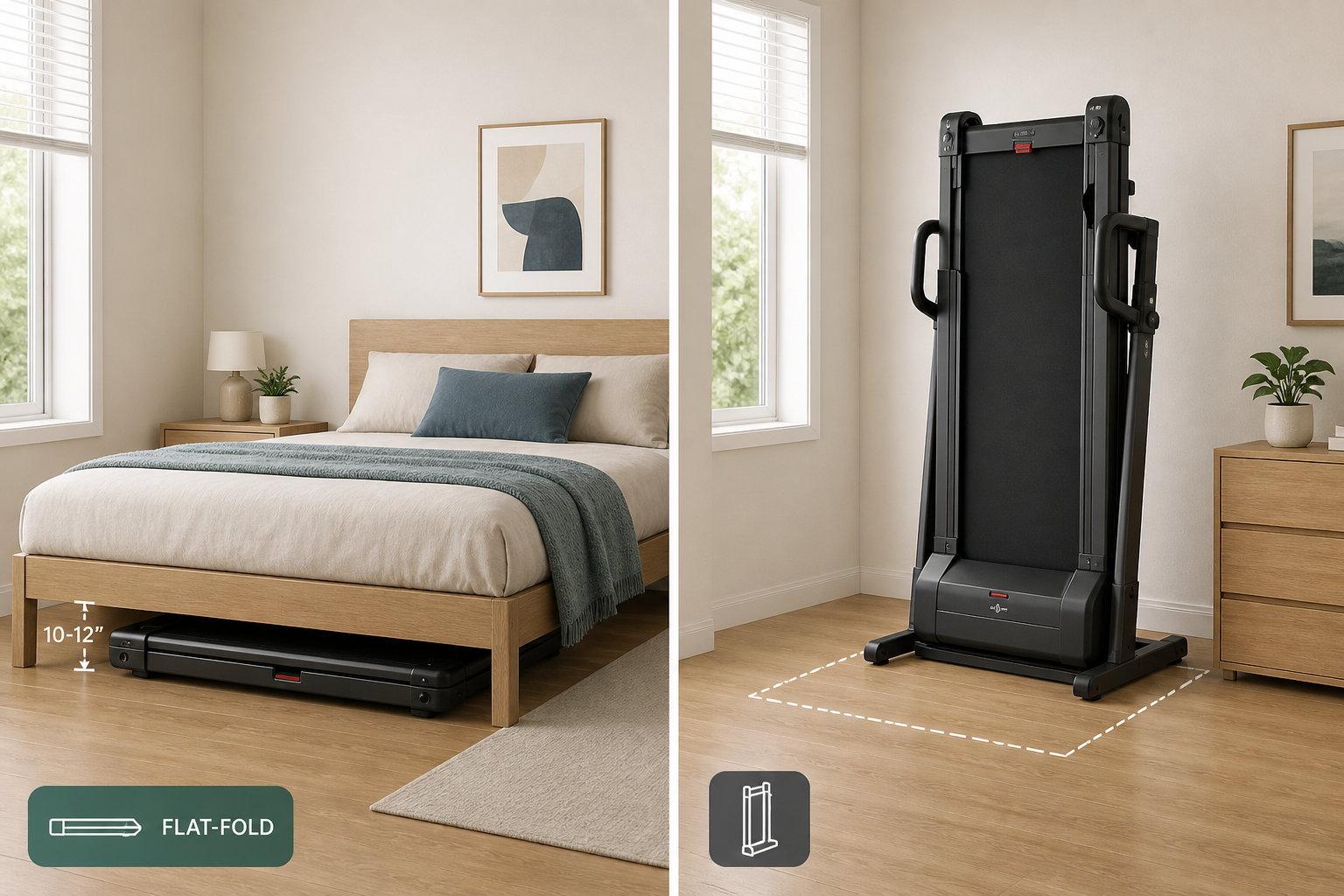
"Folding treadmill" covers two mechanically distinct storage configurations that have almost nothing in common for a small-space buyer. Treating them as interchangeable is one of the most common mistakes in treadmill research.
Flat-Fold: The Echelon Stride 6 Approach
A flat-fold treadmill folds the entire machine down to a low horizontal profile. The Echelon Stride 6 folds to approximately 12 inches deep and can slide under a standard bed frame or be stood upright in a closet. When stored, it occupies almost no visible floor space in a room.
This is the right choice for apartment users who share living space with the machine. It is the only full-size treadmill on the major roundup lists that achieves genuine under-bed storage.
Vertical-Fold: The Sole F63 and Horizon 7.0 AT Approach
A vertical-fold treadmill tilts the running deck upright at roughly 45–90 degrees. This reduces the length of the machine's footprint but does not eliminate it. A folded Sole F63 or Horizon 7.0 AT still occupies a large rectangular floor area — typically 4–5 feet wide and 2–3 feet deep — and cannot be stored under furniture or pushed against a wall without the upright deck protruding significantly.
Vertical-fold machines are well-suited for dedicated workout rooms or garages where you want to recover some floor space but do not need the machine to disappear entirely. They are not a practical solution for a small apartment bedroom.
| Storage Type | Example Machine | Stored Dimensions (approx.) | Under-Bed Storage? | Best For |
|---|---|---|---|---|
| Flat-fold | Echelon Stride 6 | 12" deep × 31.5" wide × 64.75" tall | Yes | Apartments, shared living spaces |
| Vertical-fold | Sole F63 | Deck upright — still ~35" wide footprint | No | Dedicated workout rooms, garages |
| Vertical-fold | Horizon 7.0 AT | Deck upright — similar footprint to F63 | No | Dedicated workout rooms, garages |
| No fold | Peloton Tread | Full in-use footprint always | No | Permanent dedicated space only |
| Room Dimension | Minimum Requirement | Notes |
|---|---|---|
| Length (in-use) | Machine length + 3 feet rear clearance | For a 70-inch deck machine, plan at least 11–12 feet total room length |
| Width (in-use) | Machine width + 2 feet each side | Allows safe dismount if needed |
| Ceiling height | Your height + 15 inches minimum | Accounts for stride elevation; critical on raised platforms |
| Storage footprint (flat-fold) | ~12" deep × 32" wide | Echelon Stride 6 — fits under standard bed frame |
| Storage footprint (vertical-fold) | ~35–40" wide × 30" deep (folded) | Sole F63, Horizon 7.0 AT — deck tilts up, base remains |
Spec Decoder: What the Numbers Actually Mean for Your Use
Treadmill spec sheets list motor CHP, deck dimensions, incline percentages, and warranty tiers — but rarely explain what those numbers mean relative to how you actually plan to use the machine. Here is what each spec translates to in practice.
Motor CHP: Match It to Your Use Intensity
CHP (continuous horsepower) is the motor's sustained output rating — not its peak. The practical thresholds, consistent with NordicTrack's own buying guidance and general industry standards, are:
- ~2.0–2.5 CHP: Walking and occasional light jogging. Adequate for the T101 and similar entry-level machines.
- ~2.5–3.0 CHP: Regular jogging and moderate running. The Sole F63 (3.0 CHP) and Horizon 7.0 AT (3.5 CHP) sit in this range.
- 3.0+ CHP: Regular running and sustained higher-speed use. The NordicTrack 1750 (4.25 CHP) is built for this.
- 4.0+ CHP: High-mileage running (20+ miles per week). Overkill for most home users, but appropriate for serious runners.
Deck Length: The Spec Budget Machines Cut First
Deck length is the dimension manufacturers trim first when reducing cost. The practical minimums by use type:
- 45–50 inches: Walking only. Acceptable for users under 5'8" with a shorter stride.
- 55 inches: Walking and jogging. The minimum for jogging; tight for tall users.
- 58–60 inches: Running. The standard for regular running; 60 inches is the target for anyone running at 6 mph or faster.
Deck Width: 20 Inches Is the Floor, Not the Goal
A 20-inch wide running surface is the practical minimum for most users. At higher speeds or with a wider natural gait, 22 inches is noticeably more comfortable and reduces the risk of stepping off the belt. Most mid-range and premium machines are 20–22 inches; budget machines often drop to 18 inches, which is workable for walking but constrained for running.
Warranty Tiers: What to Prioritize
Treadmill warranties are structured in layers. The frame and motor warranty matters most — these are the components most expensive to replace. Parts and electronics warranties cover the console, belt, and deck components that see regular wear.
| Warranty Tier | Frame / Motor | Parts / Electronics | Labor | Example Machines |
|---|---|---|---|---|
| Strong (best value) | Lifetime | 3–5 years | 1–2 years | Sole F63, Horizon T101, Horizon 7.0 AT |
| Good | 10–15 years | 2–3 years | 1 year | Many mid-range models |
| Limited (watch closely) | 2–5 years | 1–2 years | 90 days–1 year | Some budget and off-brand machines |
| Premium (subscription brands) | 10 years frame | Varies by model | 1 year | NordicTrack 1750, Peloton Tread |
Frequently Asked Questions
Do I need a subscription to use a home treadmill?
No — but it depends on the machine. Horizon and Sole treadmills function fully with no paid service. They include built-in workout programs and connect to third-party apps via Bluetooth, so you can use Zwift, the Peloton app, or any other platform you choose to pay for separately.
NordicTrack and ProForm machines work in basic manual mode without iFit, but the connected features — automatic adjustment, class library, route simulation — require the $39/month subscription. Peloton Tread is the most subscription-dependent option: without an active All-Access membership, the machine is limited to manual mode and loses most of its core functionality.
Will a treadmill fit in my space?
Measure both the in-use footprint and the stored footprint. In-use, plan for the machine's full length plus at least 3 feet of rear clearance — a safety requirement, not a preference. For a 70-inch deck machine, that means at least 11–12 feet of room length.
If you need the machine to genuinely disappear when not in use, only a flat-fold design like the Echelon Stride 6 achieves under-bed storage. Vertical-fold machines reduce their length but retain a significant floor footprint.
Can I actually run on a home treadmill, or are they just for walking?
Yes — but not every home treadmill is built for running. The Horizon T101 and similar budget machines are designed for walking and light jogging. For regular running at 6 mph or faster, you want a 60-inch deck, a 3.0+ CHP motor, and a 20-inch minimum belt width. The Sole F63, Horizon 7.0 AT, and NordicTrack 1750 all meet those thresholds.
What is the best treadmill under $1,000?
For walkers and light joggers: the Horizon T101 at around $649 is the most defensible choice — adequate specs, lifetime frame and motor warranty, no subscription.
For buyers who want running capability under $1,000: the Bowflex T6 regularly sells for around $999 on sale (down from a $1,299 MSRP) and offers a 15% incline range and solid build quality. Verify the current price before buying — the discount is consistent but not guaranteed. The Horizon 7.0 AT is sometimes available near $1,099 on sale, which puts it within reach of this budget with meaningfully better running specs.
One important note on calorie displays: treadmill console calorie counters are estimates. They do not account for individual differences in body composition, metabolism, or effort variation. Use them as a rough reference, not a precise measurement.
This result comes from one real apartment under the stated conditions — it is a strong signal, not a guarantee your space will measure identically.
Builds this evidence supports
Cable Machine Alternatives That Save Space and Money
Compare the best cable machine alternatives for home gyms – from resistance bands and pulley systems to suspension trainers and compact digital units – and find the right option for your space and budget.
How to Choose a Compact Home Gym That Works for Your Space, Budget, and Noise Tolerance
This article provides a structured decision framework for apartment dwellers and small-space residents to match their specific floor footprint, noise sensitivity, and budget to the most suitable compact home gym strategy — whether that's an all-in-one machine, modular build, smart digital system, or band/bodyweight setup.
The Garage Gym Reality Check: What Equipment Actually Fits in a Single-Car Garage
Most garage gym guides assume a two-car space. This article uses real dimensions, real equipment footprints, and three layout templates to show what fits—and what doesn't—in a single-car garage (10x20 to 12x20 ft).
Spot something off?
If this result didn't match your own space, let us know — floor-damage and noise claims carry real deposit-risk consequences if we get them wrong.