Best Treadmill for Small Spaces: Folding, Compact, and Walking Pad Options Compared
Apartment dwellers and small-space homeowners don't have to sacrifice running quality. We compare full folding treadmills, flat-folding designs, walking pads, and compact non-folding models with apartment-specific data on footprint, noise, and headroom.
The Space Problem: Why Standard Treadmills Don't Fit Small Homes
A standard treadmill occupies roughly 76 inches long by 35 inches wide — about 18.5 square feet of floor space. That's the footprint of a small sofa. But the real space requirement is larger. Manufacturers like NordicTrack recommend leaving at least 2 feet of clearance on each side and 6 feet of open space behind the belt. When you add those clearances, the total dedicated area balloons to roughly 7.5 feet by 14 feet — over 100 square feet of room that can't serve any other purpose during a workout.
For apartment dwellers, condo owners, and anyone working with a spare bedroom or a corner of the living room, that requirement is a non-starter. The good news is that treadmill design has adapted. Manufacturers now produce machines that fold vertically, fold flat enough to slide under a bed, or shrink the running surface to walking-only dimensions. The trade-offs are real — shorter belts, lower max speeds, smaller motors — but for many home users, these compromises are acceptable.
Category 1: Full Folding Treadmills That Store Vertically
Full folding treadmills are the most common solution for space-constrained buyers who still want a running-capable machine. These models use a hydraulic or gas-shock mechanism that allows the deck to fold up 90 degrees, reducing the floor footprint to roughly half when stored. Most include transport wheels so you can roll the folded unit against a wall or into a closet.
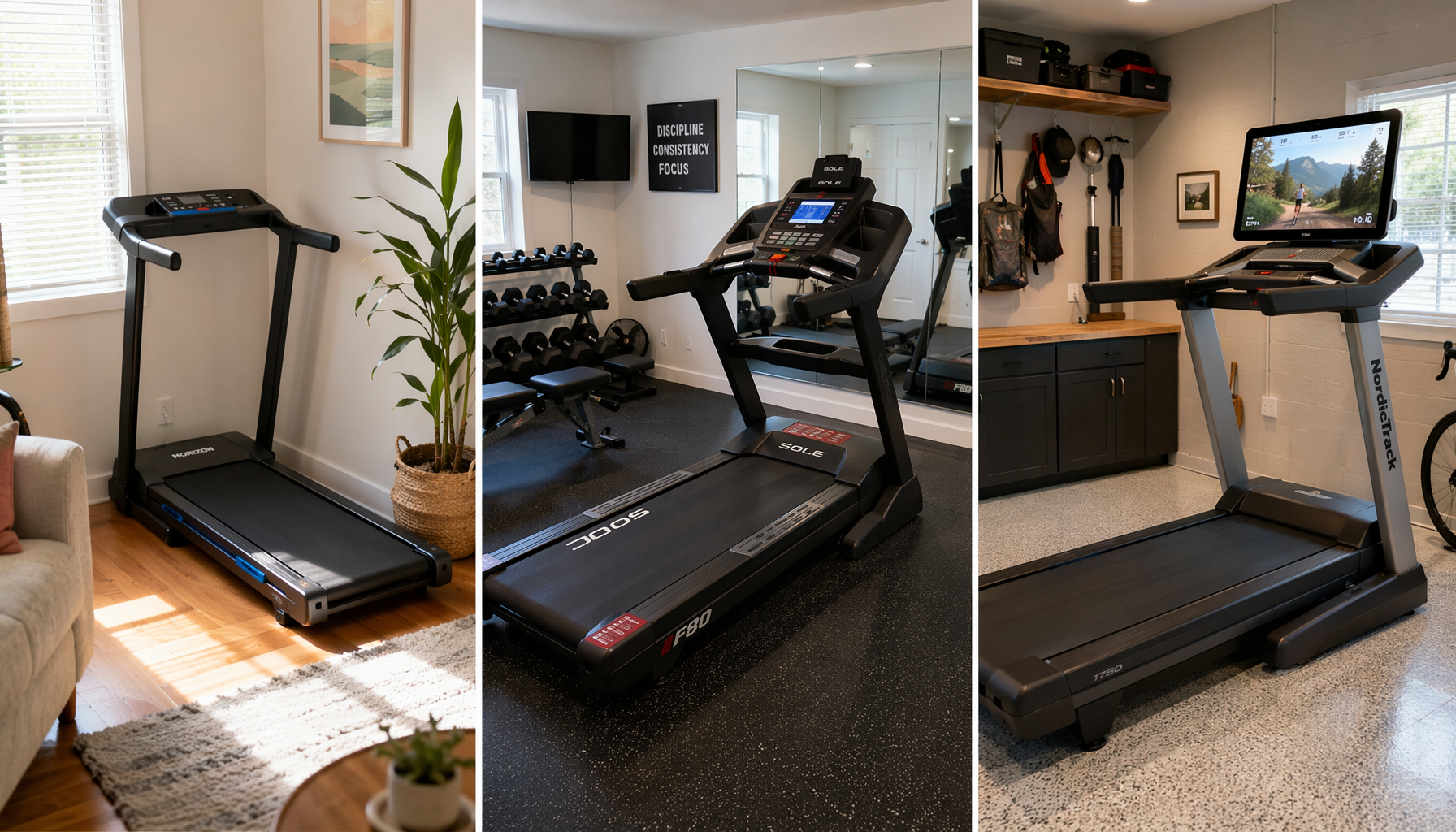
Three models dominate this category for small-space buyers: the Sole F63, the NordicTrack 1750, and the Horizon T101. Each takes a slightly different approach to balancing footprint, running quality, and price.
| Model | Folded Footprint (L × W × H) | Deck Length | Motor (CHP) | Weight | Price Range |
|---|---|---|---|---|---|
| Sole F63 | ~39" × 35" × 67" | 60" | 3.0 CHP | ~230 lbs | $800 – $1,000 |
| NordicTrack 1750 | ~40" × 35" × 70" | 60" | 3.5 CHP | ~260 lbs | $1,500 – $1,800 |
| Horizon T101 | ~38" × 34" × 66" | 55" | 2.5 CHP | ~180 lbs | $600 – $800 |
The Horizon T101 is the lightest full-size folding treadmill on the market at roughly 180 pounds. Its 55-inch deck is shorter than the standard 60 inches, which means taller runners (over 6 feet) may find their stride constrained. But for most users under 6 feet, the T101 offers a genuine running experience at a price that undercuts heavier competitors. The trade-off is a 2.5 CHP motor — adequate for walking and light jogging, but not ideal for sustained high-speed running.
The Sole F63 strikes a better balance for runners. Its 3.0 CHP motor and 60-inch deck support regular running, and the folded footprint is compact enough to store in a closet. The F63 is heavier at 230 pounds, which contributes to a more stable running platform but makes it harder to move between rooms.
The NordicTrack 1750 is the premium option in this group, with a 3.5 CHP motor and a 60-inch deck. It also includes a 14-inch tilting touchscreen and iFit subscription integration. The 1750 received a 2026 redesign, so spec sheets may differ by production run. At roughly 260 pounds, it's the heaviest of the three, and its folded height of 70 inches may be an issue for rooms with low ceilings.
For readers who want a deeper dive into the storage-mechanism differences between vertical-fold, flat-fold, and auto-fold designs, our guide How to Choose a Small Treadmill for Your Home covers the pros and cons of each approach in detail.
Category 2: Flat-Folding Designs That Slide Under Furniture
Flat-folding treadmills represent a newer category that solves a specific problem: vertical-fold models still take up floor space when stored, and they can be top-heavy in small rooms. Flat-folding designs fold the deck down to a pancake-flat profile — typically 10 to 12 inches thick — allowing the machine to slide under a bed, a sofa, or a standing desk.
The standout in this category is the Echelon Stride 6. It folds completely flat to just 10 inches deep — thin enough to fit under most standard bed frames. At 156 pounds, it's significantly lighter than vertical-fold models, and it comes with integrated transport wheels so one person can roll it out of storage and into position. The Stride 6 has a 58-inch deck and a 2.5 CHP motor, making it suitable for walking and jogging, though serious runners may find the motor underpowered for sustained high-speed work.
| Model | Folded Thickness | Deck Length | Motor (CHP) | Weight | Storage Type |
|---|---|---|---|---|---|
| Echelon Stride 6 | 10" | 58" | 2.5 CHP | 156 lbs | Slides under bed or sofa |
| NordicTrack Foldable Treadmill | ~12" | 55" | 2.6 CHP | ~175 lbs | Slides under furniture |
The primary advantage of flat-folding designs is that they don't require dedicated storage space. A vertical-fold treadmill needs a wall or closet where it can stand upright. A flat-fold model lives under your bed and is invisible when not in use. The trade-off is that flat-fold treadmills typically have shorter decks (55–58 inches vs. 60 inches) and smaller motors than their vertical-fold counterparts. They're best suited for walkers and joggers who prioritize storage invisibility over running performance.
Category 3: Walking Pads for Under-Desk Use
Walking pads are a distinct category from treadmills. They are designed exclusively for walking — not running — and their compact dimensions reflect that limitation. A typical walking pad weighs between 40 and 50 pounds, has a belt length of 36 to 48 inches, and a maximum speed of 3.7 to 6.2 mph. The short belt makes running unsafe: your stride length will exceed the belt surface, and you risk stepping off the back.
Three models dominate the walking pad market: the WalkingPad C2, the WellFit TM037, and the UREVO Strol. All three are designed to fit under a standing desk, allowing you to walk while working.
| Model | Weight | Max Speed | Belt Size (L × W) | Noise Level (Estimated) | Price Range |
|---|---|---|---|---|---|
| WalkingPad C2 | ~40 lbs | 3.7 mph | 47" × 16" | ~50 dB | $300 – $400 |
| WellFit TM037 | ~45 lbs | 6.2 mph | 48" × 17" | ~55 dB | $250 – $350 |
| UREVO Strol | ~42 lbs | 4.0 mph | 44" × 16" | ~52 dB | $200 – $300 |
The WalkingPad C2 is the most popular model in this category, known for its foldable design (it folds in half for storage) and very quiet operation. Its 3.7 mph max speed is sufficient for a brisk walk but won't challenge anyone looking for a power walk. The WellFit TM037 offers a higher top speed of 6.2 mph, which approaches a slow jog, but its belt is still too short for safe running. The UREVO Strol is the budget option, with a lower max speed and a slightly shorter belt, but it's also the lightest and most portable.
Category 4: Compact Non-Folding Treadmills
Not every small-space solution involves folding. Some treadmills achieve a compact footprint through careful design without a folding mechanism. These machines are typically more stable than folding models because the frame is a single, rigid structure. The trade-off is that they don't store any smaller than their footprint — you need permanent floor space for them.
The Peloton Tread is the most prominent example. Its footprint is 68 inches long by 33 inches wide — noticeably smaller than the standard 76 by 35 inches. That 8-inch reduction in length and 2-inch reduction in width make a real difference in a small room. The Peloton Tread doesn't fold, but its compact footprint means it can fit in spaces where a standard treadmill would be too tight.
| Model | Footprint (L × W) | Deck Length | Motor (CHP) | Folding? | Price |
|---|---|---|---|---|---|
| Peloton Tread | 68" × 33" | 59" | 3.0 CHP | No | $2,995 |
| LifeSpan TR1200i | 70" × 33" | 55" | 2.5 CHP | No | $1,200 |
The Peloton Tread's 59-inch deck is close to the standard 60 inches, so taller runners won't feel constrained. Its 3.0 CHP motor supports regular running, and the 24-inch touchscreen is the largest in this category. The downside, beyond the lack of folding storage, is the price — $2,995 — and the $44 to $49 per month Peloton subscription required for full functionality.
The LifeSpan TR1200i is a more affordable alternative at roughly $1,200. Its 55-inch deck is shorter, and its 2.5 CHP motor is better suited for walking and light jogging. But its 70-by-33-inch footprint is still smaller than a standard treadmill, and it doesn't require any subscription.
Headroom Calculations: Will a Treadmill Fit Your Ceiling?
Footprint isn't the only spatial constraint. Ceiling height is equally critical, especially for taller users. Running on a treadmill raises your vertical position by the height of the deck — typically 6 to 10 inches off the floor. If you're 6 feet tall and the deck adds 8 inches, your head is now at 6 feet 8 inches. In a room with an 8-foot ceiling, you have only 16 inches of clearance. That's enough for most people, but if you're 6 feet 4 inches, the same calculation leaves only 8 inches — dangerously close to a head strike.
The standard formula for checking headroom is:
(Tallest user height in inches) + (Deck height in inches) + (3–5 inches of clearance) < (Ceiling height in inches)
| Model | Deck Height | User Height (6'0") | User Height (6'2") | User Height (6'4") |
|---|---|---|---|---|
| Sole F63 | ~8" | Requires 7'11" ceiling | Requires 8'1" ceiling | Requires 8'3" ceiling |
| Horizon T101 | ~7" | Requires 7'10" ceiling | Requires 8'0" ceiling | Requires 8'2" ceiling |
| Peloton Tread | ~6" | Requires 7'9" ceiling | Requires 7'11" ceiling | Requires 8'1" ceiling |
| Echelon Stride 6 | ~7" | Requires 7'10" ceiling | Requires 8'0" ceiling | Requires 8'2" ceiling |
Noise Comparisons: Which Models Are Quiet Enough for Apartments?
Noise is a critical concern for apartment dwellers. A loud treadmill can disturb neighbors below or in adjacent units, and it can make using the machine during early morning or late evening hours impossible. Noise levels vary significantly between models, and the difference between 50 dB and 65 dB is substantial in real-world terms.
| Model | Noise Level (dB) | Real-World Equivalent | Apartment Suitability |
|---|---|---|---|
| Sole F80 | 53.8 dB | Refrigerator hum | Excellent — unlikely to disturb neighbors |
| Echelon Stride 6 | ~60 dB | Normal conversation | Good — may be audible through thin floors |
| Peloton Tread | ~65 dB | Loud conversation | Fair — likely audible in adjacent units |
| WalkingPad C2 | ~50 dB | Quiet library | Excellent — nearly silent |
The Sole F80 at 53.8 dB is the quietest full-size treadmill we've seen tested. That's roughly the sound level of a refrigerator compressor — audible if you're in the same room, but unlikely to carry through a floor or wall. The Echelon Stride 6 at approximately 60 dB is louder but still within the range of normal conversation. The Peloton Tread at 65 dB is noticeably louder — think of a loud conversation or a vacuum cleaner in the next room.
Walking pads are the quietest option overall. The WalkingPad C2 operates at roughly 50 dB, which is barely audible outside the room. This makes walking pads the best choice for apartment dwellers who plan to use the machine during work hours or late at night.
Walking Pad vs. Treadmill: Which Should You Choose?
The most common question from small-space buyers is whether a walking pad will suffice or whether they need a full treadmill. The answer depends on three factors: your primary activity, your available storage, and your budget.
| Factor | Walking Pad | Full Treadmill (Folding or Compact) |
|---|---|---|
| Primary activity | Walking only (max speed 3.7–6.2 mph) | Walking, jogging, and running |
| Belt length | 36–48 inches (too short for running) | 55–60 inches (safe for running) |
| Storage | Folds flat or in half; fits under desk or bed | Folds vertically or requires permanent floor space |
| Weight | 40–50 lbs (easily portable) | 150–260 lbs (requires effort to move) |
| Noise level | ~50 dB (very quiet) | 54–65 dB (varies by model) |
| Price range | $200 – $400 | $600 – $3,000+ |
| Subscription required | No (typically standalone) | Some models require $35–$49/month |
If your primary goal is to increase daily step count while working at a standing desk, a walking pad is the right choice. It's quiet, portable, and inexpensive. If you want to run — even occasionally — you need a full treadmill with a deck length of at least 55 inches and a motor of at least 2.5 CHP.
For first-time buyers who are unsure about treadmill terminology like CHP, deck size, and incline range, our Best Treadmill for Beginners: A First-Time Buyer's Guide by Activity Type breaks down the basics before you compare specific models.
This result comes from one real apartment under the stated conditions — it is a strong signal, not a guarantee your space will measure identically.
Builds this evidence supports
Cable Machine Alternatives That Save Space and Money
Compare the best cable machine alternatives for home gyms – from resistance bands and pulley systems to suspension trainers and compact digital units – and find the right option for your space and budget.
How to Choose a Compact Home Gym That Works for Your Space, Budget, and Noise Tolerance
This article provides a structured decision framework for apartment dwellers and small-space residents to match their specific floor footprint, noise sensitivity, and budget to the most suitable compact home gym strategy — whether that's an all-in-one machine, modular build, smart digital system, or band/bodyweight setup.
The Garage Gym Reality Check: What Equipment Actually Fits in a Single-Car Garage
Most garage gym guides assume a two-car space. This article uses real dimensions, real equipment footprints, and three layout templates to show what fits—and what doesn't—in a single-car garage (10x20 to 12x20 ft).
Spot something off?
If this result didn't match your own space, let us know — floor-damage and noise claims carry real deposit-risk consequences if we get them wrong.