
Best Treadmill for Beginners: A First-Time Buyer's Guide by Activity Type
A beginner-first treadmill guide organized by how you actually plan to use the machine — walking, light jogging, or new running — with curated picks for each activity type, the three specs that matter and three you can safely ignore, and a setup and safety checklist most roundups skip.
Who This Guide Is For — and What It Does Differently
This guide is written for first-time treadmill buyers: people who currently walk and want to start jogging, beginners building a home fitness routine from scratch, and anyone who has never owned a treadmill and doesn't know which specs to trust. If that's you, most treadmill roundups will not serve you well. They're organized by price tier, they compare 12 models across a $300–$3,500 range, and they assume you already know what CHP means and why it matters.
This guide is organized differently. The primary axis here is your activity type — walker, light jogger, or new runner — because that single factor determines your minimum spec floor more reliably than budget alone. The $600–$1,200 range covers every beginner need without subscription lock-in. Picks are curated to four to six models, not thirteen.
Step One: Identify Your Activity Type
Before any product recommendation makes sense, you need to know which of three activity types describes your actual plan for the first 90 days. Not your aspirational plan — your realistic one. Most first-time treadmill buyers start as walkers and progress to jogging somewhere between 30 and 90 days in. That matters because over-speccing on day one wastes budget on motor power and features you won't touch until you've built the habit.
| Activity Type | What It Looks Like | Typical Speed Range | Minimum Deck Needed |
|---|---|---|---|
| Walker | Walking only, no jogging planned yet — desk walking, daily step goals, low-impact cardio | 2–3.5 mph | 45–50" long × 16" wide (walking only) |
| Light Jogger | Occasional jog intervals mixed with walking; building up from a walking base | 3.5–5 mph | 55" long × 20" wide |
| New Runner | Planning to run regularly at 5+ mph; jogging is the primary goal from the start | 5–7 mph | 55–60" long × 20" wide |
3 Specs Beginners Actually Need — and 3 to Ignore
Treadmill spec sheets list a dozen numbers. Most of them don't affect your experience in the first three months. Here are the three that do, and the three you can safely set aside.
The 3 Specs That Actually Matter
- Deck size. This is the spec most likely to create a safety problem if you get it wrong. For jogging, the minimum is 55 inches long by 20 inches wide. Anything shorter and your stride will clip the end of the belt — a real fall risk, not a comfort issue. Testing by Garage Gym Reviews found that testers had issues jogging on decks shorter than 55 inches because their strides were too long. If you only plan to walk, 45–50 inches is sufficient.
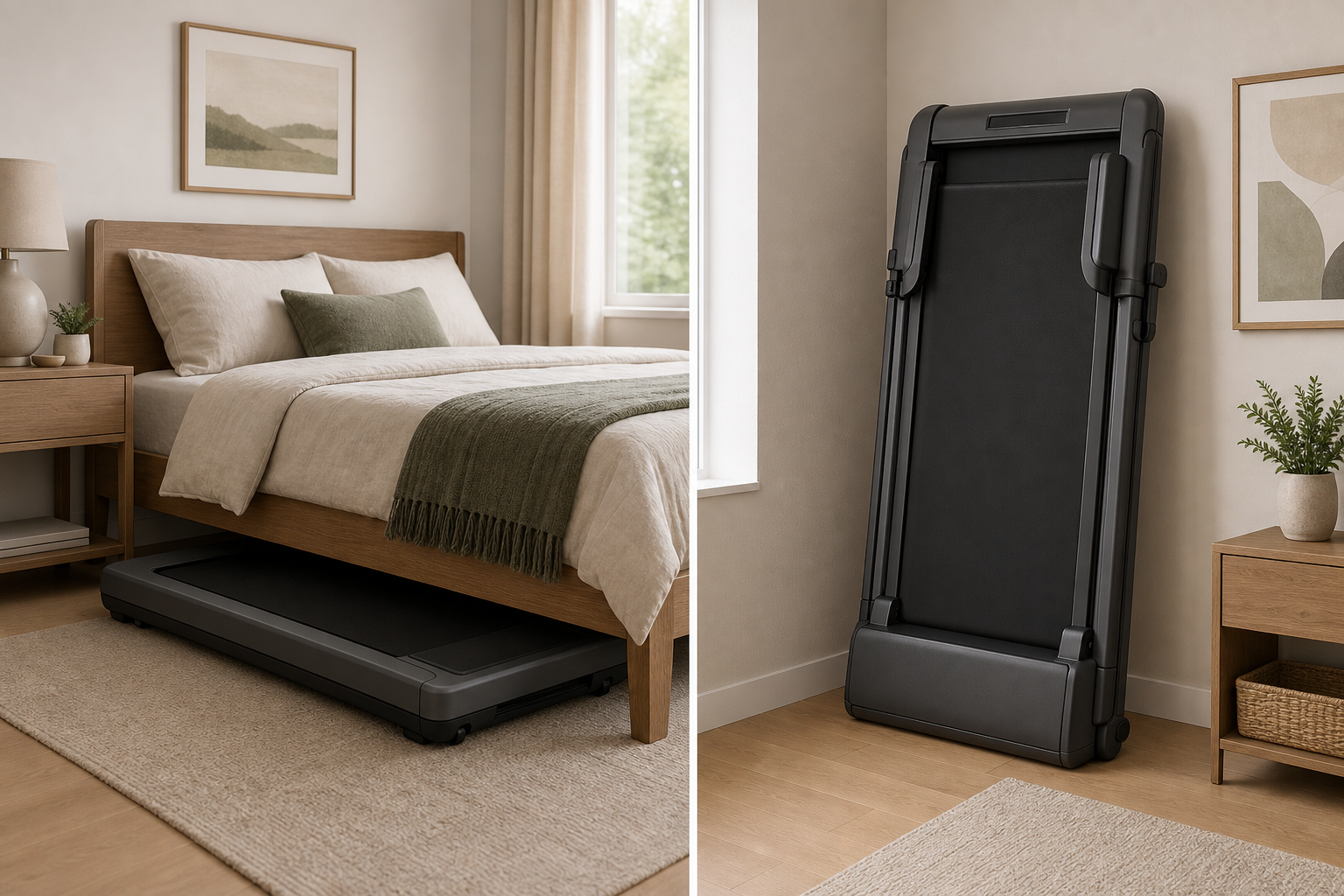
- Fold type. There are two kinds of folding treadmill, and beginners consistently confuse them. Flat-fold designs (like the WalkingPad C2 and Echelon Stride 6s) fold horizontally — the deck drops flat and the machine stores low, under a bed or against a wall at minimal height. Standard upright-fold designs (like the Horizon T101) tilt the deck to near-vertical — they're more compact than an unfolded treadmill, but they still occupy floor area and lean against a wall at shoulder height. Neither is better; they solve different space problems.
- Warranty. The industry standard is a lifetime warranty on the frame and motor. Consumer Reports recommends looking for at least three to seven years on parts and one year on labor, with lifetime coverage on frame and motor. A treadmill offering only a 1-year warranty on everything is signaling a machine that won't hold up — the Echelon Stride 6s is a notable exception to watch here, as its warranty falls below this standard despite being a useful walker-to-jogger option.
The 3 Specs to Ignore for Your First 90 Days
- CHP beyond 2.5. A 2.5 continuous horsepower motor handles walking and light jogging reliably. GGR's buying guide confirms that 1.5–2.5 CHP covers walking and light jogging; you only need 2.5–3.0 CHP when you're running regularly. Paying for a 3.5 CHP motor on day one is budget spent on capacity you won't use for months.
- Built-in touchscreen and subscription. Treadmills with integrated streaming screens (iFIT, Peloton, JRNY) add $400–$500 or more per year in subscription costs on top of the hardware price. None of the picks in this guide require a subscription to function. Your phone and a free app will cover everything you need as a beginner.
- Max incline beyond 12%. Beginner progressions rarely push past 5–6% incline in the first several months. A treadmill with a 15% max incline is useful later; it's not a differentiating feature for someone building their first walking or jogging habit.
| Spec | Matters for Beginners? | Why |
|---|---|---|
| Deck size (55" × 20" min for jogging) | Yes — critical | Undersized deck is a fall risk during jogging strides |
| Fold type (flat vs. upright) | Yes — space planning | Flat-fold stores horizontally; upright-fold still occupies floor area |
| Warranty (lifetime frame/motor) | Yes — quality signal | 1-year warranties indicate lower build quality |
| CHP beyond 2.5 | No — for first 90 days | 2.5 CHP is sufficient for walking and light jogging |
| Built-in touchscreen / subscription | No | Adds $400–$500+/year; unnecessary for beginners |
| Max incline beyond 12% | No | Beginner progressions rarely exceed 5–6% |
Curated Picks by Activity Type
The following picks are organized by the three activity types above, not by price tier. Prices reflect mid-2026 sale pricing and shift frequently — verify current pricing before purchasing.
For Walkers
WalkingPad C2 (~$599) — A flat-fold walking treadmill with a 3.7 mph max speed, designed specifically for walkers. It folds sandwich-style to roughly 47 inches in length and weighs about 55 lbs, making it genuinely storable under a desk or bed. The speed cap means it's not a path to jogging — if you think you'll want to jog within six months, buy the next option instead. No subscription required.
Echelon Stride 6s (~$799) — A flat-fold design that supports speeds up to 12.5 mph, making it a genuine walker-to-jogger bridge. It folds completely flat — folded dimensions are approximately 12" deep — and can be stored vertically against a wall or slid under a bed. Zero-assembly delivery is standard. One important caveat: the Echelon Stride 6s carries only a 1-year warranty, which is below the lifetime frame/motor standard. If long-term durability is a priority, the Horizon T101 below is the more reliable choice. No subscription required for basic use.
For Light Joggers
Horizon T101 ($599–$999 depending on sale) — The most consistently recommended entry-level jogging treadmill across independent testing. It has a 55" × 20" deck — the minimum for safe jogging strides — a 2.5 CHP motor, and a 10 mph top speed. It folds upright (not flat) and weighs around 170 lbs, so it stays where you put it. Runner's World testing describes it as ideal for casual runners up to 6 feet tall. Lifetime frame and motor warranty. No subscription required.
For New Runners
Horizon 7.0 AT (~$1,099 on sale, list ~$2,100) — A 60" × 20" deck accommodates taller runners and longer strides. The 3.0 CHP motor handles regular running without strain. QuickDial speed and incline controls make mid-run adjustments practical. Bluetooth FTMS support means it syncs with third-party apps without a proprietary subscription. No mandatory subscription.
Bowflex T6 (~$999 on sale, list ~$1,299) — A 60" × 20" deck with a 15% max incline and a lifetime frame and motor warranty. No built-in screen, but JRNY app-compatible if you want guided content later. At the sale price, it's the strongest warranty-to-cost ratio in this guide. No subscription required for basic use.
Budget-First Pick
UREVO Strol 2E (~$290) — A flat-fold walking treadmill with a 6.2 mph max speed and a 265 lb weight capacity. At this price, it's a legitimate option for walkers and very light jogging. Important limitation: the deck is 40.2" × 15", which is too short and too narrow for safe running strides. If you plan to jog regularly, this machine will feel cramped within weeks. Buy it only if walking is your firm plan for the foreseeable future.
| Model | Activity Type | Deck Size | Motor | Fold Type | Approx. Price | Subscription Required | Warranty |
|---|---|---|---|---|---|---|---|
| WalkingPad C2 | Walker only | Not rated for jogging | Walking-spec | Flat-fold (under bed) | ~$599 | No | Check at purchase |
| Echelon Stride 6s | Walker → Light Jogger | Jogging-capable | 2.5 CHP | Flat-fold (under bed / against wall) | ~$799 | No (optional) | 1 year only — below standard |
| Horizon T101 | Light Jogger | 55" × 20" | 2.5 CHP | Upright-fold | $599–$999 | No | Lifetime frame/motor |
| Horizon 7.0 AT | New Runner | 60" × 20" | 3.0 CHP | Upright-fold | ~$1,099 on sale | No | Lifetime frame/motor |
| Bowflex T6 | New Runner | 60" × 20" | 3.0 CHP | Upright-fold | ~$999 on sale | No (JRNY optional) | Lifetime frame/motor |
| UREVO Strol 2E | Walker / Light Jog only | 40.2" × 15" — not for running | Walking-spec | Flat-fold | ~$290 | No | Check at purchase |
Floor Space and Setup Checklist
Most treadmill roundups end at the purchase recommendation. The setup steps below are the ones that actually affect whether the machine works safely in your space — and they're the ones most first-time buyers skip.
- Calculate ceiling clearance. Add 15 inches to your height to get the minimum ceiling height you need. Industry veteran Ed Pryts at Gym Source specifies this formula: a 6-foot person needs at least a 7-foot, 3-inch ceiling. Low ceilings in basements are a common problem.
- Leave 3 feet of clear space behind the machine. This is the safety buffer if you stumble or need to step off quickly. Pryts specifies at least 3 feet of unobstructed space behind the treadmill as a standard installation requirement.
- Place a rubber floor mat under the treadmill. A mat absorbs vibration, reduces noise transmission to floors below, and protects hardwood or laminate from wear. This is especially relevant in apartments. Treadmill mats are widely available from the same retailers selling the machines.
- Dedicate an electrical circuit. Pryts advises dedicating a circuit to the treadmill if possible — other appliances sharing the circuit can cause power overloads and inadvertent shutdowns mid-session. Also keep the power cord short enough that it doesn't become a tripping hazard.
- Measure doorways and stairwells before delivery. Upright-fold treadmills in the 150–250 lb range are awkward to maneuver. The Horizon T101, for example, needs to clear standard doorways both assembled and during delivery. Flat-fold machines are generally easier to move but still require measuring the path from your front door to the final room.
- Place the treadmill on a flat, stable surface. A creaky second-floor bedroom with uneven flooring is not ideal. Uneven surfaces stress the frame and can affect belt tracking over time.
| Model | Folded Footprint | Storage Style | Weight |
|---|---|---|---|
| WalkingPad C2 | ~47" L × 21" W × 5" H | Flat — under bed or desk | ~55 lbs |
| Echelon Stride 6s | ~12" D × 31.5" W × 64.75" H | Flat or vertical against wall | ~110 lbs |
| Horizon T101 | Upright — deck tilts near-vertical | Upright against wall, still occupies floor area | ~170 lbs |
| Horizon 7.0 AT | Upright — deck tilts near-vertical | Upright against wall | ~220 lbs |
| Bowflex T6 | Upright — deck tilts near-vertical | Upright against wall | ~220 lbs |
| UREVO Strol 2E | Flat-fold, compact | Flat — under desk or bed | ~57 lbs |
Safety Basics Every First-Time Treadmill Owner Should Know
These are the safety fundamentals specific to treadmill use. They're often buried in owner's manuals or omitted from product roundups entirely.
- Always use the safety key. Every motorized treadmill comes with a safety key attached to a cord with a clip. Clip it to your clothing before starting. Consumer Reports explains that if you slip or fall, the cord pulls the key out and the belt stops immediately. It is not optional.
- Unplug when not in use. Accidental starts are one of the leading causes of child injuries around treadmills. Remove the safety key and store it separately, and unplug the machine when you're done using it.
- Warm up and cool down with gradual speed changes. Start each session at a slow walk and increase speed gradually rather than jumping to your target pace. End the same way — walk for two to three minutes before stopping. This is especially important for new runners whose tendons and joints are adapting to the movement pattern.
- Don't let the speed exceed what you can safely handle. Treadmill belts make it easy to push speed faster than you're ready for. Set a pace you can maintain with good form — don't let the machine pull you along.
Your First 4 Weeks: A Beginner Walk-to-Jog Progression
The most common mistake new treadmill owners make is getting on the machine and immediately trying to run. The walk-to-jog approach below builds the habit and conditions your joints progressively. Most beginners reach consistent 5-minute jog intervals within four weeks starting from a walking base.
Speed reference: walking is typically 2–3.5 mph; a light jog is 4–5 mph. Use these as starting points — your comfortable pace may differ slightly based on height and fitness level.
| Week | Session Structure | Duration | Target Speed |
|---|---|---|---|
| Week 1 | Walk continuously | 20–30 min | 3–3.5 mph |
| Week 2 | Alternate: 2 min walk / 1 min jog, repeat | 20 min total | Walk 3 mph / Jog 4–4.5 mph |
| Week 3 | Alternate: 2 min walk / 2 min jog, repeat | 25 min total | Walk 3 mph / Jog 4.5–5 mph |
| Week 4 | 5 min jog intervals / 2 min walk recovery, repeat | 25–30 min total | Jog 5 mph / Walk 3 mph |
If you're still deciding whether treadmill-based cardio is the right starting point for your home routine, the beginner home workout guide covers broader options including bodyweight and equipment-free approaches.
Frequently Asked Questions
What's the minimum deck size for jogging safely?
55 inches long by 20 inches wide is the minimum for safe jogging. Shorter decks — particularly anything under 50 inches — create a real fall risk because your stride can extend past the end of the belt. For walking only, 45–50 inches is workable. For runners over 6 feet tall, a 60-inch deck is the better choice.
Do I need a subscription to use any of these treadmills?
No. Every model in this guide functions fully without a subscription. The Bowflex T6 is JRNY-compatible and the Echelon Stride 6s has an optional Echelon app, but neither requires a paid membership to operate. You can use a free app on your phone or simply run the machine manually.
What's the difference between a flat-fold and a standard folding treadmill?
A flat-fold treadmill (WalkingPad C2, Echelon Stride 6s) collapses horizontally — the deck folds down to a low profile that can slide under a bed or lean flat against a wall. A standard upright-fold treadmill (Horizon T101, Horizon 7.0 AT) lifts the deck to near-vertical — it takes up less floor area than an unfolded machine, but it's still leaning against a wall at shoulder height and occupying some floor space. If you need to completely clear a room, flat-fold is the only option.
How much CHP do I actually need as a beginner?
2.5 CHP is sufficient for walking and light jogging. You only need 3.0 CHP or more when you're running regularly at 5+ mph for extended sessions. Buying a 3.5 CHP motor as a beginner is spending money on capacity you won't use for months. The Horizon T101's 2.5 CHP handles the first phase of most beginner programs without issue.
Can I use a treadmill in an apartment?
Yes, with two practical steps: use a rubber floor mat under the machine to absorb vibration and reduce noise transmission to the floor below, and choose a flat-fold model if storage space is limited. The Echelon Stride 6s is specifically noted for its quiet 60 dB operation and compact folded profile, making it one of the better apartment options. Avoid placing the treadmill directly on hardwood without a mat — the vibration and belt friction will damage the floor over time.
This result comes from one real apartment under the stated conditions — it is a strong signal, not a guarantee your space will measure identically.
Builds this evidence supports
Cable Machine Alternatives That Save Space and Money
Compare the best cable machine alternatives for home gyms – from resistance bands and pulley systems to suspension trainers and compact digital units – and find the right option for your space and budget.
How to Choose a Compact Home Gym That Works for Your Space, Budget, and Noise Tolerance
This article provides a structured decision framework for apartment dwellers and small-space residents to match their specific floor footprint, noise sensitivity, and budget to the most suitable compact home gym strategy — whether that's an all-in-one machine, modular build, smart digital system, or band/bodyweight setup.
The Garage Gym Reality Check: What Equipment Actually Fits in a Single-Car Garage
Most garage gym guides assume a two-car space. This article uses real dimensions, real equipment footprints, and three layout templates to show what fits—and what doesn't—in a single-car garage (10x20 to 12x20 ft).
Spot something off?
If this result didn't match your own space, let us know — floor-damage and noise claims carry real deposit-risk consequences if we get them wrong.