
Best Low-Impact Exercise Equipment for a Home Gym: A Decision Guide by Space, Budget, and Goal
Choosing the right low-impact home exercise equipment depends on your available floor space, budget, and primary fitness goal — not a universal ranking. This guide walks through the key constraint axes and maps each combination to a practical, actionable equipment recommendation.
- Duration
- 30 min
What Low-Impact Exercise Equipment Actually Means
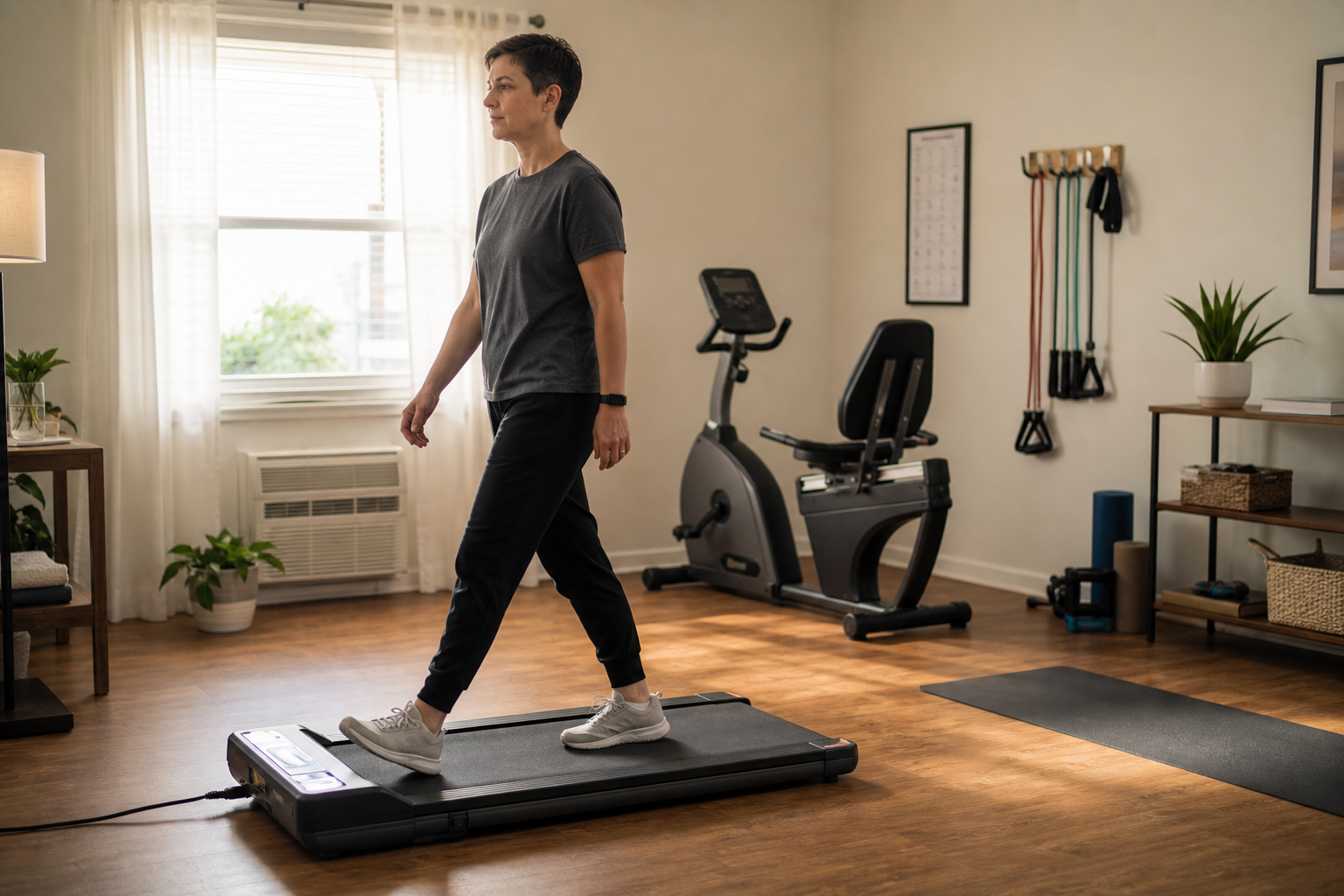
Low-impact exercise means your joints — ankles, knees, hips — are not absorbing the repetitive collision forces that come with running or jumping. It does not mean the workout is easy, slow, or ineffective.
A rowing machine session at moderate resistance can burn roughly 210–300 calories in 30 minutes while working nearly every major muscle group — that is not a light workout by any measure. An elliptical at a challenging resistance level will elevate your heart rate as effectively as jogging, without the ground-strike stress on your knees. The equipment type controls the impact; your effort controls the intensity.
For most healthy adults, low-impact equipment is simply a smarter way to train consistently without accumulating the wear that high-impact activity imposes over time. For people managing joint pain, returning from injury, or just starting out after a long break, it is often the only practical path to sustainable cardio and strength work.
The Three Constraint Axes to Assess Before You Buy
Most equipment guides rank machines by popularity or review score. That approach breaks down quickly when the top-ranked machine is too large for your space, costs twice your budget, or is optimized for a goal that does not match yours.
The correct frame is a constraint-matching problem. Before looking at any specific machine, establish your position on three axes:
- Floor space available: Very small (under 50 sq ft — a corner of a bedroom, a narrow apartment area), small (50–100 sq ft — a dedicated room section or small spare room), or medium (100+ sq ft — a full spare room, garage bay, or open basement area).
- Budget ceiling: Under $100, $100–$500, $500–$1,500, or $1,500+. Note that connected machines (Peloton, iFIT-equipped models) carry ongoing subscription costs of roughly $15–$40 per month on top of the purchase price — factor this into your total cost of ownership before comparing sticker prices.
- Primary fitness goal: Daily cardio and calorie burn, full-body strength with a cardio component, weight loss through sustained moderate-intensity volume, or rehab and pain management (returning from injury, managing joint or back issues).
These three axes are the decision filter. A machine that scores well in reviews but fails on any one of your three constraints is the wrong machine for you — regardless of how it ranks in a generic list.
Equipment Type Profiles: Specs, Footprint, and Best-For Use Cases
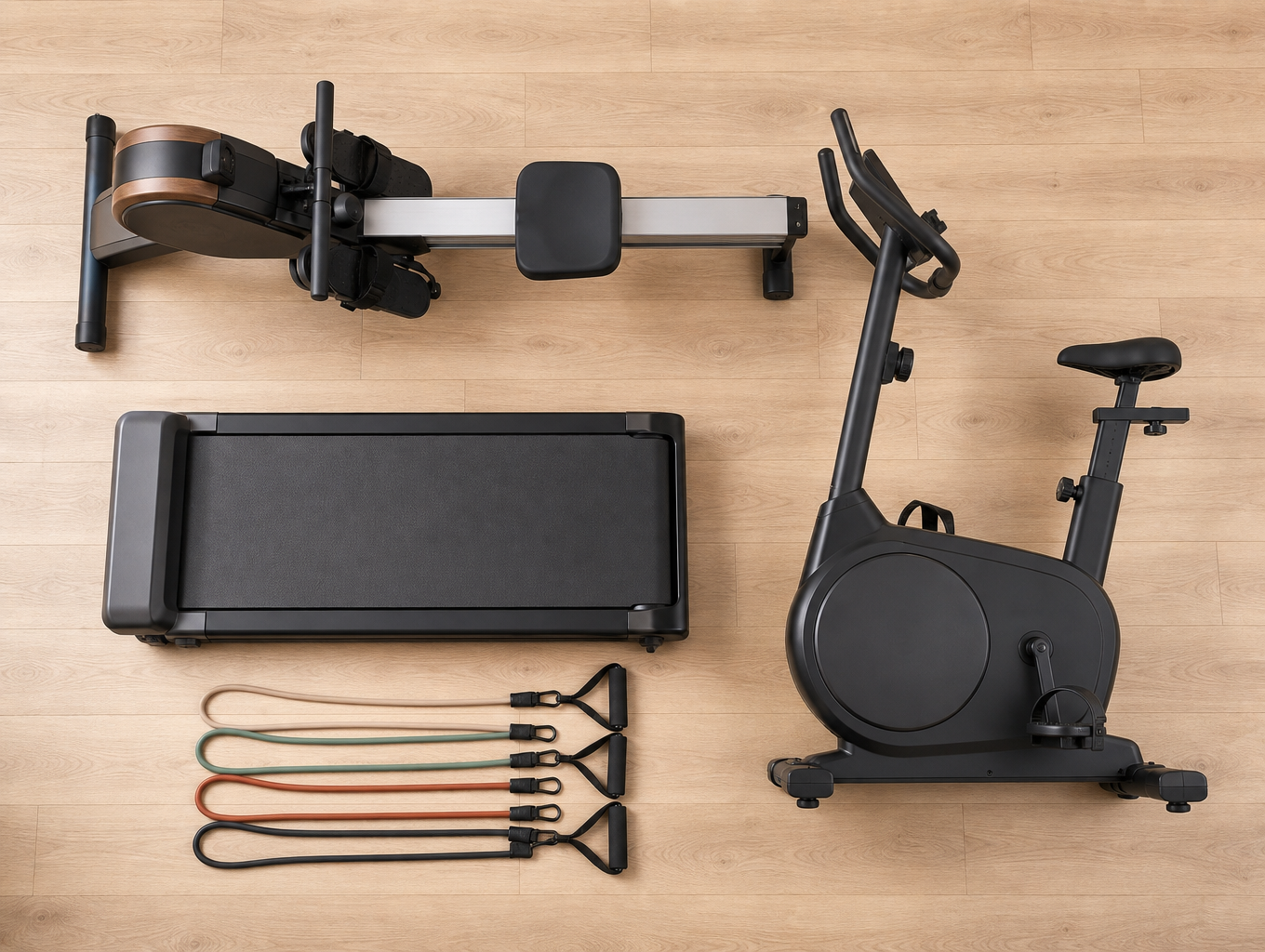
The following profiles cover the seven major low-impact equipment types relevant to a home gym buyer. Calorie burn estimates are approximate 30-minute ranges at moderate effort and vary by body weight, age, and intensity. Footprint figures are typical for standard home-use models.
| Equipment Type | Typical Footprint | Price Tier | Est. Cal Burn (30 min) | Primary Muscles | Noise Level | Subscription Dependency |
|---|---|---|---|---|---|---|
| Elliptical | ~6×3 ft + arm clearance | $500–$1,500+ | 200–270 cal | Legs, glutes, arms, core | Low–Medium | Optional (connected models) |
| Recumbent Bike | ~5×2.5 ft | $300–$1,200 | 150–220 cal | Quads, hamstrings, calves | Very Low | Optional (connected models) |
| Upright / Spin Bike | ~4×2 ft | $200–$2,500+ | 180–250 cal | Quads, hamstrings, glutes, calves | Low–Medium | Optional / Required (Peloton, iFIT) |
| Rowing Machine | ~8×2 ft (folds vertically) | $400–$1,800+ | 210–300 cal | Legs, core, back, arms (~86% of major muscles) | Low–Medium (air rowers louder) | Optional |
| Walking Pad / Under-Desk Treadmill | ~5×2 ft | $200–$700 | 120–200 cal | Legs, glutes, calves | Low–Medium | None typically |
| Resistance Bands | <1 sq ft stored | Under $30–$80 | Varies widely by routine | Full body (varies by exercise) | Silent | None |
| Under-Desk Pedaler | ~2×1.5 ft | $30–$150 | Very low (light movement) | Quads, calves (light) | Very Low | None |
A Few Profile Notes Worth Calling Out
Ellipticals provide strong combined upper and lower body cardio and are endorsed as joint-friendly by physical therapists at institutions including Spaulding Outpatient Center. Their limitation is footprint: they require more overhead clearance than treadmills and are a poor fit for rooms with low ceilings or tight dimensions, as noted by Consumer Reports.
Recumbent bikes are the most forgiving starting point for lower back pain and post-surgery rehab. The reclined seat position reduces pressure on the lower back and hips compared to upright cycling. If you use one, Arthritis.org recommends skipping foot straps on the pedals — straps can recruit the wrong muscles and prevent a quick foot-down if you lose balance. Adjust the seat so your knee has a slight bend at full pedal extension.
Rowing machines offer the highest full-body return of any low-impact option, engaging roughly 86% of major muscle groups across legs, core, back, and arms in a single movement pattern. The tradeoff is space (you need at least 8 feet of clear floor length) and a moderate learning curve on form. One practical consideration flagged by a Harvard Health physical therapist: rowing machines sit low to the ground, so getting down to and up from the seat is a real factor for deconditioned users or anyone post-surgery.
Resistance bands are the most space- and budget-efficient option on this list. Physical therapists frequently prescribe them because they allow targeted isolation of specific muscle groups — including knee extensors and flexors — in standing, sitting, or lying positions. For joint-pain or arthritis users, tube-style bands with handles are easier to grip than loop bands.
Constraint-to-Equipment Decision Table: Space × Budget × Goal
The table below maps your three constraint positions to a primary recommended pick. Where two options appear, the first is the stronger fit; the second is a viable alternative if the primary is unavailable or out of stock.
| Floor Space | Budget | Primary Goal | Primary Pick | Alternative |
|---|---|---|---|---|
| Very small (<50 sq ft) | Under $100 | Any / General movement | Resistance bands | Under-desk pedaler |
| Very small (<50 sq ft) | Under $100 | Rehab / Pain management | Resistance bands (tube-style with handles) | Under-desk pedaler |
| Very small (<50 sq ft) | $100–$500 | Daily cardio | Walking pad | Upright bike (compact model) |
| Very small (<50 sq ft) | $100–$500 | Full-body strength | Resistance bands (full set) | Walking pad |
| Small (50–100 sq ft) | Under $100 | Daily cardio / Weight loss | Resistance bands + bodyweight circuit | Under-desk pedaler |
| Small (50–100 sq ft) | $100–$500 | Daily cardio | Upright / spin bike | Walking pad |
| Small (50–100 sq ft) | $100–$500 | Rehab / Pain management | Recumbent bike | Upright bike (seat-adjustable) |
| Small (50–100 sq ft) | $500–$1,500 | Full-body strength + cardio | Rowing machine (foldable) | Upright bike + resistance bands |
| Small (50–100 sq ft) | $500–$1,500 | Weight loss | Rowing machine | Upright bike |
| Medium (100+ sq ft) | $100–$500 | Daily cardio | Upright / spin bike | Walking pad |
| Medium (100+ sq ft) | $500–$1,500 | Daily cardio + upper body | Elliptical | Rowing machine |
| Medium (100+ sq ft) | $500–$1,500 | Full-body strength + cardio | Rowing machine | Elliptical |
| Medium (100+ sq ft) | $500–$1,500 | Rehab / Pain management | Recumbent bike | Rowing machine (air or fluid resistance) |
| Medium (100+ sq ft) | $1,500+ | Full-body strength + cardio | Rowing machine (premium) | Elliptical (mid-range) + resistance bands |
| Medium (100+ sq ft) | $1,500+ | Daily cardio / Weight loss | Elliptical or upright bike (connected, no subscription) | Rowing machine |
What to Look for When Evaluating Each Equipment Type
Once you have narrowed the field using the decision table, the following criteria apply when comparing specific models within a category.
Adjustability
Seat height and position adjustability is critical on any bike — upright, spin, or recumbent. Improper seat height can create knee stress even on low-impact equipment. The standard guideline: at full pedal extension, your knee should have a slight bend (not fully locked). On rowing machines, foot stretcher position should accommodate your leg length so you can reach full compression at the catch without rounding your lower back.
Resistance Type
For rowing machines, air and fluid-chamber resistance mechanisms produce smoother, more natural motion than weight-stack models. This matters for joint comfort — the resistance increases proportionally with your effort rather than in fixed increments, which reduces the jerk at the start of each stroke. Magnetic resistance on bikes and ellipticals is quieter than friction-based resistance and tends to feel more consistent across the resistance range.
Smoothness of Operation
A machine that feels jerky or uneven at low resistance is a red flag — it will feel worse as components wear. On ellipticals, test the stride motion through its full range before purchasing; some budget models have a choppy arc that puts unexpected stress on ankles and hips. On bikes, the flywheel weight affects smoothness: heavier flywheels (18 lbs+) tend to produce a more consistent pedal stroke.
Subscription and Hidden Costs
- Check whether the machine requires an active subscription for basic functionality (display metrics, resistance control) vs. only for streaming classes. Some connected bikes lock resistance adjustment behind the subscription.
- Verify the current subscription price directly with the manufacturer before purchase — these prices change, and articles (including this one) may not reflect the most current rate.
- Factor in the cost of a compatible mat (typically $30–$80), delivery and assembly fees (often $100–$200 for larger machines), and any extended warranty cost.
- For resistance bands, check whether the set includes a door anchor and handles — buying a tube-style set without handles limits the exercises you can do and makes the bands harder to grip for users with hand or wrist issues.
Weight Capacity
Most home cardio machines list a user weight capacity between 250 and 350 lbs. If you are near or above the listed capacity, the machine will wear faster and may feel unstable. Look for models with higher-rated frames — these are typically not much more expensive but are built with heavier steel gauge and sturdier welds.
The Best Low-Impact Pick for Your Situation: Scenario Summaries
The decision table above covers the full matrix. These four scenario summaries translate the most common reader situations into plain-language recommendations.
- Very small space, tight budget (under $100): Resistance bands are the correct pick. A full tube-style set with handles, a door anchor, and a resistance range from light to heavy runs $25–$60 and stores in a drawer. They are not a compromise — physical therapists prescribe them specifically because they allow targeted, joint-safe loading in positions that machines cannot replicate. If your goal is light daily movement rather than structured training, an under-desk pedaler is a reasonable complement.
- Apartment dweller, cardio focus, $100–$500: A walking pad (under-desk treadmill) is the most practical fit. It folds flat for storage under a bed or sofa, operates quietly enough for apartment use, and supports the 3–4 mph walking pace that trainers recommend as an entry point for building cardio base. If you have slightly more floor space and want adjustable resistance, a compact upright bike is the alternative — it occupies roughly 4×2 ft and can be stored against a wall.
- Managing joint pain or returning from injury: Start with a recumbent bike if your primary issue is lower back, hip, or knee pain. The reclined seat removes pressure from the spine and distributes weight across a wider seat surface. If you are post-surgery or significantly deconditioned, follow the protocol recommended by physical therapists at Harvard Health: start with a few minutes at the lowest resistance, and only progress when 15 minutes at no resistance feels easy. Consult your healthcare provider before starting.
- Medium budget ($500–$1,500), medium space, want full-body results: A rowing machine is the strongest pick. It delivers the highest full-body training return of any low-impact option, combining sustained cardio with meaningful load on legs, core, back, and arms. The main requirement is clear floor length — you need at least 8 feet. Many models fold vertically for storage. If you do not have the floor length, a mid-range elliptical is the alternative — it provides combined upper and lower body cardio with a smaller length footprint than a rower, though it requires ceiling clearance.
Frequently Asked Questions
What is the best low-impact machine for bad knees?
It depends on the nature of the knee issue. For general knee sensitivity or mild osteoarthritis, an upright or recumbent bike is typically the safest starting point — both are non-weight-bearing and allow you to control load precisely. The key is seat adjustment: an improperly set seat height creates knee stress even on a bike. For users who want a cardio machine that also builds leg strength without gravitational impact on the knee joint, rowing is a strong option provided form is correct. A physical therapist at Garage Gym Reviews notes that rowing, when performed with proper technique, adds no gravitational impact stress to the knee joints. If you are managing a diagnosed knee condition, confirm the appropriate equipment choice with your healthcare provider.
Is a rowing machine good for beginners?
Yes, but it has the steepest learning curve of the common low-impact machines. The rowing stroke requires coordinating leg drive, core engagement, and arm pull in a specific sequence — doing it incorrectly puts load on the lower back rather than the legs. Most beginners benefit from a short technique-focused session before their first real workout. The practical accessibility consideration: rowing machines sit low to the ground, so getting down to and up from the seat is a real factor for deconditioned users. If floor access is a concern, a bike or elliptical is a more accessible starting point.
Which machine fits a small apartment?
For very small spaces (under 50 sq ft of usable floor area), resistance bands are the only equipment type with no meaningful footprint. For slightly more space, a walking pad or compact upright bike are the two practical motorized options — both occupy roughly 4–5 square feet when in use and can be stored against a wall or under furniture. Exercise bikes are specifically noted by Consumer Reports as compact enough to store in a closet in some cases. Ellipticals and rowing machines are not suitable for genuinely small apartments — both require more floor length than a typical bedroom corner can provide.
Can resistance bands replace a cardio machine?
For cardiovascular conditioning in the traditional sense — sustained elevated heart rate over 20–40 minutes — resistance bands alone are a limited substitute for a dedicated cardio machine. They are most effective for strength work, mobility, and targeted muscle loading. That said, a structured circuit using resistance bands (high-rep sequences with short rest periods) can elevate heart rate meaningfully and produce a conditioning effect, particularly for beginners or deconditioned users. If your primary goal is cardiovascular fitness and you have any budget at all, a walking pad or compact bike will serve that goal more efficiently. If your budget is genuinely under $50 and your space is very limited, a resistance band circuit is a practical starting point — not a permanent replacement for cardio equipment.
What a small equipment investment adds
We don't have a build tagged to this exact tier yet. Browse all builds.
How often should you repeat this?
See our recovery and rest reference for citation-anchored rest-interval guidance.
Spot something off?
Tell us if a movement, tier assumption, or duration didn't match your experience.