
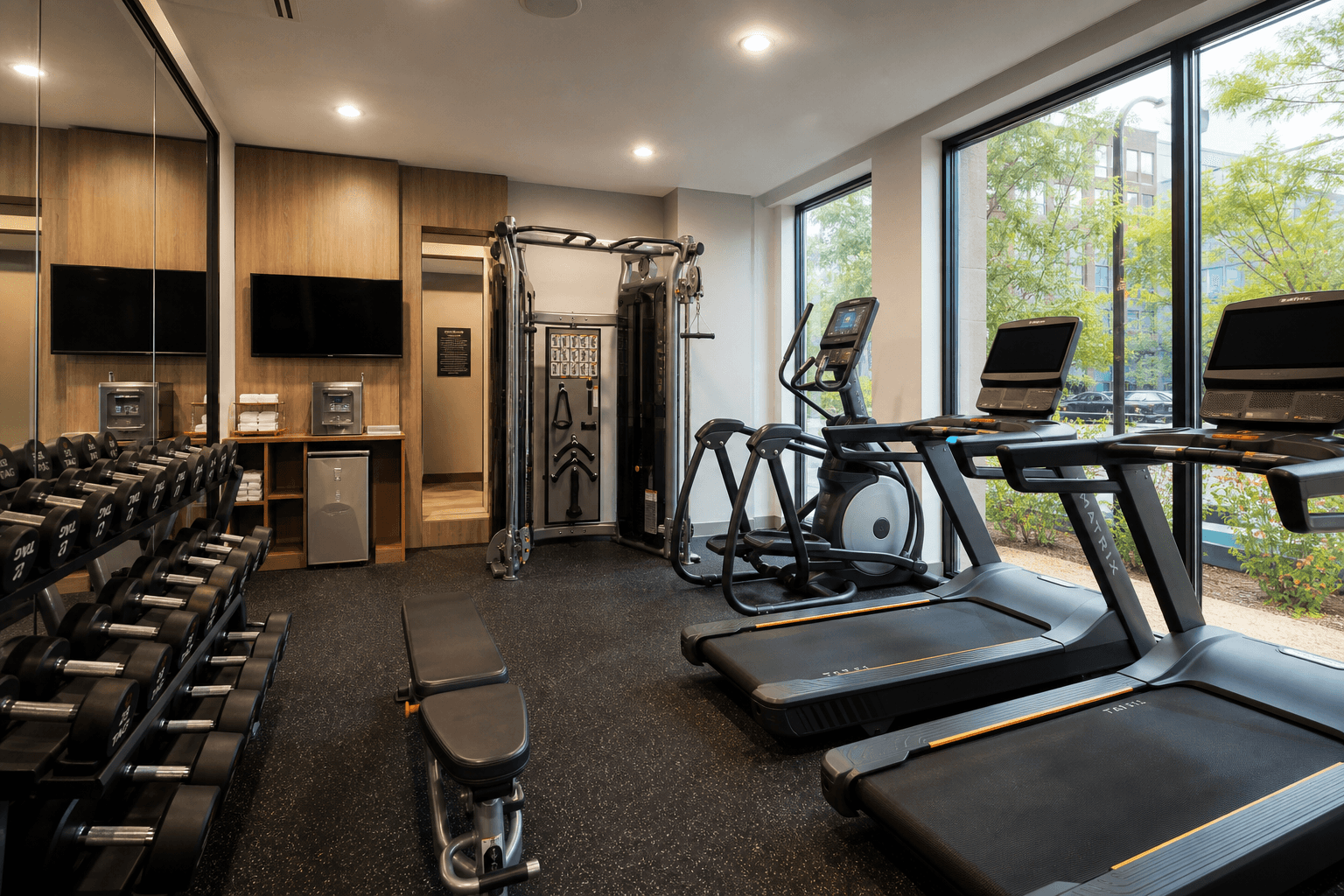
Why Hotel Fitness Rooms Need a Different Buying Framework
Outfitting a hotel fitness room is not the same as equipping a commercial gym. The buyer is a property manager or owner, not a gym operator. The users are transient guests, not members. The usage pattern is burst-based — a spike between 6:00 and 8:00 a.m., then sporadic use through the evening — not the steady throughput of a 24-hour fitness club. These differences change every equipment decision, from resistance type to warranty terms.
Hotel fitness rooms operate without staff supervision for most of the day. That means every piece of equipment must be intuitive enough for a first-time user who may not speak English as a first language, durable enough to withstand improper use, and quiet enough not to disturb guests in adjacent rooms. A residential treadmill placed in a hotel setting will fail faster, generate more noise complaints, and create liability exposure that a commercial-grade unit would not.
The financial stakes are higher than most buyers realize. According to surveys cited by equipment manufacturer BodyKore, approximately 70% of travelers say they would pay more for a hotel that offers a fitness facility, and properties with well-equipped gyms can see a 10–15% lift in average daily rate (ADR). That revenue impact makes the fitness room a profit center, not a cost center — but only if the equipment is selected, spaced, and maintained correctly.
This guide is written for hotel owners, property managers, and facility operators who need to spec a fitness room for a property with under 100 rooms up to 300+ rooms. It covers budget planning by property size, the light-commercial vs. full-commercial decision, equipment mix ratios, noise and flooring costs, ADA compliance, and the certified refurbished pathway — all tailored to the unique constraints of an unstaffed, guest-facing fitness space.
Equipment Budgets by Property Size
Hotel fitness room budgets scale with room count and square footage, but the relationship is not linear. A 200-square-foot room in a boutique hotel may need higher-end finishes and quieter machines than a 600-square-foot room in a full-service property, because the guest expectations differ. The following ranges represent equipment-only costs — flooring, mirrors, installation, and signage are separate line items.
| Property Size | Typical Fitness Room Sq. Ft. | Equipment Budget Range | Budget per Sq. Ft. (Equipment Only) |
|---|---|---|---|
| Small (under 100 rooms) | 200–400 sq ft | $15,000 – $35,000 | $50–$75/sq ft |
| Mid-size (100–300 rooms) | 400–800 sq ft | $30,000 – $75,000 | $50–$75/sq ft |
| Large (300+ rooms) | 800–1,500+ sq ft | $75,000 – $200,000+ | $50–$75/sq ft |
The $50–$75 per square foot estimate is a useful planning rule of thumb, but it assumes a balanced mix of cardio and strength equipment at light-commercial or full-commercial quality. A room that leans heavily on premium treadmills will push toward the upper end of that range; a room built around functional trainers and fixed dumbbells may come in lower. The budget excludes flooring ($3–$8 per sq ft for rubber), mirrors ($15–$30 per sq ft), and installation labor ($2,000–$15,000 depending on scope).
For properties at the small end of the spectrum — a 35-room boutique or a 60-room extended-stay — the $15,000–$35,000 range forces hard choices. A single premium treadmill can consume $8,000–$12,000 of that budget. The certified refurbished pathway, covered later in this guide, becomes especially relevant at this tier.
Light Commercial vs. Full Commercial: Choosing the Right Tier
One of the most common mistakes hotel buyers make is assuming that any machine labeled "commercial" is appropriate for their use case. In reality, the commercial equipment market splits into two distinct tiers: light commercial and full commercial. The difference matters most in hotel settings, where usage intensity falls somewhere between a home gym and a 24-hour fitness franchise.
The Fitness Outlet defines light commercial equipment as designed for "moderate daily use in small studios, hotels, apartment gyms" — exactly the use case for most hotel fitness rooms. Full commercial equipment, by contrast, is built for "continuous, high-traffic gym environments" where machines run 12–16 hours per day. Brands such as TRUE Fitness, Spirit Fitness, Life Fitness, StairMaster, and Hoist Fitness produce equipment that meets commercial standards across both tiers.
| Factor | Light Commercial | Full Commercial |
|---|---|---|
| Best for | Hotels under 100 rooms, low-traffic fitness rooms, apartment gyms | Hotels 300+ rooms, high-traffic fitness centers, 24-hour facilities |
| Expected daily cycles | 4–8 hours of intermittent use | 12–16 hours of continuous use |
| Treadmill price range | $2,500 – $5,000 | $5,000 – $12,000 |
| Frame warranty | 2–3 years typical | 3–5 years typical (lifetime on some frames) |
| Motor duty rating (treadmills) | 2.5–3.0 CHP (continuous duty) | 3.0–4.0 CHP (continuous duty) |
| Example brands | Spirit Fitness, TRUE Fitness (entry), Matrix (entry) | Life Fitness, Precor, Matrix (premium), StairMaster |
For a property with under 100 rooms and a fitness room that sees 15–30 guest visits per day, light commercial equipment is the appropriate tier. It offers commercial-grade build quality — 11–14 gauge steel frames, industrial-grade bearings, and motors rated for continuous duty — without the price premium of full commercial machines that would never be pushed to their design limits in that setting.
For properties with 300+ rooms or fitness rooms that serve as a guest amenity differentiator (luxury resorts, convention hotels), full commercial equipment justifies its higher cost through longer service intervals, better parts availability, and stronger warranty coverage. The decision framework is simple: match the tier to the expected daily cycle count, not to the property's room rate.
Recommended Equipment Mix by Footprint
The ratio of cardio to strength equipment should shift as the fitness room grows. In a small room, cardio machines dominate because they serve the widest range of guest fitness levels and require minimal instruction. As square footage increases, strength equipment takes a larger share, giving guests more variety and reducing wait times during peak morning hours.
| Property Size | Cardio-to-Strength Ratio | Recommended Core Pieces |
|---|---|---|
| Small (under 100 rooms) | 65:35 | 1–2 treadmills, 1 elliptical or bike, 1 functional trainer, fixed dumbbells 5–50 lb |
| Mid-size (100–300 rooms) | 55:45 | 2–3 treadmills, 1 elliptical, 1 bike, 1 functional trainer, fixed dumbbells 5–75 lb, 1 multi-purpose bench |
| Large (300+ rooms) | 50:50 or strength-led | 3–4 treadmills, 1–2 ellipticals, 1–2 bikes, 1–2 functional trainers, selectorized machines, fixed dumbbells 5–100 lb, cable crossover or lat pulldown |
Within this mix, certain equipment types deserve priority consideration for hotel settings:
- Treadmills: These draw the highest guest demand of any machine. In a hotel fitness room, a treadmill with a quiet motor (under 70 dB at operating speed), a shock-absorbing deck, and an intuitive console is worth the premium. Avoid models with complex login requirements or app subscriptions — guests want to step on and go.
- Functional trainers: A single functional trainer delivers the most guided exercises per square foot of any strength machine. For an unstaffed hotel gym, this is critical — guests can follow the exercise diagram on the console without needing a trainer. Dual-adjustable pulley (DAP) units are the standard choice for hotel installations.
- Fixed dumbbells: Adjustable dumbbells are common in home gyms but create noise and loose-part risks in hotel settings. Fixed dumbbells on a rack (5–50 lb for small rooms, up to 100 lb for larger rooms) are quieter, safer, and easier for guests to use correctly without instruction.
- Space-efficient cardio: In rooms under 300 sq ft, consider a single elliptical or recumbent bike instead of a second treadmill. Ellipticals offer lower impact for older guests and take roughly the same footprint as a treadmill (30–35 sq ft) while providing a different movement pattern.
For readers working with tight square footage, the Complete Small-Space Home Gym Buyer's Decision Guide offers general principles for maximizing a small footprint, though hotel buyers should add the considerations covered here — noise, unsupervised use, and guest diversity — to that framework.
Noise, Flooring, and Acoustic Considerations
Noise is the single most common source of guest complaints about hotel fitness rooms. A treadmill running directly above a guest room can transmit structure-borne vibration that makes sleep impossible. Even in rooms on the ground floor, the clatter of weight stacks and the hum of motors can carry into adjacent meeting spaces or lobbies.
The first line of defense is proper flooring. Rubber flooring — typically 3/8-inch to 1/2-inch thick — costs $3–$8 per square foot installed and provides the impact absorption and vibration dampening that carpet or vinyl cannot. For rooms above guest floors, an acoustic underlayment beneath the rubber adds an additional decoupling layer. The total flooring investment for a 400 sq ft room runs $1,200–$3,200, which is modest compared to the cost of noise-related complaints or lost repeat bookings.
| Item | Cost Range | Notes |
|---|---|---|
| Rubber flooring (3/8"–1/2") | $3 – $8 per sq ft | Includes material and basic installation; thicker is better for impact noise |
| Acoustic underlayment | $1 – $3 per sq ft | Recommended for rooms above guest floors; adds decoupling layer |
| Wall mirrors | $15 – $30 per sq ft | Tempered glass, 1/4" thickness minimum for safety |
| Installation labor (equipment + flooring) | $2,000 – $15,000 | Varies by room size, equipment count, and electrical work needed |
Beyond flooring, equipment selection directly affects noise levels. Treadmills with DC motors and low-decibel ratings (under 70 dB) are preferable. Fixed dumbbells eliminate the clatter of adjustable dumbbell collars. Functional trainers with nylon-coated cables run quieter than those with bare steel cables. Every decibel reduction is a guest-experience investment.
For a deeper comparison of flooring materials — including the trade-offs between rubber tiles, rolled rubber, and foam alternatives — see our Rubber vs. Foam Gym Flooring comparison. The hotel context adds acoustic isolation and fire-code compliance to the decision criteria covered in that article.
ADA Compliance Essentials for Hotel Fitness Rooms
Hotel fitness rooms in the United States must comply with the Americans with Disabilities Act (ADA) standards for accessible design. Compliance is not optional — it is a legal requirement for public accommodations under Title III of the ADA. Beyond legal exposure, an accessible fitness room signals to guests that the property considers their needs, which builds loyalty and positive reviews.
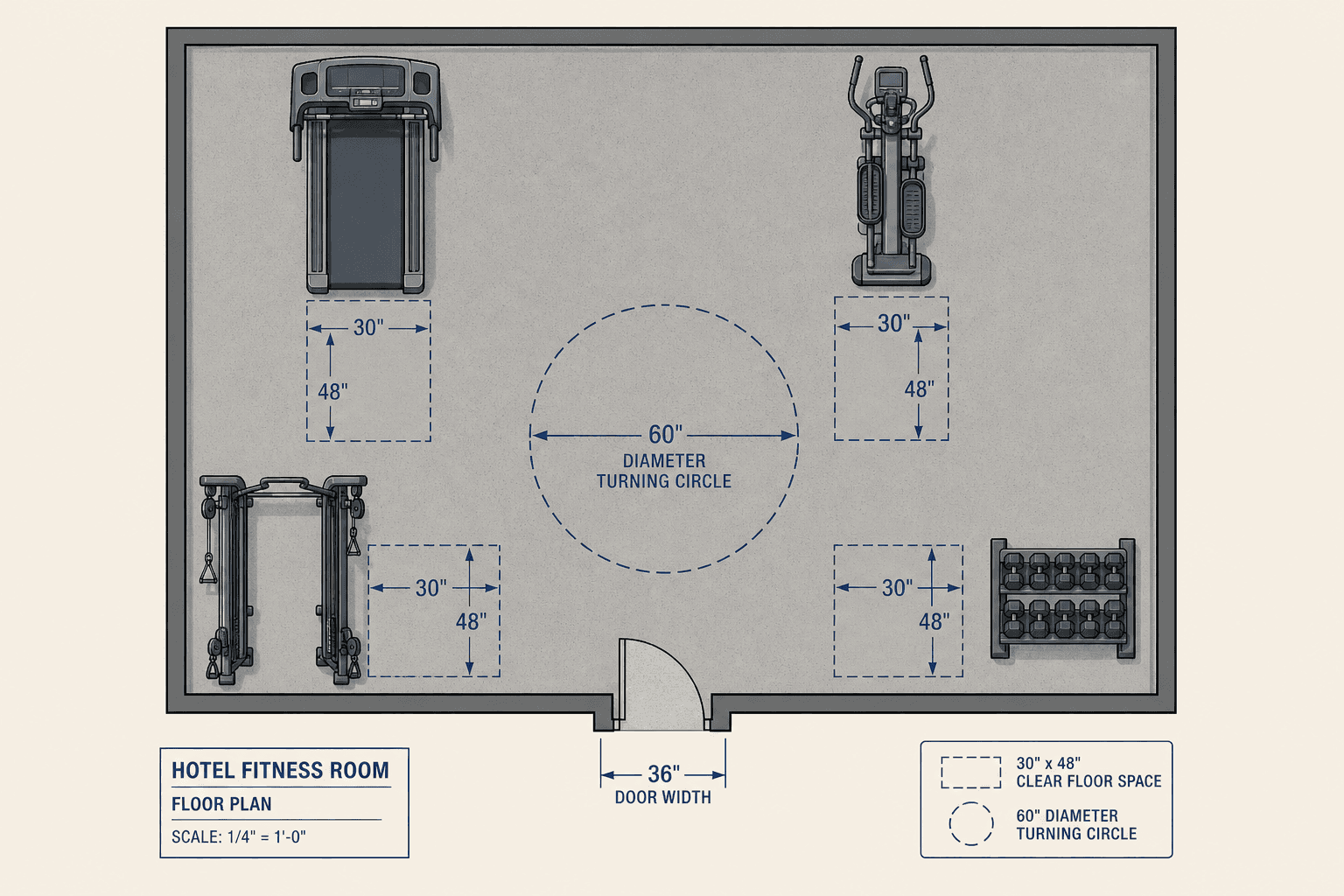
The following checklist covers the ADA requirements most relevant to hotel fitness room design, based on the 2010 ADA Standards for Accessible Design:
- 30" x 48" clear floor space: Every piece of exercise equipment must have a clear floor space of at least 30 inches deep by 48 inches wide in front of it, positioned for either a forward or parallel approach. This space must be level and free of obstructions.
- 32" clear opening doorways: The entrance to the fitness room must have a clear opening width of at least 32 inches when the door is open at 90 degrees. In practice, this means installing a 36-inch-wide door (the standard for commercial openings).
- 60" turning diameter: The room must include a clear floor space with a 60-inch diameter that allows a wheelchair to make a 180-degree turn. This space cannot overlap with the clear floor spaces in front of machines.
- Operable parts within reach range: Console controls, start buttons, and emergency stops must be reachable from a wheelchair — between 15 and 48 inches above the floor for a side reach, or 20 to 48 inches for a forward reach.
- Floor surface: The floor surface must be stable, firm, and slip-resistant. Rubber flooring meets this requirement; thick carpet or loose mats do not.
For small rooms (under 300 sq ft), meeting the 60-inch turning diameter requirement while also providing 30"x48" clear floor spaces in front of each machine can be challenging. This is where the equipment mix matters: a functional trainer with a compact footprint (roughly 40" x 60") may serve multiple exercise functions while occupying less total clear-floor-space area than a selectorized machine with a separate bench.
Certified Refurbished as a Budget Strategy
For properties where the equipment budget is tight — particularly small hotels under 100 rooms — certified refurbished commercial equipment offers a path to full-commercial durability at light-commercial pricing. The strategy is well-established in the fitness industry: a refurbisher takes a trade-in machine from a large commercial account, replaces worn components (belts, decks, upholstery, cables), repaints the frame, and sells it with a warranty.
The value proposition is strongest for treadmills and ellipticals, where the frame and motor are the high-cost components and the wear items (deck, belt, roller) are replaceable. A remanufactured commercial treadmill from a brand like Life Fitness or Precor typically costs 40–60% of the new price and carries a 1-year parts-and-labor warranty, with extension options up to 5 years from some refurbishers.
| Factor | New Commercial Equipment | Certified Refurbished Commercial |
|---|---|---|
| Upfront cost | 100% of MSRP | 40–60% of MSRP |
| Warranty (typical) | 3–5 year frame, 1–3 year parts, 1 year labor | 1 year parts/labor standard; extension up to 5 years available |
| Resale value after 5 years | 40–50% of original value | Similar retention to new (frame and motor are the same) |
| Lead time | 8–24 weeks (varies by brand) | 2–6 weeks (in-stock units) |
| Best for | Large properties, flagship locations, luxury resorts | Small-to-mid-size properties, budget-constrained projects, secondary locations |
The resale value retention advantage is worth noting. According to CTX Home Gyms, a 5-year-old commercial treadmill retains 40–50% of its original value, while consumer-grade equipment retains only 10–20% over the same period. For a hotel that may renovate its fitness room every 5–7 years as part of a property refresh, that residual value matters — the equipment can be sold or traded in rather than sent to a landfill.
The caveat is that not all refurbishers are equal. A certified refurbished machine from a provider that uses OEM parts, follows manufacturer service specifications, and offers a parts-and-labor warranty is a different product from a used machine sold "as-is" with no service history. Hotel buyers should verify the refurbisher's process, ask for references from other hospitality clients, and confirm that the warranty covers on-site service — not just return-to-depot repair.
For a 60-room hotel with a $20,000 equipment budget, a certified refurbished strategy might mean the difference between buying two new light-commercial treadmills and a functional trainer, versus outfitting the room with three remanufactured full-commercial treadmills, a commercial elliptical, and a functional trainer — all within the same budget. The latter configuration serves more guests, lasts longer, and retains more value at the next renovation cycle.
Comments
Join the discussion with an anonymous comment.