
Rubber vs. Foam Gym Flooring: Which Material Actually Fits Your Workout and Space?
Choosing between rubber and foam flooring isn't about preference—it depends on your workout type and equipment weight. This comparison breaks down durability, cost, and performance so first-time buyers can pick the right material without overpaying or underprotecting their floor.
- Budget tier
- under $300, $300–$1,000
- Space type
- apartment, garage
Items included: —
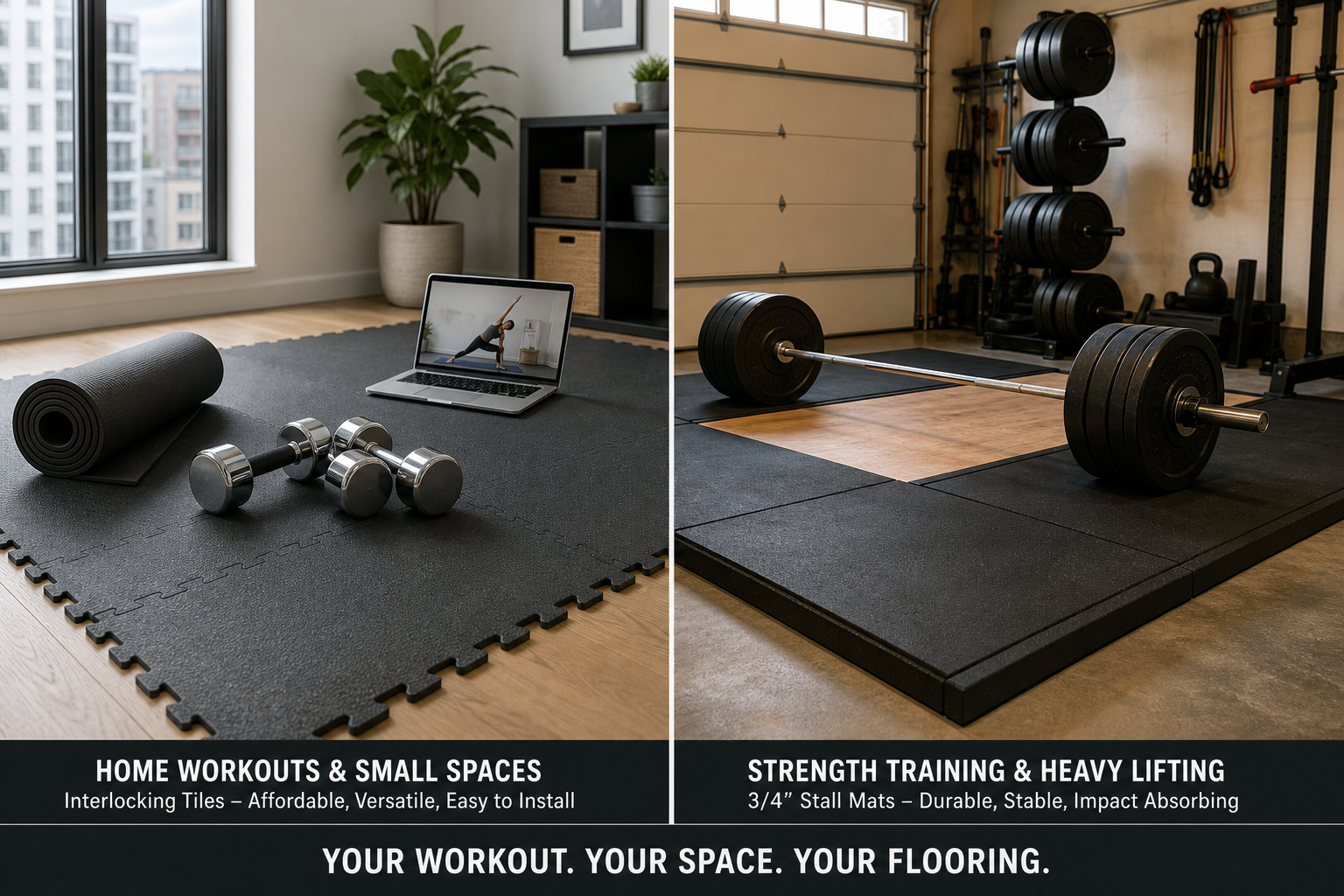
Why the Rubber vs. Foam Decision Matters More Than You Think
Walk into any home gym aisle or scroll through online listings, and you are immediately confronted with a choice: rubber or foam. It looks like a simple preference — pick the color, pick the price, move on. But that framing is misleading. The material you choose directly determines whether your floor protects your equipment, your subfloor, and your safety, or whether it becomes a costly mistake you replace within a year.
The core thesis of this comparison is straightforward: the decision is driven by your workout type and the weight of your equipment, not by aesthetics or upfront cost. Rubber is a necessity for any training that involves dropping weights, heavy gear, or high-impact movement. Foam is adequate only for bodyweight exercises, yoga, stretching, and temporary setups. Overbuying rubber wastes money on material you do not need. Under-buying foam can damage your floor, ruin your equipment, and compromise your stability during lifts.
This article breaks down the two materials across five critical dimensions — composition, durability, cost, performance by activity, and practical considerations for small spaces — so you can make an informed choice the first time.
Material Breakdown: What Rubber and Foam Flooring Actually Are
Before comparing performance, it helps to understand what you are actually buying. Both materials come in several subtypes, and the specific variant affects durability, smell, and cost.
Rubber Flooring
Rubber gym flooring is typically made from one of three materials: natural rubber, SBR (styrene-butadiene rubber), or recycled rubber. SBR and recycled rubber are the most common in home gyms because they offer high durability at a lower cost than natural rubber. Rubber flooring is typically sold in three formats:
- Rolls: Wide sheets (often 4–6 feet wide) that provide a seamless surface. Common thicknesses range from 6mm (1/4") to 19mm (3/4").
- Interlocking tiles: Puzzle-edge tiles that snap together without adhesive. Typically 1/4" to 1/2" thick.
- Stall mats: Thick, dense rubber mats (usually 3/4" or 1") originally designed for livestock stalls. They are the budget-friendly heavyweight option for garage gyms.
Rubber is dense, heavy, and highly resistant to compression. A single 3/4" stall mat from Tractor Supply weighs approximately 94 lbs, which gives you a sense of the material's density.
Foam Flooring
Foam gym flooring is most commonly made from EVA (ethylene-vinyl acetate) or cross-linked polyethylene. These are the same materials used in yoga mats and children's play mats. Foam tiles are almost always interlocking puzzle pieces, typically 1/8" to 1/2" thick.
Foam is lightweight, soft underfoot, and easy to cut with a utility knife. It provides excellent cushioning for bodyweight exercises and is comfortable for kneeling or lying down. However, its softness is also its primary limitation.
| Property | Rubber | Foam |
|---|---|---|
| Common materials | Natural rubber, SBR, recycled rubber | EVA, cross-linked polyethylene |
| Typical thickness | 1/4" to 3/4" (6mm to 19mm) | 1/8" to 1/2" (3mm to 12mm) |
| Common formats | Rolls, interlocking tiles, stall mats | Interlocking tiles, rolls |
| Weight per sq ft | Heavy (e.g., 94 lbs per 4x6 stall mat) | Lightweight |
| Surface feel | Firm, dense, minimal give | Soft, cushioned, compressible |
Durability: Decades vs. Years Under Real Gym Conditions
This is the single most important difference between the two materials. Rubber flooring, when properly installed and maintained, can last decades under heavy gym equipment. Foam flooring, by contrast, compresses, tears, and develops permanent indentations in high-use areas within 1 to 3 years.
The Living.Fit blog, which specializes in home gym flooring, states this directly: rubber can last decades under heavy equipment, while foam compresses faster and degrades under heavy weights. The same source notes that foam develops permanent indentations in high-use areas — meaning once a heavy dumbbell or barbell sits on a foam tile for a period, that spot is permanently compressed.
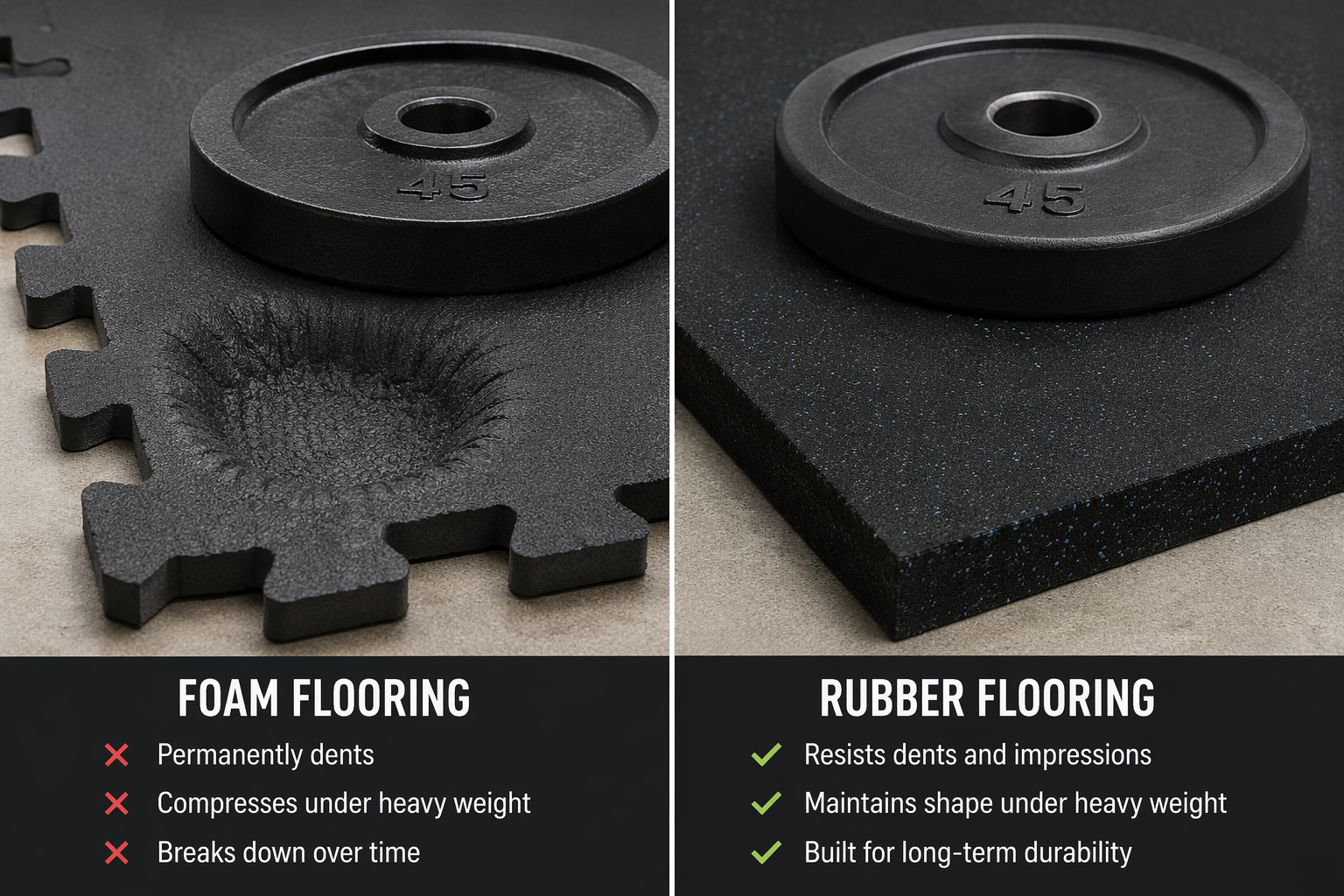
The durability problem with foam is not just cosmetic. When foam compresses unevenly under equipment, it creates an unstable surface. This is particularly dangerous for weightlifting. Coop Mitchell, founder of Garage Gym Reviews, warns that foam "is basically not going to allow you to stabilize during lifts" and compares squatting on foam to "squatting with running shoes." The instability increases the risk of losing balance during heavy lifts.
Rubber, on the other hand, is designed to handle exactly these conditions. A 3/4" rubber stall mat from Tractor Supply, for example, is rated 5/5 for durability by Garage Gym Reviews. Home gym owner Joe Gray, writing on Gray Matter Lifting, confirms that horse stall mats can last close to a decade, and that rubber rolls provide a surface that does not compress under heavy loads.
Cost Comparison: Upfront Price vs. Long-Term Value
The upfront cost difference between foam and rubber is significant. Foam is cheaper per square foot, which makes it attractive for first-time buyers on a tight budget. But the total cost of ownership tells a different story.
| Product | Price per sq ft | Durability Rating | Expected Lifespan |
|---|---|---|---|
| ProsourceFit foam mats | $1.12 | 3/5 (GGR) | 1–3 years |
| Flooring Inc 8mm rubber rolls | $2.17 | 5/5 (GGR) | 10+ years |
| Tractor Supply 3/4" stall mats | $2.38 | 5/5 (GGR) | 10+ years |
| Living.Fit rubber rolls | $2.24 | 4/5 (GGR) | 10+ years |
| Living.Fit interlocking rubber tiles | $5–$10 | 5/5 (GGR) | 10+ years |
At first glance, foam looks like the clear winner: $1.12 per square foot versus $2.17 to $10 for rubber. For a 100-square-foot gym area, foam costs roughly $112, while rubber rolls cost $217 to $238, and interlocking rubber tiles cost $500 to $1,000.
But foam's short-term savings are often erased by replacement costs. If you use your gym regularly — even for moderate bodyweight workouts — foam will likely need replacement within 1 to 3 years. Over a 10-year period, you could buy foam flooring 3 to 10 times, bringing the total cost to $336 to $1,120 or more. Rubber, by contrast, is a single purchase that lasts the entire decade.
The math changes only if your gym is genuinely temporary — a setup you plan to use for less than a year, or one that sees very light use (e.g., occasional yoga or stretching). In those cases, foam's low upfront cost makes sense because you may never need to replace it.
Performance by Workout Type: Which Material Wins Where
The most practical way to decide between rubber and foam is to map each material to the activities you actually do. The table below summarizes the consensus from multiple expert sources.
| Activity | Best Material | Why |
|---|---|---|
| Weightlifting (squats, deadlifts, bench press) | Rubber | Provides stable, non-compressible surface for heavy lifts; absorbs impact from dropped weights; protects subfloor from cracking |
| HIIT / CrossFit | Rubber | High durability under repeated impact; excellent shock absorption for jumps and burpees; resists tearing from dynamic movement |
| Dumbbell work (moderate weights, no drops) | Rubber | Prevents permanent indentations; stable surface for standing exercises |
| Yoga / Pilates | Foam | Soft, comfortable surface for floor poses; good cushioning for joints; easy to roll up and store |
| Stretching / Mobility work | Foam | Comfortable for lying down; lightweight and portable; adequate for bodyweight pressure only |
| Bodyweight circuits (push-ups, planks, lunges) | Foam | Adequate cushioning; no heavy equipment to cause indentations; easy to move for temporary setups |
| Kids' play area | Foam | Soft, safe surface for falls; lightweight and easy to reconfigure; colorful options available |
The pattern is clear: rubber wins for any activity involving heavy equipment, dropped weights, or high-impact movement. Foam is suitable only for activities where your body weight is the maximum load and where surface stability is not a safety concern.
Smell and Off-Gassing: What to Expect from Each Material
One practical consideration that surprises many first-time buyers is the smell. Rubber flooring — especially recycled rubber and SBR stall mats — has a strong, distinctive odor when new. This is the result of volatile organic compounds (VOCs) off-gassing from the manufacturing process. The smell can be intense enough to fill a room for the first few days to weeks.
Garage Gym Reviews rates the Tractor Supply stall mats as having a "mild smell" (4/5 for odor), but many users report a stronger initial odor that dissipates over time. The Flooring Inc rubber rolls are also noted to have a mild smell. The key is to air out rubber flooring before installation — unroll or unpack the tiles in a well-ventilated area (preferably outdoors or in a garage) for several days before bringing them inside.
Foam flooring, by contrast, typically has little to no smell. EVA foam is generally low-VOC and does not produce the same off-gassing as rubber. For apartment dwellers or anyone installing flooring in a bedroom or living space, this can be a meaningful advantage.
Small-Space Considerations: Portability, Weight, and Installation
For readers setting up a gym in an apartment, spare room, or other small space, the material choice has practical implications beyond durability and cost.
Foam: Lightweight and Portable
Foam tiles are lightweight, easy to cut, and simple to install. They can be laid directly on most subfloors without adhesive, and they are easy to remove and reconfigure. This makes foam an excellent choice for renters who need to take their flooring with them, or for anyone who wants a temporary setup that can be packed away.
Rubber Rolls: Heavy and Permanent
Rubber rolls are heavy and require more effort to install. A 4x6 stall mat weighs 94 lbs, and a full roll of rubber flooring can weigh several hundred pounds. Installation typically requires a utility knife, a straightedge, and potentially adhesive for a permanent bond. Gray Matter Lifting notes that one garage floor upgrade with 8mm rolled rubber cost over $2,000, with urethane glue alone costing over $600. Rubber rolls are best suited for permanent installations where you do not plan to move the flooring.
Interlocking Rubber Tiles: The Middle Ground
Interlocking rubber tiles offer a practical compromise. They provide the durability of rubber with the ease of installation of foam tiles. They snap together without adhesive, can be cut to fit irregular spaces, and individual tiles can be replaced if damaged. Gray Matter Lifting recommends Living.Fit and Freedom Fitness interlocking tiles as a middle path that combines easier installation with better durability than foam.
- Foam: Best for temporary setups, renters, and light use. Easy to install, move, and store.
- Rubber rolls: Best for permanent garage or basement gyms. Maximum durability but heavy and difficult to install.
- Interlocking rubber tiles: Best for small spaces where you want rubber durability without the installation hassle. Individual tiles can be replaced.
For readers who are also choosing equipment for a small space, our Compact Home Gym Equipment Guide for Apartments covers noise, footprint, and portability considerations that pair directly with your flooring choice.
Decision Flowchart: Find Your Flooring in Three Questions
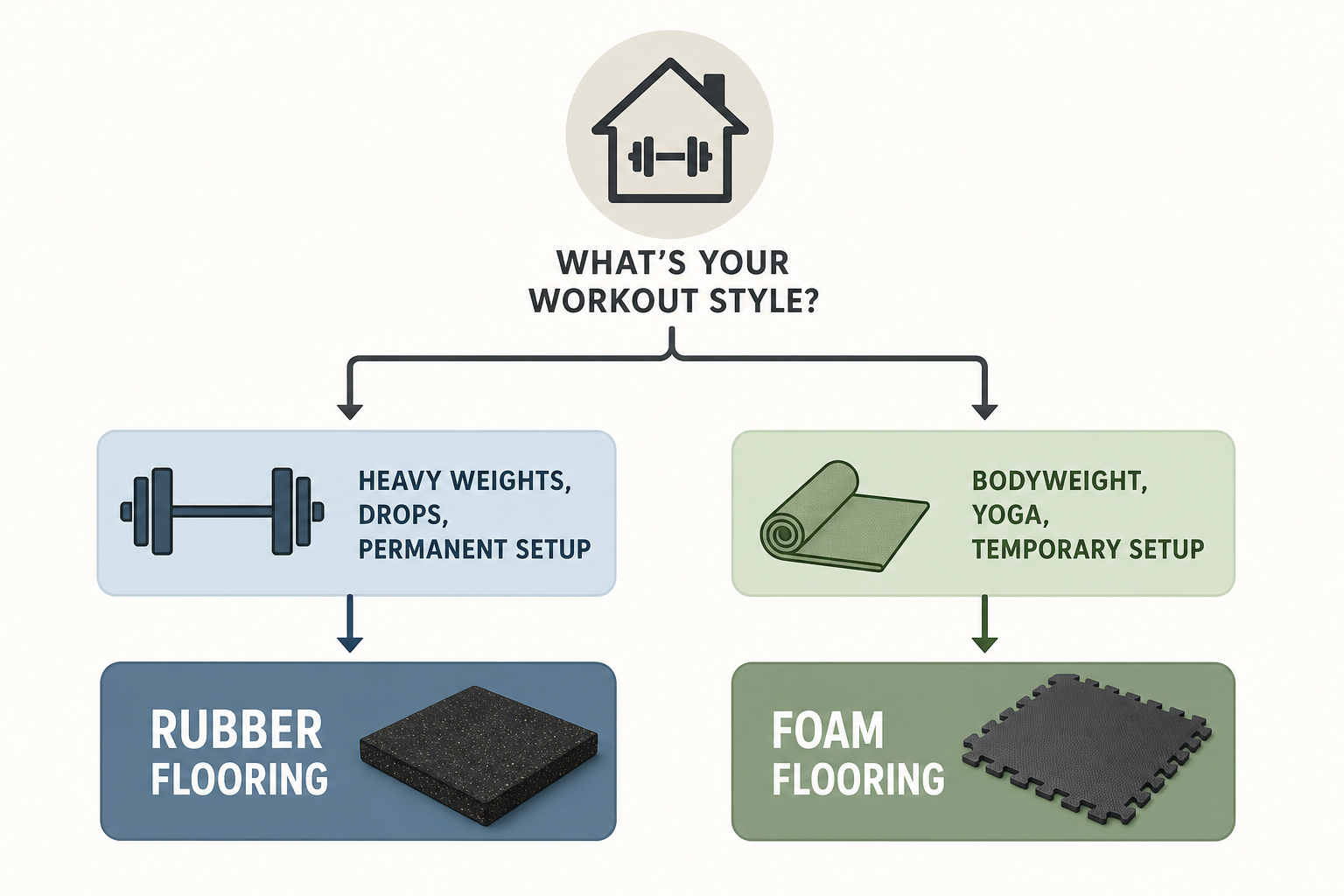
If the detailed comparison above feels like too much information, use this simple three-question framework to make your decision:
- Do you drop heavy weights? If you deadlift, clean, snatch, or drop dumbbells from overhead, you need rubber. Foam will not protect your floor or your equipment.
- Is this a permanent setup? If you plan to keep your gym in the same space for more than a year, rubber is the better long-term investment. Foam's short lifespan will cost you more in replacements.
- Do you prioritize portability? If you are a renter, or if you need to pack up your gym regularly, foam's light weight and easy installation make it the practical choice — provided your workouts are bodyweight only.
The paths are clear:
- Yes to heavy weights + permanent setup → Rubber rolls or stall mats
- Yes to heavy weights + need portability → Interlocking rubber tiles
- No to heavy weights + temporary setup → Foam tiles
- No to heavy weights + permanent setup → Either material works; choose based on budget and comfort preference
For a broader overview that also covers thickness and budget factors, see our Home Gym Flooring: A Decision Guide for Thickness, Material, and Budget. That guide takes a neutral, survey-style approach to all flooring options, while this article focuses specifically on the rubber-versus-foam material conflict with a clear recommendation: choose rubber for any workout involving heavy equipment or dropped weights, and choose foam only for bodyweight and temporary setups.
Some links on this page are affiliate links — they may earn us a commission at no extra cost to you. Our tier and tests are decided before we ever check which links pay; see our full affiliate disclosure.
Spot something off?
Noise and floor-damage claims carry real deposit-risk consequences if we get them wrong — tell us if your experience with this build didn't match what's above.