
The Best Home Treadmill for Your Running Style: Matching CHP, Deck Length, and Cushioning to Marathon Training, HIIT Sprints, or Casual Jogging
Most treadmill guides treat all runners the same. This article helps marathoners, HIIT athletes, and casual joggers choose the right treadmill by matching motor power, deck size, and cushioning to their specific running volume and training style.

Why Your Running Style Matters More Than Your Budget
Most treadmill buying guides start with a price bracket and then list every machine that fits within it. That approach works if you are buying a toaster, but it fails runners because it ignores the single most important variable: how you actually run. A marathoner logging 35 miles per week, a HIIT athlete doing repeated 30-second sprints, and a casual jogger covering three miles three times a week have fundamentally different requirements in motor power, deck length, and cushioning. Treating them as the same buyer leads to a treadmill that either wears out prematurely, forces you to shorten your stride, or delivers a ride that feels wrong for your training.
This guide abandons the budget-first framework. Instead, it matches three critical treadmill specifications — continuous horsepower (CHP), deck size, and cushioning system — to three distinct runner profiles. By the end, you will know exactly which motor rating, belt length, and cushioning type your running style demands, and which specific models deliver on those requirements.
Treadmill Requirements by Runner Type
Before diving into individual specs, it helps to see how the three runner profiles map to the key treadmill dimensions. The table below summarizes the priorities for each type. The sections that follow will explain the reasoning behind each recommendation.
| Runner Profile | Weekly Volume | Motor CHP | Deck Size | Cushioning Priority | Control Priority |
|---|---|---|---|---|---|
| Marathon / High-Volume Runner | 30+ miles per week | 3.5 – 4.25 CHP | 22" x 60" | Maximum impact reduction (fixed or toggleable soft zone) | Decline training, steady-state speed accuracy |
| HIIT / Speed Work Athlete | 10–20 miles per week, mostly intervals | 3.0 – 3.5 CHP | 20" x 60" | Firmer feel for rapid pace changes (variable zone) | Quick speed/incline transitions (dial or one-touch) |
| Casual Jogger | 6–15 miles per week, 3–5 miles per session | 3.0 CHP minimum | 20" x 60" | Any system; comfort is the main concern | Simple interface, reliable preset programs |
The table makes one thing clear: the marathoner and the HIIT athlete have overlapping but distinct needs. Both need a 60-inch deck, but the marathoner needs more motor power and softer cushioning, while the HIIT athlete needs faster control response and a firmer platform. The casual jogger has the widest tolerance but still needs a motor that can handle regular running — which rules out entry-level machines.
Motor CHP: How Much Power Do You Really Need?
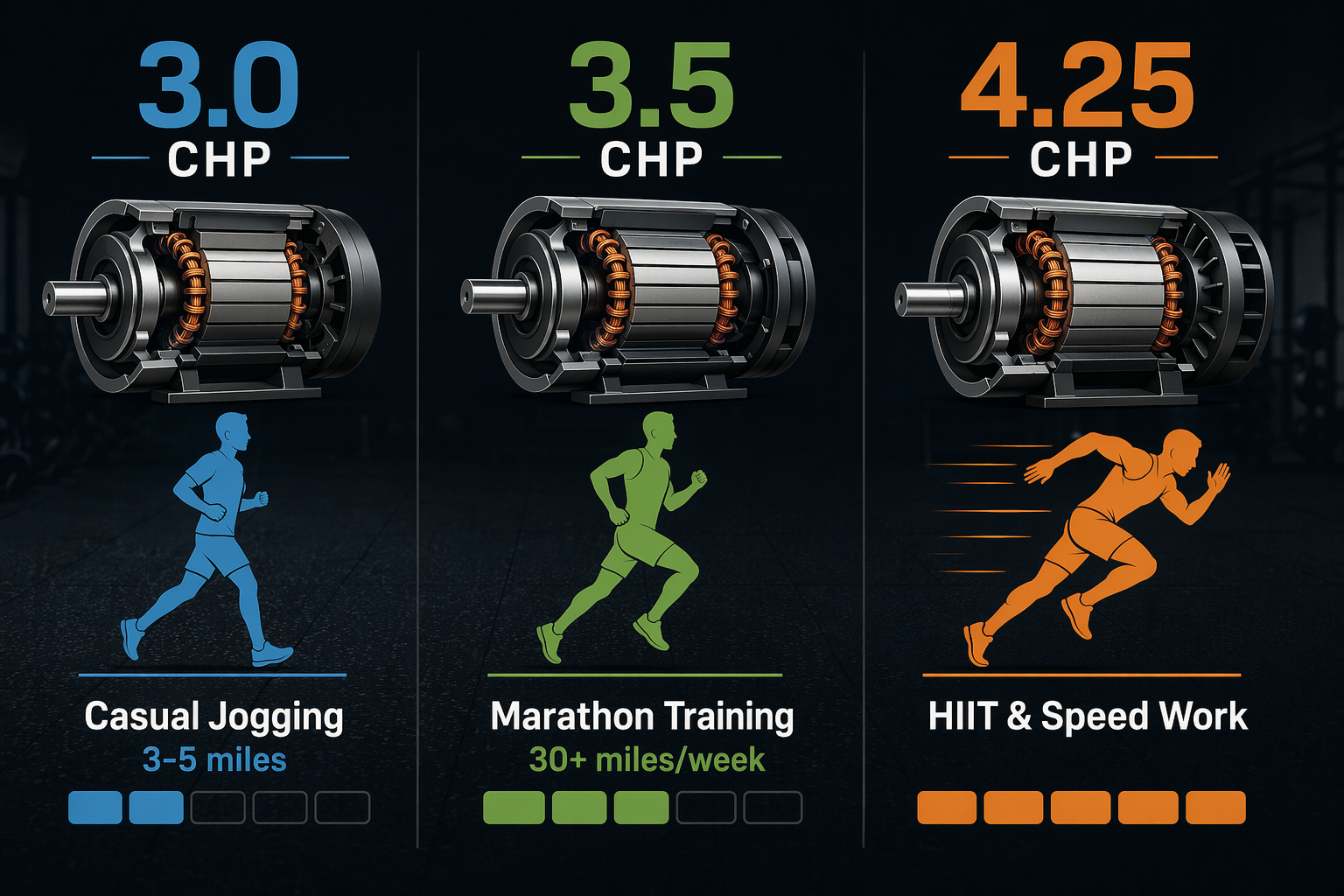
The motor is the heart of any treadmill, and the only rating that matters is Continuous Horsepower (CHP). Peak HP is a marketing number — it measures the motor's maximum output for a few seconds, not its sustained capability. CHP tells you how much power the motor can deliver continuously, which is what matters when you are running for 30 minutes or more.
According to a comprehensive motor guide from TreadmillReviews.net, a 3.0 CHP motor is the absolute minimum for regular running. A 2.5 CHP motor — like the one in the Horizon T101 — is insufficient for running and will wear out quickly under regular use. For heavier runners (200+ pounds) or those who do significant incline work, the recommendation rises to 3.5–4.25 CHP. Motor RPMs under 4,000 indicate higher torque and better durability, while RPMs over 5,000 are a red flag for longevity.
| Running Volume | Body Weight | Minimum CHP | Recommended CHP | Motor Warranty Signal |
|---|---|---|---|---|
| Casual (3–5 miles, 2–3x/week) | Under 200 lbs | 3.0 CHP | 3.0 CHP | 10-year motor warranty (e.g., Sole F63) |
| Moderate (10–20 miles/week) | Under 200 lbs | 3.0 CHP | 3.5 CHP | Lifetime motor warranty (e.g., Sole F80) |
| High Volume (30+ miles/week) | Under 200 lbs | 3.5 CHP | 4.25 CHP | Lifetime motor warranty (e.g., NordicTrack 1750) |
| Any volume | 200+ lbs | 3.5 CHP | 4.25 CHP | Lifetime motor warranty |
Motor warranty length is the best proxy for quality. According to the same motor guide, a warranty under 5 years indicates sub-par construction; 5–10 years is standard; and 10 years to lifetime signals premium quality. The Sole F63, for example, carries a lifetime motor warranty despite its 3.0 CHP rating, which suggests the manufacturer stands behind its durability for its intended use case. The NordicTrack Commercial 1750, with its 4.25 CHP motor and lifetime motor warranty, is the consensus pick across multiple tester sources for runners doing mixed training at high volume.
Deck Size: Matching Belt Length to Your Stride
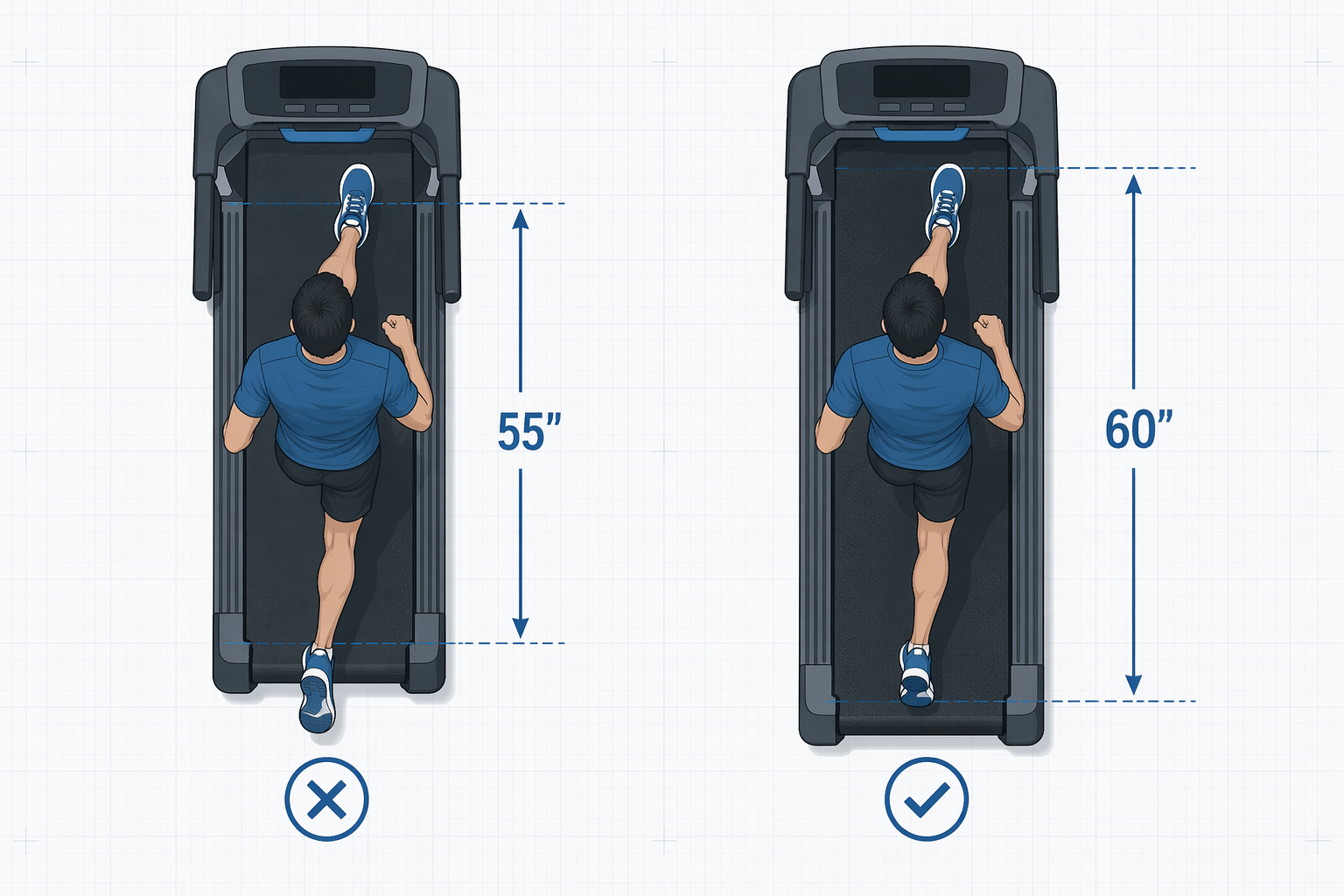
Deck length is the most overlooked specification in treadmill buying, yet it directly affects your running form and injury risk. A deck that is too short forces you to shorten your stride, which alters your biomechanics and can lead to hip, knee, or lower back strain over time.
For runners over 5'8", a 60-inch deck is the minimum for maintaining a natural stride. Shorter decks — the Horizon T101 has a 55-inch deck — are designed for walkers and shorter users. If you are 5'8" or taller and try to run at speed on a 55-inch deck, you will find yourself either running too close to the front motor cover or constantly checking your footing to avoid stepping off the back of the belt.
| Runner Height | Minimum Deck Length | Recommended Deck Length | Deck Width |
|---|---|---|---|
| Under 5'4" | 55" | 60" | 20" |
| 5'4" – 5'8" | 60" | 60" | 20" |
| 5'8" – 6'0" | 60" | 60" | 22" |
| Over 6'0" | 60" | 60" or longer (if available) | 22" |
Deck width is a secondary concern. A 20-inch wide belt is sufficient for most runners, but a 22-inch wide belt — found on the NordicTrack 1750, Sole F80, and Horizon 7.4 AT — provides extra lateral room, which is especially useful during longer runs when form can deteriorate. If you are over 6'0" or have a wider stance, prioritize 22-inch width.
For apartment dwellers or those with strict space constraints, the challenge is finding a compact treadmill that still meets running specs. Many folding treadmills with 60-inch decks exist, but they often compromise on motor power or cushioning. Our Small Treadmill Buying Guide covers the specific specs to check when space is tight but running performance is non-negotiable.
Cushioning Systems: Fixed, Variable, and Toggleable
Cushioning is the treadmill's suspension system. It absorbs the impact of each footstrike and reduces the stress transmitted through your joints. The right cushioning system depends on your running style: distance runners need maximum impact reduction to protect joints over thousands of repetitions, while HIIT athletes often prefer a firmer surface that provides better energy return during explosive movements.
There are three main approaches to treadmill cushioning, and each suits a different runner profile.
| Cushioning Type | How It Works | Best For | Example Models |
|---|---|---|---|
| Fixed Cushioning | The entire deck has a uniform level of cushioning, usually achieved through elastomers or rubber bushings under the deck. | Distance runners who want consistent, predictable impact reduction across every stride. | Sole F63, Sole F80 (Cushion Flex Whisper Deck) |
| Variable Zone Cushioning | The deck is divided into zones with different firmness levels — softer in the impact zone (front), firmer in the push-off zone (rear). | Runners who want a more natural feel that mimics outdoor running; HIIT athletes who need a firm push-off for speed work. | Horizon 7.4 AT (3-Zone Variable Response Cushioning) |
| Toggleable Cushioning | The user can adjust the firmness of the deck, usually by turning a knob or inserting/removing cushioning pads. | Households with multiple runners of different types, or runners who want different settings for different workouts. | NordicTrack Commercial 1750 (RunFlex cushioning) |
Sole's Cushion Flex Whisper Deck, found on the F80 and F63, is a fixed system that the manufacturer claims reduces joint impact by up to 40% compared to running on asphalt. While this figure comes from Sole's own marketing and has not been independently verified, multiple tester reviews confirm that the F80 provides a noticeably softer landing than many competitors. The deck is also reversible, which doubles its lifespan — a practical consideration for high-mileage runners.
The Horizon 7.4 AT uses a 3-Zone Variable Response system with a 1.6-mm, 2-ply belt. The front zone is softer to absorb initial impact, while the rear zone is firmer to provide a stable platform for push-off. This design is particularly well-suited to HIIT runners who transition rapidly between sprinting and recovery paces, because the firmer rear zone gives better traction and energy return during explosive movements.
The NordicTrack Commercial 1750 features RunFlex cushioning, which Garage Gym Reviews describes as providing a smooth, quiet ride. The 1750 also has the thickest traditional belt tested by GGR — a 2.8-mm, 2-ply belt — which contributes significantly to impact absorption. The combination of a thick belt and adjustable cushioning makes the 1750 the most versatile option for runners who do a mix of long slow distance and speed work.
Top Picks for Each Runner Type
The following recommendations are based on the runner-type framework established above. Each pick is chosen because its specifications align with the demands of that runner profile — not because it is the most expensive or the most popular model in its category.
For Marathoners and High-Volume Runners: NordicTrack Commercial 1750
The NordicTrack Commercial 1750 is the consensus top pick across multiple independent tester sources for runners who log significant weekly mileage. Its 4.25 CHP motor provides ample headroom for sustained running at any pace, including incline work. The 22" x 60" deck accommodates tall runners with long strides, and the 2.8-mm, 2-ply belt is the thickest traditional belt tested by Garage Gym Reviews, delivering exceptional impact absorption.
Key features for marathoners include a -3% to 12% incline range (decline training is valuable for building eccentric strength and simulating downhill sections of a race course), RunFlex cushioning that can be adjusted for preference, and a lifetime motor warranty. TreadmillReviews.net measured the 1750 at 50.8 dB at 3 mph (belt only), making it one of the quieter options in its class — a meaningful consideration for early-morning or late-night runs in shared living spaces.
The primary trade-off is the iFIT subscription requirement for full functionality. If you want to avoid subscription lock-in, the Sole F80 is a strong alternative. It has a 3.5 CHP motor, the same 22" x 60" deck, the Cushion Flex Whisper Deck, and a lifetime frame and motor warranty — all without a mandatory subscription. The F80 is quieter at walking speed (53.8 dB per TreadmillReviews.net) and its cushioning is fixed rather than toggleable, but for pure distance running, it is a proven workhorse.
For HIIT and Speed Work Athletes: Horizon 7.4 AT
HIIT training places unique demands on a treadmill. Rapid transitions between walking recovery and all-out sprinting require controls that respond instantly, and a cushioning system that provides a firm platform for explosive push-offs. The Horizon 7.4 AT excels on both fronts.
The 7.4 AT's QuickDial controls allow you to adjust speed and incline by turning a dial — no button mashing, no waiting for digital lag. This is a genuine advantage during interval workouts where every second of transition time matters. The 3-Zone Variable Response Cushioning provides a firmer feel in the rear zone for better energy return during sprints, while the softer front zone absorbs the impact of each footstrike.
With a 3.5 CHP motor (the 7.4 AT is often listed with a 3.5 CHP rating in tester reviews) and a 60" x 22" deck, it has sufficient power and space for interval work. Garage Gym Reviews gave it a score of 4.3/5, noting its smooth operation and responsive controls. The 1.6-mm, 2-ply belt is thinner than the NordicTrack or Sole options, but the variable cushioning compensates by providing targeted support where it matters most.
For Casual Joggers: Sole F63
The Sole F63 is the best budget pick for runners who cover 3–5 miles per session, two to three times per week. It has a 3.0 CHP motor — the minimum for running — and a 20" x 60" deck, which is sufficient for most runners under 5'8". The Cushion Flex Whisper Deck provides the same impact-reducing technology found in the more expensive F80, just on a slightly narrower belt.
What makes the F63 a standout for casual joggers is its lifetime frame and motor warranty. At this price point, most competitors offer 10-year motor warranties at best. The lifetime warranty signals that Sole expects the motor to outlast the machine's other components, which is reassuring for a runner who plans to keep the treadmill for a decade or more. Garage Gym Reviews gave the F63 a score of 4.3/5, calling it a reliable, no-frills running treadmill.
The trade-off is a slower, noisier incline adjustment and a 2.3-mm belt that, while adequate, is not as plush as the NordicTrack 1750's 2.8-mm belt. For a casual jogger doing moderate volume, these are acceptable compromises. If your budget allows a step up, the Sole F80 adds a 3.5 CHP motor and a 22-inch wide belt for roughly $300–$400 more.
Side-by-Side Spec Comparison
The table below compares the top picks and the Sole F80 alternative across the specifications that matter most for runners. Use it to make direct comparisons without scrolling back through the article.
| Specification | NordicTrack 1750 | Sole F80 | Horizon 7.4 AT | Sole F63 |
|---|---|---|---|---|
| Best For | Marathon / High-Volume | Marathon / High-Volume (no subscription) | HIIT / Speed Work | Casual Jogging |
| Motor CHP | 4.25 CHP | 3.5 CHP | 3.5 CHP | 3.0 CHP |
| Deck Size | 22" x 60" | 22" x 60" | 22" x 60" | 20" x 60" |
| Belt Thickness | 2.8 mm, 2-ply | Not specified | 1.6 mm, 2-ply | 2.3 mm, 2-ply |
| Cushioning Type | RunFlex (toggleable) | Cushion Flex Whisper Deck (fixed) | 3-Zone Variable Response (variable) | Cushion Flex Whisper Deck (fixed) |
| Incline Range | -3% to 12% | 0% to 15% | 0% to 15% | 0% to 15% |
| Noise Level (walking) | 50.8 dB | 53.8 dB | Quietest motor tested (source: TreadmillReviews.com) | Slow but quiet transitions |
| Motor Warranty | Lifetime | Lifetime | Lifetime | Lifetime |
| Subscription Required | Yes (iFIT) | No | No | No |
| Price Tier | $1,500+ | $1,200 – $1,500 | $1,200 – $1,500 | Under $1,000 |
For marathoners who want the best cushioning and motor power without a subscription, the Sole F80 is the clear alternative to the NordicTrack 1750. It trades the 1750's 4.25 CHP motor and decline training for a quieter, simpler machine with the same deck size and a lifetime warranty. For HIIT athletes, the Horizon 7.4 AT's QuickDial controls and variable cushioning make it the most responsive option on this list. And for casual joggers, the Sole F63 delivers the essential running specs at the lowest price point with the best warranty in its class.
Frequently Asked Questions
Can I run on a 2.5 CHP treadmill?
No. A 2.5 CHP motor is designed for walking and occasional jogging. Running on it regularly will cause the motor to overheat, the belt to slip, and the drive system to fail prematurely. Multiple expert sources, including TreadmillReviews.net and Garage Gym Reviews, state that 3.0 CHP is the minimum for regular running. The Horizon T101, with its 2.5 CHP motor and 55-inch deck, is a common example of a treadmill that looks like a bargain but is fundamentally unsuitable for runners.
What is the difference between CHP and HP?
CHP (Continuous Horsepower) measures the motor's sustained output over time. HP (Horsepower) on a treadmill spec sheet is almost always Peak HP, which measures the motor's maximum output for a few seconds. A motor rated at 4.0 HP peak might have a CHP rating of only 2.5. Always look for the CHP rating. If a manufacturer only lists Peak HP, treat the specification with skepticism and look for independent tester data.
How long should a treadmill motor last?
With proper maintenance — regular belt lubrication, keeping the motor area clean, and not exceeding the weight limit — a treadmill motor typically lasts 7 to 12 years. Motor warranty length is the best predictor of expected lifespan. A 10-year warranty suggests the manufacturer expects the motor to last at least that long under normal use. Lifetime motor warranties, like those on the Sole F63, F80, and NordicTrack 1750, indicate the highest confidence in motor durability.
Do I need a subscription for any of these treadmills?
Of the four models compared above, only the NordicTrack Commercial 1750 requires a subscription (iFIT) to access its full feature set, including interactive training programs, automatic trainer control, and the full library of workout content. You can still use the 1750 manually without a subscription, but you lose the guided workout experience. The Sole F80, Sole F63, and Horizon 7.4 AT all operate fully without any subscription. If avoiding ongoing costs is a priority, the Sole or Horizon models are the better choice.
Is a folding treadmill stable enough for running?
Yes, if the treadmill is designed for running. The Sole F63 and Sole F80 are both folding treadmills, and they are widely recommended for running by multiple tester sources. The key is to check the motor CHP, deck size, and weight capacity rather than assuming that folding equals flimsy. Many non-folding treadmills have weaker motors and smaller decks than their folding counterparts. The folding mechanism adds some complexity and potential failure points, but on well-built models like the Sole F63, the trade-off is worth it for the space savings.
For runners who need a compact folding design that still meets running specs, our Best Space-Saving Home Gym Equipment guide covers additional options that balance footprint with performance.
This result comes from one real apartment under the stated conditions — it is a strong signal, not a guarantee your space will measure identically.
Builds this evidence supports
Small Treadmill Buying Guide: 7 Critical Specs to Check Before You Buy
A cross-category spec primer for apartment and small-space dwellers comparing walking pads, ultra-compact folding treadmills, and full-size folding treadmills. Learn the concrete thresholds for motor HP, deck length, noise, warranty, and subscription lock-in so you can compare apples to apples.
Compact Home Gym Buyer's Guide: 8 Questions to Answer Before Buying a Single Piece of Gear
Most compact home gym purchases fail not because of bad products, but because buyers skip the constraint-framing step. This guide helps complete beginners with limited space ask the right questions about noise, space, training style, budget, and growth plans before evaluating any gear.
Spot something off?
If this result didn't match your own space, let us know — floor-damage and noise claims carry real deposit-risk consequences if we get them wrong.