
Home Gym Cable Machine Pulley Ratios: What 1:1 vs 2:1 Means for Your Training
Pulley ratio is the most misunderstood spec in cable machine buying. This guide explains the physics of 1:1 vs 2:1, how each ratio affects felt weight and cable travel, and which machines use which configuration — so you can choose the right setup for heavy back work, isolation movements, or both.
Why Pulley Ratio Matters More Than Most Buyers Realize
When you start shopping for a home gym cable machine, the spec sheet hits you with a wall of numbers: weight stack size, footprint, cable travel, pulley ratio. Most buyers skip straight to the stack weight — 200 lbs sounds like plenty — and only discover the problem after the machine is bolted together in their garage. The lat pulldown that should feel challenging at 150 lbs feels suspiciously light. The cable row that should build a thick back feels like a warm-up. The culprit is almost always the pulley ratio.
Pulley ratio is the single most misunderstood specification in cable machine buying. It determines how much of the weight on the stack actually reaches your hands, and how far the cable travels for each repetition. A machine with a 200 lb stack and a 2:1 ratio delivers only 100 lbs of felt resistance — a fact that catches even experienced lifters off guard. Understanding this one number before you buy separates a machine that matches your training from one that frustrates you every session.
This article is a pure educational deep-dive into pulley ratio physics and training implications. If you are still deciding between a rack-mounted unit, a standalone functional trainer, or a wall-mounted system, start with our format-first buying guide first. That guide covers the big-picture format decision. This one covers the physics that makes or breaks your experience once you have a format in mind.
How Pulley Ratios Work: The Simple Physics Behind 1:1 and 2:1
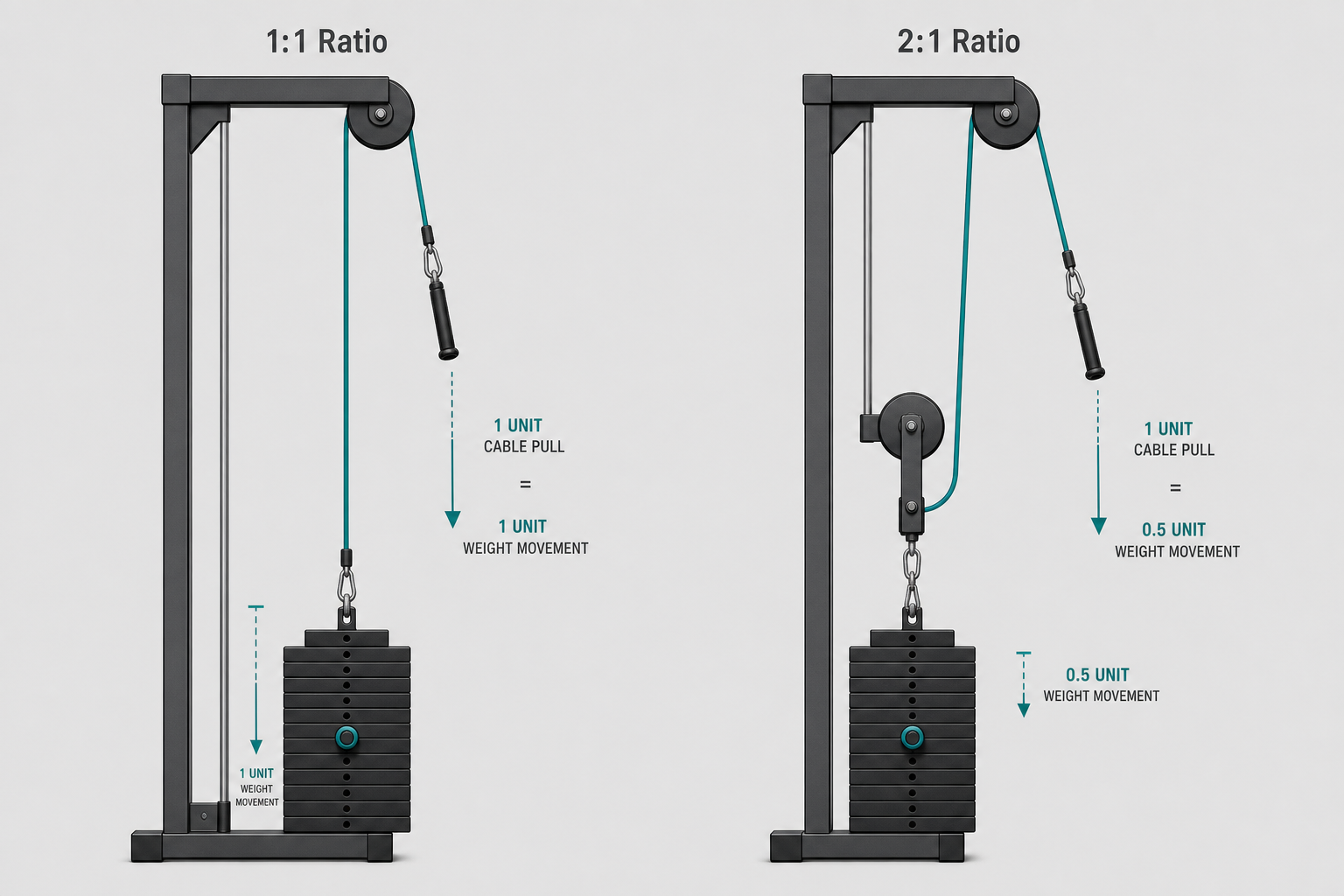
A pulley system is a mechanical advantage device. It trades force for distance — or in the case of a cable machine, it trades felt weight for cable travel. The ratio tells you how much cable moves for each unit of weight-stack movement.
In a 1:1 system, the cable is attached directly to the weight stack with a single pulley redirecting the direction. Pull the handle one foot, the weight stack rises one foot. The weight you feel at the handle equals the weight on the stack. No mechanical advantage, no disadvantage — just honest, direct resistance. As Gray Matter Lifting puts it in their FAQ, "If a machine is a 1:1 ratio, that means 100 lbs FEELS like 100 lbs."
In a 2:1 system, the cable loops through a pulley on the weight stack before reaching the handle. This creates a mechanical advantage of 2:1. Pull the handle one foot, and the weight stack rises only half a foot. The trade-off: the felt weight at the handle is half of what is on the stack. A 200 lb stack feels like 100 lbs. The same Gray Matter Lifting FAQ notes that "the higher the ratios typically have smoother cable operation, especially for smaller movements."
1:1 Ratio: Honest Weight for Heavy Compound Work
A 1:1 cable machine delivers exactly what it says on the weight stack. If you pin 200 lbs, you pull 200 lbs. The cable travel is relatively short — about the same distance the weight stack moves — which means the resistance profile feels direct and immediate. There is no delay, no stretch, no mechanical cushioning. It is the closest a cable machine gets to the feel of a barbell or dumbbell.
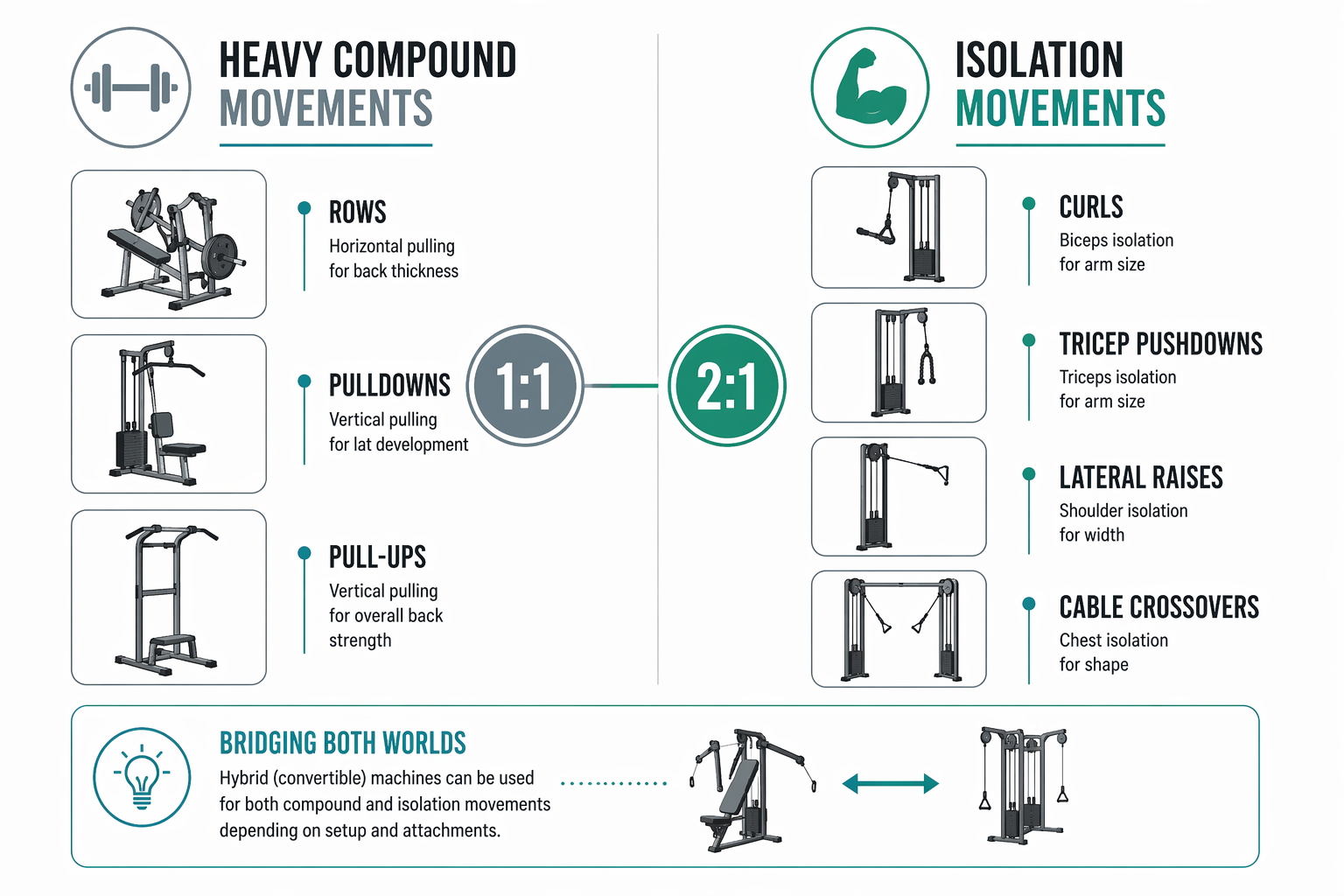
This makes 1:1 the clear choice for heavy compound cable work:
- Lat pulldowns — you need honest resistance to load the lats through a full range of motion
- Seated cable rows — building a thick back requires pulling real weight, not half-weight
- Straight-arm pulldowns and pullovers — compound movements that benefit from direct loading
- Low-pulley rows and face pulls at heavier loads
In commercial gyms, 1:1 is the standard. The cable crossover machines and lat pulldown stations you have used at the gym almost certainly use a 1:1 configuration. When you bring a cable machine home, that is the reference point your nervous system expects.
For home gym buyers, the Force USA G12 and Body-Solid GDCC250 are the two major picks offering true 1:1 ratio across all cable positions. Strong Home Gym confirms that the Force USA G12 uses a 1:1 pulley ratio and notes that "the 200 lb stack actually feels like 200 lb in your hands, rather than the 2:1 ratio most home cable machines use." The Body-Solid GDCC250 is also listed as 1:1 in the same guide.
2:1 Ratio: Smooth Isolation and High-Rep Work
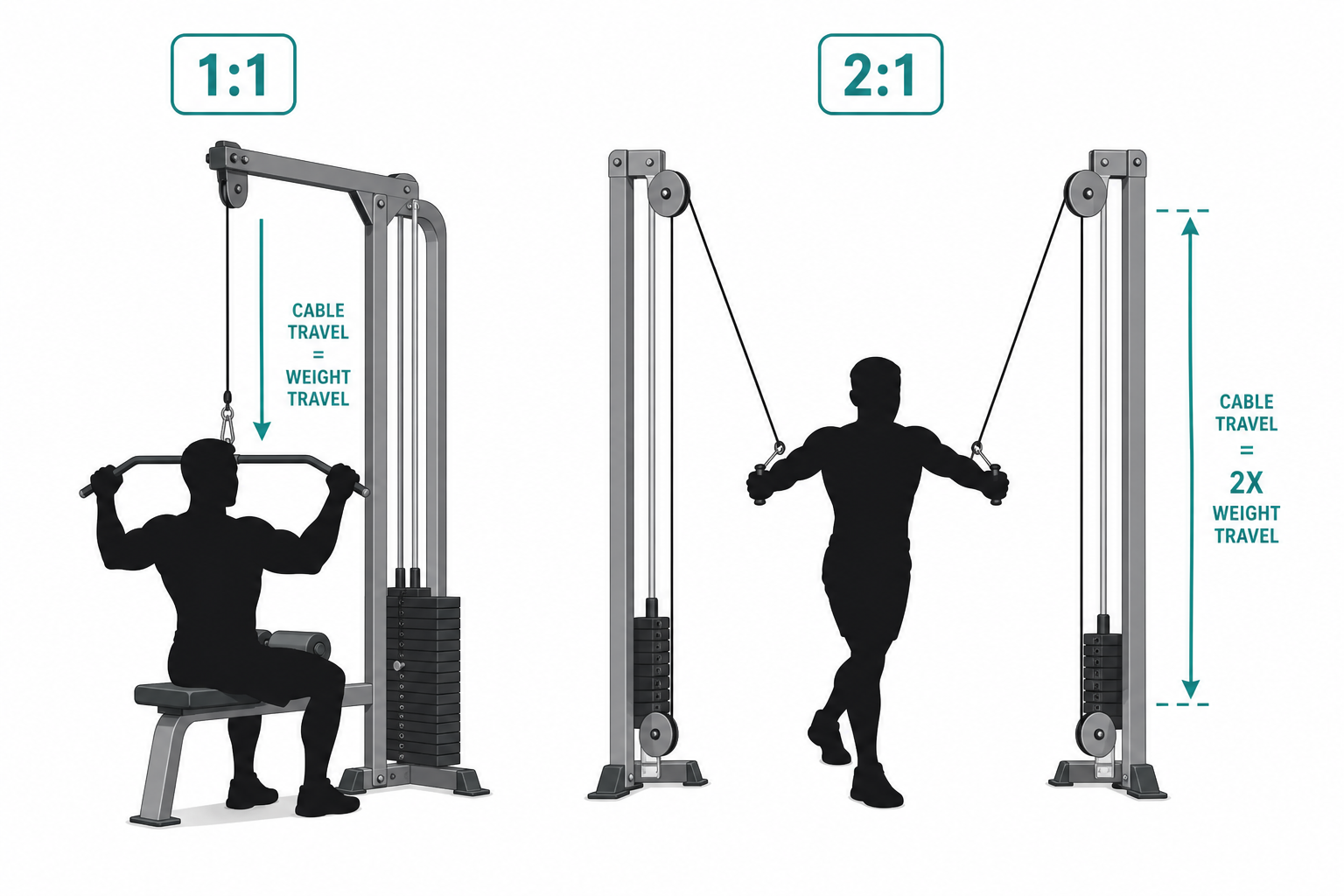
A 2:1 cable machine halves the felt weight but doubles the cable travel. That extra cable travel creates a noticeably smoother feel through the movement. The resistance builds more gradually, the transition at the top and bottom of each rep is less abrupt, and the overall sensation is more fluid. For isolation exercises and high-rep work, this is a feature, not a bug.
The 2:1 ratio excels at:
- Cable crossovers — the extra cable travel allows a full stretch and contraction without the stack bottoming out
- Tricep pushdowns and overhead extensions — smooth, controlled resistance through a long range of motion
- Bicep curls — the gradual resistance build-up reduces joint stress at the bottom of the curl
- Lateral raises and front raises — light enough to isolate the delts without cheating
- Fast, explosive movements — the mechanical cushioning protects the joints during high-speed work
Most home functional trainers use 2:1 as their primary ratio. Garage Gym Reviews lists the REP Ares 2.0 and Titan Fitness Functional Trainer as 2:1 machines. Strong Home Gym adds the Inspire Fitness FT2 to the 2:1 list. These machines are designed for versatility — they handle isolation work beautifully and can manage moderate compound work if the stack is heavy enough.
Convertible and Hybrid Options: Getting the Best of Both Ratios
What if you want honest weight for back work and smooth isolation for arms and shoulders? A growing number of home gym cable machines offer both ratios — either through dedicated stations, included adapters, or interchangeable pulley systems.
| Machine | Primary Ratio | 1:1 Option | How It Works |
|---|---|---|---|
| REP Ares 2.0 | 2:1 on swiveling pulleys | 1:1 on lat pulldown / low row | Dedicated 1:1 stations built into the rack |
| REP Athena | 2:1 | 1:1 adapter included | Adapter changes cable routing for 1:1 feel |
| Bells of Steel Cable Tower 2.0 | 2:1 | 1:1 adapter included | Adapter modifies pulley path to 1:1 |
| Major Fitness B17 | Interchangeable | Switchable mid-workout | Change pulley configuration without tools |
The REP Ares 2.0 takes a hybrid approach. Its swiveling crossover pulleys operate at 2:1, which is ideal for cable crossovers and isolation work. But the dedicated lat pulldown and low row stations use a 1:1 ratio, giving you honest weight for the two most important back exercises. Strong Home Gym confirms this split configuration: "2:1 (also 1:1 on the lat pulldown / low row stations)."
The REP Athena and Bells of Steel Cable Tower 2.0 take a different route. Both ship with a 1:1 adapter that changes the cable routing to deliver honest weight. The adapter is a simple mechanical change — you install it when you want 1:1 feel and remove it when you want the smooth 2:1 experience. Strong Home Gym lists the REP Athena as "1:1 + 2:1" and the BoS Cable Tower 2.0 as "2:1 ratio with 1:1 adapter included."
The Major Fitness B17 is the only machine in its class with an interchangeable pulley system that can be switched mid-workout without tools. Garage Gym Reviews highlights the B17 "for its incredible versatility and interchangeable pulley ratios" and lists its cable ratio as "Interchangeable 1:1 or 2:1 cable pulley ratio." The B17 also features dual 130 lb weight stacks that can be expanded up to 260 lbs, giving you real headroom for heavy work at either ratio. For readers interested in all-in-one machines, our complete 2026 comparison guide covers the B17 and other multi-function systems in detail.
The Practical Impact: What 165 lbs at 2:1 Actually Feels Like
Let us make this concrete. A common weight stack size for home functional trainers is 165 lbs per side. At 2:1, that delivers only 82.5 lbs of felt resistance per cable. For a lat pulldown, that is roughly the equivalent of a 90 lb stack on a commercial machine — light enough that most intermediate male lifters will max it out within weeks. For cable rows, 82.5 lbs per arm is barely a working set for someone who rows 150+ lbs with a barbell.
This is the most common source of buyer disappointment in the home cable machine market. A buyer sees "165 lb weight stack" and assumes it will feel like the 200 lb stack at their commercial gym. They do not realize the 2:1 ratio cuts that 165 lbs in half. The machine arrives, they do their first lat pulldown session, and the disappointment sets in by the third set.
| Stack Weight | Ratio | Felt Weight | Suitable For |
|---|---|---|---|
| 165 lbs | 2:1 | 82.5 lbs | Isolation, light back work, beginners |
| 200 lbs | 2:1 | 100 lbs | Isolation, moderate back work, intermediates |
| 260 lbs | 2:1 | 130 lbs | Heavy back work, strong intermediates |
| 200 lbs | 1:1 | 200 lbs | Heavy back work, advanced lifters |
| 300 lbs | 1:1 | 300 lbs | Very heavy back work, strong advanced lifters |
The math works both ways. A 2:1 machine with a 300 lb stack delivers 150 lbs felt — enough for most lifters' heavy back work. But 300 lb stacks are rare in home cable machines. Most functional trainers top out at 200–210 lbs per side. That is why understanding the ratio before you buy is essential: it tells you whether the machine's stack is actually heavy enough for your training.
Which Ratio Is Right for Your Training? A Quick Decision Guide
| Your Primary Training Focus | Recommended Ratio | Minimum Stack Weight | Machine Type to Look For |
|---|---|---|---|
| Heavy back work (rows, pulldowns) | 1:1 | 200 lbs | 1:1 dedicated machine or hybrid with 1:1 stations |
| Bodybuilding isolation (crossovers, curls, pushdowns) | 2:1 | 150 lbs felt (300 lbs stack) | Standard 2:1 functional trainer |
| Mixed training (back + isolation) | Hybrid or convertible | 200+ lbs per side | REP Ares 2.0, REP Athena, BoS Cable Tower 2.0, Major Fitness B17 |
| High-rep / metabolic conditioning | 2:1 or 4:1 | 100 lbs felt | Lightweight functional trainer or pulley tower |
| Rehabilitation / light training | 2:1 or 4:1 | 50–100 lbs felt | Budget pulley tower or plate-loaded unit |
If you are still unsure, ask yourself one question: what is the heaviest cable exercise you do regularly? If the answer is lat pulldowns or cable rows with more than 100 lbs, you need either a 1:1 machine or a 2:1 machine with a very heavy stack (260+ lbs). If the answer is cable crossovers, tricep pushdowns, or lateral raises, a standard 2:1 functional trainer will serve you well.
Next Steps: From Understanding Ratios to Choosing Your Machine
Pulley ratio is the spec that determines whether your cable machine feels right from day one or leaves you shopping for an upgrade within a year. A 1:1 ratio delivers honest weight for heavy compound work. A 2:1 ratio provides smooth, fluid resistance for isolation and high-rep movements. Hybrid and convertible machines let you have both — but they come with trade-offs in complexity and cost.
Before you buy, confirm three numbers: the stack weight, the pulley ratio, and the resulting felt weight. If the felt weight is too low for your heaviest cable exercise, move on to a different machine. That one number — the ratio — is the difference between a machine that grows with you and one you outgrow in months.
Ready to move from understanding ratios to selecting a specific machine? Our format-first cable machine buying guide walks you through the format decision (rack-mounted vs standalone vs wall-mounted vs portable) and then matches each format to specific brands and models. For a system-level view that includes resistance types, footprint, and total cost, see our home gym systems comparison.
This result comes from one real apartment under the stated conditions — it is a strong signal, not a guarantee your space will measure identically.
Builds this evidence supports
No build currently links to this specific test. Browse all builds with a matching tag.
Spot something off?
If this result didn't match your own space, let us know — floor-damage and noise claims carry real deposit-risk consequences if we get them wrong.