
Why Jumping Fails When You Live Downstairs
I knew it was over after my third burpee. The downstairs neighbor thumped the ceiling — not a warning, a pipe rattle that made it clear: this building was not built for jumping. If you’ve lived in an apartment for more than a month, you know the scene. The standard advice — “just do burpees, jump squats, jump rope” — assumes you have a ground-floor unit, a garage, or neighbors who do not exist.
There is a real cost to ignoring that assumption. During the first year of the pandemic, home exercise injuries that ended up in emergency rooms rose about 50% according to insurance company estimates. That number covers all home exercise injuries, not just jumping, but it makes the point: jumping on hard floors, missing the mat, landing wrong — those injuries are real. And the noise? It is the reason many people quit before they start.
The problem is not that effective cardio requires jumping. The problem is that almost every piece of content about “cardio at home” leads with moves that leave the ground. The reader is left with two bad options: do them and risk a complaint, or skip cardio entirely. Only about one in five adults gets enough exercise to maintain good health. Noise barriers are a part of that gap.
Can You Get Your Heart Rate Up Without Leaving the Ground?
Short answer: yes — if you deliberately manage how you move. The body does not know whether you are jumping or stepping. It only knows the demand you place on it. Jumping is just one way to increase demand. There are others that happen to be quiet.
The most useful framework here is the Rating of Perceived Exertion (RPE) scale — a 1-to-10 measure of how hard the work feels. At 1 you are sitting. At 10 you are sprinting up stairs. The studies that prove this come from controlled trials, but the application is straightforward: if you can push yourself to a 6 or 7 on that scale without jumping, you are getting the same cardiovascular stimulus. The American Heart Association recommends 150 minutes of moderate or 75 minutes of vigorous activity per week. The question is how to hit that intensity on a floor that cannot take a drop.
Three Levers That Replace the Jump
If you cannot add impact, you add tension. Here is how:
- Tempo manipulation. Slowing down the eccentric (lowering phase) and adding a pause at the bottom keeps muscles under tension longer and drives heart rate up. A speed squat done in two seconds is easier than a squat lowered over four seconds with a two-second hold at the bottom. As POPSUGAR trainers note, “to increase difficulty without adding weight, play with tempo — upping the pace or holding at bottom positions.”
- Range of motion. Going deeper into each move increases the work. A shallow squat is a different exercise than a full-depth squat. For no-jumping moves, the full range matters more because you are trading impact for contraction.
- Reduced rest. This is the most powerful lever. A circuit with 40 seconds of work and 20 seconds of rest keeps the heart rate elevated throughout. When you rest, your heart rate drops fast. Keeping rest short prevents that drop and turns a moderate move into a vigorous one.
These three levers are what make a low-impact workout genuinely hard. Without them, quiet cardio can feel like a warm-up. With them, it is a workout.
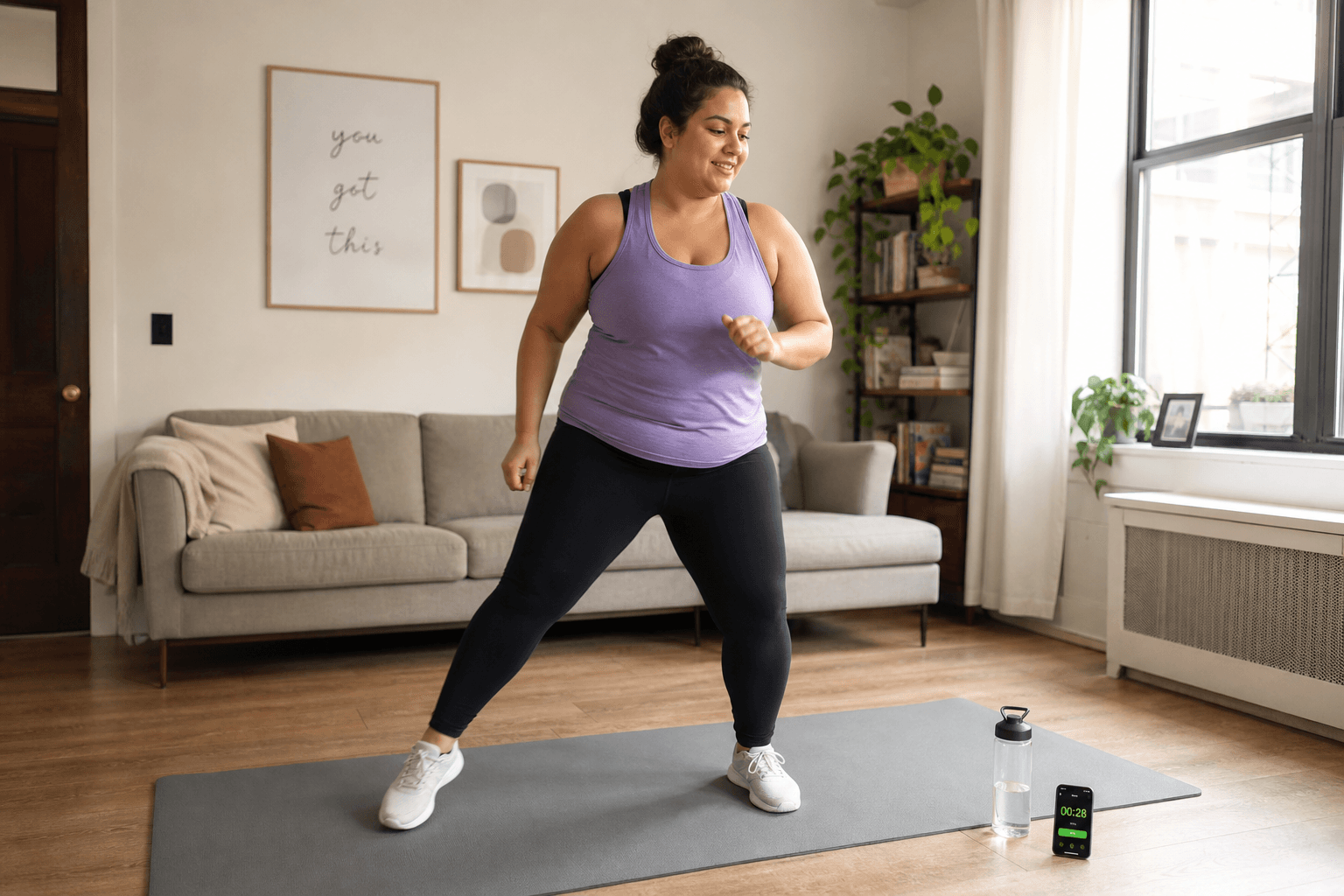
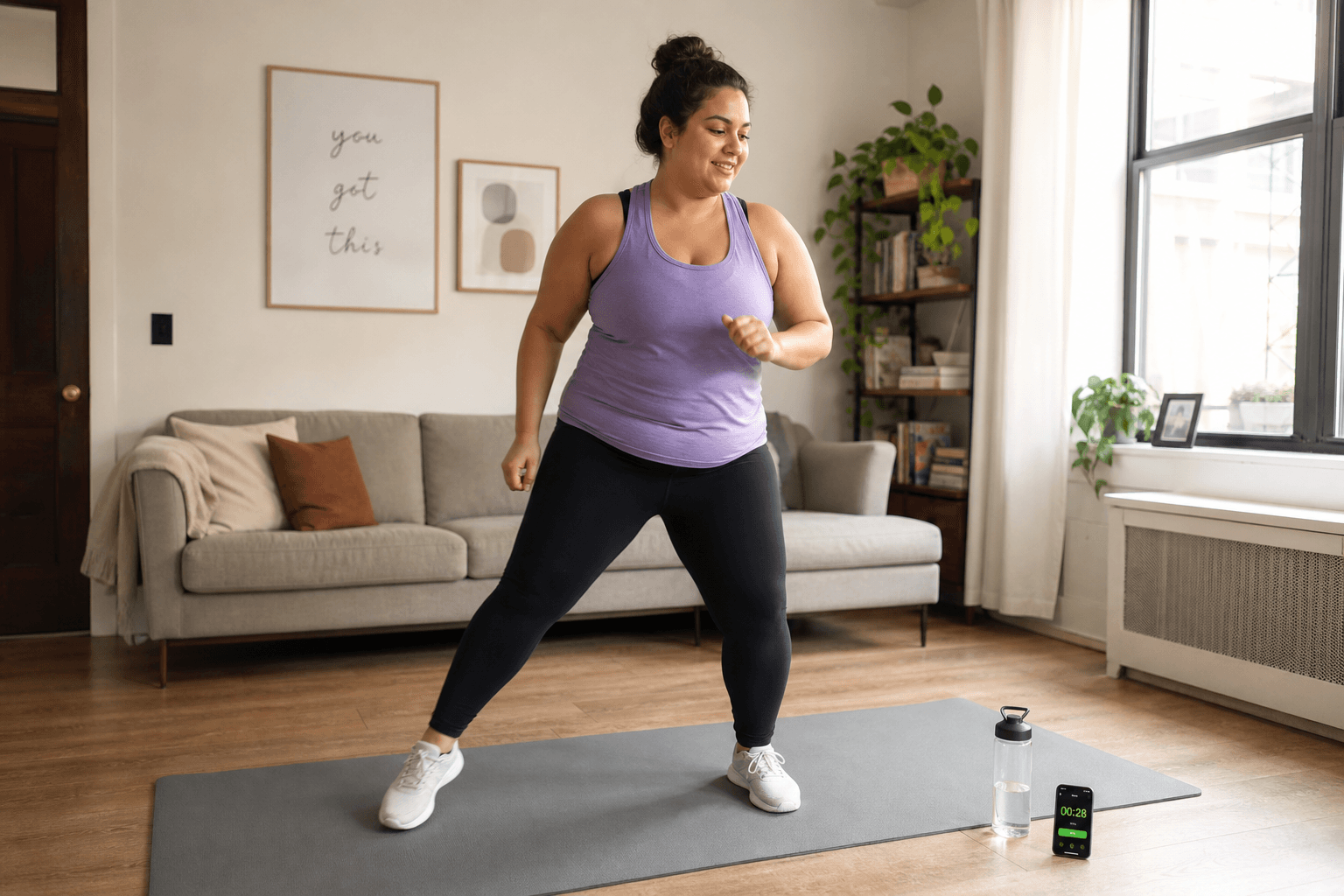
Before you start, get a thick exercise mat. Even these quiet moves can produce a thud on hardwood. A mat absorbs sound and protects your knees. Wear athletic shoes – barefoot on hard floors can cause noise and slipping.
Target RPE 5–7 for No-Jumping Cardio
A common mistake is to think that if you are not jumping, you need to max out — RPE 9 or 10 — to get any benefit. But cardiovascular gains come from sustained moderate-to-vigorous effort, not from brief all-out bursts. SELF magazine recommends aiming for a 6 or 7 on the RPE scale for a no-equipment cardio workout at home. At that level you can speak only a few words at a time, but you are not gasping.
There is a catch specific to no-jumping cardio: without the plyometric pulse, the body’s natural tendency is to drift to a lower effort level. You have to consciously maintain a faster tempo and shorter rest to stay in that 5–7 zone. The talk test helps: if you can speak a full sentence without needing a breath, you are below 5. If you cannot get out more than one or two words, you are above 7. Both extremes miss the target for sustained cardiovascular adaptation.
Ten Quiet Moves That Actually Deliver
Below are ten no-jumping cardio moves, each with specific tempo or rest guidance to keep RPE at 5–7. Every move is quiet by design — the primary version is the quiet version. If a move could generate noise on hardwood, the text addresses how to prevent it.
| Move | Key Instructions | Noise Note | Intensity Tip |
|---|---|---|---|
| Marching high knees | Lift knees to hip height at a brisk pace; avoid stomping. | Quiet if feet lift and lower softly. | Pick up the pace or add a pause at the top. |
| Step-touch jacks | Step out sideways, tap the foot, step back. No jump. | Sole of shoe on mat only — no heel slam. | Widen the step and increase speed. |
| Controlled mountain climbers | Slow, steady pace; 3-second pull of each knee toward chest. | On a mat, controlled slide is silent. Uncontrolled flailing is loud. | Hold plank position tight, pull knee slowly. |
| Skater steps (no jump) | Step laterally, tap opposite foot behind, push back. | Side step on mat — no leap. | Lower into the stance and push off harder. |
| Squat to front kick | From squat, stand and extend one leg forward in a controlled kick. | Soft landing on the standing leg. | Kick with control, not speed. |
| Alternating reverse lunges | Step back and lower until both knees are at 90 degrees. | Quiet if you lower slowly; avoid dropping into the lunge. | Hold the bottom for two seconds. |
| Standing oblique crunches | Lift one knee to the side toward the same-side elbow. | Completely silent. | Speed up or add a torso twist. |
| Plank walkouts | From standing, walk hands to plank, then walk back up. | Hands down gently — no slap. | Walk down and up at a quick pace. |
| Modified burpees (step-back) | Step back into plank, step forward, stand. No push-up or jump. | The quietest version of a burpee. Essential for apartments. | Add a push-up at the bottom for more challenge. |
| Speed squats | Regular squat but faster — down in one second, up in one second. | Keep feet fully on the mat; no heel lift. | Increase speed and depth. |
Consistently done, these moves can help you hit the AHA’s 150-minute weekly target without a single complaint from downstairs. That is not a compromise — it is a workout that works in the space you actually have.
Comments
Join the discussion with an anonymous comment.