
Best Free Workout Apps: What Their 'Free' Tiers Actually Give You (and Hide) — A Transparency Guide
Most free workout apps aren't truly free—they hide core features behind paywalls. This guide introduces the four flavors of 'free' and the four core features every genuinely useful app must offer, then audits top apps by those standards so you can choose without downloading five apps.
You tap "Free," and ten minutes later you are staring at a $12.99 monthly subscription screen.
That is how most free workout apps greet new users. The app store promised "Free." You downloaded it, created an account, logged one set, and then the rest timer was grayed out. The history tab showed a preview with a lock icon. The progress chart was a single bar with a "Upgrade to see more" label. You did not find a free app. You found a trial in disguise.
I have been through this cycle enough times that I no longer trust the word "Free" on its own. I open a new app and immediately go looking for where the first paywall appears. It is not because I am cheap. It is because there are four distinct business models hiding behind the same label, and only one of them serves the person who never wants to pay a cent. Here is what those four flavors look like.
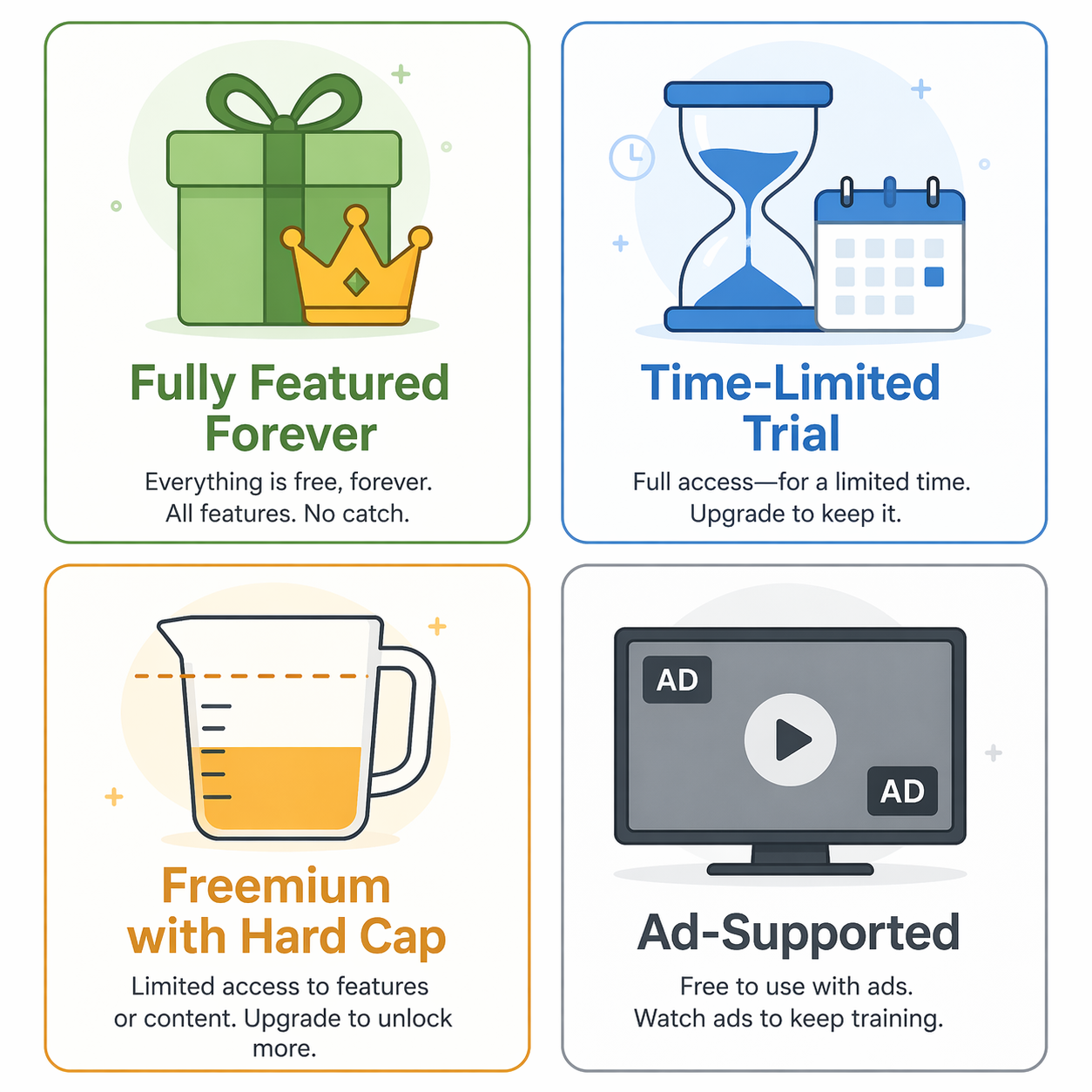
An analysis by the developer of Setgraph (a free workout tracker) lays out the taxonomy clearly: "There are four flavors of 'free' in the fitness app world: fully featured forever, free trial, freemium with a hard cap, and free but ad-supported." The first flavor is honest: the app gives you everything it has, forever, without asking for money. The second is a rental — you get full access for a set number of days, then it locks. The third gives you partial access indefinitely, but keeps a door locked until you pay (exercise count caps, missing features). The fourth is free with advertisements that may degrade the experience.
The four-core-feature test
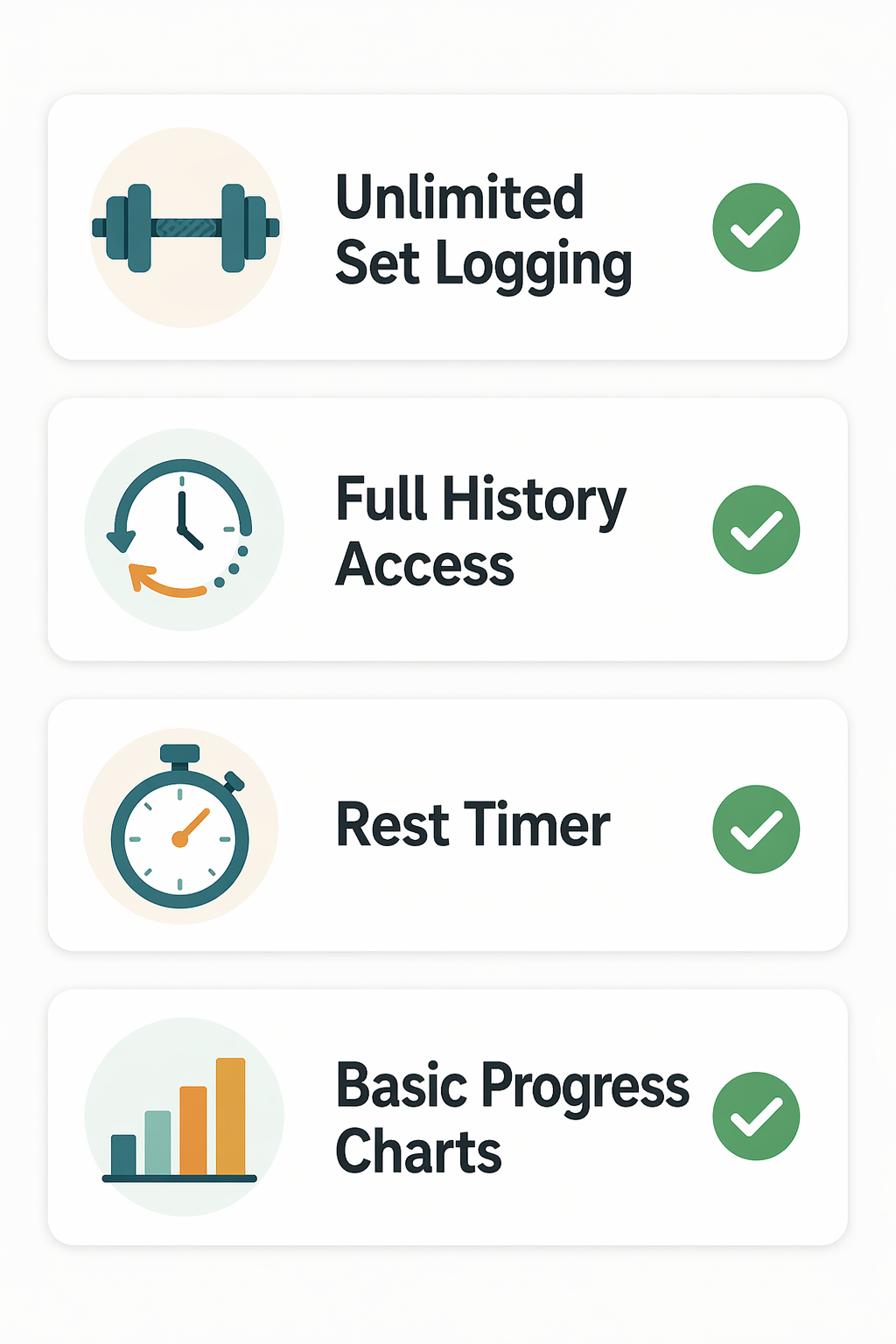
But the label tells you nothing about which flavor you are downloading. So I use one standard to separate genuinely useful free apps from those that are simply lightweight trials: the four-core-feature test. A reasonable free workout app must give you unlimited access to four things:
- Unlimited set logging. You should be able to log every set, rep, and weight without running into a monthly cap or a "Premium" limit.
- Full access to your own history. Every workout you have logged is yours to browse. No partial preview, no paywall on the past.
- A rest timer. This is a digital stopwatch. As the Setgraph article puts it, "charging for it is like charging for a stopwatch."
- Basic progress charts. At minimum, a line chart showing your lifts over time. This is how you know whether you are progressing.
Why these four? Because they are the infrastructure of progressive overload — the scientific principle that lifting slightly more over time builds muscle. A 2025 study in Cureus confirms that following a structured workout routine improves physical fitness and athletic performance. To follow a structure, you need to log, review, time rests, and see trends. Guided workouts, social feeds, and advanced analytics are premium extras. Charging for the base infrastructure is deceptive.
The global fitness apps market was worth $12.1 billion in 2025 and is expected to reach $13.9 billion in 2026. Five hundred and forty million people used fitness apps in 2025, and the apps were downloaded 888 million times (Business of Apps, 2026). But download numbers do not equal sustained free usage. One in five smartphone users downloads fitness apps — and a large share uninstall within 30 days when they hit the paywall. The app store rating tells you nothing about which flavor you are downloading.
Which apps pass?
I went through the most widely recommended free workout apps with one question: does the free tier keep all four core features accessible forever? I reviewed the app store descriptions, the official websites, and independent reviews from Garage Gym Reviews and Forbes Health (both of which include affiliate links — take that into account).
| App | Four-core-feature test | Paywall location / limits | Flavor of free |
|---|---|---|---|
| Nike Training Club | Passes all four | No premium version; 300+ workouts fully free (s2-c1, s5-c1). | Fully featured forever |
| Caliber | Passes all four | Custom algorithm program, ad-free logging, 500+ exercises, progress charts, community (s2-c2). | Fully featured forever |
| Hevy | Passes all four | Unlimited set logging, progress graphs, routine management, social features (s2-c5). | Fully featured forever |
| Boostcamp | Passes all four | 1,000+ free programs from elite coaches, including GZCLP and nSuns (s2-c3). | Fully featured forever |
| FitOn | Does not offer set logging | Free class-based (HIIT, yoga, etc.) but no strength logging; Pro $30/yr vs $99.99/yr depending on source (s2-c6, s5-c3). | Freemium / ad-supported hybrid |
| Jefit | Passes on logging/history/rest timer; fails on ads and locked routines | 1,400+ exercises free; ads present; many routines and video demos locked behind Elite ($12.99/mo or $69.99/yr) (s2-c4, s5-c2). | Freemium with ads and locked content |
| Strava | Basic tracking free; rest timer and trend charts limited | Free version lacks segment analysis, advanced training logs, custom goals (common knowledge; Garage Gym Reviews confirms). | Freemium with hard cap on analytics |
Four apps passed cleanly: Nike Training Club, Caliber, Hevy, and Boostcamp. Each lets you log unlimited sets, see your full history, use a rest timer, and view basic progress charts — all without paying a cent or hitting a cap. I should note that the Setgraph source article comes from a developer who makes a free workout tracker, but the taxonomy and testing methodology are independently verifiable.
The five-minute test you can run on any app
This audit is a snapshot as of Q2 2026. Free tiers change. Instead of trusting any article's list, you can verify any workout app yourself in five minutes. The method comes from the Setgraph article and works on any app:
- Log three sets of an exercise — include weight and reps.
- Close the app completely and reopen it.
- Go to your history — if you see a paywall overlay or a "Get Premium to view" message, the app hides your own data behind a paywall.
- Start a rest timer — if it does not work without an upgrade, the app charges for a stopwatch.
- Check whether there is a cap on the number of exercises or workouts you can log per month.
- Look for an export or backup option: can you download your history as a CSV or JSON file? If not, you are locked in.
This test takes less time than reading the app store description. Run it before you invest a week of workouts into an app that will later ask for $12.99 a month to see last Monday's session.
Free enough? Only if you can walk away
If an app passes the four-core-feature test, the free tier is enough for anyone who follows a basic linear progression or a popular program like GZCLP or StrongLifts. You do not need guided workouts, social feeds, or AI-generated programs to get stronger.
If the app fails the test — like Jefit or Strava — the free version may still be usable for certain use cases. Jefit's free logging and rest timer work, but the ads and locked routines become frustrating over time. Strava is fine if you only want to track runs and rides without analyzing segments. But for strength training specifically, I would not rely on a free tier that hides history or caps exercise count.
Upgrading is worth considering if you need features that genuinely go beyond the four core ones: custom program creators, advanced analytics (VO2 max estimates, training load), or an ad-free experience. But before you pull out your credit card, ask: is this upgrade unlocking something that should have been free? If the paywall is on a rest timer or on your own history, the answer is yes — and the app is not worth your money.
The cost of switching is real: lost history, broken streaks, retraining a new interface. The Setgraph article rightly calls training data portability the most overlooked feature. If the app does not let you export your history, switching means walking away from months or years of logged progress. This is why the four-core-feature test matters more than any individual app recommendation. Choose based on the test, not the label. The apps that pass today (NTC, Caliber, Hevy, Boostcamp) let you keep your data and your routine without gimmicks. If their free tiers ever change, at least you will be able to walk away with your history.
For a deeper look at whether free tiers are enough for muscle building, read Can You Actually Build Muscle With Free Fitness Apps?.
Trust the test, not the label
The word "Free" on an app store is a promise with no standard. The four-flavor framework and the four-core-feature test give you a repeatable way to evaluate that promise. Nike Training Club, Caliber, Hevy, and Boostcamp currently pass. FitOn, Jefit, and Strava do not — for different reasons, all related to monetizing core training infrastructure rather than genuine extras.
Next time you search for "best free workout apps" and find a listicle telling you an app is "free," run the five-minute test. If the rest timer asks for payment or the history is locked, move on. There are genuinely useful free apps that respect your training data. You just have to look past the label.
This is general fitness education, not medical advice. For diagnosis or treatment of pain or injury, consult a qualified clinician.
Pick your next session
Browse all routines to find an appropriately-spaced next session.
Spot something off?
This content sits adjacent to health guidance — tell us if a citation or figure needs a correction.