
The $1,855 Mistake Most Beginners Make
Search “home exercise equipment” for the first time and the internet tells you that you need a machine that costs more than a month’s rent. Garage Gym Reviews tested dozens of all-in-one trainers, power racks, and smart gyms and found the average home gym machine runs $1,855. That average includes commercial-grade racks and wall-mounted smart gyms. The real beginner trap isn't that average — it's the $500 to $1,000 impulse buy. You see a compact magnetic rower or a folding treadmill and think “That’s all I need.” Six months later it's holding laundry.
Garage Gym Reviews says it helped 82,000 people find their ideal strength or cardio equipment in 2025. That number measures people who already knew they needed something. It doesn't count the unused machines that end up on Craigslist. The uncomfortable truth is that most beginners overbuy. They buy based on aspirational goals — “I’ll become someone who runs every morning” — instead of the habit they already have. I've watched it happen enough times to believe the problem isn't motivation. It's the equipment-first approach.
Under $200 Gets You Started — Really
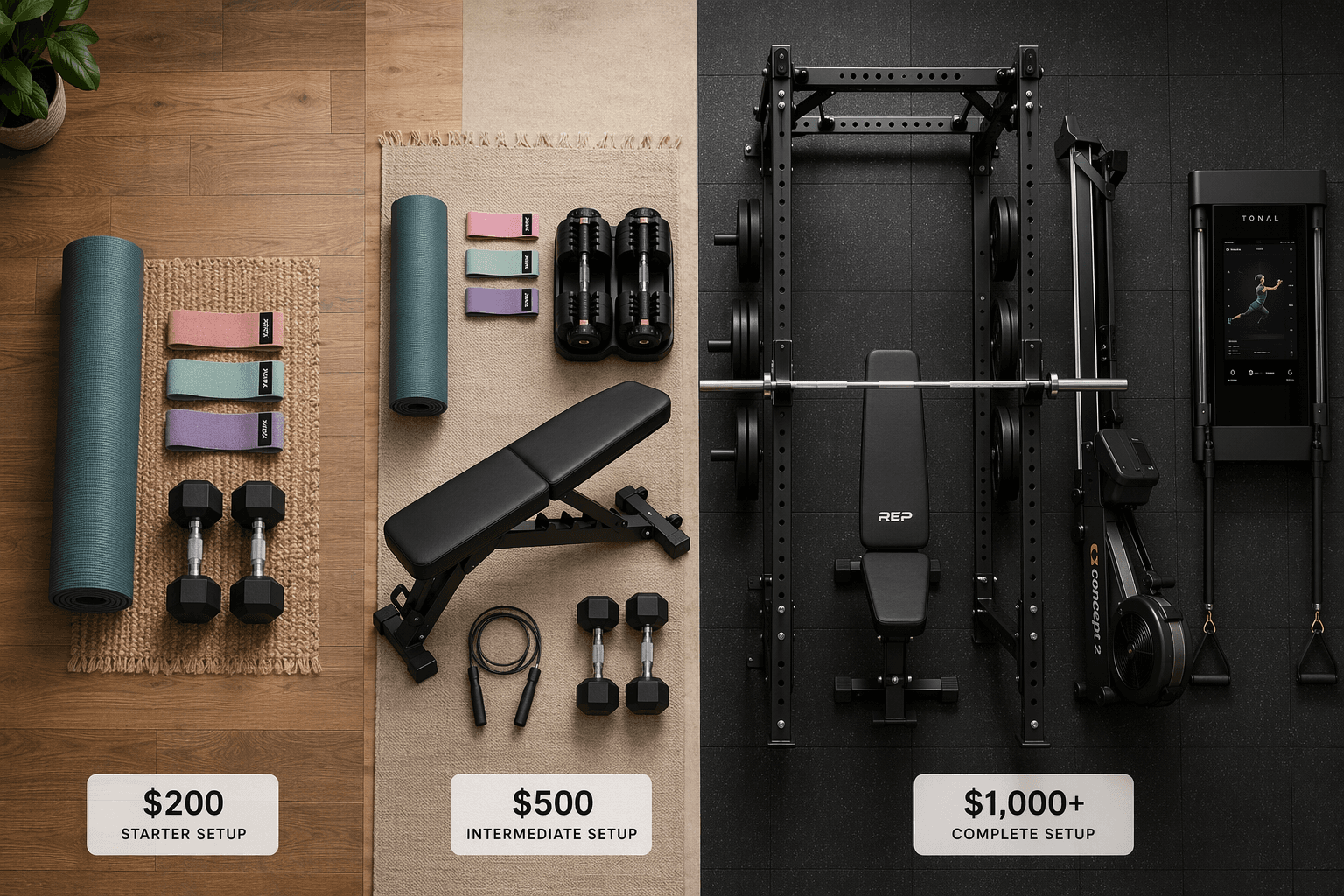
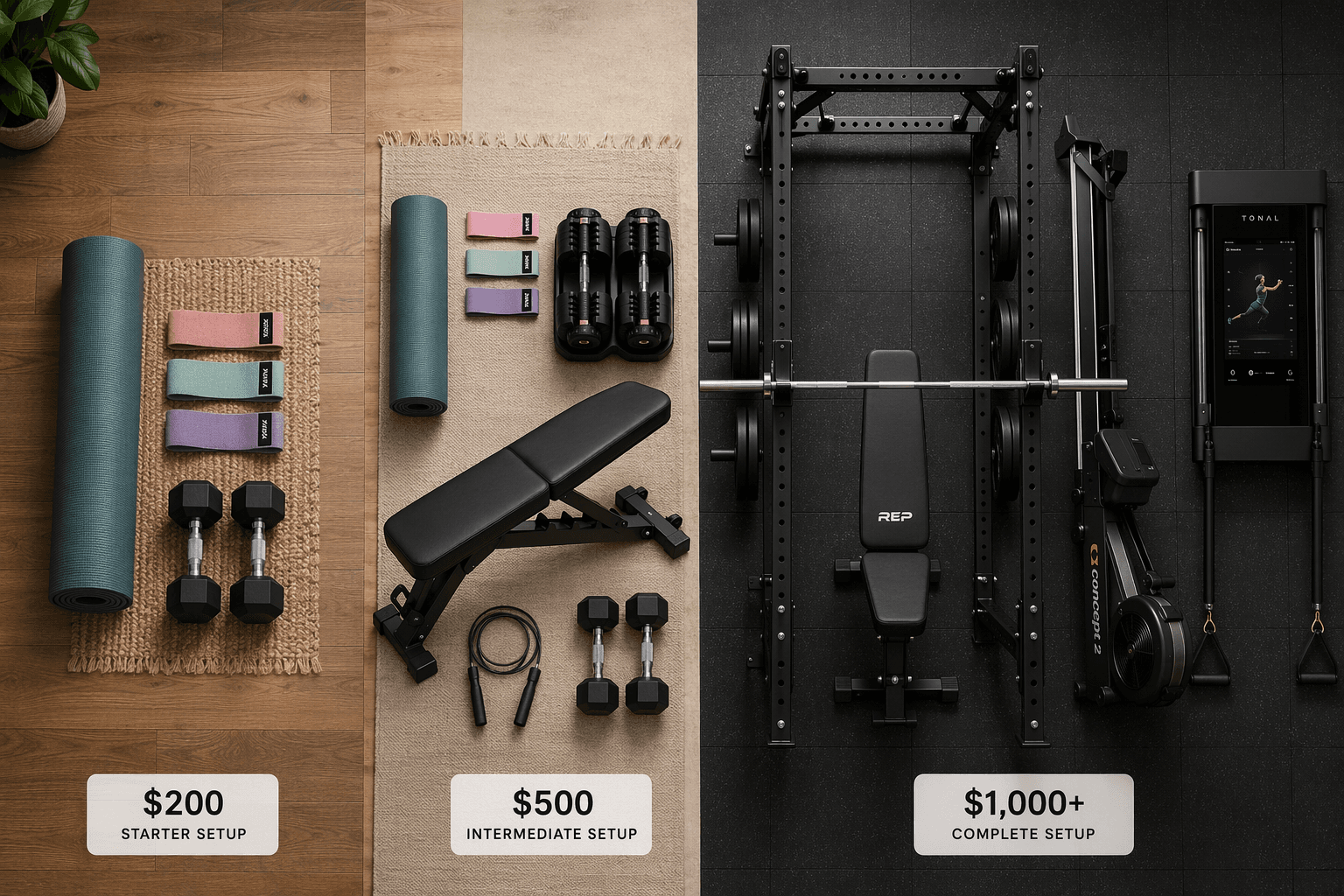
Here's the claim from Siwicki Fitness, a personal trainer who has helped beginners set up home gyms for years: a yoga mat, a set of resistance bands, and one pair of medium dumbbells. Total under $200. Let me break down the numbers so you can see it's not a theoretical minimum using flimsy products.
- Yoga mat: about $30. The premium Manduka PRO is $144 and lasts a lifetime — but that's an upgrade, not a requirement. If you buy the $30 mat and it compresses within a year, you've still spent $30, not $144.
- Resistance bands: Vergali Mini Resistance Bands 4-pack costs $19.79. They stay in place, come in four resistance levels, and take up no space. You can do rows, presses, curls, and leg work with these alone.
- Dumbbells: CAP Barbell Rubber Coated Set with a rack starts at $139.99 for a pair. For a beginner, a pair in the 10–15 lb range (women) or 15–20 lb range (men) covers 90% of what you'll do in the first month.
Add a cheap speaker if you want music — total maybe $170. The CAP dumbbells are solid cast iron, the Vergali bands have solid reviews, and a $30 mat is fine for bodyweight work. You could start today with a cardboard box as a step. But $200 buys a genuinely usable starter gym.
It's About Habit, Not Capability
A $200 setup cannot do everything. You won't squat 200 pounds with resistance bands, and you won't run a marathon on a yoga mat. But that is the wrong question for a beginner. The first priority is not having the perfect tool for every movement — it's proving to yourself that you will actually work out consistently for more than three weeks.
Here's what nobody tells you about expensive equipment: it creates a hidden cost in floor space. A $200 setup lives in a closet corner — less than two square feet. A power rack with plates takes up about 10 square feet. In an apartment, that's the difference between a workable living room and a room that feels like a gym. I've seen people calculate their budget carefully but never consider that the square footage their equipment claims could cost them $100+ per month in rent if they have to upsize.
The mechanism works like this: when you drop $1,000 on a machine, you feel pressure to “get your money’s worth.” That pressure turns into guilt when you skip a day, then avoidance, then abandonment. A $200 investment doesn't carry that weight. Miss a workout? Shrug and try again tomorrow. The low barrier makes consistency easier, not harder.
Siwicki's full essentials setup — mat, bands, dumbbells, and a speaker — runs $470 to $600 depending on dumbbell choice. That's the upgrade path after you've proven you'll use it. The $200 starter is not the permanent setup. It is the proof of concept.
The Barbell Trap
Garage Gym Reviews knows their stuff. Their standard advice for starting a home gym is a barbell, a squat rack with a pull-up bar, bumper plates, and a weight bench. For someone who already knows they want to lift seriously, that's solid. For a raw beginner, it's a trap. Here's what that costs at the budget end, using their own data:
| Item | Model | Price |
|---|---|---|
| Power rack | REP PR-1100 | $380 |
| Barbell | Synergee Games Cerakote | $179.95 |
| Bumper plates (260 lbs) | Fringe Sport Black Bumper ~$2.20/lb | $572 |
| Weight bench | Budget bench ~$150 | $150 |
| Total | $1,281.95 |
A barbell requires technique, a spotter or safety arms for heavy lifts, and a lot of space. The $380 rack alone is five times the cost of the entire $200 starter kit. And the plates? At $2.20 per pound, you're paying $572 for weight you might not touch for months. I'm not saying GGR is wrong. Their advice is right for a specific audience. But if you have never consistently followed a workout program, that audience is not you. Their recommendation is a goal to build toward, not a starting point.
When to Buy Your First Big Piece
You'll see phased expansion timelines online — buy X at one month, Y at three months, Z at six months. Useful as a rough guide, but it misses the real condition. The trigger is not time. It is consistency. If you have been working out three times a week for two months with your $200 setup, you are ready to consider a larger purchase. If you are still waffling after six months, don't buy anything new — spend that energy on the habit.
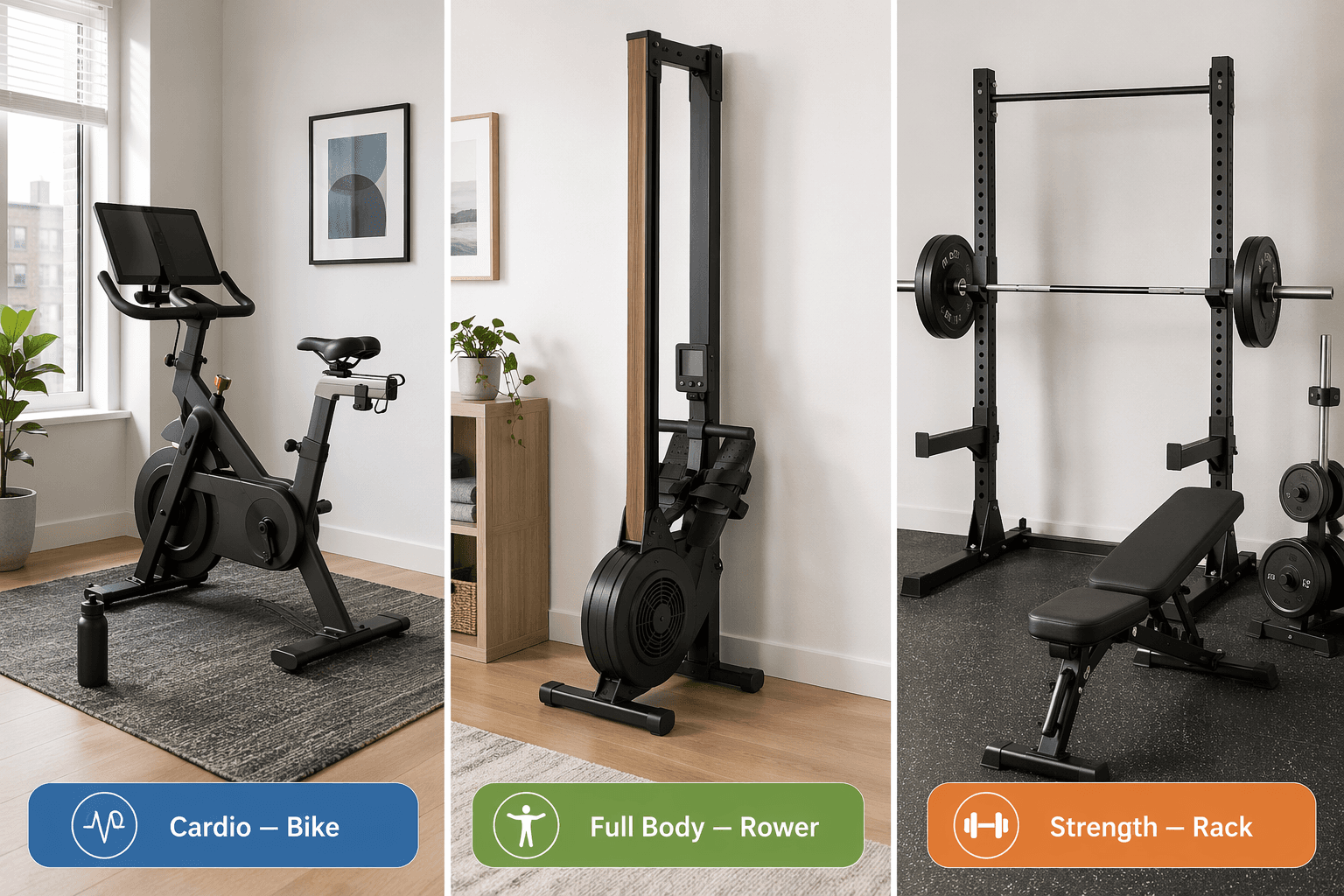
When you are ready, the choice comes down to what you actually enjoy doing. If you have found yourself gravitating toward bodyweight squats and lunges, a squat rack with a barbell makes sense. If you love the cardio from banded jumping jacks, a spin bike or rower might serve you better. Don't guess based on what looks impressive.
For a detailed decision framework that walks you through budget, space, and goal, see our First-Time Home Gym Buyer's Decision Framework. And if you are tight on space, our Compact Home Gym by Space Tier guide shows what you can build in 10, 30, 50, or 100 square feet.
Two Traps to Avoid
Buying a machine first
A treadmill, spin bike, or elliptical feels like commitment. But a machine is a single-use tool. Buy a treadmill and then discover you hate running? You're stuck with a clothes rack. The $200 starter kit — mat, bands, dumbbells — is multi-use. You can do strength, cardio, and flexibility with those three items. A machine locks you into one movement pattern before you know what you actually enjoy.
Buying junk adjustable gear
Cheap adjustable dumbbells with plastic handles, flimsy locking mechanisms, and uneven weight distribution are worse than fixed dumbbells. They break, they wobble, and they ruin the workout. Stick with simple cast-iron hex dumbbells at $1.10 per pound — they are durable, cheap, and they work. If you want adjustable later, the TYZDMY pair at $269.99 is a good upgrade, but only after you have proven you need more than one pair of fixed dumbbells.
For more on what goes wrong, read our 7 Garage Gym Mistakes That Cost You Money. The short version: start small, prove the habit, then upgrade. The $200 setup is not a compromise — it is the single smartest decision you can make as a beginner.
Comments
Join the discussion with an anonymous comment.