
How to Build a Home Gym on a Budget: A Beginner’s Phased Equipment Guide
Starting a home gym doesn’t have to cost a fortune. This guide walks beginners through three budget tiers ($200, $470–$600, $1,000+), tying each purchase to your specific fitness goals so you buy only what you’ll actually use.
The $800 Coat Hanger
I have seen it a dozen times. A friend decides to get fit, spends $800 on a power rack and Olympic bar before they own a single dumbbell, sets it up in the corner of their apartment, and after two weeks the rack is a coat hanger. They bought what they thought a home gym “should” have — and used maybe a third of it.
The home fitness equipment market is booming — $4.07 billion in the U.S. in 2025 alone, projected to grow at 6.81% CAGR through 2034. But that growth does not measure smart buying. It measures volume. And a lot of that volume ends up unused.
That 90% figure comes from Siwicki Fitness. I would not treat it as a scientific formula — it is a useful heuristic. The missing 10% includes heavy barbell squats (requires a rack), Olympic lifts (barbell and bumper plates), cable exercises (lateral raises, triceps pushdowns), and very heavy isolation work. For general fitness, fat loss, and moderate muscle gain, you can push the starter kit for months before you need any of that. Most beginners buy the missing 10% first, and that is how you end up with an $800 coat hanger.
The $200 Starter That Actually Works
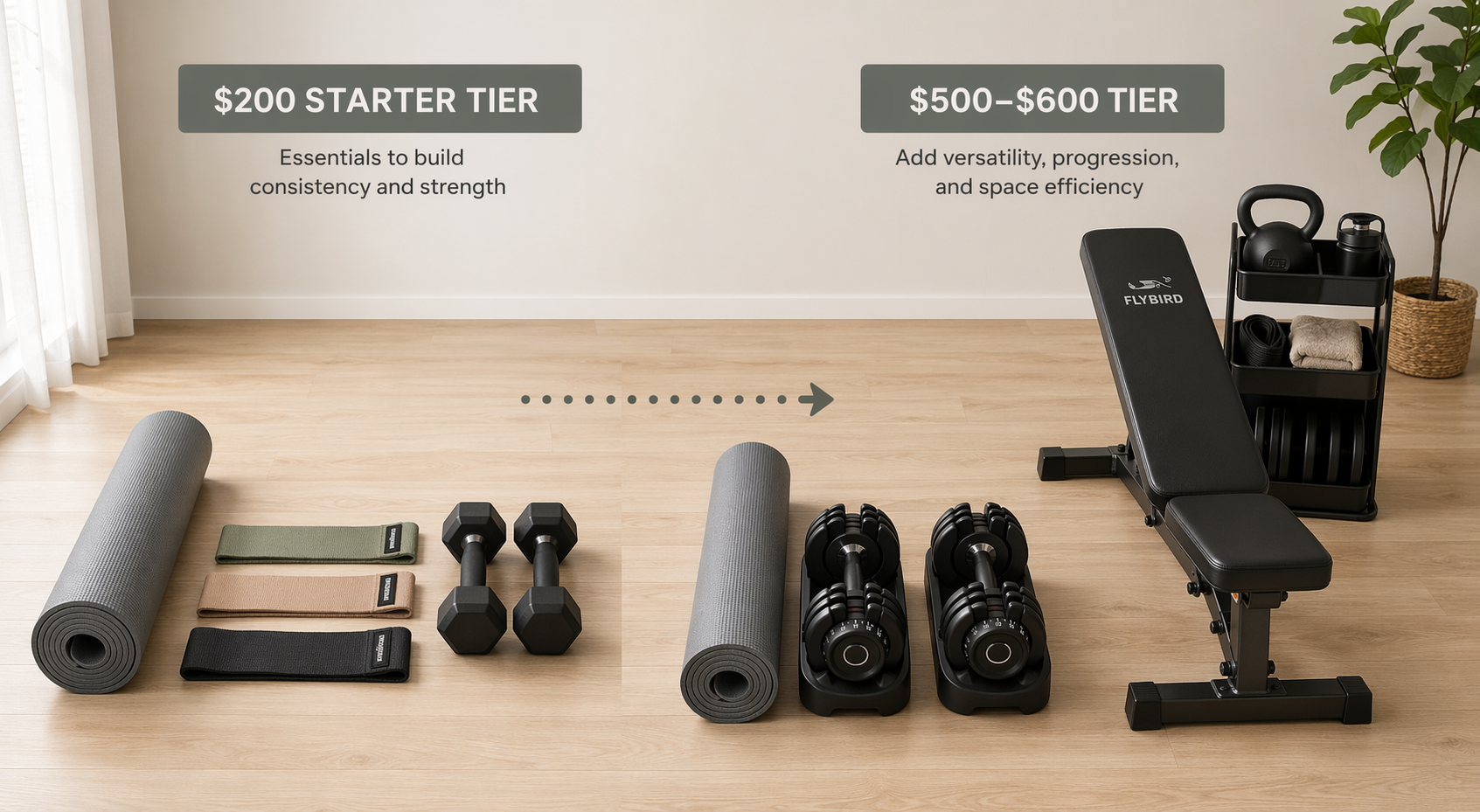
Here is what the $200 tier looks like with real product prices:
- A yoga mat — the Manduka PRO is $144, but cheaper alternatives exist. Any thick, non-slip mat works.
- Resistance bands — Vergali Mini Bands 4-pack for $19.79. These are not toys. A 2019 meta-analysis found that resistance band training produces similar strength gains to free-weight training.
- One pair of medium-weight dumbbells — CAP Barbell Rubber Coated Dumbbells start at $139.99. For a beginner, 20–25 lbs each is a good starting point.
Total: roughly $304 if you use the Manduka mat, or as low as $220 with a budget mat. Either way, under $350 for a setup that lets you do squats, presses, rows, lunges, core work, and band pull-aparts. You can train every major muscle group. You can progress by adding reps, sets, or tempo.
| Exercise | Equipment Used |
|---|---|
| Goblet Squat | Dumbbell |
| Overhead Press | Dumbbell |
| Bent-Over Row | Dumbbell |
| Lunges | Dumbbell |
| Band Pull-Apart | Band |
| Glute Bridge | Band or mat |
| Plank | Mat |
| Farmers Carry | Dumbbell |
What the Missing 10% Actually Costs — and When to Buy It
The full setup that covers that last 10% — as Garage Gym Reviews puts it — is a barbell, squat rack, plates, and bench. That is a $1,000+ investment, often more for quality gear. Spending that before you know you will stick with training is a gamble most beginners lose.
Once you outgrow the single pair of dumbbells — that is the milestone — you have a decision. You can buy another pair of fixed dumbbells at the next weight, and then another, until your floor is covered in iron. Or you can buy one pair of adjustable dumbbells that replaces all of them.
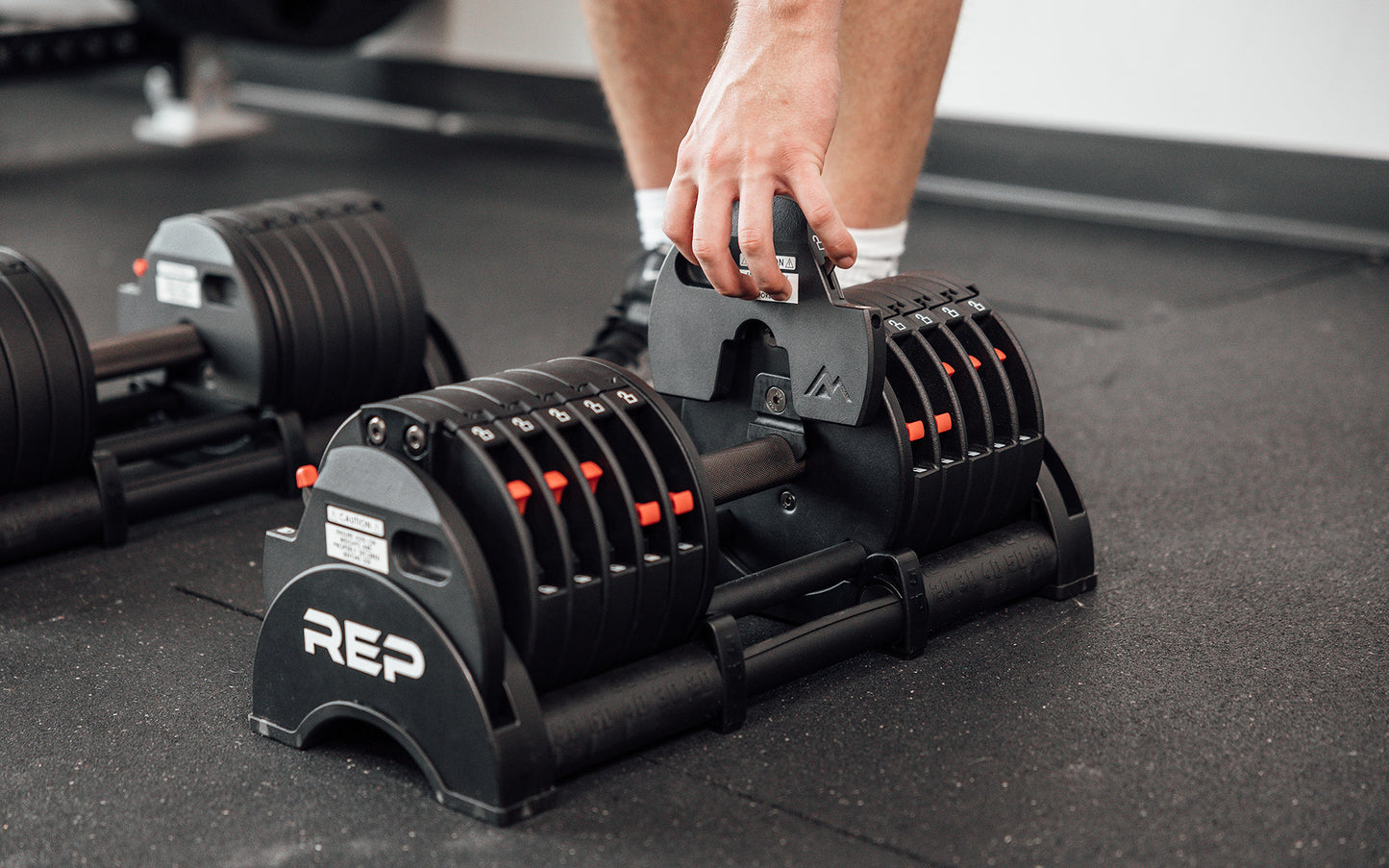
The REP QuickDraw Adjustable Dumbbells start at $335.99 and, according to Garage Gym Reviews, replace up to 12 pairs of fixed dumbbells. For a small-space apartment, that is huge. The average price for adjustable dumbbells on the market is $625, so the QuickDraw is well below average. A cheaper option: the TYZDMY 52.5 lb pair at $269.99. At this tier, you can also add a foldable bench — I recommend a flat or adjustable bench that stores upright. Siwicki Fitness pegs the full essential setup at $470–$600 depending on dumbbell choice.
| Option | Cost | Space | Best for |
|---|---|---|---|
| Fixed dumbbell pair (single weight) | $140 | 2 sq ft per pair | Starter tier, under $200 budget |
| Adjustable dumbbell pair (REP QuickDraw) | $335.99 | 1 sq ft total | $470–$600 upgrade tier, small space |
| Multiple fixed pairs (3 weights) | $420 | 6 sq ft | People with dedicated space and larger budget |
A few mistakes I have seen repeatedly at this stage:
- Buying a power rack on day one. You cannot heavy squat until you have built the base with dumbbells. A rack before you need it is just a coat hanger.
- Overestimating needed weight. A 200 lb barbell set looks serious, but most beginner work is done with 80 lb total or less. Start with what you can lift for 10 reps with good form.
- Ignoring floor protection. Dropping a dumbbell on hardwood in an apartment can cost you your security deposit. A $30 rubber mat (horse stall mat) protects the floor and reduces noise.
- Falling for subscription-locked smart equipment. A $1,500 smart gym with a $40/month subscription sounds appealing until you realize you could have bought a full adjustable-dumbbell setup with no recurring fee.
For a deeper look at the pitfalls, read 7 Mistakes People Make When Building a Compact Home Gym.
Match Your Goal to Your Gear
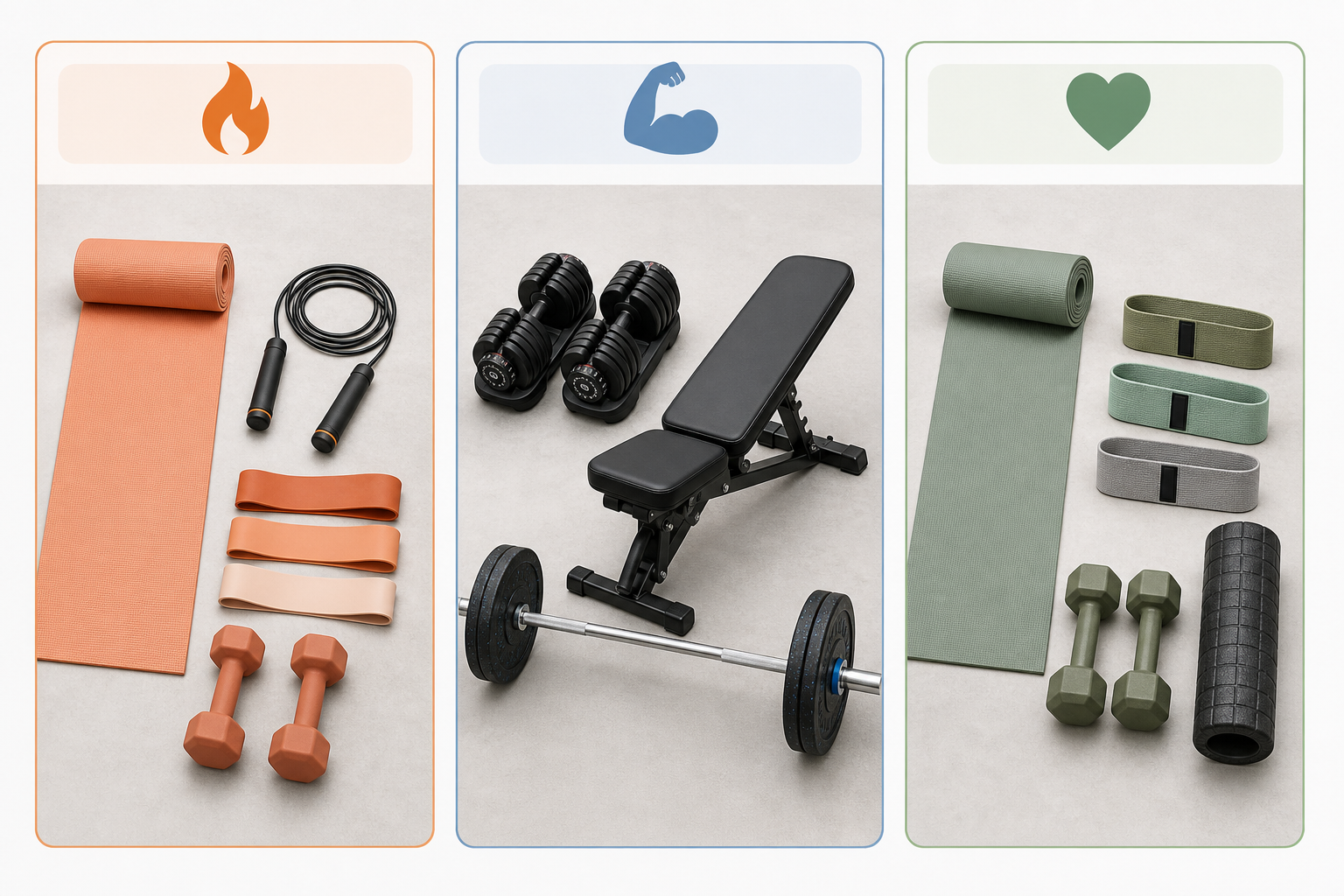
Not every goal needs the same equipment. The table below ties your primary goal to a purchase order with concrete milestones.
| Primary Goal | $200 Starter | Next $470–$600 | $1,000+ Full Setup | When to Upgrade |
|---|---|---|---|---|
| Weight loss / conditioning | Mat, bands, light dumbbells, jump rope | Add adjustable dumbbells, kettlebell | Add cardio machine (if space permits) | When you can do 20+ reps with your heaviest dumbbell |
| Muscle building / strength | Mat, bands, medium dumbbells (20–25 lbs) | Adjustable dumbbells, foldable bench | Barbell, rack, plates | When you can squat the heaviest dumbbell for 12 reps |
| General fitness / maintenance | Mat, bands, light dumbbells | Adjustable dumbbells only (skip bench) | No need for more — you have 90% covered | When you get bored — not because you need to |
If you are still unsure, the First-Time Home Gym Buyer's Decision Framework walks you through budget, space, and goal in more detail.
One Judgment Before You Buy
A mat, resistance bands, and one pair of dumbbells. That is enough to start today. The phased approach saves you money, space, and regret. Do not buy the rack until you have outgrown the dumbbells. Do not buy the subscription smart gym until you know you will actually use it every week.
This is general fitness education, not medical advice. For diagnosis or treatment of pain or injury, consult a qualified clinician.
Pick your next session
Browse all routines to find an appropriately-spaced next session.
Spot something off?
This content sits adjacent to health guidance — tell us if a citation or figure needs a correction.