
Best Workout Apps for Women by Life Stage: Prenatal, Postpartum, 40+, and Beyond (2026 Guide)
Generic 'best apps for women' roundups miss the most important variable: your life stage. This guide helps women who are pregnant, postpartum, perimenopausal, or over 40 find a workout app matched to their body's changing needs — with stage-specific picks and a framework for evaluating any app.
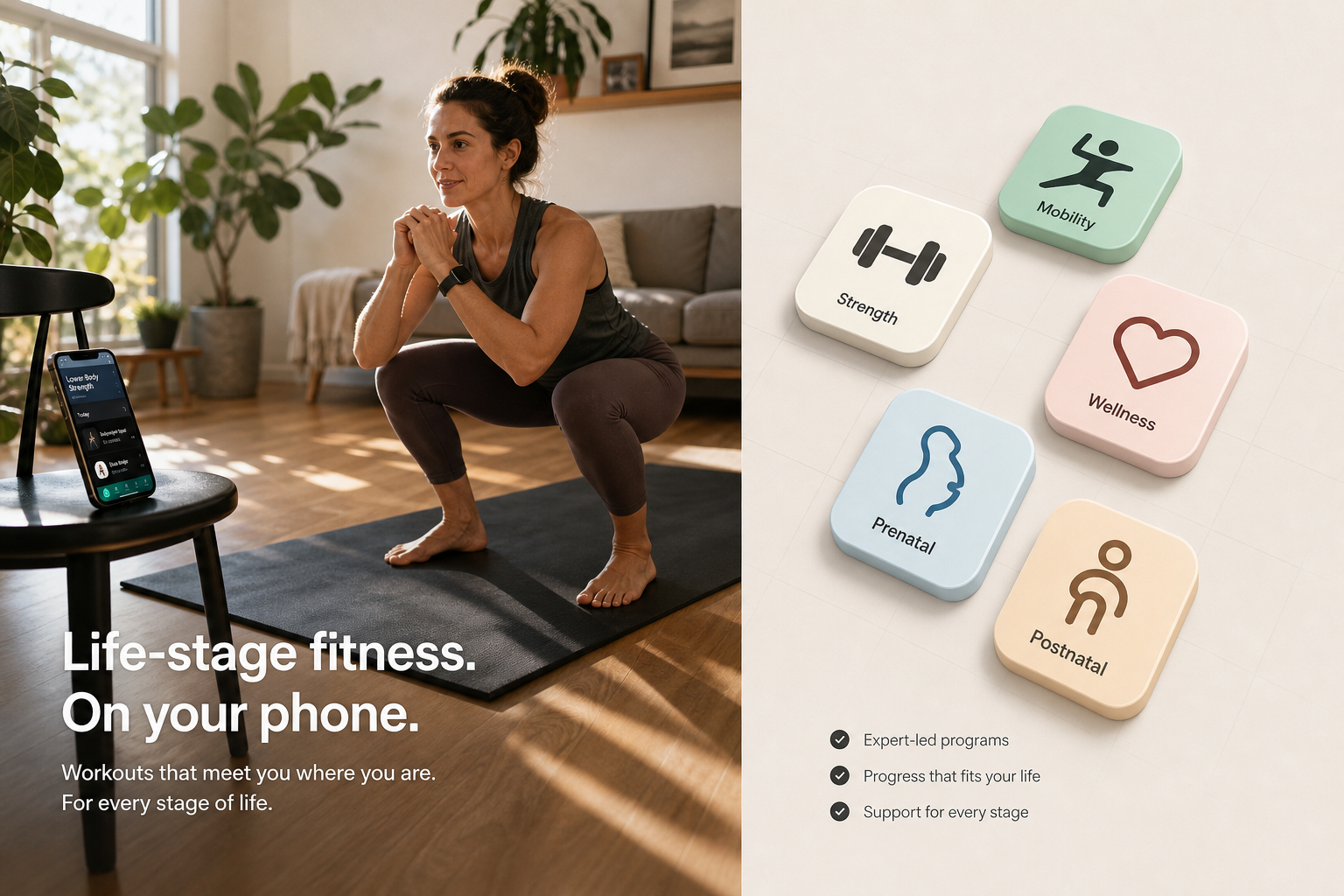
Why Your Life Stage Matters More Than Your Gender When Choosing a Workout App
Most "best apps for women" roundups share a fundamental flaw: they treat "women" as a single, uniform audience. A woman in her twenties building general strength, a woman navigating the second trimester of pregnancy, and a woman managing perimenopausal symptoms have vastly different physiological needs. Yet the typical listicle lumps them together, comparing price tiers and interface design while ignoring the variable that actually determines whether an app will serve you well: your life stage.
This guide takes a different approach. Instead of another feature-grid comparison, it organizes recommendations by the phases of life that change how your body responds to training. A prenatal program needs to prioritize pelvic floor education and core awareness. A postpartum program needs a safe return-to-training structure that respects tissue healing. A program for women over 40 needs joint-friendly progressive overload that accounts for hormonal shifts and bone density maintenance.
If you are brand new to strength training and looking for a general starting point, the best workout apps for women beginners guide covers free versus paid options and critiques apps that market to women with superficial design changes rather than substantive programming. This article is for women who already know they want to train but need stage-specific guidance — whether you are trying to conceive, currently pregnant, postpartum, in perimenopause, or over 40 and looking for programming that respects where your body is right now.
Prenatal: Bloom Method — The Only Major App Built for Pregnancy
If you are pregnant and looking for a workout app, you will quickly notice a gap in the market. Most general fitness apps offer a handful of "prenatal-friendly" modifications tacked onto existing programs. They do not teach you how to engage your deep core while protecting your pelvic floor, how to modify breathing for the changing position of your diaphragm, or how to prepare your body for labor.
Bloom Method fills that gap. At $29.99 per month with a 7-day free trial, it is the only major app specifically designed for prenatal and postnatal women, according to testing by Garage Gym Reviews. Their certified personal trainer team tested over 20 workout apps and named Bloom Method the best for prenatal and postnatal women. Nicole Davis, CPT, PN1-NC and Head of Content at Garage Gym Reviews, used the app after searching for a high-quality prenatal training plan.
It focuses heavily on diaphragmatic breathing, core activation, and pelvic floor exercises and recovery, all of which are mostly overlooked — or just addressed on the surface level — with other programs.
What sets Bloom Method apart is its trimester-specific programming. The app does not give you a generic pregnancy workout. It adjusts exercises, breathing techniques, and intensity based on which trimester you are in. It also includes birth preparation classes, which is a feature you will not find in any general fitness app. For a pregnant woman, the value of an app that understands the difference between first-trimester fatigue management and third-trimester mobility work is substantial.
Postpartum: Sweat's PWR Post-Pregnancy Program — Built for Returning to Training
Returning to exercise after having a baby is not the same as returning after a break. Your core and pelvic floor have undergone significant changes. Your sleep is disrupted. Your schedule is no longer your own. A postpartum program needs to respect these realities while still providing enough structure to rebuild strength progressively.
Sweat's PWR Post-Pregnancy program, designed by trainer Kelsey Wells, is the standout recommendation for this phase. At $25 per month or $135 per year, Sweat was named "Best for Women" by Good Housekeeping after testers evaluated more than 40 workout apps. One new mom tester specifically praised the PWR Post-Pregnancy program.
It challenged me and gave me something to stick to after having the baby.
Sweat offers more than 50 workout programs and over 13,000 workouts created specifically for women by women. The app features all-female instructors and includes programs for pregnancy and post-pregnancy. What makes the PWR Post-Pregnancy program effective is that it applies progressive overload in a way that respects the postpartum body — gradually rebuilding strength rather than expecting you to pick up where you left off before pregnancy.
One advantage of Sweat is that it gives you room to grow. Once you have completed the postpartum program and feel ready for a different training focus, the full Sweat library — including strength, HIIT, barre, and yoga programs — is available under the same subscription. You do not need to switch apps when your needs change.
Perimenopause and Menopause (40+): Fit Over 40 and Fortify — Apps That Understand Hormonal Change
Perimenopause and menopause bring hormonal shifts that affect muscle mass, bone density, joint health, and recovery. A workout app designed for a 25-year-old building maximal strength is not necessarily appropriate for a woman in her mid-40s whose body is adapting to lower estrogen levels. The right app for this stage emphasizes low-impact strength training, joint-friendly movement patterns, and programming that accounts for changing recovery needs.
Two apps specifically target this demographic: Fit Over 40 and Fortify. Both focus on low-impact bodyweight strength training tailored to the unique needs of perimenopausal and menopausal women. Fit Over 40 provides programming that emphasizes bone density maintenance, joint mobility, and strength training that works with — not against — hormonal changes. Fortify takes a similar approach with an emphasis on functional strength and recovery-aware programming.
It is worth noting that these apps have less independent testing data compared to major platforms like Peloton or Sweat. They are smaller, more specialized services. If you are considering either app, verify current features and pricing directly on their websites, as their offerings may change more frequently than larger platforms.
General Strength at Any Life Stage: Caliber, Stronger By The Day, and Fitbod
Not every woman needs a life-stage-specific app. If you are not pregnant, postpartum, or perimenopausal, or if you are in one of those phases but want to supplement stage-specific programming with general strength work, there are excellent generalist apps that adapt to your equipment, fitness level, and goals.
These apps share a common strength: they use progressive overload principles to help you build strength systematically. They are not designed for a specific life stage, which means they lack the specialized education that pregnancy or menopause requires. But for general strength training at any age, they are well-built tools.
- Caliber: Offers a free version with 500+ exercises. Pro is $19 per month, and Premium is $200+ per month. Garage Gym Reviews named it "Best Workout App for Women Overall" in their 2026 testing. Caliber provides structured programming that adapts to your equipment and experience level.
- Stronger By The Day: At $15 per month, this app delivers daily strength programming designed by a professional coach. It focuses on progressive overload and periodization, making it suitable for women who want a structured, no-frills strength program.
- Fitbod: Priced at $15.99 per month or $95.99 per year, Fitbod uses a "Smart AI Workout Generator" that adjusts your workout based on your history, muscle recovery scores, and available equipment. It is a strong option for women who want an app that handles the programming decisions.
If you are in a life stage that requires specialized knowledge — pregnancy, postpartum recovery, or perimenopause — these apps can serve as your general strength foundation, but you should supplement them with stage-specific education. For example, a postpartum woman might use Caliber for general strength work while following Sweat's PWR Post-Pregnancy program for her primary training.
For readers who want to understand the difference between apps that program your training versus apps that simply log your workouts, the fitness plan apps comparison guide provides a deeper breakdown. And if budget is a primary concern, the best free fitness apps guide covers quality free options that do not require a subscription.
How to Evaluate Any Workout App for Your Life Stage
The apps recommended above are starting points, but the fitness app market changes quickly. New apps launch, existing apps update their features, and pricing shifts. Rather than relying solely on a single guide, you can evaluate any app against your specific life stage needs using the following criteria.
- Does the app offer pelvic floor awareness or modifications for pregnancy and postpartum? If you are pregnant or recently gave birth, this is non-negotiable. A general app that simply tells you to "modify as needed" is not sufficient. You need an app that actively teaches you how to protect your pelvic floor.
- Does it include joint-friendly options and low-impact alternatives? For women over 40 or those managing perimenopausal joint changes, high-impact movements may need to be replaced with lower-impact alternatives. The app should offer substitutions, not just a single default exercise.
- Does it use progressive overload even at lower weights? Progressive overload — gradually increasing the demands on your muscles — is how you build strength at any age. The app should have a system for increasing difficulty, whether through weight, reps, sets, or tempo, even if you are working with light dumbbells or bodyweight only.
- Is the programming designed by professionals with women's health credentials? Look for apps whose program designers have certifications in prenatal and postnatal fitness, women's health physical therapy, or exercise physiology. An app designed by a general personal trainer may not have the specialized knowledge your stage requires.
- Can it adapt to changing energy levels and recovery needs? Pregnancy, postpartum recovery, and perimenopause all come with fluctuating energy. An app that locks you into a rigid schedule without the ability to deload, swap workouts, or adjust intensity on low-energy days will be harder to stick with long-term.
Quick-Reference Table: Which App for Your Stage?
The table below matches each life stage to the recommended app or apps, with key details to help you make a quick decision.
| Life Stage | Recommended App(s) | Monthly Price | Standout Feature | Stage-Specific Education? |
|---|---|---|---|---|
| Prenatal | Bloom Method | $29.99 (7-day free trial) | Pelvic floor education, diaphragmatic breathing, trimester-specific programming, birth preparation classes | Yes — core focus of the app |
| Postpartum | Sweat (PWR Post-Pregnancy by Kelsey Wells) | $25/mo or $135/yr | Progressive overload designed for returning to training after pregnancy | Yes — dedicated postpartum program |
| Perimenopause / Menopause (40+) | Fit Over 40, Fortify | Varies (verify on app website) | Low-impact bodyweight strength training tailored to hormonal changes | Yes — designed for this demographic |
| General strength at any stage | Caliber, Stronger By The Day, Fitbod | Caliber: free / $19 Pro / $200+ Premium; Stronger By The Day: $15; Fitbod: $15.99/mo or $95.99/yr | Adapts to equipment and fitness level; structured progressive overload | No — supplement with stage-specific knowledge |
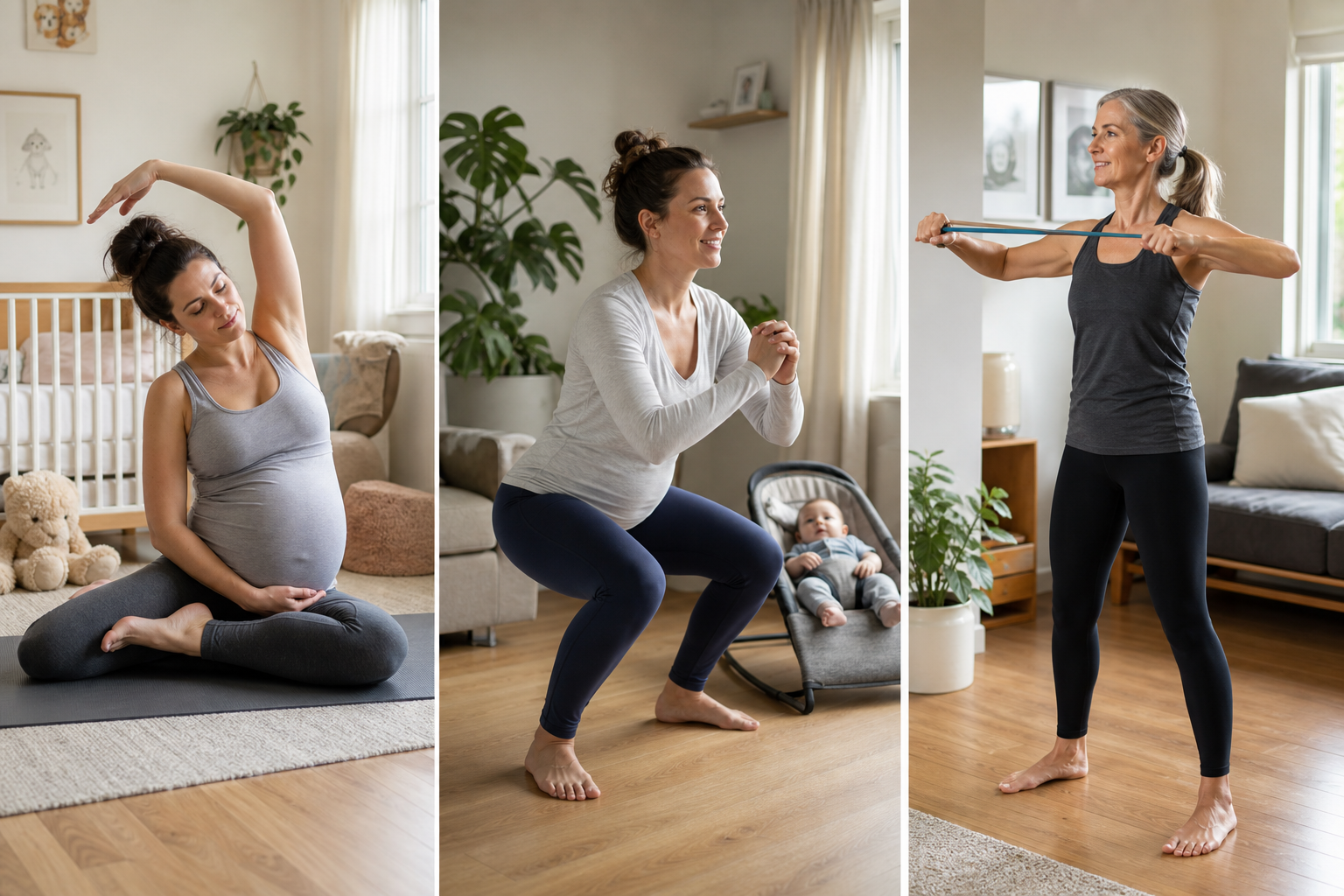
This is general fitness education, not medical advice. For diagnosis or treatment of pain or injury, consult a qualified clinician.
Pick your next session
Browse all routines to find an appropriately-spaced next session.
Spot something off?
This content sits adjacent to health guidance — tell us if a citation or figure needs a correction.