
Best Fitness Plan Apps: Which Apps Actually Program Your Training vs. Just Log It?
Most workout app lists lump true training plan apps with simple loggers. This guide draws the line between apps that intelligently program periodized workouts with auto-progression and those that only record what you decide to do, helping intermediate lifters choose based on planning capability.
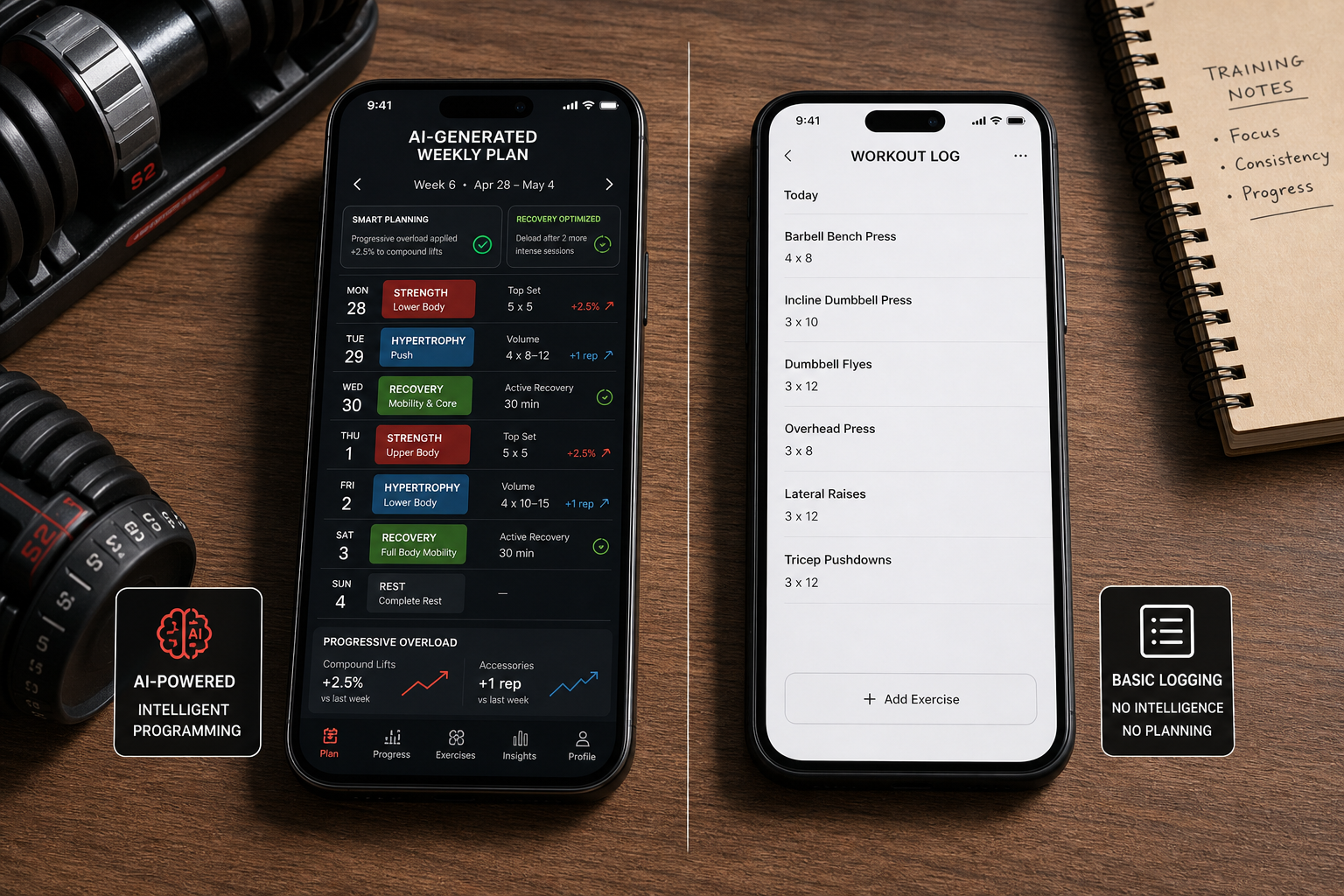
The Fundamental Divide: Plan-Builders vs. Plan-Followers vs. Pure Loggers
If you search for "best fitness plan apps" right now, you will get lists that place Jefit next to Strong, Boostcamp next to Hevy, and JuggernautAI next to a basic rep counter. This is not just unhelpful — it is misleading. These apps serve fundamentally different purposes, and treating them as interchangeable options is why so many intermediate lifters download an app expecting intelligent programming and end up with a digital notebook.
The core distinction comes down to one question: does the app decide what you should do next, or does it only record what you already decided to do?
There are three categories, and they are not interchangeable:
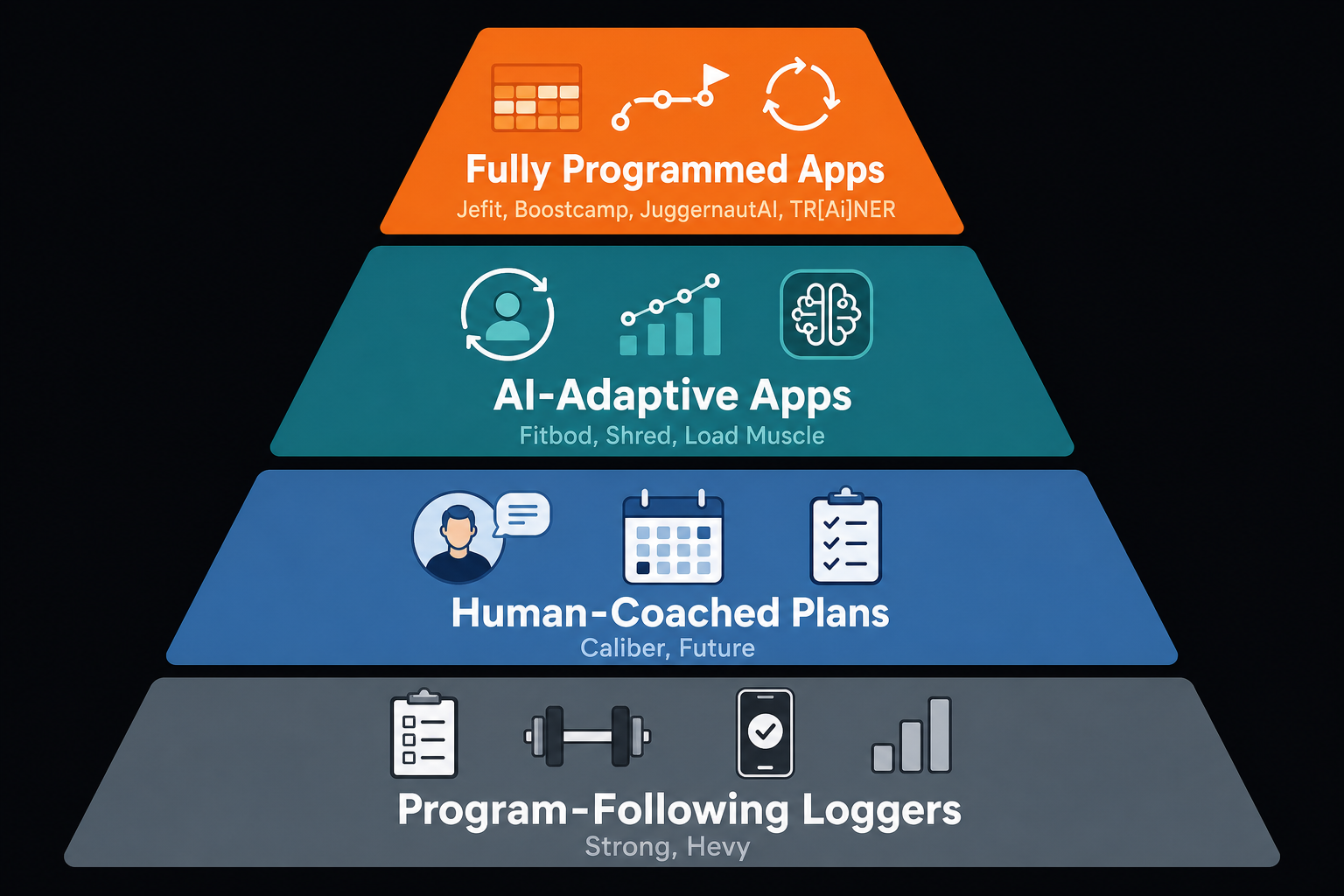
- Plan-Builders (Fully Programmed Apps) — These apps generate your workouts using an algorithm or a coach. They handle periodization, progressive overload, and recovery management. You tell them your goal, equipment, and schedule, and they produce a multi-week plan with specific exercises, sets, reps, and rest periods. Examples: Jefit, Boostcamp, JuggernautAI, TR[Ai]NER.
- Plan-Followers (Program-Following Loggers) — These apps let you import or manually enter a program you already have. They track your progress, calculate working weights, and log your performance, but they do not design the program for you. Examples: Strong, Hevy.
- Pure Loggers — These apps record what you did after you decide it. They offer no programming, no periodization, and no progression logic. They are digital notebooks with a timer. Examples: Basic note-taking apps repurposed as workout logs.
What Makes an App a True "Fitness Plan" App?
Before evaluating specific apps, it is worth defining the features that separate a genuine plan-programming app from a logger dressed up with a workout builder. These are the criteria used throughout this guide:
- Progressive Overload Algorithm — The app must automatically determine when to increase weight, reps, or volume based on your logged performance. This is not a manual "increase weight" button — it is a system that analyzes your last session and prescribes the next one.
- Periodization Support — The app should structure training into phases (e.g., accumulation, intensification, deload) rather than treating every session as an isolated workout.
- Deload Management — A true plan app knows when to schedule a deload week based on accumulated fatigue, not just a calendar date.
- Session-to-Session Adaptation — The app should adjust the next workout based on how the previous one went. If you failed a rep, the app should modify the load or volume for the next session.
- Multi-Week Planning — The app should present a complete weekly or monthly schedule, not just a single workout you repeat each time.
If an app lacks three or more of these features, it is not a fitness plan app — it is a logger. That is not a criticism; loggers serve a valid purpose. But they do not belong in the same category as apps that program your training.
Tier 1: Fully Programmed Apps
These are the apps that do the thinking for you. They generate complete training plans based on your goals, experience level, and available equipment, and they adjust those plans as you log your workouts. If you want an app that acts like a coach, this is your tier.
| App | Monthly Price | Progressive Overload Method | Periodization | Exercise Library | Free Tier |
|---|---|---|---|---|---|
| Jefit | $12.99/mo (Elite) | AI algorithm + NSPI score tracking volume across movement patterns | Yes (phased programs) | 1,400+ exercises | Free with ads; Elite unlocks full programming |
| Boostcamp | $14.99/mo (Pro) | Auto-calculated working weights from proven programs (5/3/1, nSuns, GZCLP) | Yes (program-specific periodization) | 1,000+ pre-made programs | Free tier includes 1,000+ programs |
| JuggernautAI | $35/mo | AI-driven auto-regulation based on RPE and rep velocity | Yes (full periodization cycles) | Built into AI system | 14-day free trial |
| TR[Ai]NER by Element 26 | $10/mo (annual) or $14.99/mo | AI builds custom program based on goals, equipment, and experience | Yes (multi-week phases) | AI-generated from your inputs | Up to 3 free programs (some 8 weeks each) |
Jefit stands out for its AI progressive overload algorithm and the NSPI (North Star Progress Index) score, which tracks volume across muscles and movement patterns to flag exactly when to increase weight. With over 1,400 exercises and a claimed user base of 20 million lifters, it is the most comprehensive option for lifters who want granular control over their programming. The free version includes the exercise library but limits programming features behind the Elite paywall.
Boostcamp takes a different approach: instead of an AI generating programs from scratch, it hosts proven programs like 5/3/1, nSuns, and GZCLP, and auto-calculates your working weights based on your training max. This is ideal for lifters who trust established programming methodologies and want an app that executes them correctly. The free tier includes access to over 1,000 programs, making it one of the most generous free offerings in this tier.
JuggernautAI uses AI-driven auto-regulation based on RPE and rep velocity, making it a strong choice for experienced lifters who want a program that adapts to daily fluctuations in performance. At $35/month, it is the most expensive option in this tier, but it offers a 14-day free trial to evaluate the system.
TR[Ai]NER by Element 26 is the budget-friendly entry point. At roughly $10/month with an annual plan, it builds a customized AI program based on your goals, equipment, and experience level. Its free tier is notably generous: you can create up to three full programs, some lasting eight weeks each, which effectively gives you up to six months of free AI programming.
Tier 2: AI-Adaptive Apps
Tier 2 apps use AI to adapt workouts based on your training history and recovery status, but they generally lack the structured periodization and multi-week planning of Tier 1. They are best suited for lifters who want a degree of intelligent adaptation without committing to a rigid program structure.
Fitbod uses adaptive AI that tracks your training history and adjusts volume based on muscle recovery. It costs roughly $15/month and offers a 3-workout free trial. Its strength is in balancing volume across muscle groups to avoid overtraining, but it does not offer the same level of periodization as Jefit or JuggernautAI.
Shred is priced at $9.99/month (or $119.99/year) and scores 5/5 for equipment demands and ease of use in Garage Gym Reviews' testing. It generates workouts based on your goals and available equipment, but its programming is less sophisticated than Tier 1 apps.
Load Muscle claims a library of 4,000+ exercises with video demos and AI-generated plans based on goals, equipment, and schedule. It offers a free plan, making it accessible for testing. However, the AI programming is less transparent than Tier 1 options, and the exercise count figure comes from the company's own marketing.
The key difference between Tier 1 and Tier 2 is structure. Tier 1 apps give you a complete weekly schedule with planned progression and deloads. Tier 2 apps generate individual workouts that adapt session-to-session but do not necessarily fit into a larger periodized framework. If you prefer a flexible, adaptive approach over a structured plan, Tier 2 may be a better fit.
Tier 3: Human-Coached Plan Apps
For lifters who want the highest level of personalization and accountability, human-coached apps pair you with a real coach who designs and adjusts your program. The trade-off is cost: you are paying for a person's expertise, not an algorithm.
| App | Monthly Price | Coaching Model | Free Tier | Best For |
|---|---|---|---|---|
| Caliber | Free (basic); $19/mo (Pro); $200+/mo (Premium) | Algorithm-generated plans in free tier; human coaching in paid tiers | Free-forever tier with 500+ exercise library and algorithm-generated plans | Lifters who want to start free and upgrade to coaching later |
| Future | $199/mo | 1-on-1 coaching with real trainers who design and adjust programs | None | Lifters who want full personalization and daily coach interaction |
Caliber offers a unique hybrid model. Its free-forever tier includes an algorithm-generated custom workout program and a library of 500+ exercises with video demos. The Pro tier ($19/month) adds human coaching, and Premium ($200+/month) provides more intensive 1-on-1 support. This makes Caliber a low-risk entry point: you can evaluate the programming quality before committing to a coach.
Future is the premium option at $199/month. You are paired with a real coach who designs your program, adjusts it based on your feedback, and communicates with you through the app. This is the closest you can get to a personal trainer without being in the same room. The cost reflects the human element: you are paying for a coach's time and expertise, not software.
The human-coached model is ideal for lifters who need accountability and personalized adjustments but cannot justify the cost of in-person training. It is less suitable for lifters who are comfortable with self-directed programming and prefer a lower monthly cost.
Tier 4: Program-Following Loggers — And Why They Are Different
This is where the confusion is most common. Apps like Strong and Hevy are frequently listed alongside plan-programming apps, but they serve a fundamentally different purpose. They are excellent at what they do — logging workouts — but they do not program them.
Strong is widely regarded as the best minimalist workout tracker. It offers a clean interface, Apple Watch integration, and the ability to create custom routines. But it has no AI recommendations, no progressive overload algorithm, and no periodization support. You must bring your own program and manually enter every exercise, set, and rep.
Hevy is similar but adds social features like sharing workouts and following other users. Its free tier is generous, including core tracking and social functionality. Like Strong, it does not program workouts — it records what you decide to do.
This is not a criticism of these apps. Strong and Hevy are excellent tools for their intended purpose. But they belong in a different category from Jefit, Boostcamp, and JuggernautAI. Treating them as interchangeable options is like comparing a notebook to a personal trainer.
Decision Framework: Which App Tier Fits Your Goal?
The right app depends on your primary training goal. The table below maps common goals to the recommended app tier, with specific app suggestions for each.
| Primary Goal | Recommended Tier | Best App Options | Why This Tier |
|---|---|---|---|
| Strength (powerlifting, 5/3/1, linear progression) | Tier 1: Fully Programmed | Boostcamp (for proven programs like 5/3/1, nSuns), JuggernautAI (for RPE-based auto-regulation) | These apps handle the complex periodization and progression schemes that strength training requires. |
| Hypertrophy (muscle building, bodybuilding-style splits) | Tier 1 or Tier 2 | Jefit (for volume tracking and NSPI score), Fitbod (for adaptive volume management) | Jefit's NSPI score tracks volume across movement patterns, while Fitbod adjusts volume based on muscle recovery. |
| General fitness (mixed goals, varied training) | Tier 2 or Tier 3 | Shred (budget-friendly AI), Caliber free tier (algorithm-generated plans) | These apps offer flexibility without the rigidity of a structured strength program. |
| Hybrid training (strength + cardio integrated) | Tier 1 (specialized) | Edge (£19.99/month, programs strength and cardio as a single integrated system) | Edge is the only app tested that programs both modalities with recovery management across them. |
| Home gym constraints (limited equipment, small space) | Tier 1 or Tier 2 | TR[Ai]NER (AI builds program from your equipment list), Fitbod (adapts to available equipment) | These apps generate programs based on what you actually own, not a full commercial gym. |
If you are still unsure which tier fits your situation, the 7-question strength training app selection guide provides a broader framework for evaluating apps based on your specific constraints.
Home Gym Constraints
If you train at home with limited equipment, your app choice becomes more critical. Many apps assume access to a full commercial gym with dumbbells up to 100 lbs, cable machines, and barbells. TR[Ai]NER and Fitbod are the strongest options here because they build programs based on the equipment you specify. For a deeper dive into equipment-specific recommendations, see our tested picks for home fitness apps.
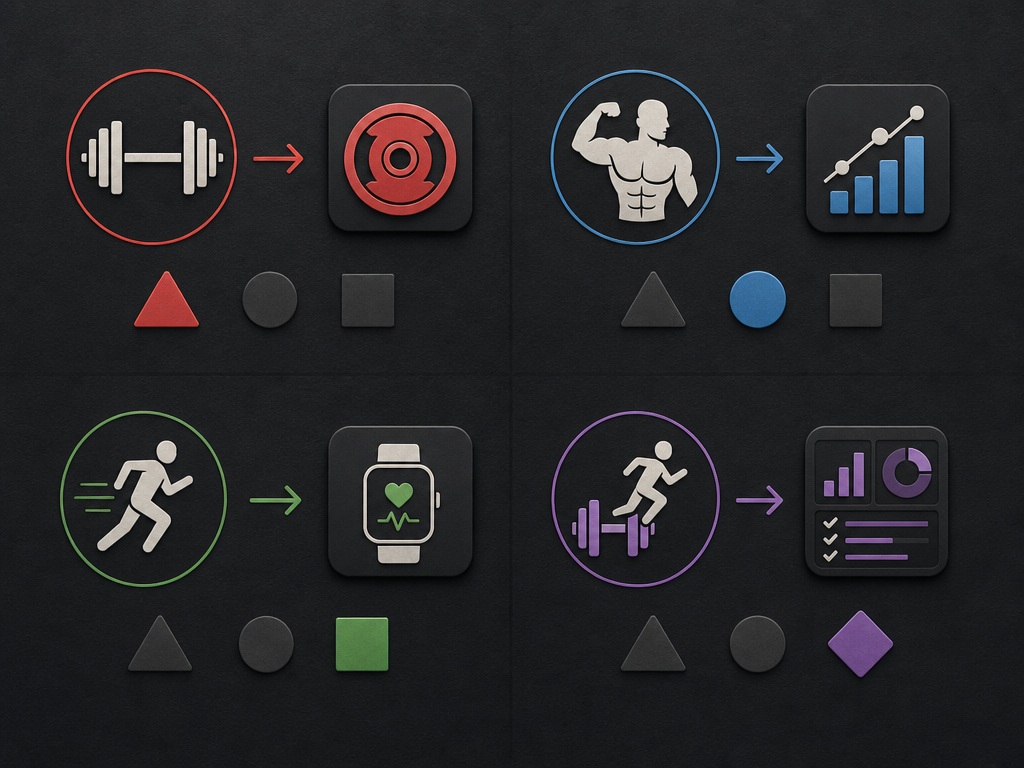
The Bottom Line: Don't Confuse a Logger with a Programmer
The fitness app market is crowded, and most "best of" lists do readers a disservice by treating all workout apps as interchangeable. The reality is simpler: you need to decide whether you want an app that programs your training or an app that logs it.
If you want intelligent programming with periodization, progressive overload, and recovery management, choose from Tier 1 (Jefit, Boostcamp, JuggernautAI, TR[Ai]NER) or Tier 3 (Caliber, Future) if you want human coaching. If you already have a program and just need a clean log, Tier 4 (Strong, Hevy) is the right choice. Tier 2 (Fitbod, Shred, Load Muscle) sits in between — adaptive but less structured.
For a broader look at free options across all categories, including apps that may not fit the plan-building mold but are still valuable for specific goals, see our comparison of free workout planners by equipment, space, time, and level.
What a small equipment investment adds
We don't have a build tagged to this exact tier yet. Browse all builds.
How often should you repeat this?
See our recovery and rest reference for citation-anchored rest-interval guidance.
Spot something off?
Tell us if a movement, tier assumption, or duration didn't match your experience.