
The Essential Home Fitness Starter Kit for Under $500
This guide helps budget-conscious beginners build a minimal viable home gym for $200–500, covering equipment choices that work in small spaces and progressive overload strategies without buying more gear.
I have watched too many beginners blow $500 on equipment that never gets used. The problem isn't the budget — it's the advice. Most "best home gym" articles are affiliate-driven: they push high-commission items, not what a space- and budget-constrained beginner actually needs. The result is a closet full of impulse buys and a workout habit that never started.
I want to offer a different approach: a minimal viable setup for $200–500 that covers real training needs without filling a garage. The data backs it up. According to PTPioneer, 38.6% of US home fitness equipment buyers spent under $500 on a single piece of equipment. That's per item, not a whole setup. When you apply the same logic to an entire starter kit, the message is clear: most beginners prefer an affordable entry point. The same source found that 20% of exercisers cite lack of space as a reason for not owning equipment. The setup I'll describe — a mat, resistance bands, and one pair of dumbbells — takes up less than 4 square feet.
The $200 Setup That Actually Works
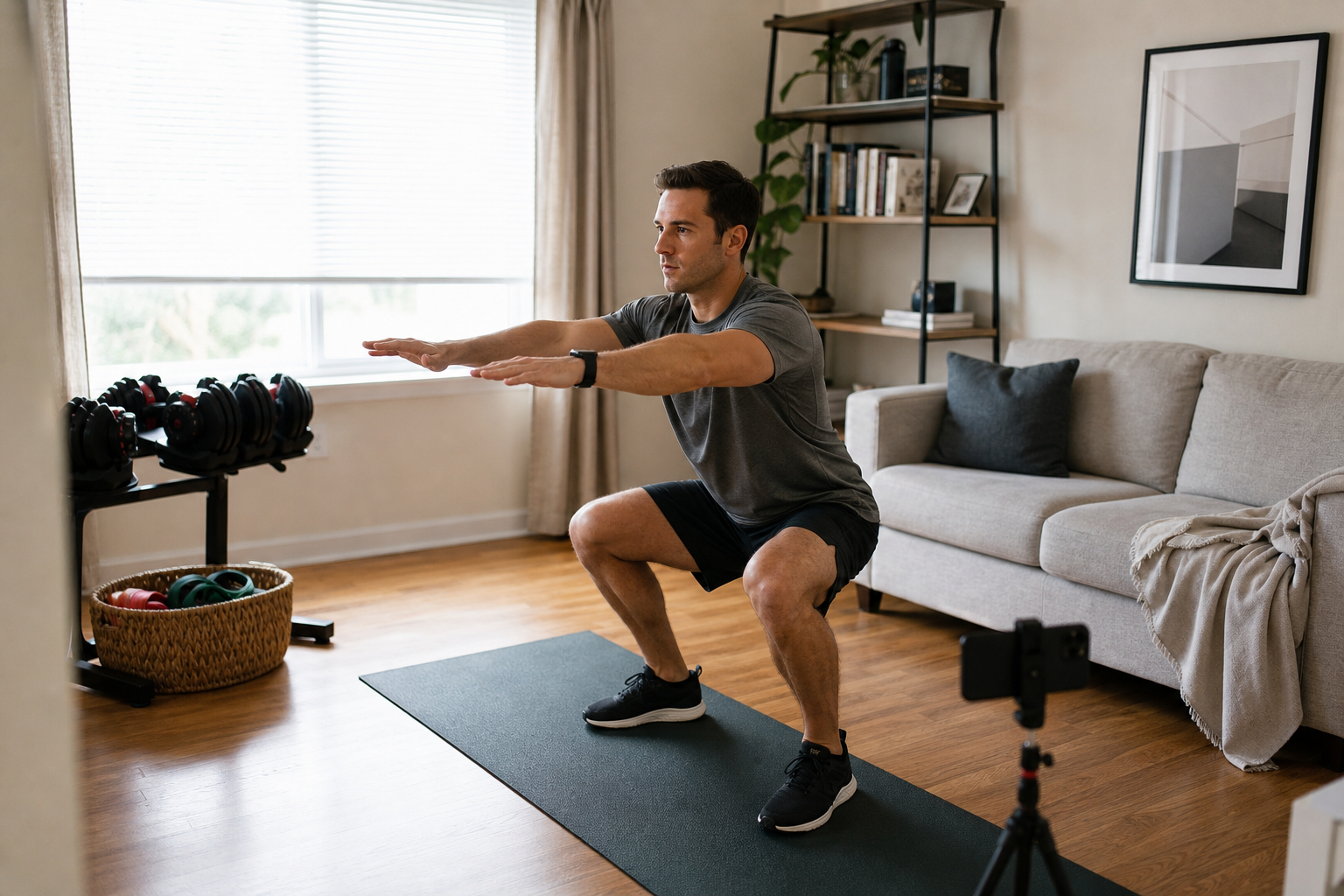
The absolute minimum for effective home fitness is a yoga mat, a set of resistance bands, and one pair of medium dumbbells. Siwicki Fitness pegs this kit at under $200 and claims it covers about 90% of exercises. That number sounds impressive, but let me test it against real movement patterns.
Here's what this setup covers:
- Push: dumbbell press, band push-ups
- Pull: band rows, dumbbell rows
- Squat: goblet squat, band squats
- Hinge: dumbbell deadlifts, band good mornings
- Carry: dumbbell farmer walks
What it misses: heavy deadlifts and pull-ups. But bands can approximate both — loop a band over a door anchor for seated rows or use it for banded pull-up negatives. The trade-off is honest: you lose the absolute load, but you gain the ability to train every major movement pattern in a corner of your living room.
The $300–500 Upgrade: Worth It?
The next tier swaps the fixed dumbbells for an adjustable pair. Siwicki lists a complete setup with a Manduka PRO mat ($144), Vergali resistance bands ($19.79), TYZDMY adjustable dumbbells (5–52.5 lb per hand, $269.99), and a JBL speaker ($159.95) for a total that ranges from $470 to $600. I have no doubt this works, but let me add some real-world perspective.
That Manduka mat is excellent, but a $30 mat from Target serves just fine for the first year. The adjustable dumbbells are the real star: they replace a full rack of weights in the footprint of two dumbbells. But if you never progress beyond 20 pounds — and many beginners don't in the first six months — you could have bought a fixed pair for half the price. The 38.6% stat from PTPioneer now applies correctly: spending under $500 on your total setup is reasonable, provided you buy only what you will actually use.
| Item | Siwicki Price | Budget Alternative |
|---|---|---|
| Yoga mat | $144 (Manduka PRO) | $30 (Target or Amazon) |
| Resistance bands | $20 (Vergali) | $15 (generic set) |
| Dumbbells | $270 (adjustable 5-52.5 lb) | $50 (fixed 15-20 lb pair) |
| Speaker | $160 (JBL) | Your phone (free) |
What to Avoid: The Space Hogs and Money Pits
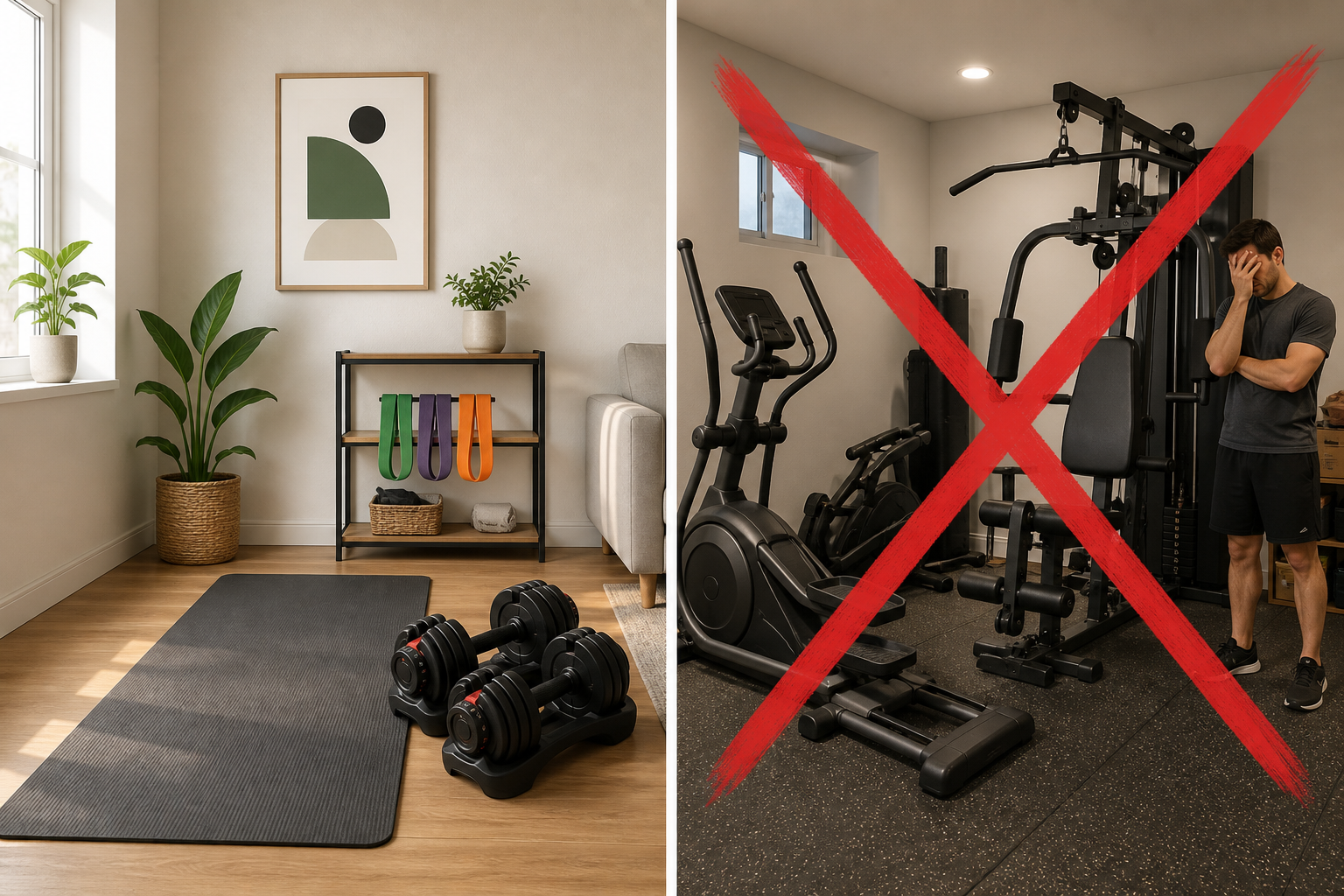
Now let me be blunt about the stuff you should avoid. Folding ellipticals: a $300 model provides too little resistance for strength gains yet takes up as much floor space as a yoga mat. Bulky cable machines: they cost $500+, require anchoring, and most beginners don't use half the attachments. Weight benches that don't fold: they sit in the middle of the room and become a laundry rack.
The trend data from Garage Gym Reviews tells a clear story: since 2011, search interest for strength equipment grew 170%, while cardio equipment interest dropped 34% from its pandemic peak. That's search intent, not actual purchases, but it reflects a real shift: beginners are biasing toward versatile strength gear over single-use cardio machines. Listen to the market.
Where to Save and Where to Splurge (My Rules)
Not all equipment is equal. Spend on the mat and dumbbells if they get heavy use; save on bands and accessories. The JBL speaker from the Siwicki list? Skip it. You have a phone. That $160 buys you another 8 pounds of dumbbell weight or three months of a quality app subscription.
- Mat: splurge if you train on hard floors daily; save if you're on carpet or train occasionally.
- Dumbbells: splurge on adjustability if you plan to progress past 20 pounds; otherwise, a fixed pair at 15–20 lb is plenty.
- Bands: save. A $20 set is enough for years.
- Everything else (speaker, apparel, fancy floor mats): spend only if it solves a specific problem you actually have.
How to Progress Without Buying Another Pound of Weight
The real bottleneck for beginners isn't the equipment — it's knowing how to keep making progress with what you have. Progressive overload does not require buying heavier dumbbells every month.
Here are concrete methods adapted from Centr's guide that work with a single dumbbell pair and bands:
- Add one rep per session for 3 weeks. If you did 8 reps on goblet squats, do 9 next time, then 10.
- Slow down the lowering phase to 3–4 seconds. This increases time under tension without adding weight.
- Reduce rest between sets by 15 seconds each week — start at 90 seconds, drop to 75, then 60.
- Use household items: a loaded backpack adds 10–20 pounds for squats and rows.
By rotating through these variables, you can squeeze months of progress out of a $30 pair of dumbbells and a $20 set of bands. The Centr guide also notes that proper warm-ups boost performance by up to 20% — five minutes of dynamic stretching before each session is free and effective. And don't skip rest days: overtraining syndrome can sideline you for weeks. A rest day is not a luxury; it's part of the plan.
The Real Bottleneck Isn't the Gear
The 170% growth in strength equipment search interest is real, but it measures purchase intent, not usage. The 51% of exercisers who prefer home workouts (PTPioneer) only succeed if they have a plan, not just gear. A $200–500 minimal kit, combined with a progression strategy, outperforms a garage full of unused equipment every time.
Start small. Focus on your workout, not your shopping cart. That's the only formula that matters.
This is general fitness education, not medical advice. For diagnosis or treatment of pain or injury, consult a qualified clinician.
Pick your next session
Browse all routines to find an appropriately-spaced next session.
Spot something off?
This content sits adjacent to health guidance — tell us if a citation or figure needs a correction.