
Fitness Band Tracker vs. Smartwatch vs. Smart Ring: How to Choose the Right Form Factor in 2026
Not sure whether to buy a fitness band, smartwatch, smart ring, or screenless strap? This comparison article explains why form factor is the most important decision, covering comfort, battery life, workout tracking, and subscription costs to help you pick the right wearable for your home fitness routine.
The Form Factor, Not the Brand, Is Your First Decision
Most people start a wearable search by typing “best fitness tracker” or “Fitbit vs Garmin.” That sequence is backward. The form factor—band, watch, ring, or screenless strap—determines whether you’ll actually wear the thing every day, how often you charge it, and what kinds of workouts it handles. Brand comes last.
Take the Xiaomi Smart Band 10—$53 and roughly 90% of the features for 30% of the price of a typical smartwatch. That sounds like a slam dunk—until you ask which 10% is missing. The missing slice includes built-in GPS accuracy, on-screen workout metrics during a run, and third‑party app integration. For a daily walker those gaps are irrelevant. For a cyclist who wants to glance at a map mid‑ride, they matter.
The app is more important than the hardware. A cheap tracker with a great app is more useful long-term than an expensive one with a confusing interface.
That’s Conor Allison, editor at Wareable, and I agree. But the app experience is also tied to the form factor—a band’s small screen limits what the app can show on-device. The point is: don’t start with brand. Start with how you’ll wear it.
The Four Form Factors at a Glance
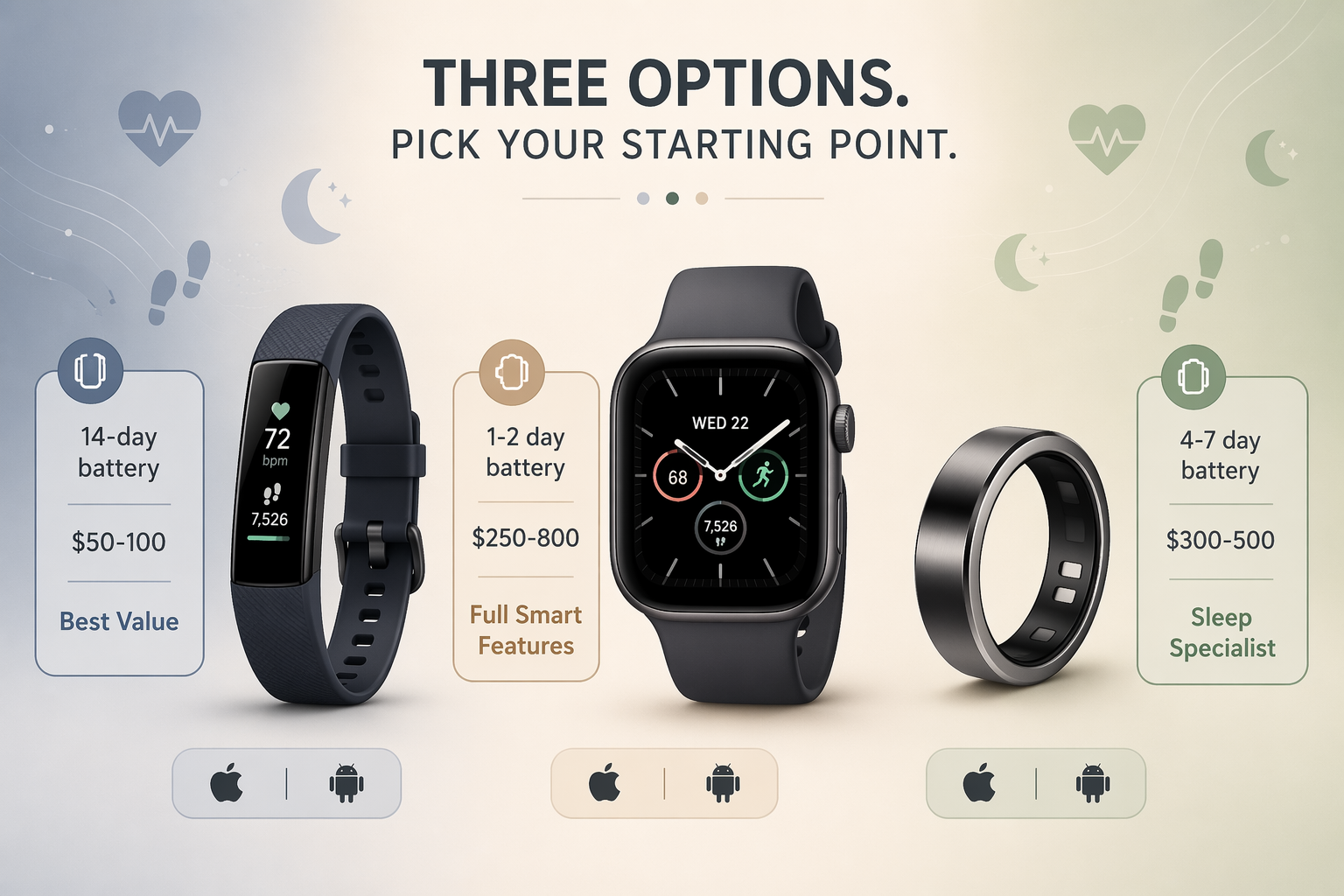
| Form Factor | Typical Price | Battery (Claimed / Tested) | Best For |
|---|---|---|---|
| Fitness band (e.g., Xiaomi Band 10, Fitbit Inspire 3) | $50–$150 | 7–14 days / 8.5 days (Inspire 3) | All‑day wear, simple tracking, best value |
| Smartwatch (e.g., Apple Watch Series 11, Samsung Galaxy Watch 8) | $250–$800+ | 18–48 hours / 43h (Apple), 26h (Samsung) | Screen‑on metrics, GPS runs, phone apps |
| Smart ring (e.g., Oura Ring 4) | $299–$349 + $6/mo | 4–7 days / 7.25 days (Oura Ring 4) | Sleep & recovery, discreet 24/7 wear |
| Screenless strap (e.g., Whoop 5.0) | Free hardware + $199/yr | 4–5 days | Serious athletes, training load, no screen distraction |
Notice the subscription rows: a Whoop strap costs $199 per year, Oura Ring 4 $72 per year. Over three years, Whoop becomes $597 plus nothing upfront, while Oura becomes $216 plus the $299 hardware—total $515. That is more than a decent fitness band, and you still own the ring. Meanwhile, most bands come with a free app. The subscription math matters more than the sticker price.
Comfort, Sleep, and Why Most People Quit Wearing a Tracker
A tracker that stays in a drawer helps nobody. The most important question about any wearable is whether you will keep it on overnight, during workouts, and during daily life.
Data from Jointcorp, a smart ring manufacturer, claims overnight wear compliance of 98% for smart rings versus 67% for wrist‑based devices. I would not treat that figure as an independent truth—it comes from a company that sells rings—but the direction matches what I see in practice: a bulky watch is the first thing people take off before bed. A slim band or a ring stays on because you barely notice it.
The Fitbit Inspire 3 is a useful example. Wirecutter found its step accuracy error was just 0.32%—the best of any tracker tested. That precision is irrelevant if the device is sitting on the nightstand. The Inspire 3 is thin and light enough that most people forget they are wearing it. That is not a spec you can read off a box.
What You Lose During a Workout With Each Form Factor
The form factor you choose dictates how you interact with data during exercise. Smart rings simply cannot show pace, heart rate zone, or distance mid‑run—they have no screen. The Oura Ring 4 can track 40 exercise types, but PCMag notes it provides fewer workout details than wrist‑based trackers. That is a hard limit, not a software update.
Here is how the four form factors stack up for common home fitness activities:
- Running or cycling outdoors: A smartwatch with built‑in GPS and a screen you can glance at is the obvious choice. Fitness bands that rely on connected GPS (phone in pocket) work well enough for casual runs, but GPS accuracy degrades. The Xiaomi Band 10’s missing 10% includes GPS precision.
- Weightlifting or bodyweight circuits: A screenless strap like Whoop or a slim band works because you only need to log rest periods—no live map needed. A smartwatch can get in the way during wrist‑heavy moves.
- Yoga, Pilates, or stretching: A smart ring is ideal—no wrist obstruction, comfortable on the mat. A band is fine if it is low‑profile. A smartwatch may feel bulky during downward dog.
- Swimming: Most fitness bands and smartwatches offer water resistance to 50 meters. Smart rings are usually water‑resistant enough for swimming but lack a display for lap counting.
For a deeper look at how heart rate accuracy varies by form factor, see our guide to wrist vs. chest strap vs. armband vs. smart ring.
Battery Life: The Real Number That Determines Your Charging Habit
Battery life is not a feature—it is a constraint baked into the form factor. You can fix GPS accuracy with a phone sync; you cannot make a watch last a week without turning off half its capabilities.
| Device | Advertised Battery | Tested Battery | Source |
|---|---|---|---|
| Apple Watch Series 11 | 18 hours (typical) | 43 hours | PCMag |
| Samsung Galaxy Watch 8 | ~30 hours | 26 hours | PCMag |
| Fitbit Inspire 3 | 10 days | 8.5 days | Wirecutter |
| Fitbit Charge 6 | 7 days | 5 days (with regular GPS) | Wirecutter |
| Oura Ring 4 | 7 days | 7.25 days | PCMag |
| Xiaomi Smart Band 10 | 14+ days | Not independently tested (claimed) | Wareable |
Look at the gap between advertised and tested for the Apple Watch: 18 hours claimed vs 43 hours tested. That is because Apple’s “typical” assumes frequent use. In real-world testing, the watch lasts much longer—but still less than two days. If you want to wear a device overnight and not have to charge every day, you need at least 4–5 days of battery. That eliminates every smartwatch and puts the smart ring or fitness band in the lead.
The Dual-Wear Option Worth Considering
If you want the sleep tracking of a ring and the workout display of a watch, you can wear both. The Verge has covered this strategy. It sounds expensive, but consider: a fitness band like the Inspire 3 ($100) plus an Oura Ring 4 ($299) costs less than a high-end smartwatch, and you get the best of each form factor. Over three years, the combination costs about $615 (including Oura’s subscription), which is less than a Whoop strap alone ($597) for far more utility. If the ring lasts five years, the math tilts even more.
That said, most people do not need two devices. A good fitness band covers sleep, steps, and heart rate well enough for 90% of users. The dual-wear approach is for the person who wants serious training load analysis (Whoop-style) but also wants real-time GPS maps during runs—and is willing to charge two things.
What to Do Now
Start with a fitness band unless you have a specific reason to buy a watch, ring, or strap. The $50–150 price range leaves room for error, and the battery life means you will actually wear it. If after a month you find you want live GPS without carrying your phone, upgrade to a smartwatch. If you sleep poorly and want detailed recovery data without wrist bulk, add a ring or switch to a Whoop.
The brand can wait. The form factor is the decision that shapes your daily experience, and it is the one you can change later without losing much money—as long as you start cheap.
This is general fitness education, not medical advice. For diagnosis or treatment of pain or injury, consult a qualified clinician.
Pick your next session
Browse all routines to find an appropriately-spaced next session.
Spot something off?
This content sits adjacent to health guidance — tell us if a citation or figure needs a correction.