
Wrist vs. Chest Strap vs. Armband vs. Smart Ring: Which Heart Rate Monitor Form Factor Is Right for Your Home Fitness Routine?
Not all heart rate monitors are created equal. This guide compares the four main form factors—wrist trackers, chest straps, armbands, and smart rings—across accuracy, comfort, cost, and use case, so you can choose the right device (or combination of devices) for your home workouts.
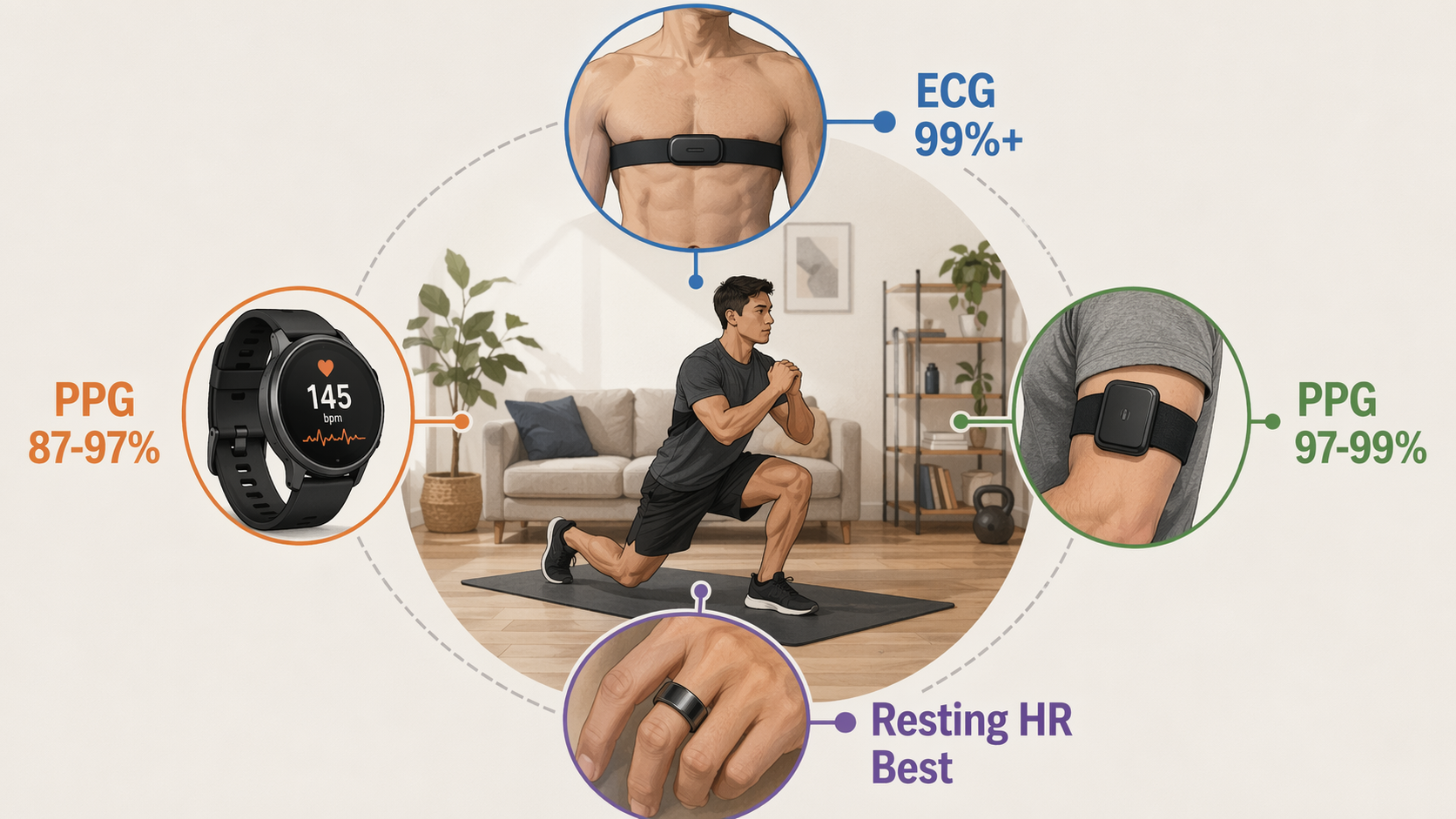
Why Form Factor Matters More Than Brand
If you are shopping for a heart rate fitness tracker, the first decision should not be which brand to buy. It should be which form factor to wear. The four main options — wrist trackers, chest straps, armbands, and smart rings — use fundamentally different sensor technologies and are designed for different jobs. A wrist tracker that delivers excellent step counts and sleep data can produce wildly inaccurate heart rate readings during a HIIT session. A chest strap that nails workout accuracy is impractical to wear 24/7. Most buyers never learn this tradeoff exists until after they have already made a purchase.
This guide compares all four form factors across accuracy, comfort, battery life, water resistance, compatibility, and total cost of ownership. The goal is not to crown a single winner — there is no such thing — but to give you a decision framework that starts with form factor and then narrows by activity type, budget, and tolerance for wearing multiple devices.
The Four Heart Rate Monitor Form Factors at a Glance
Before diving into the details, here is a quick-reference table that maps each form factor to its accuracy tier, primary use case, and the key tradeoff you need to know.
| Form Factor | Sensor Type | Accuracy Tier | Best For | Key Tradeoff |
|---|---|---|---|---|
| Chest Strap | ECG (electrocardiography) | Gold standard (99%+ vs. medical ECG) | Workouts where accuracy matters most — HIIT, intervals, zone training | Least comfortable for all-day wear; requires washing the strap |
| Wrist Tracker | Optical PPG (photoplethysmography) | Good for rest / light activity; degrades at high intensity | 24/7 wear — steps, sleep, resting HR, notifications | Accuracy drops during intense exercise; cadence lock during running |
| Armband Monitor | Optical PPG (multi-LED array) | Very good — within 1–3 BPM of chest strap during steady-state | Workout accuracy without wearing a chest strap; swim-compatible options | Less common form factor; fewer device options than wrist or chest |
| Smart Ring | Optical PPG + infrared | Excellent for resting HR and HRV; poor during exercise | Sleep tracking, recovery monitoring, resting metrics | Expensive ($349 + subscription); not suitable for workout tracking |
Chest Straps: The Gold Standard for Workout Accuracy
Chest straps use electrocardiography (ECG) sensors that detect the electrical signal of each heartbeat directly from the skin. This is the same underlying technology as a medical-grade 12-lead ECG, which is why chest straps remain the reference standard for heart rate accuracy in exercise science and professional sports.
A 2017 research letter published in JAMA Cardiology found that a chest strap had a 99% correlation with an electrocardiograph. Another 2017 study in the Journal of Medicine and Science in Sport and Exercise tested the Polar H7 against an ECG and reported 99.6% accuracy. These figures have made chest straps the go-to choice for researchers, coaches, and athletes who need reliable data for zone-based training.
Specific models to know:
- Polar H10 ($104.95): The most widely recommended chest strap. It uses an ECG sensor, has built-in memory for offline workouts, supports both Bluetooth and ANT+, offers up to 400 hours of battery life from a replaceable coin cell, and is swim-compatible to 3 ATM. The buckle-style connector with silicone dots prevents slippage during high-intensity movement.
- Garmin HRM 600 ($169.99): A rechargeable model with up to 60 hours of battery life (or roughly 2 months of typical use). It has 5 ATM water resistance, records running dynamics (cadence, stride length, ground contact time) when paired with a compatible Garmin watch, and powers advanced metrics like 'Step Speed Loss' analysis on the Forerunner 970.
- Wahoo TRACKR: Another strong contender in the chest strap category, tested alongside the Polar H10 and Garmin HRM 600 in REI's 8-week evaluation.
The main downside of chest straps is comfort for all-day wear. The elastic strap needs to be snug enough to maintain skin contact, and the sensor pod can be noticeable when sitting or sleeping. Most users take the strap off after their workout, which means a chest strap alone cannot provide 24/7 metrics like step count, sleep stages, or resting heart rate trends.
Wrist-Worn Trackers: Best for All-Day Wear, Limited for Intense Exercise
Wrist-worn devices — including smartwatches, fitness bands, and screenless trackers — use optical photoplethysmography (PPG) sensors. These sensors shine green or red LED light into the skin and measure the amount of light scattered or absorbed by blood volume changes with each heartbeat. It is an indirect measurement, and that indirectness introduces several sources of error.
Accuracy ranges for wrist optical sensors vary widely depending on activity. A 2019 study in the Journal of Sports Science found error rates ranging from as low as +/-1% to as high as +/-13.5%. A 2018 study in Cardiovascular Diagnosis & Therapy tested optical HR sensors on runners at increasing treadmill speeds and found that as workout intensity increased, accuracy decreased.
Two specific problems affect wrist trackers during home workouts:
- Cadence lock: During running, the sensor can mistake the rhythmic bouncing of the arm for the pulse, locking onto stride cadence (typically 160–180 steps per minute) instead of actual heart rate. This produces readings that look plausible but are completely wrong.
- Motion artifact during HIIT and strength work: Exercises like burpees, press-ups, kettlebell swings, and dumbbell presses involve rapid wrist movement and changes in grip pressure. These movements can break the optical contact between the sensor and skin, causing the device to lose the signal or report erratic values.
That said, wrist tracker technology has improved significantly. The Garmin Forerunner 970's Elevate Gen 5 optical sensor has been shown to match chest strap accuracy across multiple activity types in testing. The Fitbit Charge 6, priced around $100, offers 60% improved HR accuracy over the Charge 5 according to Fitbit, and includes an EKG sensor for atrial fibrillation assessment. The Apple Watch Series 10 is considered one of the most accurate optical HR sensors on the market, though Wareable notes that even the best wrist-based options still cannot match chest strap real-time reliability.
For all-day metrics — step count, resting heart rate, sleep stages, HRV trends — wrist trackers are excellent. The Fitbit Inspire 3, for example, had just 0.32% step count error in Wirecutter's testing, the best of all trackers tested. The problem is not the technology for low-intensity or stationary use; it is the technology's fundamental limitation during the kind of movement that defines most home workouts.
Armband Monitors: The Middle Ground You Haven't Considered
Armband heart rate monitors occupy a sweet spot that few buyers know exists. They use the same optical PPG technology as wrist trackers, but the sensor placement on the upper arm or forearm offers several advantages: the arm moves less relative to the torso than the wrist does, the skin is less hairy and has better blood perfusion, and the strap can be worn tighter without interfering with wrist movement during exercises like push-ups or planks.
REI's 8-week testing of six external heart rate monitors — including chest straps and armbands — across running, rowing, and swimming found that armband optical monitors produce nearly identical data to chest straps during steady-state runs and treadmill intervals. Specifically, the COROS armband was typically 1–3 BPM out from a chest strap. The Polar Verity Sense and Wahoo TICKR FIT performed similarly. Armband monitors showed identical accuracy whether worn on the bicep or forearm.
Key armband models:
- COROS Heart Rate Monitor ($79): Uses a 5-LED optical sensor with a Velcro strap made of polyester, nylon, and Spandex. Tested within 1–3 BPM of chest straps on runs, indoor rides, and high-intensity workouts.
- Polar Verity Sense: Swim-compatible via a goggle clip, with up to 600 hours of internal memory for storing workouts without a phone or watch nearby.
- Wahoo TICKR FIT: An optical armband that pairs via Bluetooth and ANT+, designed for users who want chest-strap-level accuracy without the chest strap.
The armband form factor is not perfect. It is a dedicated workout device — you put it on before exercise and take it off after. It does not provide all-day metrics. And the selection of armband monitors is smaller than the wrist tracker or chest strap markets. But for home gym users who want workout accuracy without the discomfort of a chest strap, the armband is the most underrated option in the category.
Smart Rings: Excellent for Rest and Recovery, Limited for Workouts
Smart rings like the Oura Ring 4 use a combination of optical PPG sensors and infrared LEDs to measure heart rate, heart rate variability (HRV), and blood oxygen saturation from the finger. Because the finger has excellent blood perfusion and the ring maintains consistent contact with the skin, these devices are exceptionally accurate for resting metrics.
Independent studies have found the Oura Ring 4 to be among the most accurate wearable devices for resting heart rate and HRV — metrics that matter most for sleep tracking and recovery monitoring. This makes the smart ring a natural companion for users who follow recovery-focused training and want to track readiness scores, sleep quality, and autonomic nervous system balance.
However, smart rings are the least responsive form factor during exercise. The sensor is on the finger, which is subject to grip pressure, hand movement, and changes in blood flow during weightlifting and bodyweight exercises. The Oura Ring 4 is not designed for real-time workout heart rate tracking — it is designed to capture your body's baseline and recovery state.
The cost is also a factor. The Oura Ring 4 starts at $349, and full access to readiness scores, sleep coaching, and detailed HRV data requires a $5.99/month subscription ($71.88/year). Over two years, the total cost of ownership is approximately $493 — significantly more than any chest strap or armband, and comparable to a mid-range smartwatch.
Head-to-Head Comparison: 10+ Dimensions Across All Four Form Factors
The table below compares all four form factors across the dimensions that matter most for home fitness buyers. Use it as your primary decision-making tool.
| Dimension | Chest Strap | Wrist Tracker | Armband | Smart Ring |
|---|---|---|---|---|
| Accuracy — Resting HR | Excellent (ECG) | Good (PPG) | Good (PPG) | Excellent (PPG + IR) |
| Accuracy — Steady-State Cardio | Excellent (99%+ vs. ECG) | Good to Very Good (87–97%) | Very Good (1–3 BPM vs. chest strap) | Fair (not designed for exercise) |
| Accuracy — HIIT / Intervals | Excellent (rapid response) | Poor to Fair (motion artifact, cadence lock) | Good (less motion artifact than wrist) | Poor (grip pressure, hand movement) |
| Accuracy — Swimming | Excellent (Polar H10, Garmin HRM 600) | Poor (water blocks optical signal) | Good (Polar Verity Sense with goggle clip) | Not recommended |
| Comfort for All-Day Wear | Poor (strap must be snug) | Excellent | Fair (workout-only device) | Excellent (unobtrusive) |
| Battery Life | 400 hours (Polar H10, coin cell); 60 hours (Garmin HRM 600, rechargeable) | 5–14 days (varies by model) | 20–30 hours (rechargeable) | 4–7 days (Oura Ring 4) |
| Water Resistance | 3–5 ATM (swim-compatible) | 5 ATM (most modern models) | Swim-compatible (Verity Sense via clip) | 100m (Oura Ring 4) |
| Subscription Required | No | No (most models); Fitbit Premium optional | No | Yes ($5.99/mo for Oura) |
| Bluetooth / ANT+ | Both (most models) | Bluetooth (most); ANT+ (Garmin, some others) | Both (most models) | Bluetooth only |
| Upfront Price Range | $60–$170 | $80–$800+ | $79–$130 | $349+ |
| Best Use Case | Workout accuracy above all else | 24/7 wear + casual fitness tracking | Workout accuracy without chest strap | Sleep, recovery, resting metrics |
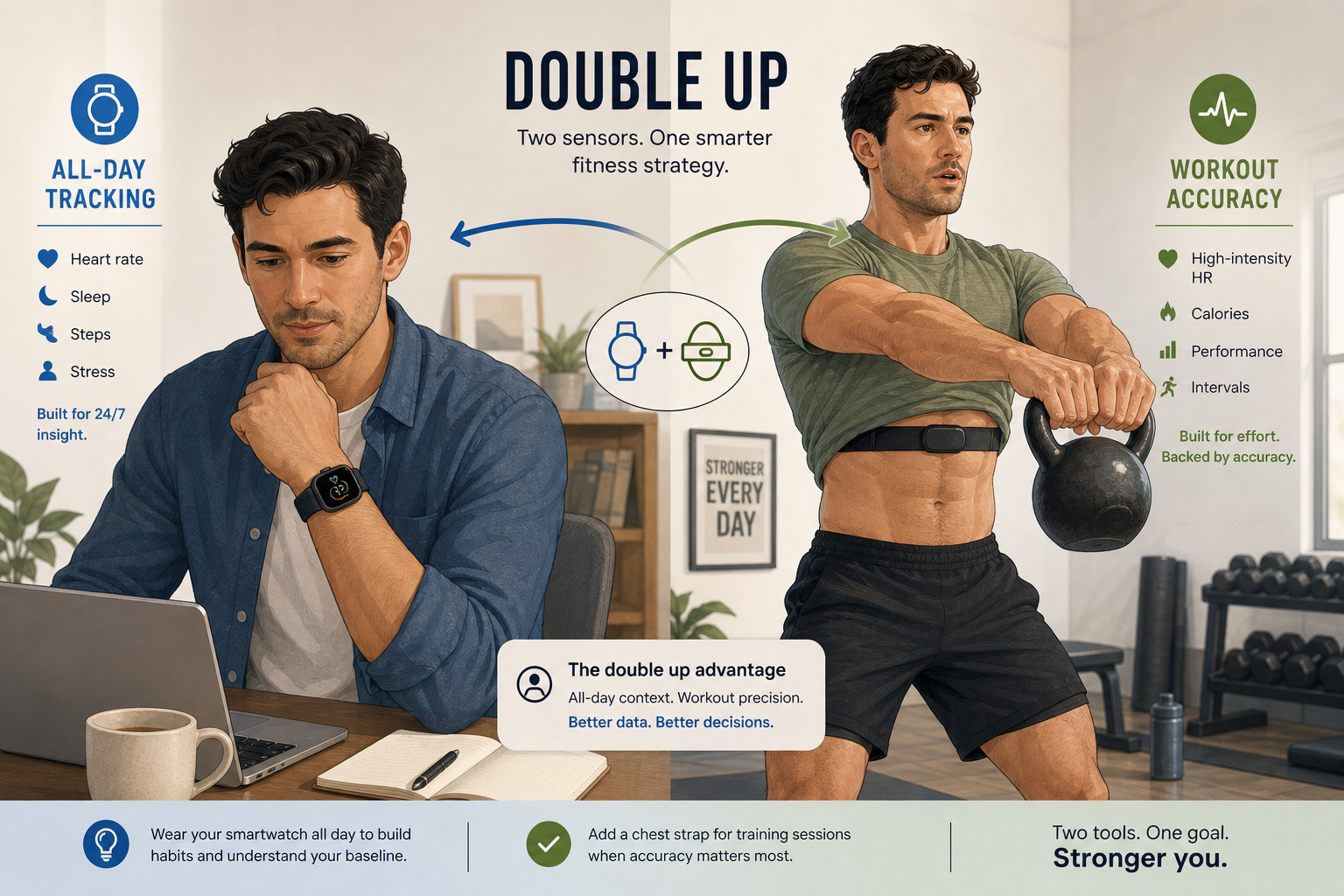
The 'Double Up' Strategy: Why Many Home Gym Users Wear Two Devices
The most practical solution for serious home fitness enthusiasts is not to find a single device that does everything — it is to wear two devices that each do their job well. This is the 'double up' strategy: a wrist tracker or smart ring for 24/7 metrics (steps, sleep, resting HR, HRV trends) plus a chest strap or armband for workout heart rate accuracy.
Here is how the strategy works in practice:
- Wear a wrist tracker (Garmin, Fitbit, Apple Watch) or a smart ring (Oura) all day and night. This gives you step count, sleep stages, resting heart rate, HRV, and readiness scores — the data you need for recovery and daily activity awareness.
- Put on a chest strap (Polar H10, Garmin HRM 600) or armband (COROS, Polar Verity Sense) only during workouts. This gives you accurate, real-time heart rate data for zone training, interval work, and HIIT sessions.
- Most modern platforms (Apple Health, Garmin Connect, Fitbit, Oura) can consolidate data from multiple sources, so your daily dashboard shows a complete picture even though the data comes from two devices.
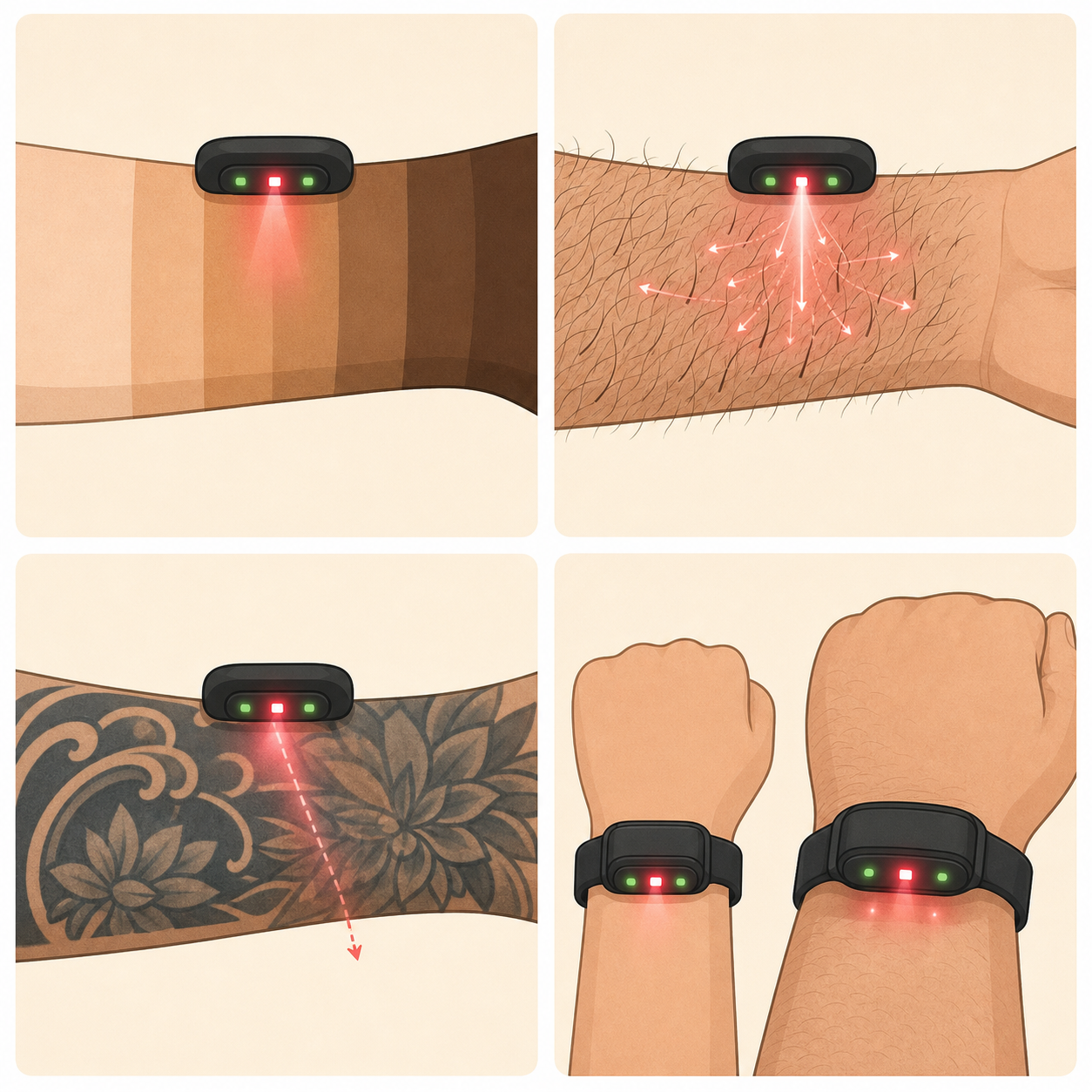
How Skin Tone, Tattoos, Body Hair, and Wrist Size Affect Accuracy
Optical heart rate sensors work by shining light through the skin and measuring how much is absorbed or scattered by blood flow. Anything that changes how light passes through the skin — melanin concentration, ink, hair, or the fit of the device — can affect the reading.
A study published in NPJ Digital Medicine on February 10, 2020 recruited 53 participants with different skin tones and tested six wrist-worn optical HR devices against ECG patches during sitting, deep breathing, walking, and typing. The researchers found no appreciable differences in heart rate accuracy among people with light, medium, or dark skin tones. However, accuracy did vary by activity: walking tended to cause reported HR to be higher than true HR, and typing caused reported HR to be lower, possibly due to wrist movements affecting sensor contact.
Other physical factors that can affect accuracy:
- Tattoos: Dark ink, particularly black, blue, and green ink, can absorb the LED light from optical sensors, preventing it from reaching the blood vessels underneath. If you have a tattoo on your wrist, forearm, or bicep, an optical sensor worn over that area may produce no reading or erratic readings. Moving the sensor to an un-tattooed area usually solves the problem.
- Body hair: Chest straps require good skin contact for the ECG electrodes. Heavy chest hair can create a gap between the electrode and the skin, causing signal dropout. Some users trim or shave the contact area. Armband monitors are less affected because the upper arm typically has less hair than the chest.
- Wrist size and fit: A wrist tracker that is too loose will let ambient light in, washing out the sensor signal. A tracker that is too tight can restrict blood flow, also affecting readings. Most wrist trackers work best when worn one finger-width above the wrist bone, snug enough that the sensor does not move but not tight enough to leave an indentation.
Cost Comparison: Upfront Price, Subscription Costs, and Total Cost of Ownership
The upfront price is only part of the equation. Subscription costs can significantly change the total cost of ownership, especially for smart rings and some wrist trackers with premium tiers.
| Form Factor | Example Model | Upfront Price | Subscription Cost | Total Cost (2 Years) |
|---|---|---|---|---|
| Chest Strap | Polar H10 | $104.95 | $0 | $104.95 |
| Chest Strap | Garmin HRM 600 | $169.99 | $0 | $169.99 |
| Armband | COROS HR Monitor | $79.00 | $0 | $79.00 |
| Armband | Polar Verity Sense | $129.95 | $0 | $129.95 |
| Wrist Tracker | Fitbit Charge 6 | $159.95 | $0 (Premium optional at $9.99/mo) | $159.95 (or $399.95 with Premium) |
| Wrist Tracker | Garmin Forerunner 970 | $599.99 | $0 | $599.99 |
| Smart Ring | Oura Ring 4 | $349.00 | $5.99/mo ($71.88/yr) | $492.76 |
For a broader look at how different devices compare on accuracy across multiple metrics — including step count, distance, and calorie estimation — see our Fitness Tracker Accuracy Report 2026: Which Devices Get It Right (and Which Don't).
Which Form Factor Should You Choose? A Decision Framework by Activity Type
Use the following decision framework to match a form factor (or combination of form factors) to your primary home fitness activities.
- You do steady-state cardio (walking, jogging, indoor cycling, elliptical): A modern wrist tracker with a good optical sensor (Garmin Elevate Gen 5, Apple Watch Series 10, Fitbit Charge 6) will provide sufficient accuracy. You do not need a chest strap unless you are training in specific heart rate zones and want the highest possible precision.
- You do HIIT, interval training, or CrossFit-style workouts: A wrist tracker alone will not give you reliable data. Use a chest strap (Polar H10, Garmin HRM 600) or an armband (COROS, Polar Verity Sense) for workout accuracy. Pair it with a wrist tracker or smart ring for all-day metrics.
- You lift weights or do bodyweight strength training: Wrist trackers struggle with grip pressure changes and wrist movement during exercises like deadlifts, pull-ups, and push-ups. An armband worn on the bicep avoids these issues and provides accurate readings. A chest strap also works well.
- You swim: Optical sensors on wrist trackers and armbands lose accuracy in water because water scatters the LED light. Chest straps with ECG sensors (Polar H10, Garmin HRM 600) are the most reliable option for swim heart rate tracking. The Polar Verity Sense armband is also swim-compatible via a goggle clip.
- You prioritize sleep tracking and recovery monitoring above workout data: A smart ring (Oura Ring 4) is the best choice for resting HR, HRV, and sleep stage accuracy. Pair it with a chest strap or armband for workouts if you also train with intensity.
- You want one device for everything and are willing to accept some workout inaccuracy: Choose a high-end wrist tracker with the latest optical sensor (Garmin Forerunner 970, Apple Watch Series 10). You will get good all-day metrics and passable workout data, but you will miss the rapid-response accuracy of a chest strap during intervals and HIIT.
This result comes from one real apartment under the stated conditions — it is a strong signal, not a guarantee your space will measure identically.
Builds this evidence supports
No build currently links to this specific test. Browse all builds with a matching tag.
Spot something off?
If this result didn't match your own space, let us know — floor-damage and noise claims carry real deposit-risk consequences if we get them wrong.