
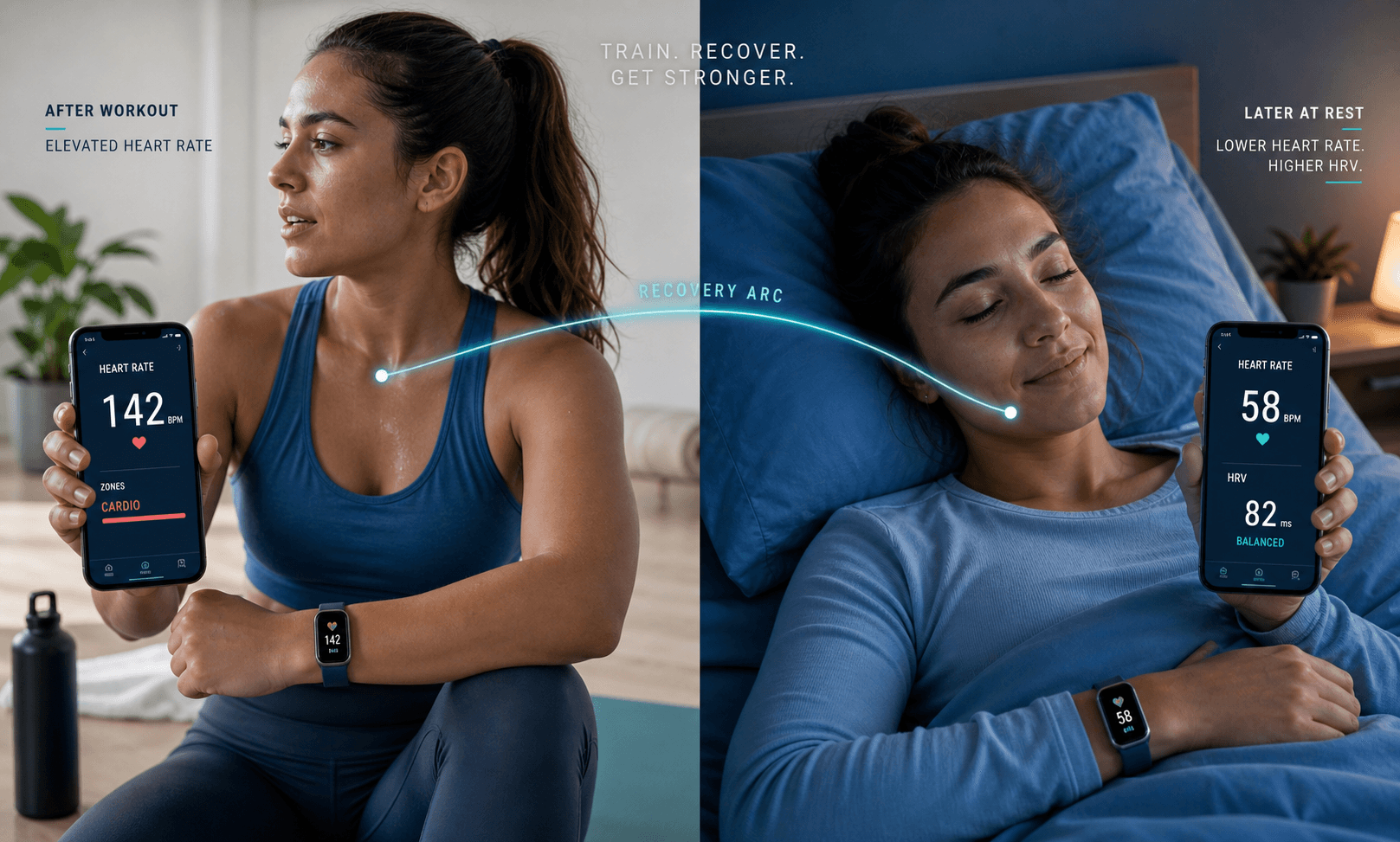
The Promise vs. The Reality of Recovery Scores
Open your Garmin app and you'll see a Body Battery score. Whoop gives you a Recovery percentage. Oura offers a Readiness Score. Fitbit has a Daily Readiness Score. Each one claims to tell you, in a single number, whether your body is primed for a hard workout or needs a rest day. It's an appealing promise — especially for home fitness enthusiasts who train without a coach watching their form or asking how they slept.
But here's the tension that rarely gets addressed in the marketing materials: these scores are built on heart rate variability (HRV) data collected from consumer-grade optical sensors, processed through proprietary algorithms, and presented as if they were objective medical measurements. They are not. The gap between what these scores promise and what they can actually deliver is significant, and understanding that gap is the difference between using your tracker as a useful tool and letting it make poor training decisions for you.
This article takes a skeptical, evidence-based look at wearable recovery metrics. We'll examine what the peer-reviewed research actually says about consumer HRV accuracy, why you cannot compare scores across brands, why reacting to a single low number is a mistake, and — most importantly — how to use this data intelligently without letting it override how you actually feel. If you need a refresher on what HRV, resting heart rate, and heart rate recovery are, our explanatory guide on how trackers measure recovery covers that baseline. Here, we go further — into the reliability of the data itself.
What the Science Actually Says About Wearable HRV Accuracy
The most comprehensive evidence we have on wearable HRV accuracy comes from a meta-analysis of 23 studies published by Dobbs et al. in 2019, which was later reviewed and summarized in a 2023 review from the Texas Heart Institute. The headline finding: consumer wearable HRV measurements show a small absolute error when compared to clinical-grade ECG. That sounds reassuring, but the details matter a great deal.
The meta-analysis found that not all HRV metrics are measured equally well by consumer devices. The time-domain metric SDNN (the standard deviation of normal-to-normal intervals) showed the greatest error compared to ECG. The metric RMSSD (the root mean square of successive differences) and high-frequency band measurements were more reliable. This is not a trivial technical detail — it means that the specific HRV number your tracker shows you depends heavily on which metric the manufacturer chose to calculate, and whether that metric is one the optical sensor can capture accurately.
A separate validation study by Miller et al. in 2022 tested six consumer devices against ECG and found similar patterns: accuracy was acceptable during rest and sleep but degraded significantly during movement. This is a fundamental limitation of photoplethysmography (PPG) — the optical technology most wrist-worn and ring-based trackers use to measure heart rate. PPG sensors detect blood volume changes through the skin using light. Any motion introduces artifacts that the device's algorithm must filter out, and that filtering is imperfect.
| Metric | Consumer Wearable Accuracy vs. ECG | Key Limitation |
|---|---|---|
| SDNN (time-domain) | Greatest error among common metrics | More sensitive to motion artifacts and recording duration |
| RMSSD (time-domain) | More reliable, smaller error | Still affected by movement; best during sleep/rest |
| High-frequency (frequency-domain) | More reliable than SDNN | Requires longer recording windows for accuracy |
Comments
Join the discussion with an anonymous comment.