
Apple Watch Fitness Tracking Accuracy: What the Data Says About Heart Rate, Steps, and Calories
The Apple Watch is one of the most popular fitness wearables, but how much should you trust its data? This article breaks down the science — including a meta-analysis of 56 studies — to show where the Apple Watch excels (heart rate and steps) and where it falls short (calorie burn), with practical advice for home fitness users.
How Accurate Is the Apple Watch for Fitness Tracking?
The Apple Watch is the most popular wearable in the United States, and for good reason: it integrates deeply with the iPhone, offers a polished workout experience, and tracks a wide range of health metrics. But if you are using it to guide your home fitness decisions — how hard to push, how many calories you burned, whether you hit your daily step goal — the accuracy of that data matters.
The short answer is that the Apple Watch is not equally accurate across all metrics. It is excellent at measuring heart rate and step count, but its calorie burn estimates are unreliable enough that you should not base nutrition or training-load decisions on them. This article breaks down the evidence — anchored by a meta-analysis of 56 studies from the University of Mississippi — so you know exactly what to trust and what to treat as a rough estimate.
What the Research Says: A Meta-Analysis of 56 Studies
A single study can be misleading. Sample sizes vary, testing conditions differ, and individual results may not generalize. That is why the meta-analysis conducted by researchers at the University of Mississippi carries more weight than most individual accuracy tests. A meta-analysis pools data from multiple independent studies and calculates a combined result, giving a much more reliable picture of real-world performance.
The Mississippi team analyzed 56 separate studies that compared Apple Watch readings against gold-standard reference tools — clinical ECG monitors for heart rate, indirect calorimetry for energy expenditure, and manual step counting or validated pedometers for step count. The result is the most comprehensive accuracy assessment of the Apple Watch currently available.
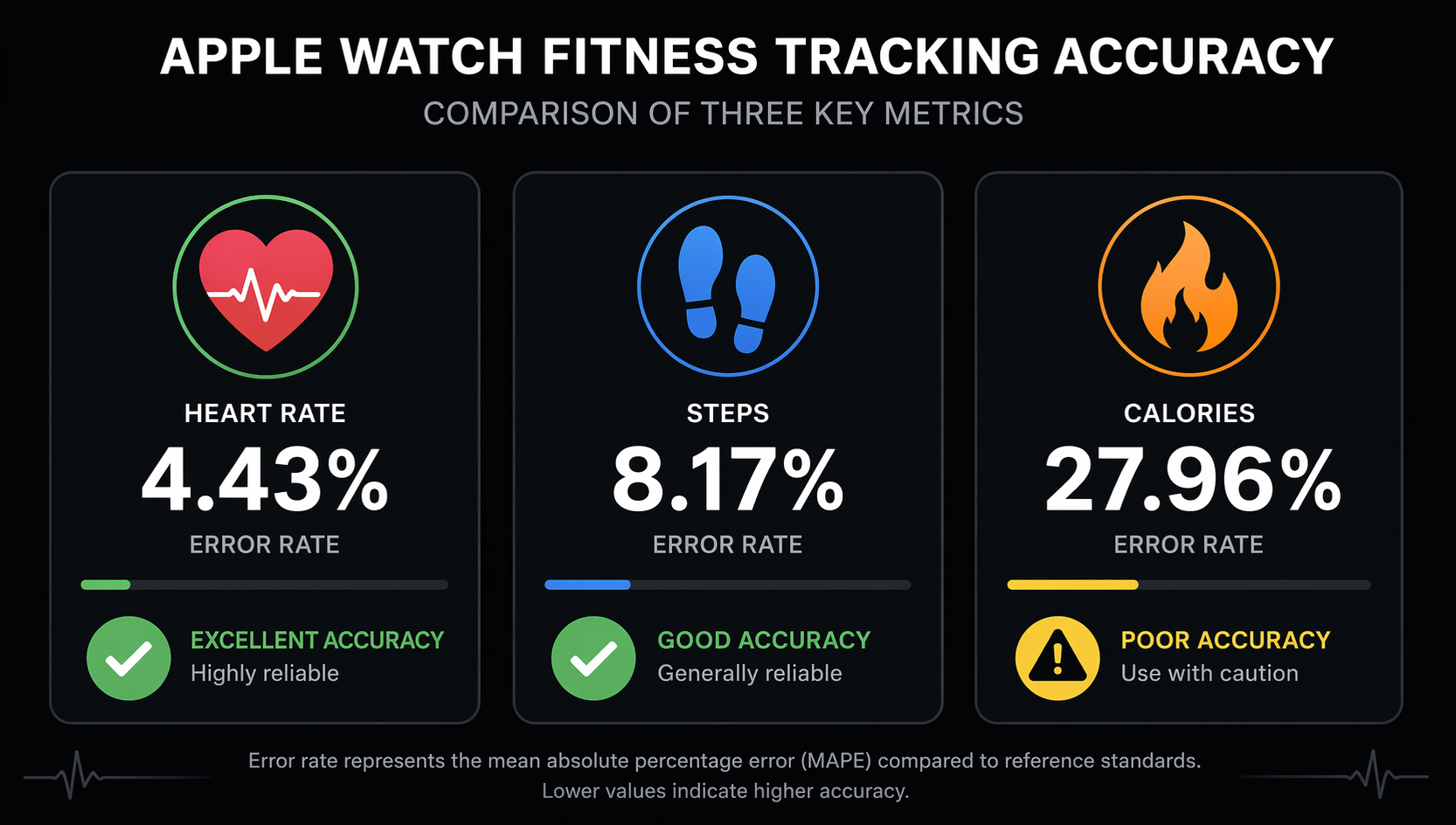
The overall finding is clear: accuracy varies dramatically by metric. Heart rate and step count both fall below the 10% mean absolute percentage error (MAPE) threshold that researchers consider "excellent." Energy expenditure — the watch's calorie burn estimate — does not come close.
Heart Rate Accuracy: Excellent (4.43% Error)
The Apple Watch's optical heart rate sensor performed impressively across the 56 studies, with a mean absolute percentage error of just 4.43%. That means if your true heart rate is 150 bpm, the watch will typically report a value between roughly 143 and 157 bpm. For most home fitness purposes, that level of accuracy is more than sufficient.
Why this matters for home fitness:
- Zone-based training: If you are following a heart rate zone program (e.g., Zone 2 endurance work or Zone 4 intervals), the Apple Watch can place you in the correct zone reliably.
- Effort monitoring: During a home HIIT session or steady-state cardio, the watch gives you real-time feedback on whether you are hitting your target intensity.
- Recovery tracking: Resting heart rate and heart rate recovery trends — both available on the Apple Watch — are useful signals for gauging overall fitness and recovery status.
Step Count Accuracy: Good (8.17% Error)
Step count accuracy came in at 8.17% MAPE — also below the 10% excellent threshold, though slightly less precise than heart rate. For a device that relies on wrist-based accelerometry to detect steps, this is a solid result.
In practical terms, an 8.17% error means that if you walk 10,000 steps, the watch might record anywhere from about 9,180 to 10,820 steps. That is close enough for daily activity awareness and general motivation, but not precise enough for research-grade step counting.
The main source of step count error is non-walking arm movement. Activities like pushing a stroller, carrying groceries, typing, or using a rowing machine can produce false positives or missed steps. The Apple Watch's algorithm handles these edge cases reasonably well compared to other wrist-worn trackers, but it is not perfect.
Calorie Burn Accuracy: Poor (27.96% Error, Can Be Off 40–80%)
This is where the Apple Watch's accuracy story takes a sharp turn. The meta-analysis found a mean absolute percentage error of 27.96% for energy expenditure — well above any acceptable threshold. And that is just the average. Multiple individual studies have found that wrist-based calorie tracking can be off by 40% to 80% depending on the activity and the individual.
The researchers found that the Apple Watch was inaccurate across all activities tested: walking, running, mixed-intensity workouts, and cycling. This was not a problem limited to one type of exercise. The calorie estimate was unreliable regardless of what the user was doing.
| Metric | Mean Absolute Percentage Error | Accuracy Rating |
|---|---|---|
| Heart Rate | 4.43% | Excellent (below 10% threshold) |
| Step Count | 8.17% | Good (below 10% threshold) |
| Energy Expenditure (Calories) | 27.96% | Poor (well above acceptable threshold) |
Why Wrist-Based Calorie Tracking Is Inherently Flawed
The reason calorie tracking is so much less accurate than heart rate or step tracking comes down to a fundamental limitation of the technology. The Apple Watch does not measure calorie burn directly. Instead, it estimates energy expenditure using an algorithm that combines heart rate data, movement data from the accelerometer, and personal information you provide (age, weight, height, sex).
The problem is that these algorithms use population-level averages to make individual predictions. They cannot account for the factors that make your metabolism unique:
- Muscle mass: Two people of the same weight can have very different resting metabolic rates depending on their body composition.
- Fitness level: A trained athlete burns fewer calories at a given heart rate than a sedentary person, because their cardiovascular system is more efficient.
- Genetics and hormones: Individual variation in metabolism can be substantial and is not captured by any wearable.
- Thermic effect of food: Digestion itself burns calories, and this varies by meal composition and individual.
The 27.96% error from the meta-analysis and the 30%+ error from the 2022 study are not bugs that Apple can fix with a software update. They are inherent limitations of estimating a complex physiological process from wrist-worn sensors. Any device that relies on the same approach — heart rate plus accelerometry plus population algorithm — will face the same challenge.
Practical Recommendations: What to Trust and What to Flag
Knowing where the Apple Watch is accurate and where it is not allows you to use it effectively without being misled. Here is a simple framework for home fitness users:
- Trust heart rate data for zone training and effort monitoring. The 4.43% error rate is excellent for real-time feedback during workouts. Use it to stay in your target zone during steady-state cardio or to ensure you are recovering adequately between intervals.
- Trust step counts for daily activity awareness. The 8.17% error is good enough to track general movement trends and stay motivated. Do not obsess over hitting exactly 10,000 steps — focus on whether your weekly average is trending up or down.
- Do not rely on calorie data for nutrition decisions. The 27.96% error (and potential for 40–80% error in individual cases) means that using the watch's calorie burn to decide how much to eat is a recipe for inaccurate energy balance calculations.
How Apple Watch Compares to Garmin and Whoop on Accuracy
The Apple Watch is not alone in its accuracy profile. All wrist-worn optical trackers share the same fundamental limitations, especially when it comes to calorie estimation. However, there are meaningful differences between platforms that may influence your choice.
- Garmin: Garmin devices that support external chest strap connectivity can achieve significantly better heart rate accuracy during structured training, because chest straps use electrical (ECG) sensing rather than optical (PPG) sensing. For serious athletes doing zone-based training, a Garmin paired with a chest strap is the more accurate setup. See our Garmin fitness tracker accuracy deep-dive for the full evidence review.
- Whoop: Whoop focuses exclusively on recovery and training load metrics rather than step counts or GPS. Its strength is in HRV and resting heart rate trend analysis, not real-time workout tracking. Like the Apple Watch, its calorie estimates are subject to the same wrist-based limitations.
- Oura Ring: The Oura Ring is a different form factor entirely — a smart ring rather than a wrist-worn device. Its accuracy profile is strongest for sleep tracking and HRV, but it is not designed for real-time workout tracking. Our Oura Ring accuracy article covers what the peer-reviewed studies show.
The key takeaway: no wrist-worn device is reliable for calorie tracking. If that is your primary concern, you will be disappointed by every option on the market. If you care most about heart rate accuracy during workouts, the Apple Watch is excellent — and if you need the absolute best heart rate data, a chest strap paired with any compatible device is the way to go.
The Bottom Line for Home Fitness Users
The Apple Watch is a capable and well-designed fitness companion for home workouts. Its heart rate tracking is excellent, its step counting is reliable enough for daily awareness, and its integration with Apple Health and third-party fitness apps makes it a versatile training tool.
But its calorie burn estimates should be treated as a rough approximation at best. The evidence — from a meta-analysis of 56 studies and corroborated by multiple independent investigations — is consistent and clear: wrist-based energy expenditure tracking is not accurate enough to inform nutrition decisions or precise training load calculations.
This result comes from one real apartment under the stated conditions — it is a strong signal, not a guarantee your space will measure identically.
Builds this evidence supports
No build currently links to this specific test. Browse all builds with a matching tag.
Spot something off?
If this result didn't match your own space, let us know — floor-damage and noise claims carry real deposit-risk consequences if we get them wrong.