
Best Fitness Tracker 2026: A Decision-Matrix Guide by User Type (Not a Generic Roundup)
There is no single 'best' fitness tracker. This guide uses a four-axis decision matrix — form factor, phone ecosystem, activity type, and budget — to match you with the right device for your specific needs, from casual wellness to serious training.
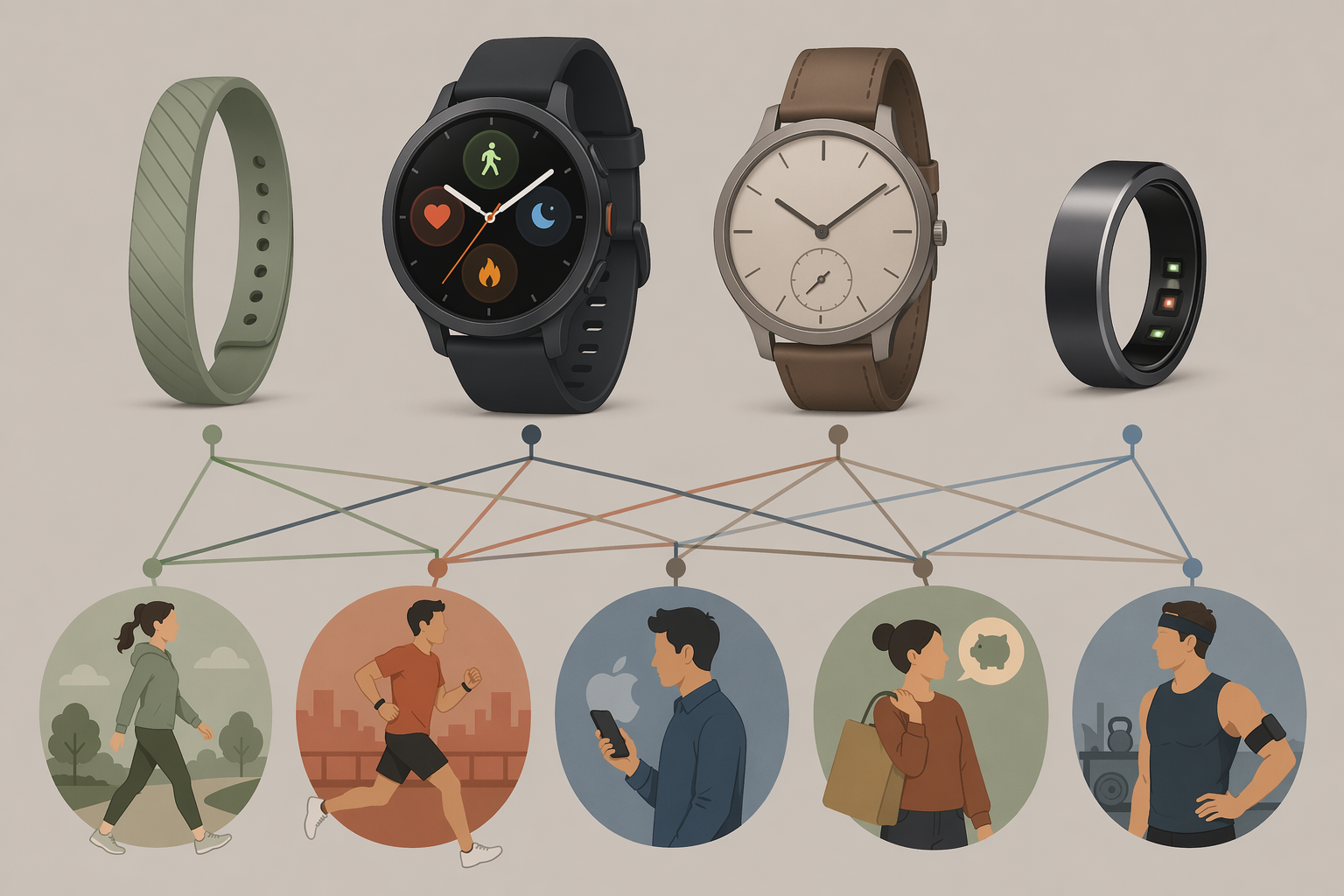
Why a One-Size-Fits-All ‘Best Tracker’ List Fails Most Buyers
Open any fitness tracker roundup and you will find a numbered list: #1 is the Apple Watch, #2 is a Garmin, #3 is a Fitbit. The problem is that these rankings assume a universal user — someone who wants everything, has an unlimited budget, and uses an iPhone. Real buyers do not fit that mold.
The wearable fitness tracker market is now valued at $70.3 billion in 2026, up 17.1% year over year from $60 billion in 2025, according to a March 2026 report from Sahha. With that growth comes fragmentation: smart rings are the fastest-growing segment at 32.5% annual growth, screenless bands are carving out a data-minimalist niche, and traditional watch-form trackers now span from $50 to $750. A single ranked list cannot serve a market this diverse.
If you prefer a straightforward category-based overview, we have one: Best Fitness Trackers of 2026: Picks by Budget, Phone OS, and Use Case. But if you want to understand why a particular device fits your life — and what you are giving up by choosing it — this guide uses a different approach. We built a four-axis decision matrix that maps your specific constraints to the right device, rather than forcing you to adapt to a generic pick.
The Four Axes of Your Fitness Tracker Decision
Every fitness tracker decision can be reduced to four independent variables. Change any one of them, and the optimal device changes. Here is the framework we will use throughout this guide.
Axis 1: Form Factor
The physical shape of the device determines how you interact with it, how often you charge it, and whether you will actually wear it consistently.
- Watch: Full touchscreen, notifications, apps, GPS. Best for users who want a smartwatch that also tracks fitness. Battery life ranges from 1–15 days depending on the model.
- Band: Slim, screen or screenless, focused on activity tracking. Lightweight and comfortable for 24/7 wear. Battery life typically 7–14 days.
- Ring: Finger-worn, no screen, continuous health monitoring. The fastest-growing segment at 32.5% annual growth. Best for users who do not want a wrist device.
- Screenless: A small sensor pod or band with no display. Data is viewed on your phone. Minimalist, long battery life, and often the most discreet option.
Axis 2: Phone Ecosystem
This is the most overlooked constraint. An Apple Watch requires an iPhone. A Samsung Galaxy Watch works best with a Samsung phone. Many Fitbit and Garmin devices work with both iOS and Android, but features like message replies, music control, and contactless payments may be limited on the non-native platform. Before choosing a tracker, confirm that it pairs fully with your phone.
Axis 3: Primary Activity
A tracker optimized for running is not necessarily good for strength training or swimming. Key considerations include:
- Running: Needs built-in GPS, accurate pace and distance tracking, and training metrics like VO2 max and recovery time.
- Swimming: Requires 5ATM or better water resistance and swim stroke detection.
- Strength training: Needs rep counting, set logging, or at least reliable heart rate tracking during non-steady-state activity.
- General wellness: Step counting, sleep tracking, and basic heart rate monitoring are sufficient.
Axis 4: Budget (Including Total Cost of Ownership)
The upfront price is only half the story. Some devices require ongoing subscriptions to unlock their full feature set. A $350 Oura Ring costs $350 plus $6 per month ($70/year). A Whoop 5.0 is free hardware locked behind a $199–$359 annual membership. We break down these costs in detail later in this guide.
| Axis | Key Question | Impact on Choice |
|---|---|---|
| Form Factor | Do you want a watch, band, ring, or screenless pod? | Determines battery life, comfort, and how you view data. |
| Phone Ecosystem | iPhone or Android? | Locks out entire categories (Apple Watch requires iPhone; Galaxy Watch best with Samsung). |
| Primary Activity | What do you actually do? | Running needs GPS; swimming needs water resistance; strength needs good HR tracking. |
| Budget (TCO) | What is the 2-year total cost? | A $100 device with a $100/year sub costs $300 over 2 years — more than a $250 device with no sub. |
Which Tracker Fits You? Archetype Recommendations
Using the four-axis framework, we mapped seven common user archetypes to their best-fit devices. Each recommendation considers form factor, phone compatibility, activity type, and total cost of ownership.
Archetype 1: The Casual Wellness Seeker
You want to track steps, sleep, and heart rate trends. You do not need GPS for runs or advanced training metrics. You want something comfortable to wear 24/7 that does not demand constant attention.
The Fitbit Charge 6 ($99.95 at time of writing, down from $159.95 MSRP) remains a strong choice. PCMag rates it 4.5 out of 5, calling it outstanding. It offers a built-in GPS, Google integration, and a familiar band form factor. However, the Charge 6 has been largely superseded by the newer Fitbit Air, according to Wareable. If you want the latest screenless band technology, the Air is the better long-term bet.
If you prefer not to wear anything on your wrist, the Oura Ring 4 ($349) tracks over 50 health metrics, including sleep, HRV, and readiness. It requires a $6/month or $70/year subscription for full functionality. PCMag rates it 4.0 out of 5. It is ideal for users who want deep health data without a wrist display.
Archetype 2: The Budget-Conscious Beginner
You are new to fitness tracking and want to spend as little as possible while still getting reliable step counting, heart rate, and sleep data. You do not want a subscription.
The Fitbit Inspire 3 ($79.95) is Wirecutter's top pick. In testing, it showed a step count error of only 0.32% over two days compared to a manual pedometer, and its battery lasted 8.5 days. PCMag rates it 4.0 out of 5, calling it excellent for beginners. It is a simple, no-fuss band with no mandatory subscription.
For an even lower price point, the Xiaomi Smart Band 10 (~$53) offers a 14-day-plus battery life and 5ATM water resistance, according to Wareable and PCMag. It has no subscription and covers the basics well. The trade-off is a less polished app experience and no built-in GPS.
Archetype 3: The Runner
You run regularly and need accurate GPS, pace, distance, and recovery metrics. You want training tools like VO2 max estimates, workout suggestions, and race prediction.
The Garmin Forerunner 265 is the sweet spot for most runners. It has a bright AMOLED display, multi-band GPS, and Garmin's deep training ecosystem. Garmin leads the industry in step count accuracy at 82.58%, according to the WellnessPulse meta-analysis of 45 studies. Battery life is approximately 13 days in smartwatch mode.
For runners who want a more affordable option with excellent GPS, the Coros Pace 4 is a strong competitor. Coros watches are known for exceptional battery life and a clean, athlete-focused interface.
Archetype 4: The Apple Ecosystem User
You have an iPhone and want seamless integration — iMessage replies, Apple Pay, Find My, and health data that flows directly into Apple Health.
The Apple Watch SE (3rd generation) ($219) is Wirecutter's recommendation for most Apple users. It offers the core Apple Watch experience — accurate tracking, crash detection, and full ecosystem integration — at a lower price than the flagship model.
If you want the most accurate heart rate tracking available, the Apple Watch Series 11 ($299 on Amazon) earned a CNET Lab Award for its heart rate monitor. In over 30 miles of testing against the Polar H10 chest strap, it showed an average error of less than 1% (0.98%, or approximately 1.40 BPM). It also includes 5G and hypertension notifications. The trade-off is its ~2-day battery life, which is typical for full-featured smartwatches.
Archetype 5: The Android User
You use an Android phone and want a smartwatch that integrates well — notifications, Google Assistant, and health tracking.
The Google Pixel Watch 4 ($350) is the natural choice for Pixel phone users. It runs Wear OS, integrates with Fitbit, and offers a clean, minimalist design. CNET recommends it for Android users who want a seamless experience.
For Samsung phone owners, the Samsung Galaxy Watch 8 (PCMag rating: 4.0, excellent) offers AI-powered coaching and accurate heart rate tracking. It is the best choice for Samsung ecosystem users who want deep integration with Samsung Health.
Archetype 6: The Screenless / Data Minimalist
You do not want another screen on your wrist. You want a device that collects data quietly and lets you check it on your phone when you choose to.
The Fitbit Air ($99.99, released May 26, 2026) is the standout new entry in this category. PCMag gives it an Outstanding 4.5 rating, calling it the best screenless tracker. It features a small pebble sensor, automatic activity detection, approximately 8.5 days of battery life, and detailed Gemini AI health coaching. Wareable also highlights it as a top screenless band. It is a significant upgrade from the older Fitbit Inspire series for users who want data without distraction.
Archetype 7: The Serious Athlete
You train multiple times per day, track recovery obsessively, and want every data point available — HRV, sleep stages, strain, and readiness. You are willing to pay for a subscription if the data is actionable.
The Whoop 5.0 is the gold standard for recovery-focused athletes. The hardware is free, but it requires a subscription: $199 per year for the basic tier, up to $359 per year for the premium tier, according to multiple sources including Wirecutter and Wareable. It offers a 14-day battery life and tracks strain, recovery, sleep, and HRV. For a deep dive into what these metrics actually mean, see our guide: Health Fitness Tracker Recovery Metrics: What HRV, Readiness Score, and Body Battery Actually Mean.
For athletes who want a subscription-free option with deep training metrics, the Garmin Forerunner 970 ($750) is designed for triathletes. It offers a 15-day battery life, multi-band GPS, and Garmin's full suite of training and recovery tools. CNET recommends it for serious multi-sport athletes.
| Archetype | Top Pick | Price | Subscription | Key Strength |
|---|---|---|---|---|
| Casual Wellness Seeker | Fitbit Charge 6 | $99.95 | Optional ($10/mo) | Familiar band, built-in GPS |
| Casual Wellness Seeker (Ring) | Oura Ring 4 | $349 | $6/mo or $70/yr | 50+ health metrics, no wrist device |
| Budget Beginner | Fitbit Inspire 3 | $79.95 | None required | Best-in-class step accuracy for the price |
| Budget Beginner (Ultra-low) | Xiaomi Smart Band 10 | ~$53 | None | 14-day battery, 5ATM water resistance |
| Runner | Garmin Forerunner 265 | ~$450 | None | Multi-band GPS, deep training metrics |
| Apple User (Value) | Apple Watch SE 3 | $219 | None | Full ecosystem integration at lower price |
| Apple User (Best HR) | Apple Watch Series 11 | $299 | None | <1% heart rate error vs. chest strap |
| Android User (Pixel) | Pixel Watch 4 | $350 | Optional | Wear OS + Fitbit integration |
| Android User (Samsung) | Galaxy Watch 8 | ~$350 | None | AI coaching, Samsung Health integration |
| Screenless Minimalist | Fitbit Air | $99.99 | Optional ($10/mo) | Screenless, 8.5-day battery, Gemini AI |
| Serious Athlete (Sub) | Whoop 5.0 | Free (hardware) | $199–$359/yr | Deep recovery and strain tracking |
| Serious Athlete (No Sub) | Garmin Forerunner 970 | $750 | None | 15-day battery, triathlon-focused |
The Hard Truth About Tracker Accuracy
Fitness trackers are not medical devices. They are consumer electronics that estimate physiological signals using algorithms. The gap between what they claim to measure and what they actually measure is wider than most buyers realize.
A comprehensive meta-analysis by WellnessPulse, updated April 29, 2025, analyzed 45 scientific studies with 168 data points. It found that the overall cumulative accuracy of consumer fitness trackers is just 67.40% across three core metrics: heart rate (76.35%), step count (68.75%), and energy expenditure (56.63%).
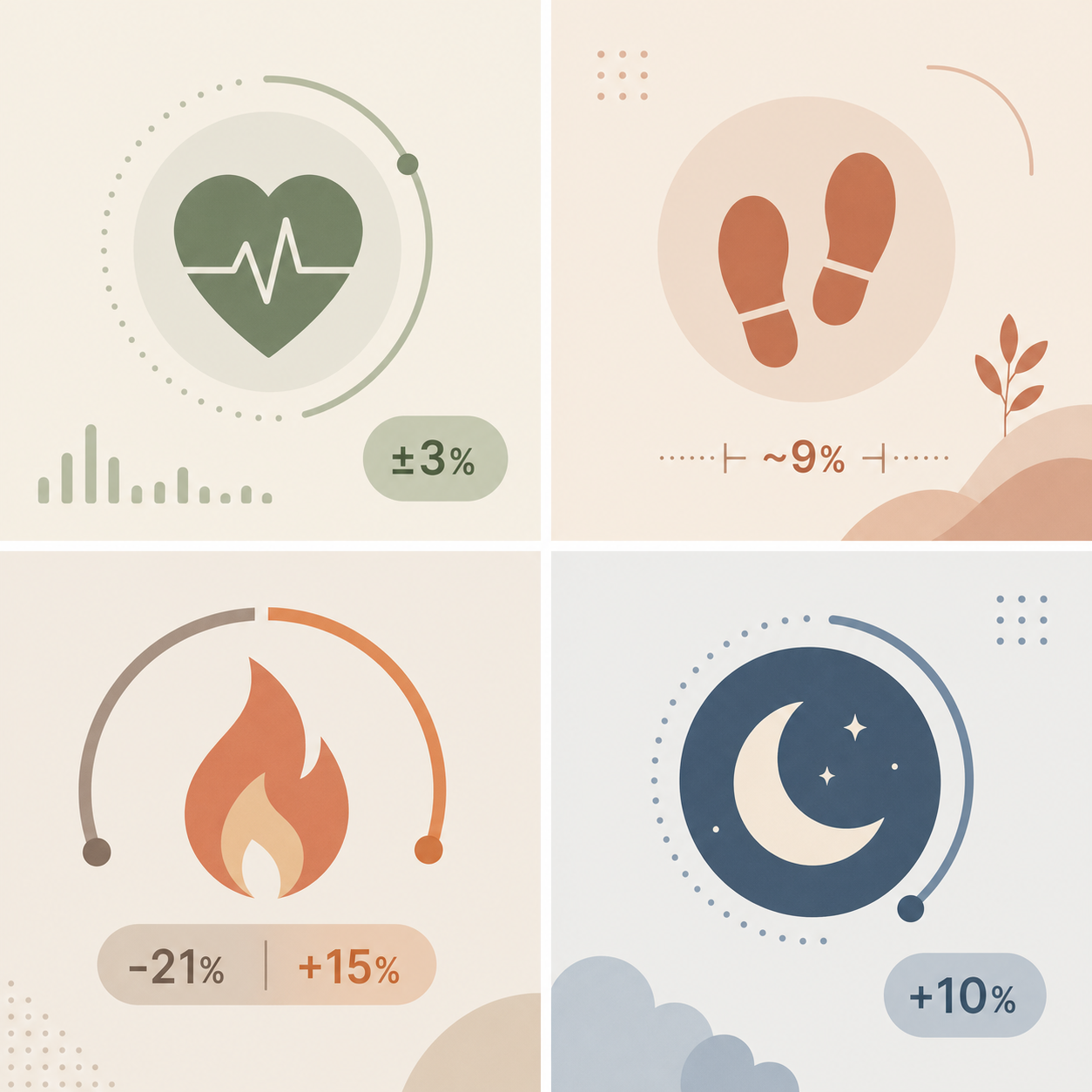
An umbrella review from University College Dublin (Cailbhe Doherty, August 2024) adds further detail:
- Heart rate error is approximately ±3%, varying by skin tone, exercise intensity, and activity type.
- Step count is underestimated by roughly 9%.
- Energy expenditure (calorie burn) error ranges from -21.27% to +14.76% — meaning a tracker can overestimate or underestimate by a wide margin.
- Sleep duration is overestimated by more than 10%.
- Sleep onset latency errors range from 12% to 180% compared to polysomnography (clinical sleep testing).
Brand-level rankings from the WellnessPulse meta-analysis show meaningful differences:
| Brand | Heart Rate Accuracy | Step Count Accuracy | Energy Expenditure Accuracy |
|---|---|---|---|
| Apple | 86.31% (best in class) | — | 71.02% (best in class) |
| Garmin | — | 82.58% (best in class) | 48.05% (lowest among analyzed) |
| Fitbit | 73.56% | 77.29% | — |
| Overall Average | 76.35% | 68.75% | 56.63% |
Apple leads in heart rate accuracy (86.31%) and energy expenditure (71.02%). Garmin leads in step count (82.58%) but scores lowest for energy expenditure (48.05%). Fitbit sits in the middle for both steps and heart rate.
For a deeper analysis of how heart rate accuracy changes during strength training and HIIT — where optical sensors struggle most — see our dedicated guide: Top-Rated Fitness Trackers and Heart Rate Accuracy: What Changes When You Lift or Do HIIT.
Subscription Costs: The Hidden Part of the Price Tag
The sticker price of a fitness tracker is often misleading. Several popular devices require ongoing subscriptions to unlock their full feature sets — and those costs add up quickly.
Here is the real two-year cost of ownership for the most common subscription-based trackers:
| Device | Upfront Price | Subscription Cost | 2-Year Total |
|---|---|---|---|
| Whoop 5.0 | $0 (hardware) | $199–$359/year | $398–$718 |
| Oura Ring 4 | $349 | $6/mo or $70/yr | $421–$489 |
| Fitbit Air / Charge 6 (with Premium) | $99.99 | $10/mo or $100/yr (Google Health Premium) | $299.99 |
| Fitbit Inspire 3 (no subscription) | $79.95 | $0 | $79.95 |
| Xiaomi Smart Band 10 | ~$53 | $0 | ~$53 |
| Garmin Forerunner 265 | ~$450 | $0 | ~$450 |
| Apple Watch SE 3 | $219 | $0 | $219 |
The Whoop 5.0 is the most extreme example: the hardware is free, but the subscription makes it the most expensive option over two years if you choose the premium tier. The Oura Ring 4 adds $70–$120 to the upfront cost over two years. Fitbit's new Google Health Premium ($10/month or $100/year) applies to devices like the Fitbit Air and Charge 6, though basic tracking works without it.
Decision Flowchart: Find Your Tracker in 4 Questions
If you are still unsure which archetype fits you, work through these four questions in order. Each answer narrows the field until you arrive at a shortlist of one to three devices.
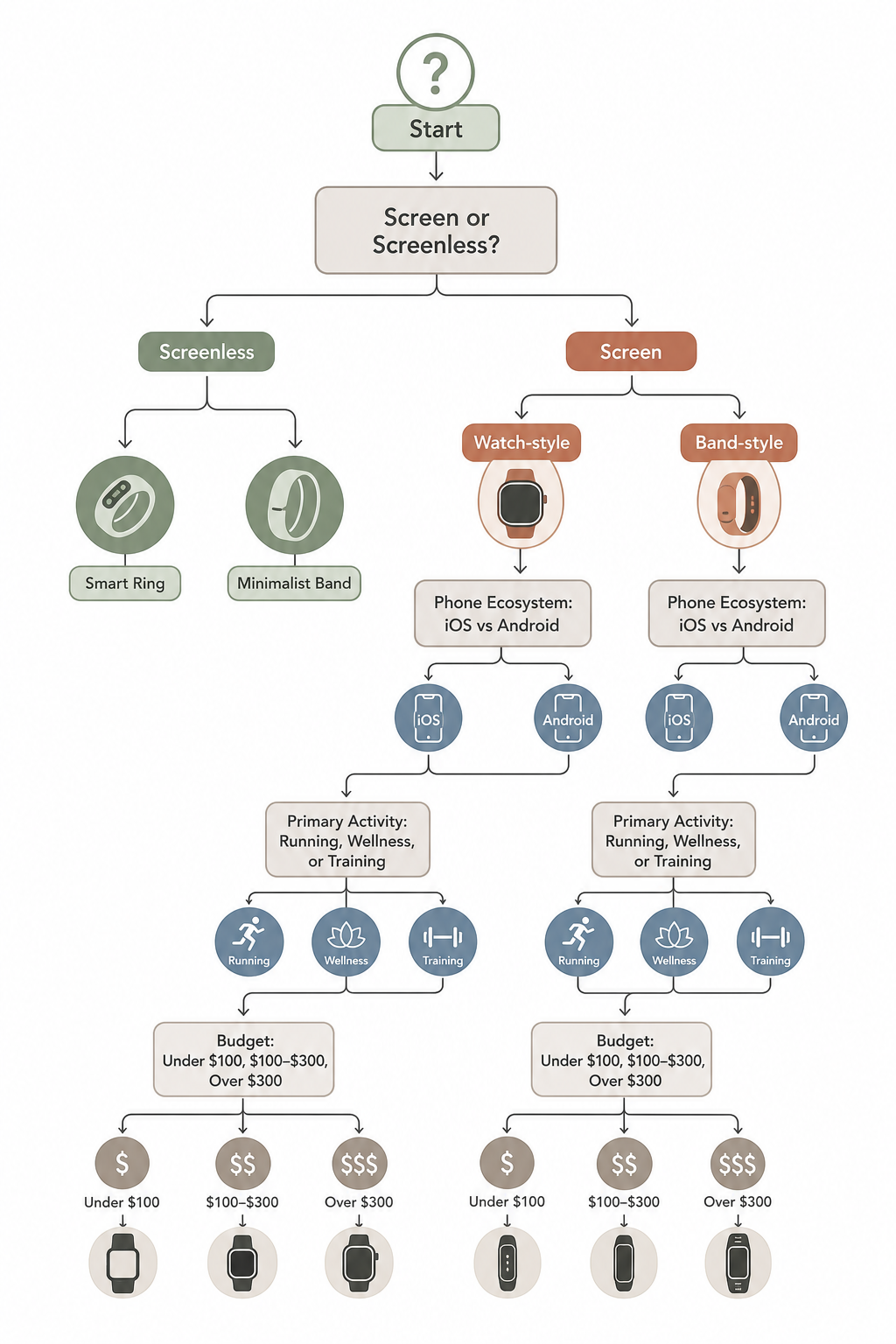
- Do you want a screen on your wrist? If no, consider the Fitbit Air (screenless band) or Oura Ring 4 (ring). If yes, proceed to question 2.
- What phone do you use? iPhone users should consider Apple Watch (SE 3 or Series 11) or any Fitbit/Garmin. Android users should consider Pixel Watch 4, Galaxy Watch 8, or any Fitbit/Garmin.
- What is your primary activity? Running → Garmin Forerunner 265 or Coros Pace 4. General fitness → Fitbit Charge 6 or Inspire 3. Multi-sport/triathlon → Garmin Forerunner 970. Strength training → any device with good HR tracking (Apple Watch Series 11 leads).
- What is your total budget over 2 years? Under $100 → Xiaomi Smart Band 10 or Fitbit Inspire 3. $100–$300 → Fitbit Charge 6, Fitbit Air, or Apple Watch SE 3. $300–$500 → Oura Ring 4, Pixel Watch 4, or Garmin Forerunner 265. $500+ → Garmin Forerunner 970 or Whoop 5.0 (with subscription).
Final Verdict: The Right Tracker Is the One That Matches Your Life
There is no single best fitness tracker. The Apple Watch Series 11 has the most accurate heart rate sensor we have ever tested, but it requires an iPhone and lasts only two days on a charge. The Garmin Forerunner 970 is a triathlon powerhouse, but it costs $750 and is overkill for someone who just wants to count steps. The Fitbit Air is a brilliant screenless option at $99.99, but it is brand new and its long-term reliability is unproven.
The best tracker is the one that matches your form factor preference, works with your phone, supports your primary activity, and fits your total budget — including any subscription costs. Use the decision flowchart above to narrow your options, then read the archetype recommendations for deeper context. And remember: all fitness trackers are estimates, not clinical instruments. Use the data as a guide, not a gospel.
This result comes from one real apartment under the stated conditions — it is a strong signal, not a guarantee your space will measure identically.
Builds this evidence supports
No build currently links to this specific test. Browse all builds with a matching tag.
Spot something off?
If this result didn't match your own space, let us know — floor-damage and noise claims carry real deposit-risk consequences if we get them wrong.