
Screenless Fitness Trackers Without a Subscription: The Best No-Monthly-Fee Options for 2026
Tired of paying $200+ per year just to see your own health data? We compare the best screenless fitness trackers that don't require a monthly subscription, including the Fitbit Air, Amazfit Helio Strap, Polar Loop, and RingConn Gen 2, with a full 3-year cost breakdown.
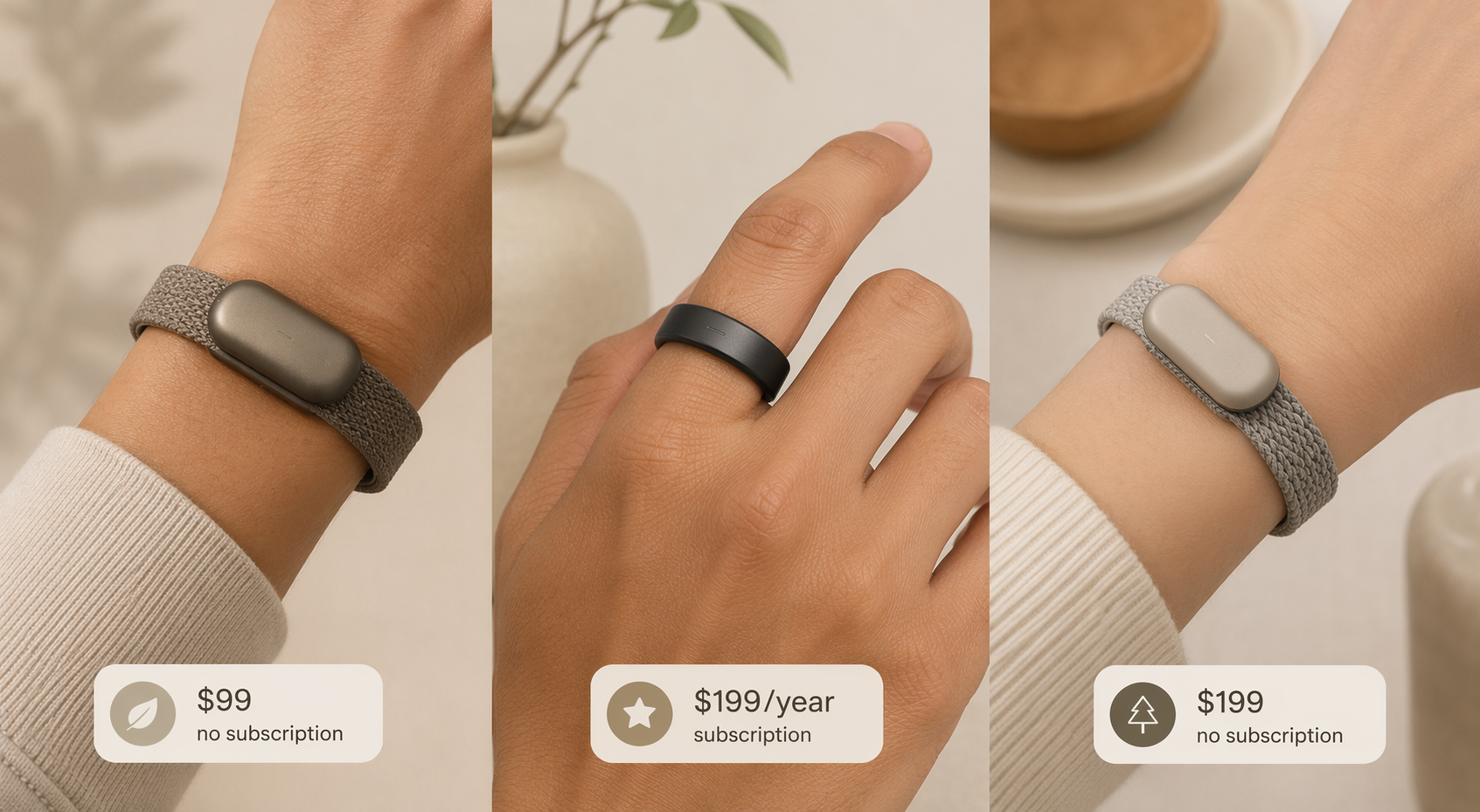
The Subscription Problem: What Whoop and Oura Really Cost Over Time
The pitch is seductive: a sleek, screenless band or ring that tracks your sleep, heart rate, and recovery with clinical-looking dashboards. But the fine print hits after the honeymoon period. Whoop requires a membership that starts at $199 per year and climbs to $359 for its top-tier plan. Oura Ring 5 costs $399 upfront, then tacks on $5.99 per month — or $70 annually — just to keep your data unlocked. Over a typical device lifespan, the subscription often costs more than the hardware itself.
Here is what those costs actually look like across one, two, three, and five years of ownership.
| Device | Upfront Cost | 1-Year Total | 2-Year Total | 3-Year Total | 5-Year Total |
|---|---|---|---|---|---|
| Whoop 5.0 (Basic) | $0 (band included) | $199 | $398 | $597 | $995 |
| Whoop 5.0 (Premium) | $0 (band included) | $359 | $718 | $1,077 | $1,795 |
| Oura Ring 5 | $399 | $471 | $543 | $615 | $759 |
| Fitbit Air | $99 | $99 | $99 | $99 | $99 |
| Amazfit Helio Strap | $99 | $99 | $99 | $99 | $99 |
| Polar Loop | $199 | $199 | $199 | $199 | $199 |
| RingConn Gen 2 | $269 | $269 | $269 | $269 | $269 |
| Ultrahuman Ring Air | $349 | $349 | $349 | $349 | $349 |
The gap is stark. A Fitbit Air user pays $99 once and owns the device. A Whoop Basic subscriber pays $597 over three years — and still owns nothing at the end. An Oura Ring 5 buyer pays $615 over three years, with $216 of that going to subscription fees alone. For price-sensitive buyers who simply want their sleep stages, resting heart rate, and activity data without a recurring bill, the subscription-free options represent a fundamentally different value proposition.
For a deeper breakdown of how subscription costs and data lock-in affect all tracker types — not just screenless devices — see our full analysis of hidden tracker costs.
The Best Subscription-Free Screenless Fitness Trackers in 2026
The screenless tracker category has matured rapidly. Where Whoop once stood alone as the only serious screenless option, a handful of well-engineered alternatives now deliver comparable tracking — heart rate, sleep stages, recovery metrics, activity detection — without locking core data behind a monthly paywall. Below are the five strongest subscription-free options available as of mid-2026.
Fitbit Air — $99
Released May 26, 2026, the Fitbit Air is Google's entry into the screenless space and immediately the strongest value proposition in the category. At $100 with no mandatory subscription, it undercuts every serious competitor on upfront cost. The Air packs an optical heart rate sensor, accelerometer, gyroscope, SpO2, skin temperature sensor, and a vibration motor into a 12-gram package. Battery life is rated at 7 days; a 9to5Google reviewer reached 16% after a full week and noted a quick charge from 36% to 58% in just 5 minutes.
The Air uses connected GPS (via your phone) and is water-resistant to 50 meters. It lacks NFC for contactless payments and does not have built-in GPS. Auto-workout detection for cardio activities was described as "night and day" compared to the Apple Watch in the same 9to5Google review, though the readiness score felt inaccurate. The device works with Android and iOS but requires the Google Health app and does not sync natively with Apple Health.
Amazfit Helio Strap — $99
The Helio Strap is the closest thing to a Whoop clone that does not require a subscription — and at $99, it costs roughly what Whoop charges for a single year of its basic plan. The arm-worn band weighs 20 grams and is advertised with a 10-day battery life; Wirecutter's testing measured 8 days, still competitive with most screenless trackers.
Heart rate accuracy is the Helio Strap's standout feature. Multiple reviewers (Wareable, Tom's Guide) found the arm-worn optical sensor tracked within 1-2 BPM of a chest strap reference, which is unusually good for an optical sensor. The Zepp app provides VO2 max estimates, recovery time, and a BioCharge energy metric that tracks exertion and readiness. The device supports 27 workout activities (Whoop offers 45), and automatic workout detection can be inconsistent — a Tom's Guide reviewer noted it struggled to auto-detect some sessions.
The main feature gap versus Whoop 5.0 is the lack of ECG. The strap is also somewhat bulky on smaller wrists, per Tom's Guide testing. But for $99 with no ongoing fees, the Helio Strap delivers roughly 60-70% of Whoop's core functionality at 6-10% of the three-year cost.
Polar Loop — $199
Polar's screenless band is the most established option on this list, and it comes with the company's full ecosystem access — no subscription required. The $199 price includes the Precision Prime Optical Heart Rate sensor (Gen 3.5), Nightly Recharge and SleepWise sleep metrics, Sleep Plus Stages, automatic training detection, and 4-week onboard memory. Battery life is rated at 8 days; Wareable testing found just over 7 days, consistent with the claim.
The Loop is water-resistant to WR30 (suitable for swimming) and weighs 1 ounce total (0.7 ounces for the sensor unit alone). It uses connected GPS via the Polar Flow app on your phone. The Polar Flow app is free with no locked features and syncs with Apple Health, Google Health, Strava, and TrainingPeaks. The main trade-off: the Precision Prime sensor struggles during high-intensity intervals, and there is no bicep band accessory option. The Polar Flow app interface also feels dated compared to Zepp or Google Health.
RingConn Gen 2 — $269
For buyers who prefer a ring form factor, the RingConn Gen 2 is the strongest subscription-free option. At $269 with lifetime free data access, it undercuts the Oura Ring 4 ($349 + $5.99/month) significantly. The Gen 2 offers a 12-day battery life — substantially longer than Oura's 4-7 days — and includes sleep apnea detection, a feature typically reserved for medical-grade devices. Wareable notes the ring is lighter than the Oura Ring 4, making it more comfortable for all-night wear.
Ultrahuman Ring Air — $349
Ultrahuman's Ring Air is the premium subscription-free option at $349. It weighs just 2.4 grams and is heavily sleep-focused, with detailed sleep stage analysis and movement tracking. There is no subscription required for any feature. The trade-off is limited workout tracking — this is not a device for runners or gym-goers who want real-time pace or rep counting. It excels as a recovery and sleep monitor for users who primarily want to understand their rest quality and daily readiness.
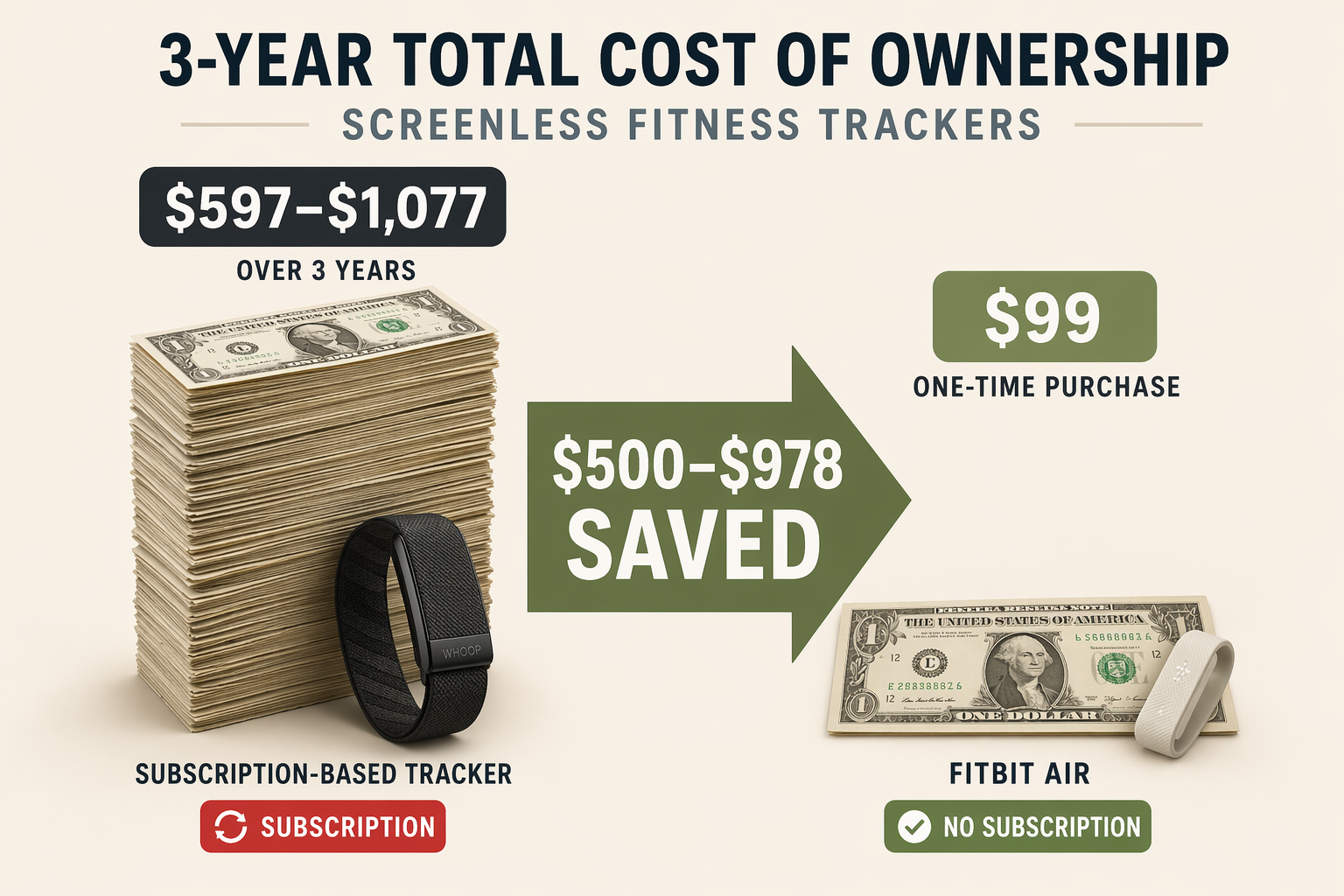
3-Year Cost Comparison: Subscription vs. One-Time Purchase
The table below shows the total cost of ownership over three years for each device, including upfront hardware and all mandatory subscription fees. This is the primary calculation a price-sensitive buyer should make before choosing a tracker.
| Device | Upfront Cost | 3-Year Subscription Cost | 3-Year Total | Savings vs. Whoop Basic | Savings vs. Oura Ring 5 |
|---|---|---|---|---|---|
| Whoop 5.0 (Basic) | $0 | $597 | $597 | — | -$18 |
| Whoop 5.0 (Premium) | $0 | $1,077 | $1,077 | -$480 | -$462 |
| Oura Ring 5 | $399 | $216 | $615 | -$18 | — |
| Fitbit Air | $99 | $0 | $99 | $498 | $516 |
| Amazfit Helio Strap | $99 | $0 | $99 | $498 | $516 |
| Polar Loop | $199 | $0 | $199 | $398 | $416 |
| RingConn Gen 2 | $269 | $0 | $269 | $328 | $346 |
| Ultrahuman Ring Air | $349 | $0 | $349 | $248 | $266 |
The math is straightforward. A Fitbit Air or Amazfit Helio Strap buyer saves $498 to $516 over three years compared to a Whoop Basic or Oura Ring 5 user. Even the most expensive subscription-free option — the Ultrahuman Ring Air at $349 — saves $248 vs. Whoop Basic and $266 vs. Oura Ring 5 over the same period. The only scenario where a subscription tracker wins on cost is if you lose or break the device within the first year and need to repurchase the hardware.
What You Give Up Without a Subscription
Subscription-free does not mean feature-free — but it does mean accepting some real trade-offs. The subscription model funds ongoing software development, server infrastructure for cloud analytics, and features that require continuous updates. Here is what you lose by skipping the monthly fee.
- AI coaching and advanced analytics. Whoop's recovery/strain platform is the most sophisticated in the category, with daily readiness scores, strain targets, and sleep coaching calibrated to your biometric data. Oura's AI features include personalized sleep and activity recommendations. The free apps (Google Health, Zepp, Polar Flow) provide raw data and basic trend analysis but lack the algorithmic depth of the paid platforms.
- Workout libraries and guided programs. Whoop offers 45 workout activities with detailed strain calculations. The Helio Strap supports 27 activities. Polar Loop has automatic training detection but its library is smaller. If you want a device that recognizes and analyzes every possible activity type, the subscription platforms still lead.
- ECG capability. Whoop 5.0 includes ECG, a feature absent from the Amazfit Helio Strap and Fitbit Air. For users who want on-demand single-lead ECG readings, the subscription trackers hold an advantage.
- Cloud-based trend analysis over very long periods. Subscription platforms store years of detailed data and provide cross-year comparisons. Free apps typically limit historical data access or offer less granular trend views.
The question is whether these trade-offs matter for your use case. If you are a competitive athlete who needs daily strain optimization and recovery periodization, Whoop's platform may justify its cost. If you are a general fitness enthusiast who wants to track sleep, resting heart rate, and activity trends — and keep your money — the subscription-free options cover those needs well.
Are the Free Apps Good Enough?
The companion app experience is a critical part of any tracker purchase. A great sensor is useless if the app buries your data behind paywalls or presents it in a confusing interface. Here is how the free apps for each subscription-free device compare.
| App | Compatible Devices | Free Features | Paid Add-Ons | Data Export / Sync |
|---|---|---|---|---|
| Google Health | Fitbit Air | Heart rate, sleep stages, SpO2, skin temperature, activity tracking, readiness score | Health Coach AI ($10/mo) — currently has hallucination issues per 9to5Google | No native Apple Health sync; works with Android and iOS |
| Zepp | Amazfit Helio Strap | HR, sleep, VO2 max, recovery time, BioCharge energy metric, 27 workout types | None | Syncs with Apple Health, Google Health, Strava |
| Polar Flow | Polar Loop | Nightly Recharge, SleepWise, Sleep Plus Stages, training loads, HRV, activity tracking | None — all features free | Syncs with Apple Health, Google Health, Strava, TrainingPeaks |
| RingConn | RingConn Gen 2 | Sleep tracking, sleep apnea detection, HR, SpO2, activity tracking | None — lifetime free data | Syncs with Apple Health, Google Health |
| Ultrahuman | Ultrahuman Ring Air | Sleep stages, movement tracking, HRV, readiness score | None | Syncs with Apple Health, Google Health |
The free apps cover the essentials: heart rate, sleep stages, activity tracking, and basic trend analysis. Polar Flow is the most generous — every feature is free with no locked tiers. Zepp provides solid recovery metrics (VO2 max, recovery time, BioCharge) that rival what Whoop offers, though the presentation is less polished. Google Health is the newest entrant and its free tier covers core metrics well, but the paid Health Coach AI add-on ($10/month) has notable reliability issues — 9to5Google's review documented the AI hallucinating workouts that never occurred.
The main gap between free and paid apps is depth of analysis. Whoop's platform provides daily strain targets, sleep need calculations, and recovery scores that are algorithmically tuned to your data over time. The free apps give you the raw numbers and basic trends — your resting heart rate is trending up or down, your sleep duration is consistent or variable — but they do not tell you what to do about it in the same prescriptive way. For many users, that is sufficient. For users who want a coach-like experience, the subscription platforms still lead.
Which Screenless Tracker Should You Buy?
The right choice depends on your budget, your primary tracking goal, and how much analytical depth you need. Here are tiered recommendations based on the data above.
- Best overall value: Fitbit Air ($99). The lowest entry price in the category, solid sensor suite, 7-day battery, and no mandatory subscription. The main caveats: no native Apple Health sync, and the readiness score felt inaccurate in early reviews. If you use Android or are comfortable with Google Health, this is the easiest recommendation.
- Best for serious training data: Amazfit Helio Strap ($99). The arm-worn HR accuracy (within 1-2 BPM of chest strap) is the best in this price range. The Zepp app provides VO2 max, recovery time, and BioCharge energy metrics that approach Whoop's depth. The trade-off: bulkier design and fewer workout activities (27 vs. Whoop's 45).
- Best for sleep tracking: RingConn Gen 2 ($269). The 12-day battery, sleep apnea detection, and lighter-than-Oura design make it the strongest sleep-focused option. The lifetime free data access is a genuine differentiator versus Oura's $5.99/month fee.
- Best for Polar ecosystem fans: Polar Loop ($199). If you already use Polar products or want the most established screenless platform with full free app access, the Loop delivers. The Precision Prime sensor is solid for steady-state activity but struggles during intervals. The Polar Flow app is dated but comprehensive.
- Best premium sleep and recovery monitor: Ultrahuman Ring Air ($349). The lightest ring option at 2.4 grams, with no subscription and excellent sleep analysis. Limited workout tracking makes it a poor choice for runners or gym-goers who want real-time exercise data.
For readers who want to see how these screenless options compare against the full wearable market — including screen-based trackers and smartwatches — our best fitness trackers of 2026 roundup provides a broader view. If you are specifically building a home gym setup and want a tracker that integrates with your workout environment, see our guide to fitness trackers for home workouts.
This result comes from one real apartment under the stated conditions — it is a strong signal, not a guarantee your space will measure identically.
Builds this evidence supports
No build currently links to this specific test. Browse all builds with a matching tag.
Spot something off?
If this result didn't match your own space, let us know — floor-damage and noise claims carry real deposit-risk consequences if we get them wrong.