
Best Fitness Trackers of 2026: Picks by Budget, Phone OS, and Use Case
With subscription costs adding up to $360 per year and platform lock-in a real risk, choosing the right fitness tracker in 2026 requires more than a spec sheet. This guide applies a transparent evaluation methodology and organizes picks by user type — budget buyer, iPhone user, Android user, recovery tracker, and more — so you can find the best match for your actual situation.
How We Evaluated These Trackers
Every tracker in this guide was evaluated against five criteria: step-count accuracy, heart-rate accuracy, battery life, app quality, and full subscription cost disclosure. Picks without independent third-party test data are flagged accordingly.
- Step-count accuracy: Measured against a validated mechanical pedometer. Wirecutter's two-day real-world test, which found the Fitbit Inspire 3 off by just 0.32%, is the primary benchmark used here.
- Heart-rate accuracy: Measured against a Polar H10 chest-strap control. CNET's 30-mile outdoor lab test is the primary accuracy reference for this article.
- Battery life: Based on tested figures from PCMag, CNET, and Wirecutter where available, not manufacturer claims.
- App quality: Assessed on data accessibility, interface usability, and whether core features require a paid tier.
- Full subscription cost disclosure: Every pick shows device price and annual subscription cost separately. A tracker that costs $99 but requires $120/year in subscriptions has a materially different total cost of ownership than one that costs $250 with no recurring fees.
Quick-Pick Summary: Best Fitness Tracker by User Type
If you already know your situation, use this table to find your pick and skip to the detailed section. Device price and annual subscription cost are listed separately — the subscription column is where total cost of ownership diverges most sharply between options.
| Best For | Device | Device Price | Annual Subscription Cost |
|---|---|---|---|
| Best overall (iPhone users) | Apple Watch Series 11 | ~$399+ | None |
| Best budget (under $100) | Fitbit Inspire 3 | ~$99 | $80/year (optional Fitbit Premium) |
| Best for iPhone | Apple Watch Series 11 | ~$399+ | None |
| Best for Android | Samsung Galaxy Watch 8 or Google Pixel Watch 4 | $299–$349 | None |
| Best no-subscription (cross-platform) | Garmin Venu Sq 2 or Amazfit Bip 6 | $80–$200 | None |
| Best for sleep and recovery | Oura Ring 4 | $350 | $70/year ($6/month) |
| Best smart ring | Oura Ring 4 | $350 | $70/year ($6/month) |
| Best screenless tracker | Fitbit Air | $99 | Free tier available; Google Health Premium $100/year (3 months included) |
Key Buying Factors Before You Choose
Form Factor Trade-Offs
The physical format of your tracker has real day-to-day implications beyond aesthetics.
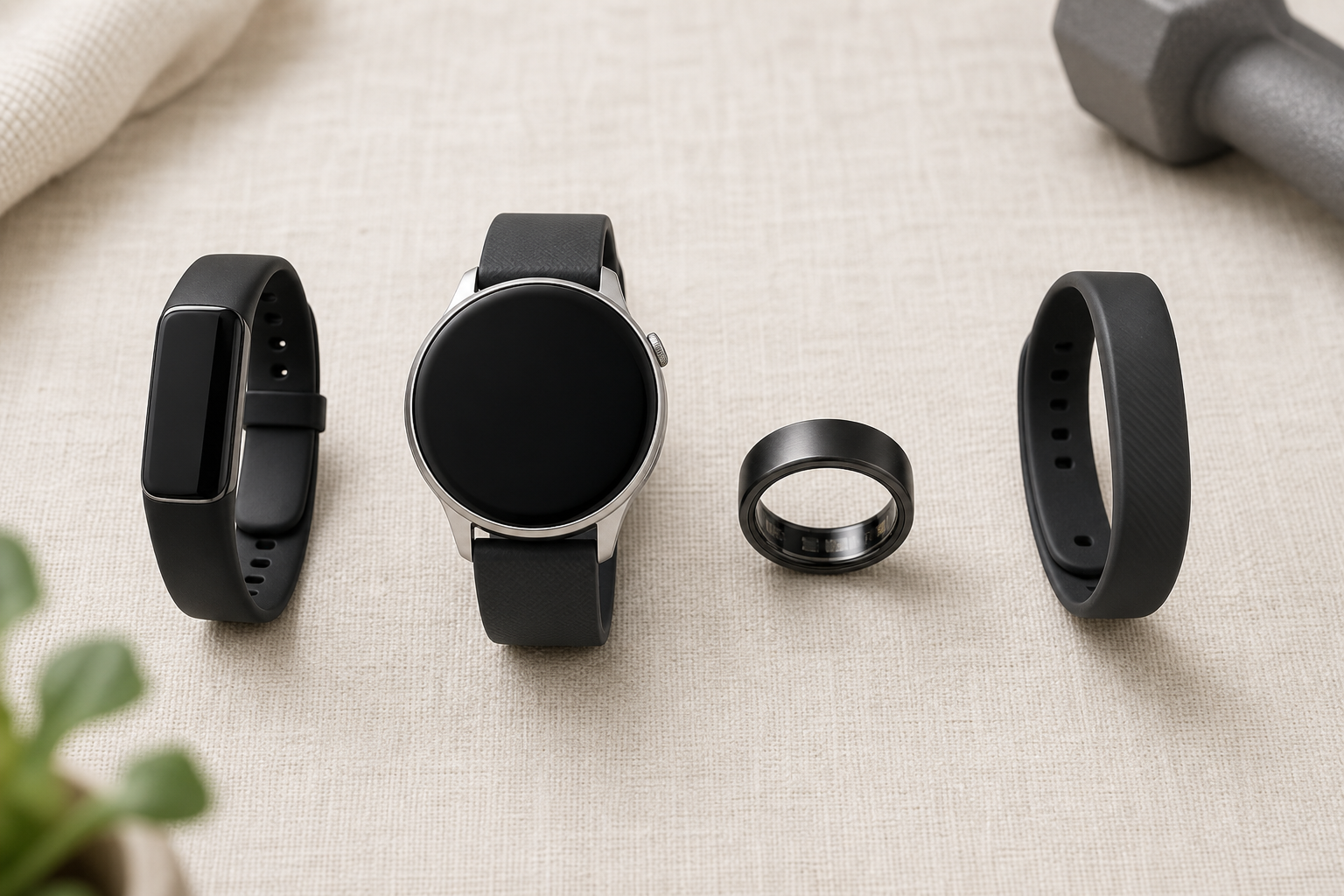
- Watches: Best for real-time workout feedback, GPS, and notifications. Trade-off is charging frequency — most smartwatches need charging every one to two days.
- Bands: Lighter and less obtrusive than watches. Better battery life. Less likely to interfere with barbell or dumbbell grips. Fewer smartwatch features.
- Rings: Passive and unobtrusive for sleep and daily recovery tracking. No screen means no real-time workout data. Fingers can swell during hot or intense workouts, sometimes requiring removal.
- Screenless straps: Longest battery life, minimal distraction. Best for users who want data in the app rather than on their wrist during a session. The new Fitbit Air is the clearest example of this category in 2026.
Subscription Costs Decoded
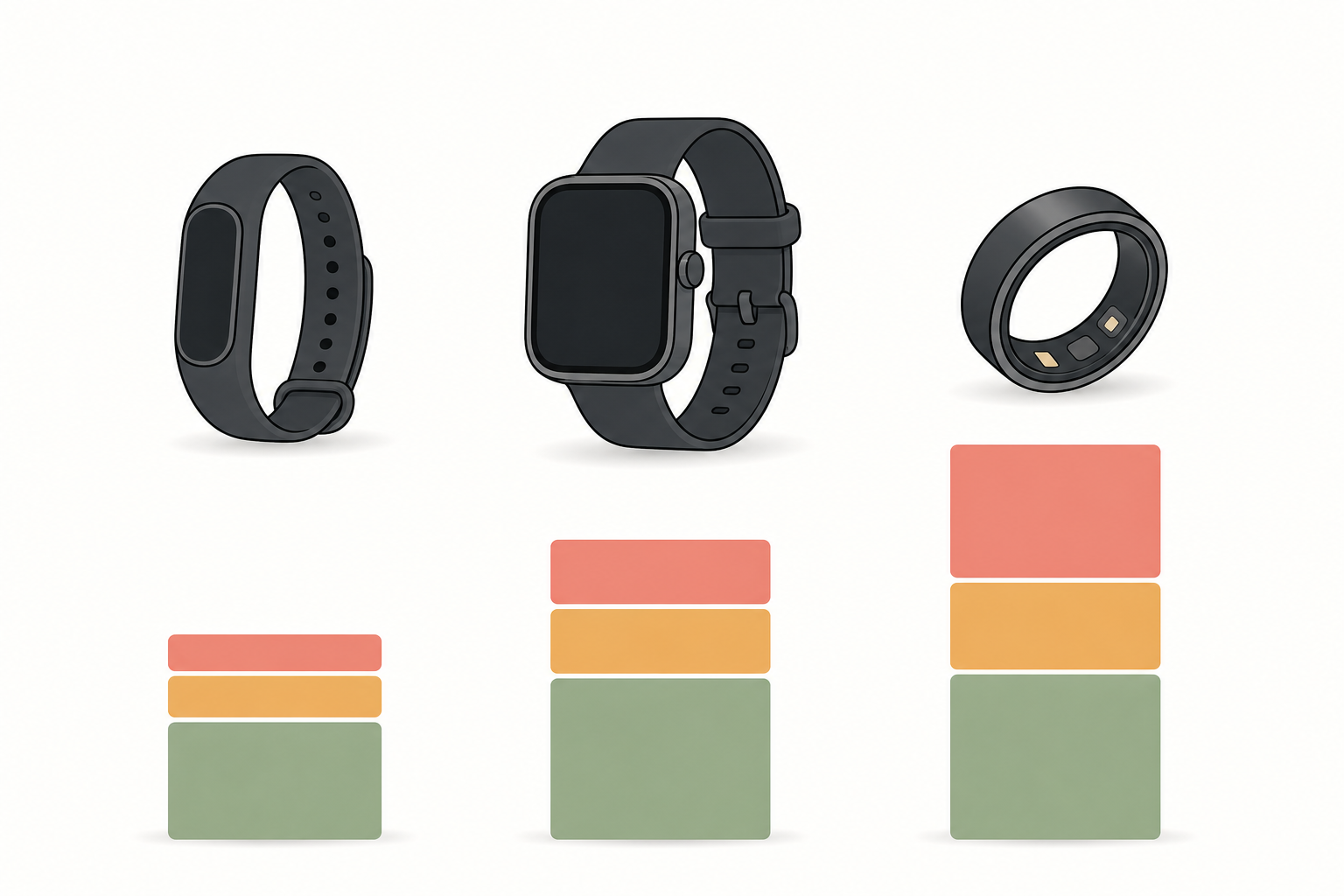
Subscription costs are where most tracker comparisons fail readers. The device price is only part of what you will pay.
- Whoop 5.0: Three subscription tiers at $199, $239, and $359 per year. The device itself is free with membership. This is the highest mandatory subscription cost of any mainstream tracker.
- Oura Ring 4: $6/month ($70/year) subscription required for most features after a free trial period.
- Fitbit Premium: $10/month or $80/year. Optional — core tracking works without it — but several features including advanced sleep analysis and some health reports sit behind the paywall.
- Fitbit Air / Google Health Premium: Three months included with purchase; $10/month or $100/year afterward. Most data is accessible free in the Google Health app.
- Apple Watch, Garmin, Amazfit, Google Pixel Watch: No subscription required for core features. Garmin Connect and the native Apple Health and Google Health apps provide full data access at no additional cost.
Platform Compatibility and Lock-In Risk
Platform lock-in is a real purchasing risk that is easy to overlook. Switching phones later can render a tracker partially or fully non-functional.
- Apple Watch requires iPhone. It will not pair with Android devices. If you switch to Android, the watch becomes significantly less functional.
- Samsung Galaxy Watch 8 requires Android. Some features are further restricted to Samsung phones. It does not work with iOS.
- Samsung Galaxy Fit3 does not work with iOS at all. This is a critical compatibility caveat — iPhone users should not consider this device.
- Fitbit, Garmin, and Amazfit are cross-platform. These trackers work with both iPhone and Android, making them the lowest-risk choice if you might switch phones.
For a step-by-step framework for matching a tracker to your phone OS and budget constraints, see our guide on how to choose a wearable fitness tracker for home workouts.
Sensor Accuracy Limitations to Know Before You Buy
Wrist-based optical heart rate sensors are less accurate during high-intensity strength training than during steady-state cardio. When heart rate rises rapidly from rest — as it does during heavy sets or interval training — most watches lag behind the actual reading. This is a hardware limitation that applies to every optical HR sensor, regardless of brand or price.
Step counting is reliably accurate across all price points. Calorie burn is not. No tracker in 2026 measures energy expenditure accurately — treat calorie estimates as rough directional data, not a measurement.
Best Overall: Apple Watch Series 11
For iPhone users who want the most accurate wrist-based heart rate monitor available, the Apple Watch Series 11 is the clear pick. In CNET's 30-mile outdoor lab test against a Polar H10 chest strap, the Series 11 posted an average heart rate error of less than 1% — approximately 1.40 beats per minute — earning CNET's Labs Award for accuracy. PCMag confirms this result independently.
- Heart rate error rate under 1% in independent lab testing against Polar H10 benchmark
- FDA-approved hypertension notifications
- 5G connectivity
- Approximately 43 hours of tested battery life
- No subscription required — Apple Health provides full data access for free
- Requires iPhone — does not function as a standalone smartwatch with Android
The Apple Watch Series 11 is not the right pick for Android users or budget buyers. It is the right pick for iPhone users who prioritize sensor accuracy and want a capable smartwatch that does not require a subscription.
Best Budget Pick (Under $100): Fitbit Inspire 3
The Fitbit Inspire 3 is the most independently tested accurate step counter under $100. Wirecutter's two-day test found it deviated from a validated pedometer by just 0.32% — the best result of all trackers tested at any price point.
At its price, the Inspire 3 includes a meaningful set of features:
- Heart rate monitoring, blood oxygen, breathing rate, stress score
- Sleep score and sleep stage tracking
- Steps, connected GPS (uses your phone's GPS), and exercise tracking
- Call, text, and app notifications
- Works with both iPhone and Android — no platform lock-in
Best for Android: Samsung Galaxy Watch 8 and Google Pixel Watch 4
Android users have two strong options in 2026 with meaningfully different trade-offs.
Samsung Galaxy Watch 8
PCMag names the Galaxy Watch 8 the best smartwatch for Android users, citing its breadth of wellness features — including AI-guided running programs and snore detection — as the most comprehensive of any tested smartwatch. The trade-off is battery life: tested at roughly one day, it requires daily charging.
- Most wellness features of any Android smartwatch tested by PCMag
- AI-guided running programs and snore detection
- Requires Android — some features are further restricted to Samsung phones
- Approximately one day of battery life — daily charging required
Google Pixel Watch 4
CNET's top Android pick, the Pixel Watch 4, offers dual-band GPS, a Gemini voice assistant, and up to 40 hours of battery life on the 45mm model — a meaningful improvement over the Galaxy Watch 8 for users who dislike daily charging.
- Dual-band GPS for more accurate outdoor tracking
- Up to 40-hour battery life (45mm model, per CNET testing)
- Gemini voice assistant integration
- No subscription required for core features
- Requires Android
Best Screenless Tracker: Fitbit Air
The Fitbit Air was released on May 26, 2026, at $99. It ditches the display entirely in favor of a small pebble sensor on a fitness band, pairing with the Google Health app for all data viewing. PCMag awarded it Editors' Choice (4.5/5) as the best screenless tracker, citing its 8.5-day tested battery life and accurate heart rate and sleep tracking in early testing. Wareable's early coverage confirms similar results.
- 8.5-day tested battery life (PCMag)
- Accurate heart rate and sleep tracking in early testing
- Most data accessible free in Google Health app — no subscription required for core features
- Three months of Google Health Premium included; $10/month or $100/year afterward
- No screen — all data viewed in app only
- Works with both iPhone and Android
For serious athletes who want a screenless tracker with deeper performance analytics, the Whoop 5.0 remains an option — but it requires a mandatory subscription starting at $199/year, and the device itself is only available with a membership. The Fitbit Air is the better fit for most people who simply want a low-distraction, long-battery tracker without a subscription commitment.
Best for Sleep and Recovery: Oura Ring 4
The Oura Ring 4 is the strongest passive sleep and recovery tracker available in 2026. At $350 for the device plus $6/month ($70/year) for the subscription, it is neither the cheapest nor the most feature-rich option — but for users whose primary goal is understanding sleep architecture and daily recovery readiness, it has no close rival in ring form.
PCMag, CNET, Forbes, and GarageGymReviews all characterize the Oura Ring 4 as a retroactive fitness tracker — it is best reviewed after activity, not used for real-time workout feedback.
- $350 device price + $70/year subscription ($6/month)
- No built-in GPS
- No screen — no real-time workout data
- Fingers can swell during hot or intense workouts, sometimes requiring removal
- Best suited for sleep stage tracking, HRV monitoring, and daily readiness scores
- Not suitable as a primary workout tracker for users who want in-session metrics
Best No-Subscription Value: Garmin and Amazfit
For cross-platform users who want long-term value without recurring costs, Garmin and Amazfit are the two strongest categories.
Garmin
Garmin's full data platform — Garmin Connect — is free with no subscription required. Models like the Venu Sq 2 (tested at 8 days battery), Forerunner 265 (up to 15 days), and Lily 2 offer strong battery life, cross-platform compatibility, and depth of athletic tracking that no subscription-dependent tracker can match at equivalent long-term cost.
The Garmin Forerunner 265 in particular earned top marks from The Independent's UESCA-certified running coach tester for its personalized training plans, VO2 max estimates, and animated strength and yoga workout guidance.
Amazfit
For US readers who want a budget no-subscription option, Amazfit is the right category. The Amazfit Bip 6 (approximately $80) proved capable for casual walkers and joggers in CNET's 30-mile lab test — it tracked steps within 11 steps per 2,500-step test alongside much more expensive watches.
| Device | Price | Annual Subscription | Platform | Battery Life (Tested) |
|---|---|---|---|---|
| Garmin Venu Sq 2 | ~$200 | None | iOS + Android | ~8 days |
| Garmin Forerunner 265 | ~$350 | None | iOS + Android | Up to 15 days |
| Garmin Lily 2 | ~$200 | None | iOS + Android | Not specified |
| Amazfit Bip 6 | ~$80 | None | iOS + Android | Not specified |
| Amazfit Active 2 | ~$65 | None | iOS + Android | Not specified |
Full Spec Comparison Table: 2026 Fitness Trackers
| Device | Device Price | Annual Subscription | Display | Battery Life (Tested) | GPS | Platform | Water Resistance |
|---|---|---|---|---|---|---|---|
| Apple Watch Series 11 | ~$399+ | None | OLED watch face | ~43 hours | Built-in | iPhone only | WR50 / swim-proof |
| Apple Watch SE 3 | ~$249 | None | OLED watch face | ~18 hours | Built-in | iPhone only | WR50 / swim-proof |
| Fitbit Inspire 3 | ~$99 | $80/year (optional) | Color AMOLED band | Up to 10 days | Connected (phone GPS) | iOS + Android | Water-resistant to 50m |
| Fitbit Charge 6 | ~$160 | $80/year (optional) | AMOLED touchscreen | Up to 7 days | Built-in | iOS + Android | Water-resistant to 50m |
| Fitbit Air | ~$99 | Free tier; $100/year optional | None (screenless) | ~8.5 days | Connected (phone GPS) | iOS + Android | Water-resistant |
| Samsung Galaxy Watch 8 | ~$299 | None | AMOLED round display | ~1 day | Built-in | Android only | IP68 / 5ATM |
| Google Pixel Watch 4 | ~$349 | None | AMOLED round display | Up to 40 hours (45mm) | Dual-band built-in | Android only | IP68 |
| Oura Ring 4 | $350 | $70/year ($6/month) | None (screenless ring) | Up to 8 days | None | iOS + Android | Water-resistant to 100m |
| Whoop 5.0 | Free with membership | $199–$359/year (required) | None (screenless strap) | Not specified | None | iOS + Android | Water-resistant |
| Garmin Venu Sq 2 | ~$200 | None | AMOLED square display | ~8 days | Built-in | iOS + Android | 5ATM |
| Garmin Forerunner 265 | ~$350 | None | AMOLED round display | Up to 15 days | Multi-band built-in | iOS + Android | 5ATM |
| Amazfit Bip 6 | ~$80 | None | AMOLED display | Not specified | Built-in | iOS + Android | 5ATM |
Sensor Accuracy: What Fitness Trackers Can and Cannot Measure
Heart Rate Accuracy
In CNET's 30-mile outdoor lab test, the Apple Watch Series 11 posted the lowest heart rate error rate: under 1%, averaging approximately 1.40 beats per minute against a Polar H10 chest strap. The Garmin Venu 4 came second at a 3.89% error rate (5.5 bpm). The Google Pixel Watch 4 posted 5.6%, the Samsung Galaxy Watch 8 posted 6.6%, and the Amazfit Bip 6 posted approximately 7%.
A consistent pattern across all tested watches: most lagged behind the chest strap during the first minute of a run, when heart rate rose rapidly from rest. This is especially relevant for strength training intervals, where heart rate spikes and recovers repeatedly. For deeper coverage of how this limitation affects home workout modalities, see our guide to heart rate fitness trackers for home workouts.
Step Count Accuracy
Step counting is the most reliable metric across all tracker price points. In CNET's lab test, all five watches tracked steps within 11 steps per 2,500-step test. Wirecutter's two-day real-world test confirms similar results — the Fitbit Inspire 3 was the most accurate at 0.32% error, but all tested devices performed well. You do not need to spend more to get accurate step counts.
Calorie Burn Accuracy
Sleep Tracking Accuracy
Wearables are generally capable of accurately estimating total sleep time and sleep fragmentation. Sleep stage data — specifically, minutes in deep sleep — is less reliable. UCSF research cited by Wirecutter notes this distinction clearly: total sleep time estimates are reasonably accurate, but granular sleep architecture data should not be treated as clinically precise.
Frequently Asked Questions
Fitbit vs. Garmin: Which is better?
This is a use-case question, not a quality question. Fitbit is the better choice for users who want a simple, approachable interface, cross-platform compatibility, and a budget entry point — the Inspire 3 under $100 is the clearest example. Garmin is the better choice for users who want no subscription ever, strong battery life, and depth of athletic tracking data that scales from casual to serious. If you train regularly and want to own your data without a recurring fee, Garmin's long-term value is hard to match.
Apple Watch vs. Fitbit: Which should I choose?
This is primarily an OS question. If you have an iPhone and want the most accurate wrist-based heart rate monitor available, the Apple Watch Series 11 is the right pick — and it requires no subscription. If you have an Android phone, the Apple Watch is not an option. If you want cross-platform flexibility or a budget-friendly entry point, Fitbit works with both iOS and Android and costs significantly less. The Fitbit Inspire 3 at under $100 with optional premium is a strong value pick for non-iPhone users.
Are calorie counts on fitness trackers accurate?
No. The systematic review evidence is clear: calorie burn estimates from wrist-based trackers have MAPE exceeding 30% across all brands. This means a tracker might show you burned 400 calories when you actually burned 280 — or 520. Use step count and heart rate data as your primary metrics. Treat calorie figures as rough context, not a measurement you should make dietary decisions based on.
Which fitness trackers have no subscription?
- Garmin: All models use Garmin Connect, which is free with no subscription required.
- Amazfit: No subscription required for core features.
- Apple Watch (Series 11, SE 3): Apple Health is free; no subscription required for any core tracking feature.
- Google Pixel Watch 4: No subscription required for core features.
- Fitbit Inspire 3 and Fitbit Air: Core tracking is free; Fitbit Premium and Google Health Premium are optional paid tiers that unlock additional features.
- Whoop 5.0 and Oura Ring 4: Both require a paid subscription for meaningful feature access. Whoop's subscription is mandatory from day one; Oura's is required for most health insights after an initial trial.
For home gym users who want to understand which of these trackers integrates best with indoor training workflows, the best fitness trackers for home workouts guide covers indoor-specific picks and subscription cost breakdowns in more depth.
This result comes from one real apartment under the stated conditions — it is a strong signal, not a guarantee your space will measure identically.
Builds this evidence supports
No build currently links to this specific test. Browse all builds with a matching tag.
Spot something off?
If this result didn't match your own space, let us know — floor-damage and noise claims carry real deposit-risk consequences if we get them wrong.